 CRO Audit
Dealfront
Audit performed March 12, 2026 · Report version 2.0 · 21 CRO suggestions identified
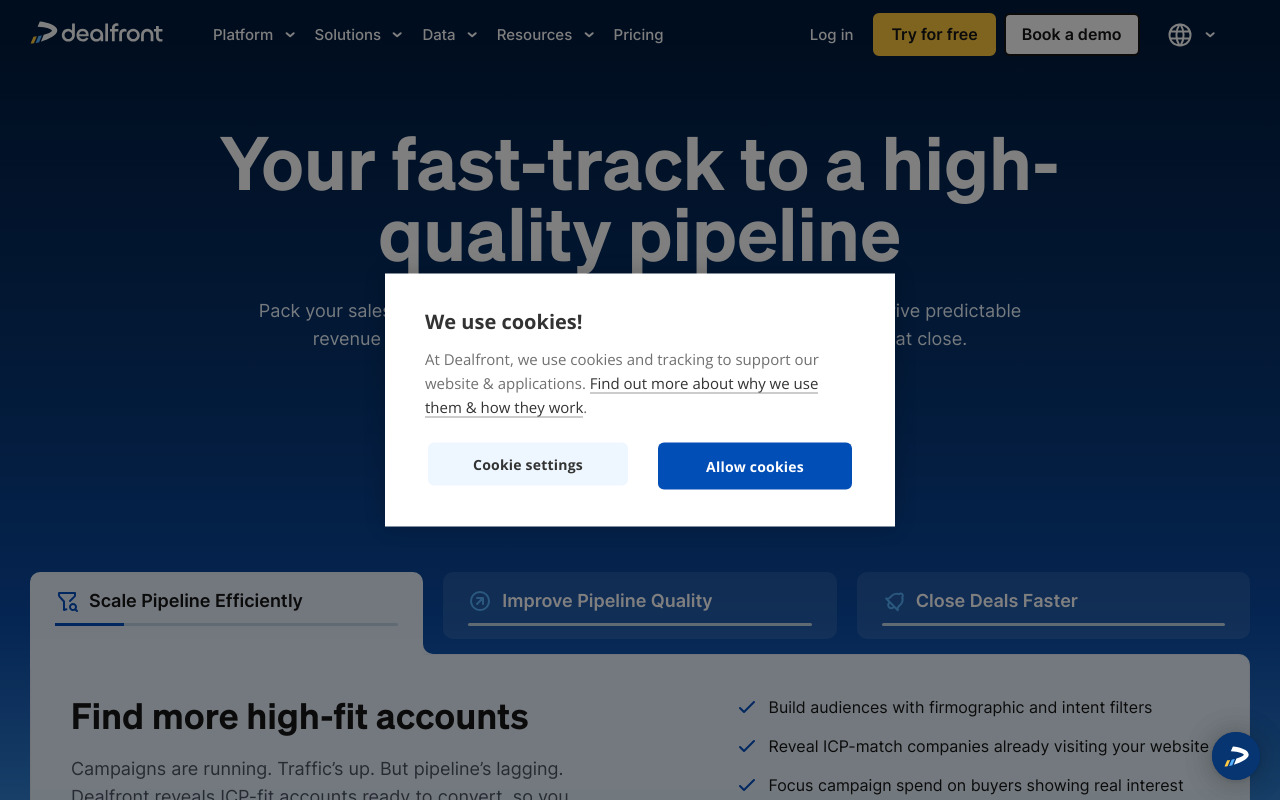
The headline 'Build pipeline that actually converts' provides a vague promise without clear context on how this is achieved. The messaging lacks specificity about the unique benefits and mechanisms employed by Dealfront. Users may struggle to quickly grasp the value, leading to diminished interest or confidence in the offering—critical in preventing potential leads from leaving the funnel early.
The CTAs, such as 'Try for free' and 'Book a demo', are not visually prioritized or compellingly differentiated, leading to potential friction points in the decision-making process. Ambiguous or competing CTAs can confuse potential leads about the next steps, slowing down momentum and reducing the likelihood of conversion.
Although some client logos are present, the website underutilizes deeper trust signals such as detailed testimonials or case studies that describe specific outcomes. The absence of these detailed elements can hinder building immediate trust and authority, crucial for engaging B2B prospects who often require extensive validation before engagement.
The order of information on the homepage lacks a persuasive sequencing that gradually moves the visitor toward conversion. Essential details like benefits are overshadowed by less actionable content. Such a hierarchy can increase cognitive load, distracting users from easily navigating to conversion actions or understanding the most critical value messages.
While features like 'smarter targeting' and 'pipeline velocity' are highlighted, their benefits may not be immediately recognized due to their presentation in small, non-prominent sections of the page. The benefits are not clearly encapsulated in a way that allows users to easily scan and absorb them, potentially leading to missed opportunities.
Want to unlock the full CRO report?
Get access to all recommendations, benchmarks, and experiment ideas.
- All 21 prioritised CRO suggestions with experiment ideas
- Industry benchmarks for your category & traffic level
- Discoverability (SEO + GEO) full audit results
- A/B test hypotheses ready to implement
- Personalised session with a CRO specialist
⚠️ Important Note
This audit is based on an automated and heuristic-based analysis of publicly accessible pages. The evaluation follows industry best practices across conversion rate optimization (CRO), usability, analytics, and discoverability.
The findings presented here are directional and indicative in nature. They do not take into account internal data such as revenue performance, customer lifetime value, traffic quality, seasonality, or proprietary testing.
Recommendations should be interpreted as optimization opportunities rather than absolute assessments. Actual impact may vary depending on audience composition, acquisition channels, and business context. This report is not exhaustive and should be used as a starting point for further analysis and experimentation.