 CRO Audit
Dealfront Group GmbH
Audit performed March 12, 2026 · Report version 2.0 · 21 CRO suggestions identified
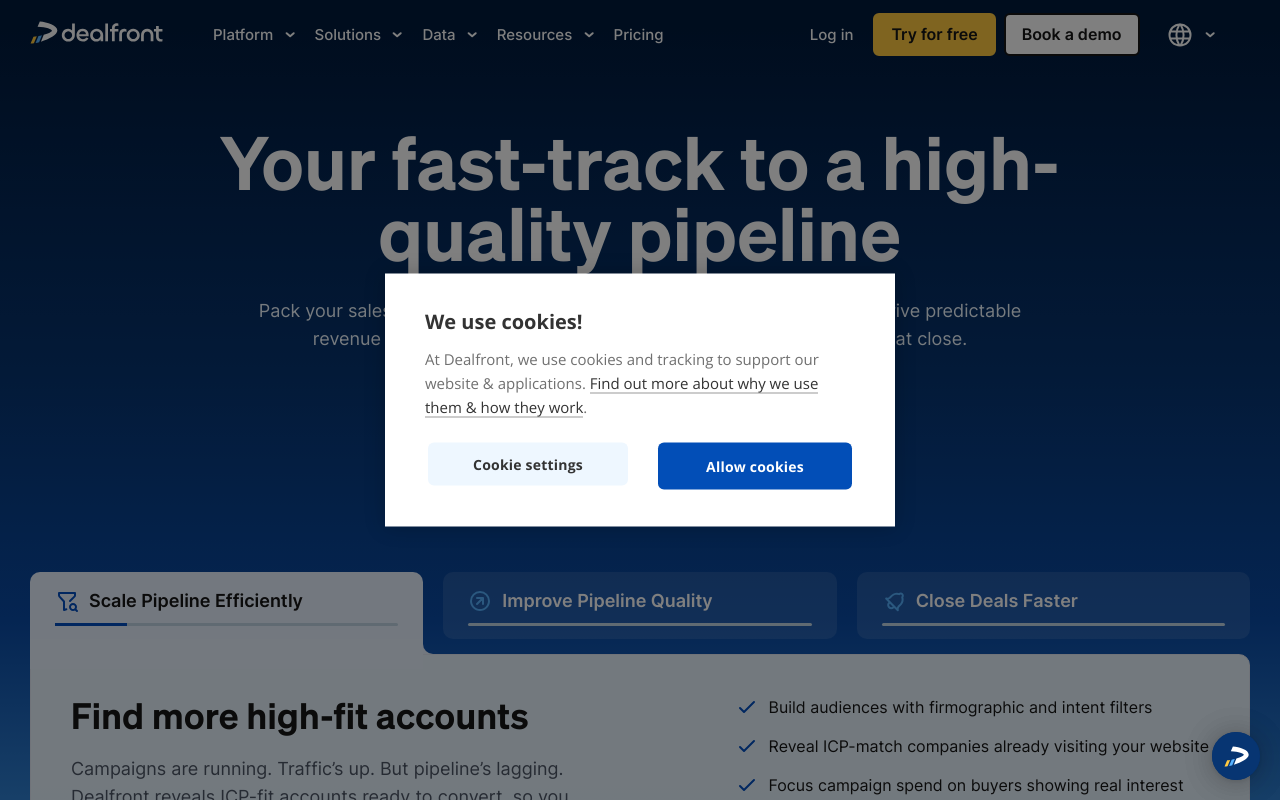
The headline mentions 'build pipeline that actually converts,' which is vague and fails to specify the unique benefit Dealfront offers over competitors. Without a clear articulation of the tangible outcomes or a distinct USP, potential leads may struggle to understand the immediate value and move on. In a crowded SaaS space, specificity about the problem solved and the potential impact is crucial for capturing attention and guiding the decision-making process.
The presence of both 'Try for free' and 'Book a demo' CTAs can disrupt the conversion path by splitting user intent. Each CTA suggests a different journey stage, potentially causing friction and indecision among visitors. Distinct and prioritized CTAs are essential for streamlining navigation and ensuring prospects follow the intended funnel path towards conversion, optimizing their journey for better lead quality and faster pipeline velocity.
The homepage displays several client logos but lacks detailed testimonials or case studies that convey successful outcomes with specifics. This absence limits the website’s ability to establish deep trust quickly, particularly for high-consideration decisions where peer validation and detailed successes influence buyer confidence and decision speed. Such content can differentiate Dealfront from less-proven competitors.
The prominent cookie notice obstructs key content, including the main headline and primary CTAs, potentially disrupting the initial user experience. Interference with the ambiguity in the first impression detracts from narrative coherence and message absorption. Interruptions like this can elevate bounce rates by distracting users from understanding the immediate value proposition.
The homepage contains a variety of headings and AJAK sliders but lacks focused SEO elements that target specific, high-intent keywords relevant to B2B SaaS solutions. This deficiency may result in lower organic search rankings and missed opportunities for capturing prospects early in their research phase. Search-based discoverability ensures the brand intersects with potential customers' purchasing journeys.
Want to unlock the full CRO report?
Get access to all recommendations, benchmarks, and experiment ideas.
- All 21 prioritised CRO suggestions with experiment ideas
- Industry benchmarks for your category & traffic level
- Discoverability (SEO + GEO) full audit results
- A/B test hypotheses ready to implement
- Personalised session with a CRO specialist
⚠️ Important Note
This audit is based on an automated and heuristic-based analysis of publicly accessible pages. The evaluation follows industry best practices across conversion rate optimization (CRO), usability, analytics, and discoverability.
The findings presented here are directional and indicative in nature. They do not take into account internal data such as revenue performance, customer lifetime value, traffic quality, seasonality, or proprietary testing.
Recommendations should be interpreted as optimization opportunities rather than absolute assessments. Actual impact may vary depending on audience composition, acquisition channels, and business context. This report is not exhaustive and should be used as a starting point for further analysis and experimentation.