 CRO Audit
Infisical
Audit performed March 12, 2026 · Report version 2.0 · 21 CRO suggestions identified
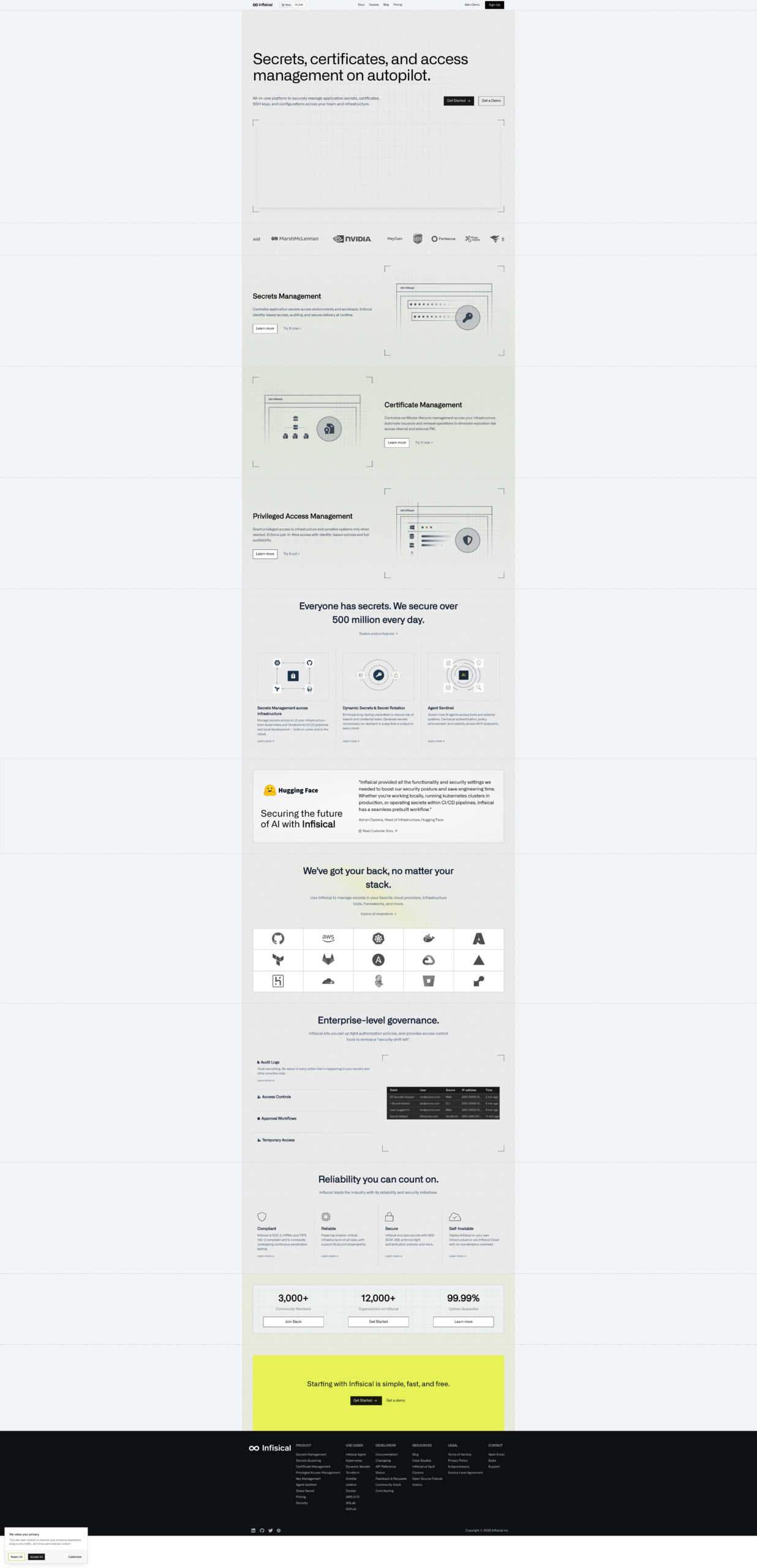
The primary CTA simply states 'Sign Up', which lacks urgency and specificity, failing to convey immediate value. This generic approach may leave visitors unclear about the tangible next steps, thereby reducing urgency and motivation. Strategically framed CTAs can help visitors understand what to expect, enhancing click-through rates. The absence of action-driven language or urgency indicators can lead to lower engagement and missed conversion opportunities.
The hero section states 'Secrets, certificates, and access management on autopilot' without clearly articulating the unique value or differentiation. While the general function is mentioned, it lacks depth in expressing how it uniquely solves pain points compared to competitors. Clear articulation of outcomes, benefits, and differentiators is essential to engage prospects who seek assurance of solution superiority.
The social proof includes a client mention and usage count, but lacks detailed testimonials or in-depth case studies. There is potential to enhance trust and credibility by showcasing detailed use cases or quantified successes. Detailed testimonials and case studies can act as effective trust-building mechanisms, providing prospects with relatable success stories and demonstrating tangible benefits.
The FAQ section provides answers but lacks substantive detail which can address specific customer pain points and resolve common objections. The information needs to be expanded with clearer, more precise language that targets potential customer concerns. Effective FAQs help pre-handle objections and align with prospect queries, therefore reducing buyer hesitation and enhancing engagement.
Website language uses technical jargon such as 'certificates' and 'access management', which might not resonate with all potential customers. This may create cognitive friction for lay decision-makers or new stakeholders, hindering their understanding of the product's direct benefits. Simplified, benefit-focused messaging can improve engagement and ensure broader discoverability and appeal.
Want to unlock the full CRO report?
Get access to all recommendations, benchmarks, and experiment ideas.
- All 21 prioritised CRO suggestions with experiment ideas
- Industry benchmarks for your category & traffic level
- Discoverability (SEO + GEO) full audit results
- A/B test hypotheses ready to implement
- Personalised session with a CRO specialist
⚠️ Important Note
This audit is based on an automated and heuristic-based analysis of publicly accessible pages. The evaluation follows industry best practices across conversion rate optimization (CRO), usability, analytics, and discoverability.
The findings presented here are directional and indicative in nature. They do not take into account internal data such as revenue performance, customer lifetime value, traffic quality, seasonality, or proprietary testing.
Recommendations should be interpreted as optimization opportunities rather than absolute assessments. Actual impact may vary depending on audience composition, acquisition channels, and business context. This report is not exhaustive and should be used as a starting point for further analysis and experimentation.