 CRO Audit
PeptideDeck
Audit performed March 16, 2026 · Report version 2.0 · 21 CRO suggestions identified
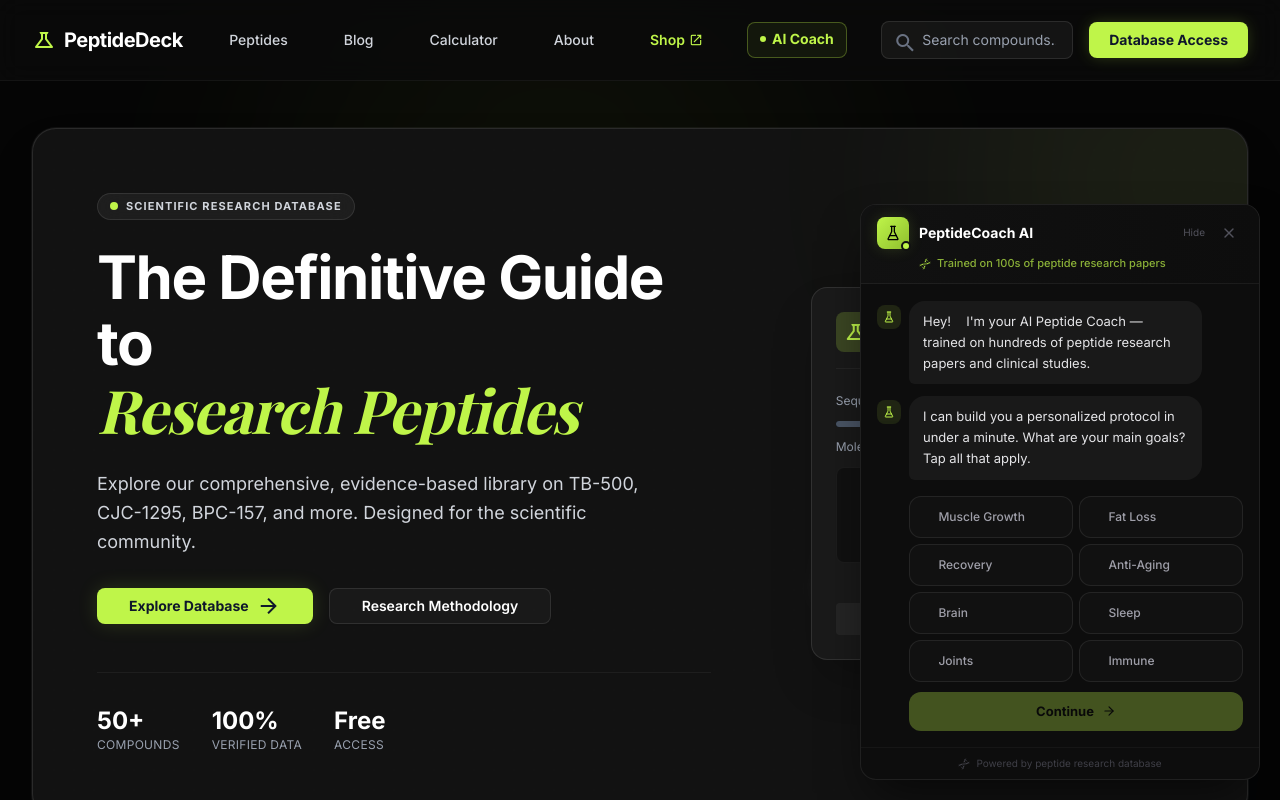
The homepage states ‘The Definitive Guide to Research Peptides,’ but fails to articulate specific, compelling benefits or outcomes for the target audience. This dilutes the immediacy of understanding why a user should engage further, thereby impacting initial conversion potential. To increase lead quality and alignment, a clear value proposition needs to precisely communicate what sets them apart and how their solution directly impacts scientific research outcomes.
The presence of multiple CTAs like ‘Explore Database’ and ‘Research Methodology’ in the same section splits user attention and undermines conversion flow. Clear and singular paths are necessary in a high-consideration B2B space, where guiding users towards a primary action is crucial for successful funnel engagement. This misalignment can create decision paralysis, leading users away from valuable lead generation paths.
The homepage and supporting sections lack visible client logos, testimonials, or case studies which are critical for building authority and trust in a B2B environment. While the site highlights ‘100% Verified Data’, this is insufficient without third-party endorsements that confirm credibility and efficacy, crucial in a field like scientific research where validation is vital.
The site lacks an easily accessible section addressing common user concerns and questions, such as FAQs. In a complex, high-investment space like scientific research, preemptively handling objections through comprehensive and visible FAQ sections can accelerate the decision process by addressing doubts upfront, reducing perceived risk and hesitation.
The website’s headings and content predominantly use broad and highly competitive keywords such as ‘Research Peptides’. However, specifics on peptide applications, outcomes, and benefits for distinct use cases are underutilized. Long-tail keywords are often a significant driver for niche B2B industries and can capture more qualified, high-intent traffic by aligning closely with detailed search queries.
Want to unlock the full CRO report?
Get access to all recommendations, benchmarks, and experiment ideas.
- All 21 prioritised CRO suggestions with experiment ideas
- Industry benchmarks for your category & traffic level
- Discoverability (SEO + GEO) full audit results
- A/B test hypotheses ready to implement
- Personalised session with a CRO specialist
⚠️ Important Note
This audit is based on an automated and heuristic-based analysis of publicly accessible pages. The evaluation follows industry best practices across conversion rate optimization (CRO), usability, analytics, and discoverability.
The findings presented here are directional and indicative in nature. They do not take into account internal data such as revenue performance, customer lifetime value, traffic quality, seasonality, or proprietary testing.
Recommendations should be interpreted as optimization opportunities rather than absolute assessments. Actual impact may vary depending on audience composition, acquisition channels, and business context. This report is not exhaustive and should be used as a starting point for further analysis and experimentation.