 CRO Audit
Saveri
Audit performed May 5, 2026 · Report version 2.0 · 21 CRO suggestions identified
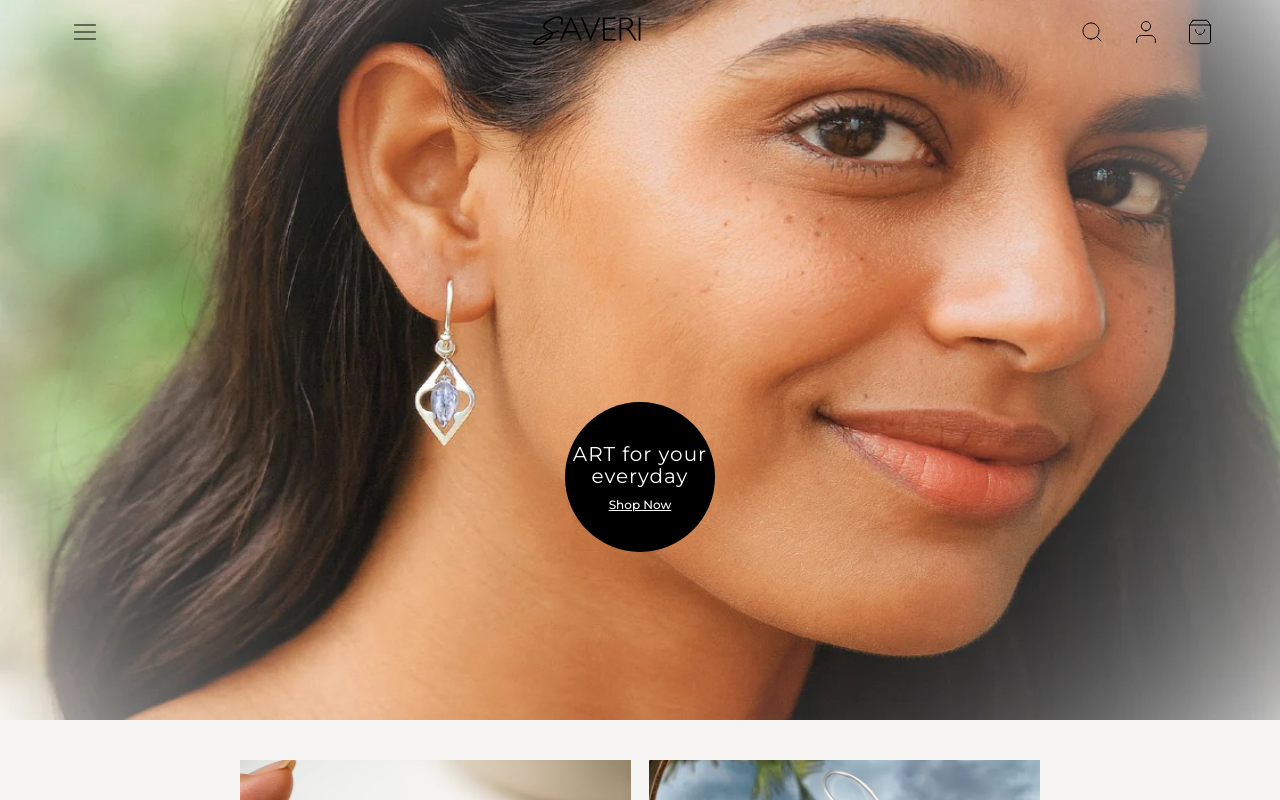
The hero section displays 'ART for your everyday', which is too broad and lacks specific value differentiation. This phrase doesn't effectively convey the unique selling points that could compel a customer to explore further. A concise, specific value proposition directly addressing jewelry quality, uniqueness, or craftsmanship would enhance immediate purchase intent.
On the product page, trust elements are minimal with only small icons indicating free shipping and easy returns. These elements are neither visually prominent nor comprehensive enough to reassure visitors. Absence of explicit customer reviews and detailed guarantee information may lead to hesitation, especially since Saveri is not a globally recognized brand.
The CTA 'Add to Bag' and 'Buy Now' on the product page lack any urgency or motivational triggers. Without compelling reasons to act immediately, potential customers may postpone purchases. Messages highlighting exclusivity, limited availability, or special offers could significantly enhance action-taking motivation.
The homepage features a mix of visual elements without clear separation of information and hierarchy. Various elements such as promotional content and product features clutter the viewing experience. This can overwhelm visitors, leading them to exit before exploring product offerings deeply.
The product descriptions and headers offer limited keyword depth, focusing mainly on product names without additional descriptive language. This lack affects search visibility for broader or related search queries, reducing potential organic traffic reach. Improved semantic content and keyword richness could increase visibility within search rankings.
Want to unlock the full CRO report?
Get access to all recommendations, benchmarks, and experiment ideas.
- All 21 prioritised CRO suggestions with experiment ideas
- Industry benchmarks for your category & traffic level
- Discoverability (SEO + GEO) full audit results
- A/B test hypotheses ready to implement
- Personalised session with a CRO specialist
⚠️ Important Note
This audit is based on an automated and heuristic-based analysis of publicly accessible pages. The evaluation follows industry best practices across conversion rate optimization (CRO), usability, analytics, and discoverability.
The findings presented here are directional and indicative in nature. They do not take into account internal data such as revenue performance, customer lifetime value, traffic quality, seasonality, or proprietary testing.
Recommendations should be interpreted as optimization opportunities rather than absolute assessments. Actual impact may vary depending on audience composition, acquisition channels, and business context. This report is not exhaustive and should be used as a starting point for further analysis and experimentation.