 CRO Audit
The Mod Labs
Audit performed April 9, 2026 · Report version 2.0 · 21 CRO suggestions identified
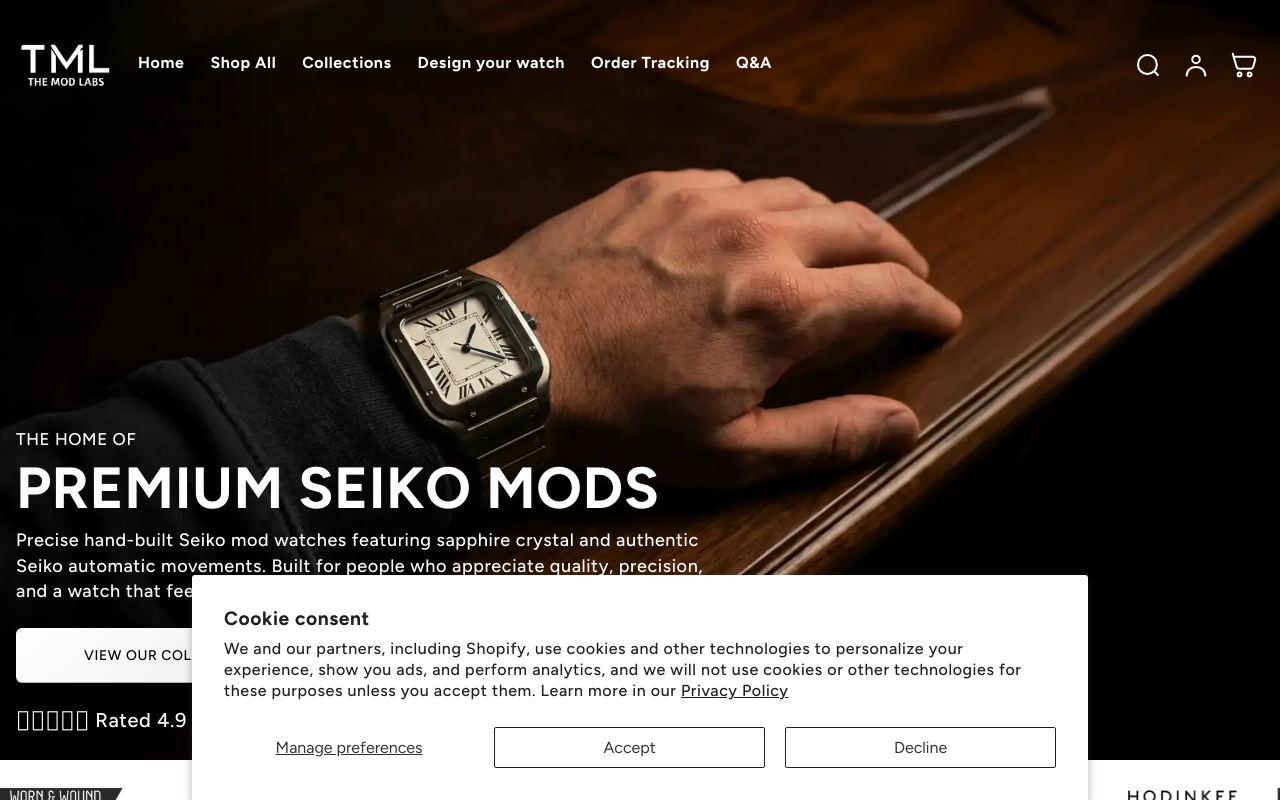
The homepage hero section prominently states 'Premium Seiko Mods,' but lacks specific, tangible differentiators that clarify why the product is superior or unique. This absence of concrete benefits or emotional triggers can lead to potential buyers overlooking the perceived value, reducing purchase intent from the outset. Without clear differentiation, visitors may fail to connect emotionally or rationally with the premium positioning, impacting initial conversion appeal.
On the product page, a scarcity of visible trust indicators close to the price impacts the buyer's confidence. Absence of review stars near price or assurances like robust guarantees create psychological friction, contributing to anxiety about quality and legitimacy upon reaching this critical decision point. Trust reduction near pricing zones is proven to increase cart abandonment, as users reevaluate risk amidst potential high-stakes transactions.
Product page CTAs like ‘Add to Cart’ lack urgency or compelling verbiage to drive immediate action. Generic CTA messaging fails to accelerate decision-making or leverage urgency psychology that can motivate conversion. When users encounter non-directive or passive CTAs, the lack of persuasive elements reduces the impetus for immediate engagement, slowing down customer momentum through the purchase funnel.
The homepage showcases multiple elements like 'Best Sellers' and 'Our Concept' without a clear visual hierarchy. The disjointed flow risks cognitive overload, dispersing user attention across competing sections. This fragmentation dilutes crucial product focus needed to encourage exploration or reinforce main sales propositions, potentially undermining product visibility and engagement.
The absence of detailed category descriptions and keyword-rich content diminishes the site’s discoverability across search engines. With limited semantic depth in listed collections and product categories, opportunities for organic search visibility shrink, directly impacting traffic quality and volume. A lack of optimized, category-specific content can lead to missed long-tail and broader search intents, ultimately affecting scalability and lead-gen potential.
Want to unlock the full CRO report?
Get access to all recommendations, benchmarks, and experiment ideas.
- All 21 prioritised CRO suggestions with experiment ideas
- Industry benchmarks for your category & traffic level
- Discoverability (SEO + GEO) full audit results
- A/B test hypotheses ready to implement
- Personalised session with a CRO specialist
⚠️ Important Note
This audit is based on an automated and heuristic-based analysis of publicly accessible pages. The evaluation follows industry best practices across conversion rate optimization (CRO), usability, analytics, and discoverability.
The findings presented here are directional and indicative in nature. They do not take into account internal data such as revenue performance, customer lifetime value, traffic quality, seasonality, or proprietary testing.
Recommendations should be interpreted as optimization opportunities rather than absolute assessments. Actual impact may vary depending on audience composition, acquisition channels, and business context. This report is not exhaustive and should be used as a starting point for further analysis and experimentation.