How companies grow organic traffic +35%* with Pathmonk running their SEO
Competitor intelligence, keyword research, content, creative assets, technical fixes, internal links, scheduling and publishing: the work an SEO team does every week, done continuously by Pathmonk from each company's own first-party data. This is how it works, who is using it, and what the early numbers look like.
*Average organic traffic lift across Pathmonk SEO customers, measured in their own Search Console and Pathmonk analytics data over the first three months.

The problem: organic traffic is getting harder to earn
Organic visitors arrive with a question already formed and choose the page over every other result, which is why organic traffic usually converts at a lower cost per acquisition than paid or social. Every company wants more of it. The problem is that the search landscape underneath it is shifting faster than most teams can react.
- Zero-click searches are eating the results page. AI Overviews, featured snippets and instant answers resolve more queries without a single visit, so ranking well no longer guarantees the click
- AI search is intercepting research queries. ChatGPT, Perplexity and Gemini now answer the top-of-funnel questions that used to land on blog posts, and they cite a handful of sources at most
- Google updates rewrite the rules every few months. Core and helpful-content updates move traffic overnight, and rankings built on generic content are the first to go
- The results page is crowded with AI-generated content. Competitors publish more pages faster than ever, so standing out takes real expertise, real data and a clear point of view
- Forums and marketplaces are taking the space brands used to own. Reddit threads, review sites and Amazon listings now outrank company pages on commercial queries
- Paid is getting more expensive at the same time. As cost per click climbs, organic stops being a nice-to-have and becomes the channel that decides margins
None of this makes SEO less valuable. It makes it more demanding: winning organic traffic today means knowing exactly what competitors rank for, publishing content with real expertise and data behind it, structuring it so both Google and AI answer engines cite it, and keeping it fresh as the results page changes. The companies in this story had real demand in their market and no capacity to keep up with it. What changed is that the competitor research, writing, fixing and publishing now run continuously, from the behavioral data their websites already produce.
How Pathmonk does it: one engine, the whole SEO workflow
Pathmonk reads the company's first-party visitor data, Search Console and analytics, learns the brand through Company DNA, and tracks what the competitors rank for. From that it plans the topics, writes the drafts, makes the images, applies the technical fixes and publishes. Every step below runs continuously, and every step can stop for a human sign-off or run straight through, depending on how the account is set.
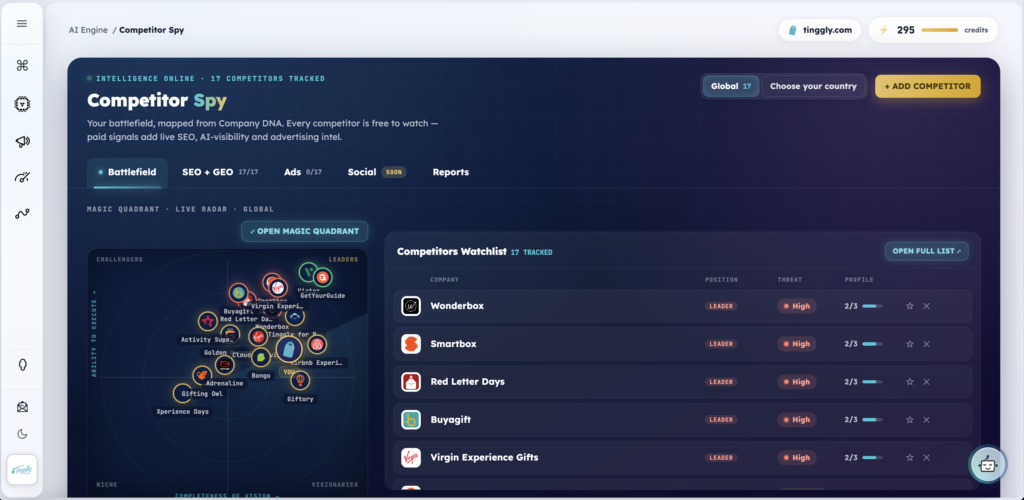
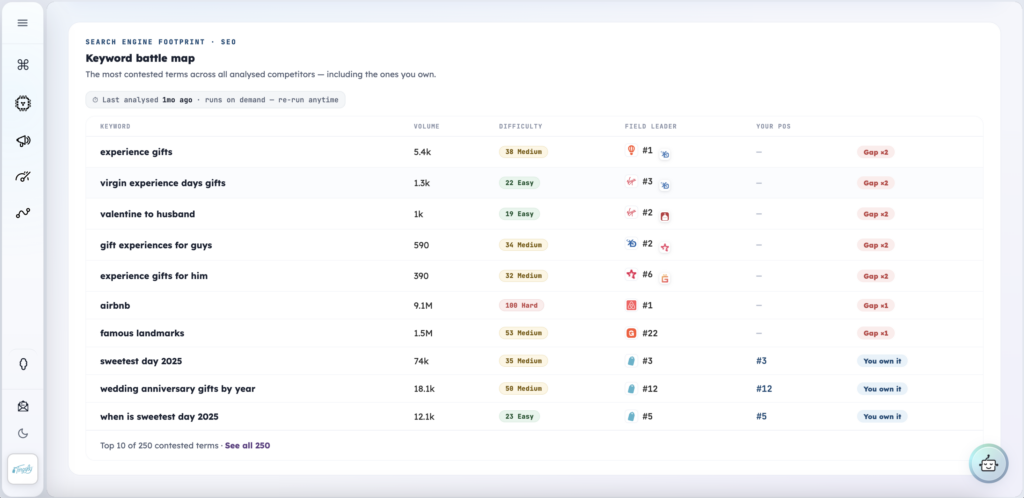
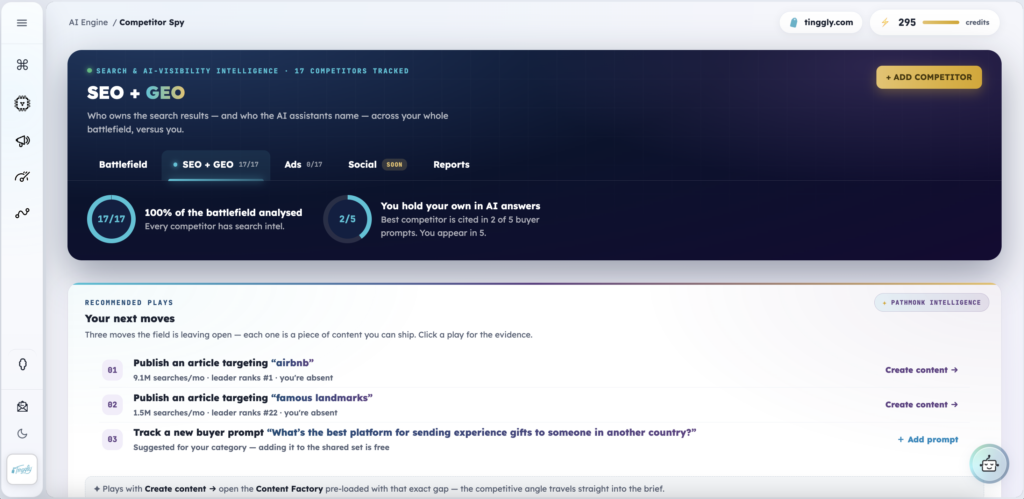
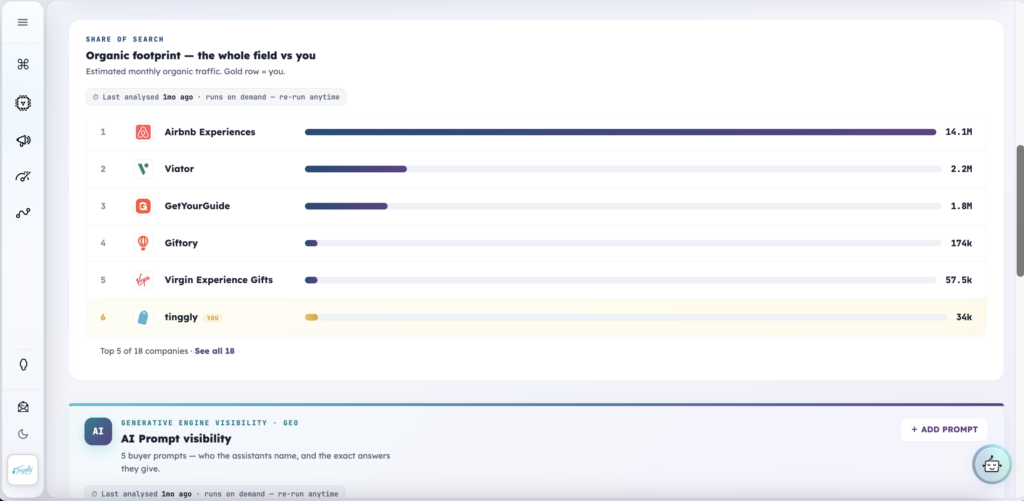
Competitor Spy: what your rivals rank for, and why
Before picking a single keyword, the engine studies the competitors already winning the category: the keywords and topics they rank for that the company does not, the type of content behind each ranking (guides, comparisons, category pages, FAQs), and the gaps they leave open. Every insight feeds the content plan.
- Keywords and topics rivals rank for and you do not, surfaced as they appear
- Insight into the content format and angle behind each competitor ranking
- Gaps and unclaimed angles flow straight into briefs
Opportunity finder: the keywords you can realistically win
Powered by Competitor Spy and the site's own data, the opportunity finder scores every topic for this specific site: realistic winnability from Company DNA, not a generic difficulty score.
- Reads Search Console, analytics and on-site behavior, cookieless
- Flags easy wins with realistic difficulty for your domain
- Refreshes the opportunity list as the market moves
Content Factory: research to publish-ready article, in your voice
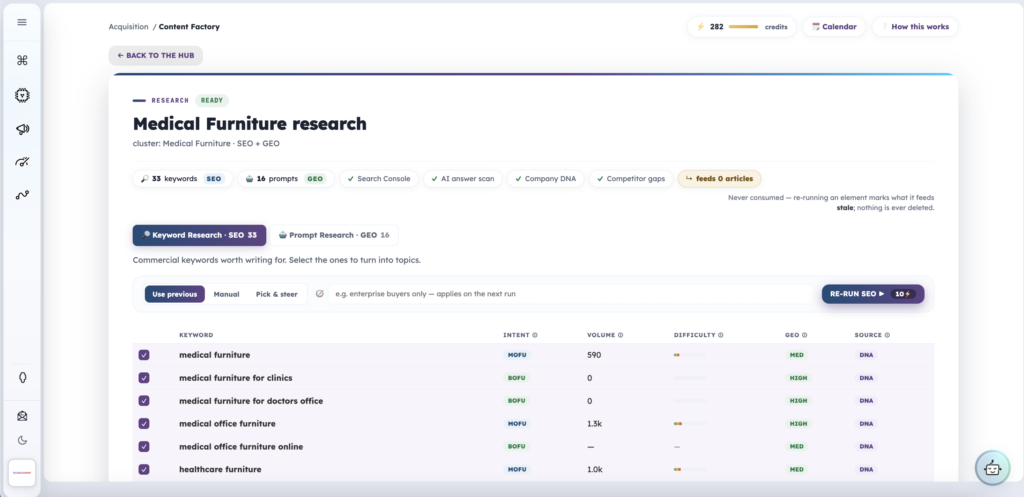
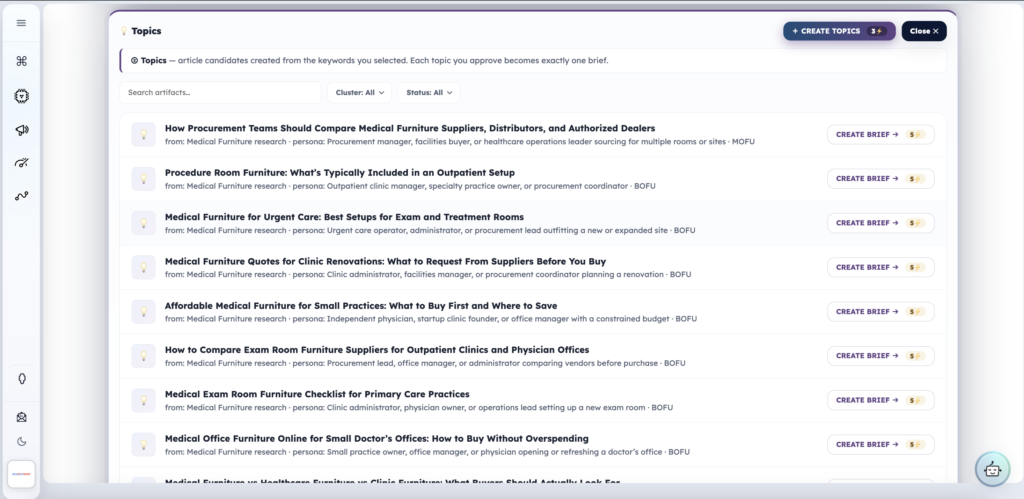
One click turns an opportunity into a brief, a full draft written from the company's Company DNA, a fact-check pass, SEO and GEO optimization, a hero image and planned internal links. It stops in the queue, publish-ready, until someone approves it.
- Drafts pages and topic clusters in the brand voice
- Optimizes for Google and AI answer engines in the same pass
- Publishes on schedule to WordPress, Webflow and other CMSs
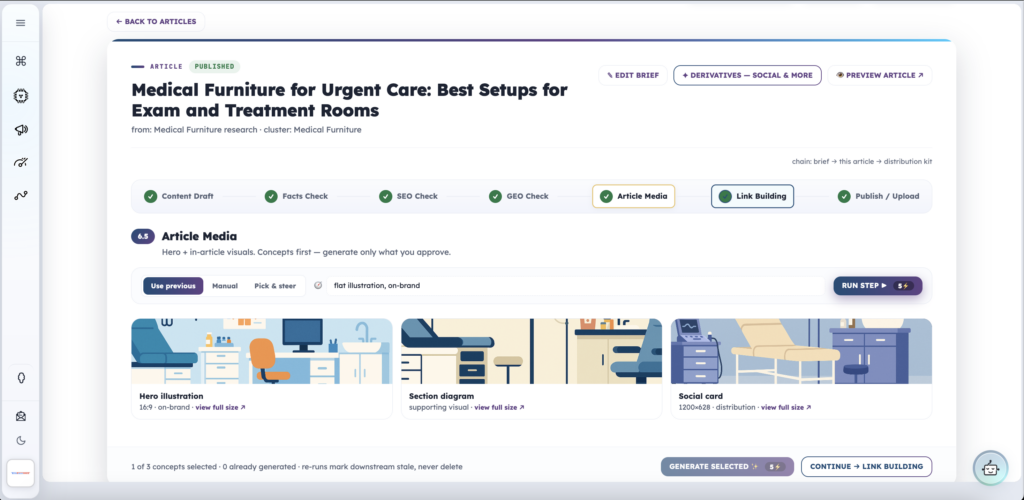
Article media: the visuals, made against the same brief
Every article needs images, and stock photography is what makes content look generic. The engine proposes concepts first, in the brand style, and generates only the ones someone picks: a hero, supporting visuals for the sections, and a social card sized for distribution.
- Concepts proposed before anything is generated
- Hero, in-article visuals and a 1200×628 social card
- Drawn in the brand style, not stock photography
Technical SEO and internal linking, handled before they cost rankings
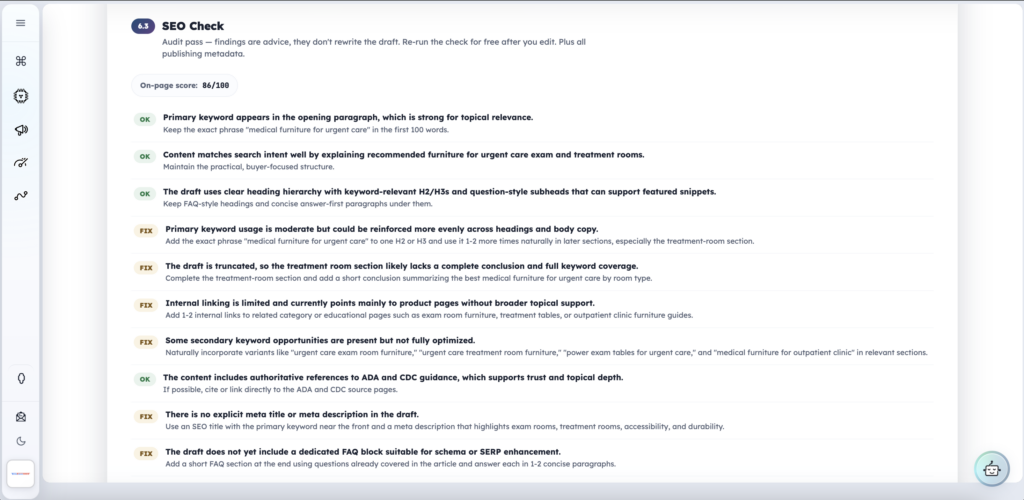
Meta descriptions, Core Web Vitals, broken links and thin pages are fixed automatically. New content is linked into the cluster it belongs to, so authority flows between related pages.
- On-page and technical fixes applied continuously
- Internal links added between cluster pages
- Clean site structure that crawlers reward
Editorial calendar: everything scheduled on one board
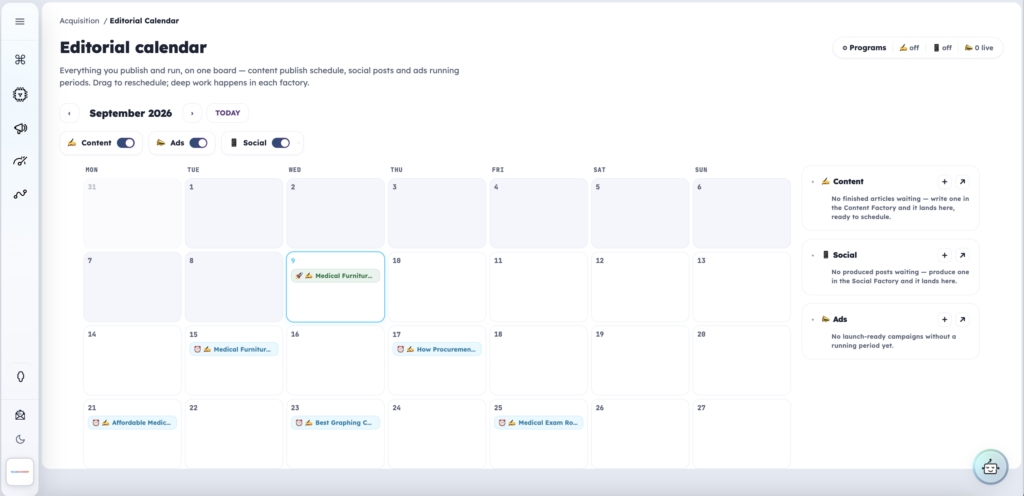
Finished articles do not pile up in a queue with no dates on them. Each one lands on a calendar with its publish date, next to the social posts and the ad running periods, and can be dragged to a different day.
- A publish date for every finished article
- Content, social and ads on one board
- Drag to reschedule without reopening the article
Derivatives: one article, every channel it can feed
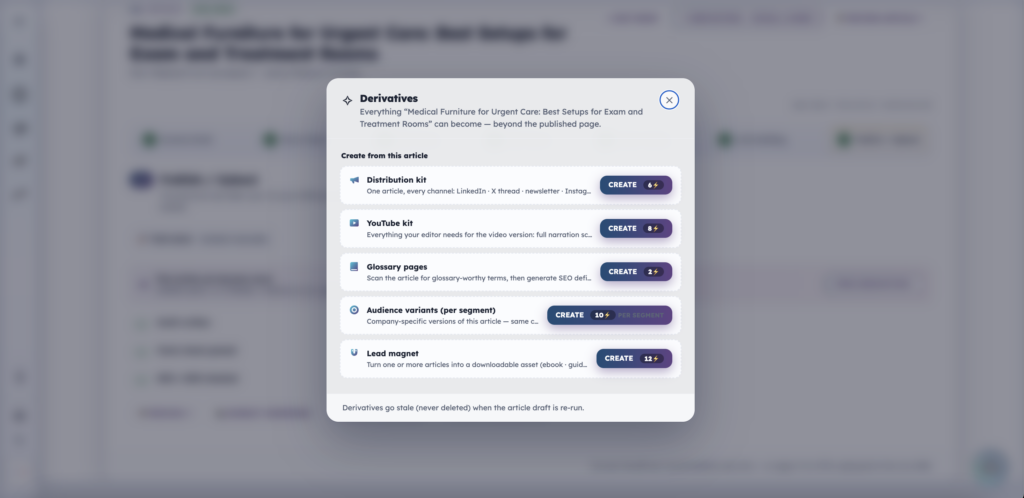
The article is the source, not the whole output. From a published piece the engine produces the distribution around it, so the research behind one article is not spent on a single page.
- A distribution kit: LinkedIn, X thread, newsletter, Instagram
- A YouTube kit with the narration script for the video version
- Glossary pages, per-segment audience variants and lead magnets
Rank tracking and auto refresh: nothing decays in silence
Live positions show which pages drive real traffic, next to the competitors' positions on the same keywords. When a page starts slipping, the engine rewrites and refreshes it before the ranking is gone.
- Daily positions per keyword and per page
- Decaying pages detected and rewritten automatically
- Results explained as plain-language growth stories
How much of it runs on its own is a setting
Why it does not read like AI content
Anyone can point a language model at a keyword and get an article. The reason most of that content is worthless is not the model, it is the input: the model has never seen the company, so it writes what it would write for anyone in the category, and the page reads exactly like that.
Every draft is written against Company DNA
Before a single word is written, Pathmonk builds Company DNA: the brand, the audience, the offers, the positioning and the tone of voice, learned from the company's own website and kept current as that site changes. Every brief, every draft, every image and every derivative is generated against that profile rather than against a generic idea of the industry.
It is not only brand knowledge. The same engine holds the first-party behavioral data from the site, the Search Console history for that exact domain, and the competitor gaps from Competitor Spy. The content is shaped by what this company sells, who actually visits it, and what its rivals already own.
That is the whole difference between content generated about an industry and content generated from a company. Two Pathmonk customers competing in the same category do not get the same article, because they do not have the same DNA, the same visitors, or the same gaps to close.
Across industries: the same engine, a different playbook
Because the engine works from each site's own data, its competitors and its Company DNA, the same features produce a different content strategy per business. What changes is the intent it chases and the rivals it studies.
The results: traffic, rankings and revenue, measured
SEO results compound, so the honest way to read them is over time. Here is what the early customers have measured so far, and what the first months typically look like.
All figures come from the customers' own Pathmonk and Search Console data, comparing the three months after install against the three months before it.
What the first months typically look like

Getting started: what happens in the first days
Pathmonk starts from what the website already knows about its visitors, and from what the competitors already rank for. There is no migration and no content audit to run first.
- Day 1Install and connect
One SDK snippet through GTM, then connect Search Console, GA4 and the CMS through Data Connectors. Cookieless, no developer needed.
- Days 2 to 5Company DNA and competitor map
The engine learns the brand, audience, offers and tone, and Competitor Spy maps what the rivals rank for and where the gaps are.
- Week 1First articles, publish-ready
The opportunity list is scored, the first briefs and drafts land in the queue, technical fixes are proposed. The team approves, the engine ships.
The Performance Suite add-on puts Pathmonk SEO specialists on the account every month, working alongside the in-house team.
Find out what your site could rank for
Run a free audit of your domain to see the keywords it could realistically win, and the ones competitors already own. No install and no dev work to get the audit.
More customer stories
How Alpine Dryers turned high-ticket browsers into consultation requests.
Read the story Education+87%How Ausbildung-Weiterbildung.ch lifted qualified leads in just one week.
Read the story Healthcare+82%How Doctoralia grew qualified B2B leads across three markets in two weeks.
Read the story