Introduction
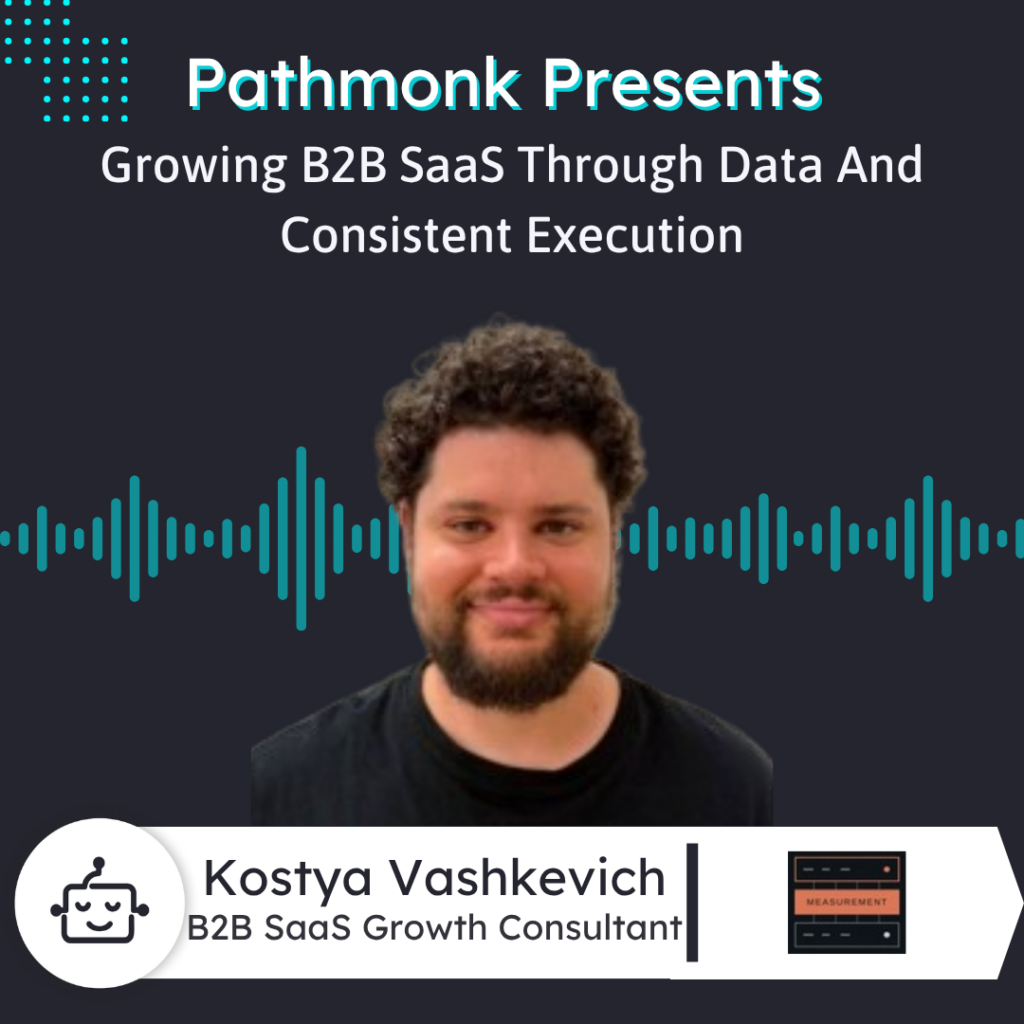
Kostya Vashkevich, B2B SaaS growth consultant at Measurement Layer, explains how established software businesses can approach growth through data rather than gut feeling. He shares why conversations with stakeholders and careful analysis of fragmented information are both essential to identifying opportunities and building a roadmap.
Discover why clear website messaging, strong positioning, and understanding your ideal customer profile remain important as AI changes discovery channels. Kostya also discusses finding accessible growth opportunities, executing consistently, and the difficulty of accurate first-touch attribution. For founders and marketers, this episode offers a grounded perspective on connecting organizational insights, communicating with customers, and pursuing sustainable progress without chasing a silver bullet.


Increase +180% conversions from your website with AI
Get more conversions from your existing traffic by delivering personalized experiences in real time.
- Adapt your website to each visitor’s intent automatically
- Increase conversions without redesigns or dev work
- Turn anonymous traffic into revenue at scale
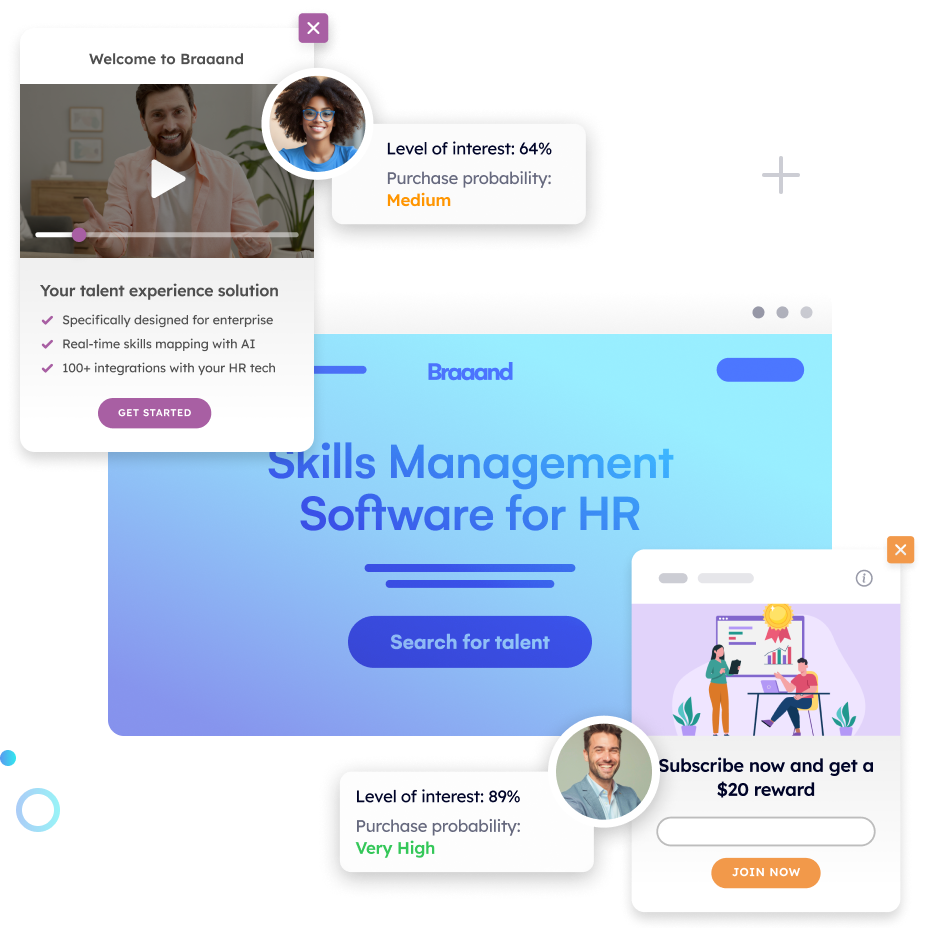
RICK: Pathmonk is the AI for website conversions. With increasing online competition, over 98% of website visitors don’t convert. The ability to successfully show your value proposition and support visitors in their buying journey separates you from the competition online. Pathmonk qualifies and converts leads on your website by figuring out where they are in the buying journey and influencing them in key decision moments with relevant micro experiences like case studies, intro videos, and much more.
Stay relevant to your visitors and increase conversions by 50% by adding Pathmonk to your website in seconds, by letting the AI do all the work, and increase conversions by 50% while you keep doing marketing as usual. Check us out on pathmonk.com. Hey, everybody. Welcome back to Pathmonk Presents. Today, we are joined by Kostya.
He’s the B2B SaaS growth consultant of Measurement Layer, and he’s also the podcast of the, same, name podcast, right? Am I correct, Kostya?
KOSTYA VASHKEVICH: Correct.
RICK: Amazing. So Kostya, welcome to the show. I’m excited to talk to you and, maybe we start with the basics. We start a little bit, with, what’s the heart of what your, consultancy does, how do you help clients?
But really, if you were explaining this to a friend over coffee, right? To keep it simple, how would you explain what you do?
KOSTYA VASHKEVICH: Thank you. That’s a great question. so in the plain terms, it would literally sound like, if you have a business in the technological industry, and the business is just emerging and new one, and you want to grow it faster, for any purpose, whether that’s a personal income or you want to, get a higher validation for VCs, I would be the go-to person to help you to develop the strategy and, implement it, so that the business starts growing, actually.
RICK: All right, that’s huge, of course, in itself, right? are there specific types of businesses that maybe, I don’t wanna say you enjoy working with the most, ’cause I’m sure that it really depends on the people and a bunch of other factors, but maybe there are industries where you feel the product really shines.
sorry, your service in a way, your offering, if you will, right? what’s the key problem that you help them solve and what do you like doing the most for them?
KOSTYA VASHKEVICH: Yeah, correct. for the past 10 years, I’ve been focusing mostly on B2B SaaS businesses, products of different sizes and niches.
Primarily that was smart tech, travel tech, fintech products. And usually the problem I’ve, jumped in to solve as a consultant is, how to make a forecastable, a predictive, a predictable growth based on the existing data, and in a consistent way so that this, data is actually collect- collected correctly, used correctly, so to say, to map all the dots which already exist in the organization.
So typically, I do not join organizations which are just funded, do not have, MVP fit. those are existing companies which have proven MVP. They have the market, they have the resources to scale, but they don’t know how, and they’re seeking for a person who can do that based on the numbers, based on data-driven approaches, not the gut feeling.
so yeah, that’s the way how I work.
RICK: Gotcha. Okay, that’s super interesting, and I’m also intrigued by, you’ve talked about connecting the dots, and I think that’s… How many people get lost is that they get lost into the weeds of the business and don’t take that, 30,000-foot view or approach of looking at the business, a bird’s-eye view, if you will, understanding a little bit, “Okay, how do I connect the dots?”
They don’t even see the dots. They don’t see the trees for the, from the forest, right? So how, if anything, you can give an example of, the way that you worked with a company, you went in, right? And just said, “Okay, this is the type of data that I’m looking at, and this is the result at the end.”
If that makes sense.
KOSTYA VASHKEVICH: Yeah, correct. I think that’s, it’s, always a matter of different perspective, and this is why I’m hired as a consultant very oftenly. the people who already operate within an organization, they live in a kind of a box, and their vision is restricted. they live in a silo or in multiple silos, and thus they are not very often able to look, from a different outlook on the situation.
And that’s why they, have those blind spots, and they don’t see the dots, and moreover, they are not able to connect them. so when I come usually, the framework is pretty simple. it’s, bloody simple. you just go and talk to different people. That’s number one. talk a lot, ask a lot of questions, different questions, being annoying.
and then, you get the access to the data, which is more objective, but still it’s a fragmented, and not complete model of the reality. And once you have everything on the table, you start actually to search for the patterns, search for the dots, and try to connect them into something palpable which you can demonstrate later on as a plan, as a roadmap.
I think the biggest difficulty here is actually to drag out what is really important out of this pile of data and actually prove to the stakeholders, that this is the direction we should look at because sometimes, the truth which, comes on the surface is not very pleasant to, realize, to be honest.
RICK: and it makes sense, and it, sounds like there’s a lot of education going on at the moment where you’re doing the consulting, right? Yeah, always. Putting all this data and just explaining why is this important to look at, not this, but that, right? Yeah, exactly. That conversation that you’re having.
now it sounds like you’re, you’re treating your clients, right? so I’m curious, how do they discover you in the first place? What are the… I- in other words, what are the marketing channels that are your go-to at the moment to bring in more business?
KOSTYA VASHKEVICH: So I wouldn’t call myself as a businessman.
I’m more like an artisan, and in the majority of cases, that model is not scalable at all. It’s just, a lifestyle, I should say. primarily people find me through the recommendations, word of mouth, referrals, LinkedIn, and, my bandwidth is very limited because I cannot, thoroughly focus on more than, a couple projects at a time, and I have to cherry-pick them very carefully, taking a look at their perspective, if I can be helpful.
yeah, that, that’s how it works in my case, and, I’m just currently enjoying how it works and s- look into the future.
RICK: Fair enough. Fair enough. And it sounds like, whenever you have a good referral system, you’re good. when you do your job right, and in fact, when you excel- Yeah
people will be ecstatic to just refer to you to someone else, because, they’ve had a great experience. They want to look good in front of them, right? So they present the, the guy that sold everything for me. So that’s, great.
KOSTYA VASHKEVICH: Yeah, exactly. that’s the kind of recommendation I seek for.
RICK: No, that’s awesome. That’s awesome. Now, Kostya, I’m curious, based on your experience working with these clients, how much of a role does the website play in, in growth in general? What you think? And also, it’s a two-part, right? Yeah … what have you seen working so far? Are there any tools, any tactics, any frameworks even that you rely on when you look at a website- holistically and, yeah, what are you seeing as far as conversion? what’s working right now?
KOSTYA VASHKEVICH: So I think the website is the base. It’s like the, the cornerstone, stone of everything, and, it’s usually the main asset of the business when it comes to the informational intent to convert some leads, regardless of what kind of business you have.
Is it sales driven? Is it self-served? it doesn’t matter. Still, people research about you, and if you are a serious established business and you do not have the website, that, that’s kind tricky. I have never come across such cases, to be honest, and I don’t think they exist at all in the technological, industry.
And, when it comes to what currently works and what not, of course, taking into consideration that, AI literally shifted everything and it’s a disruptor for everyone right now. But, I want to reassure people who, who are stressed by the changes, like, in a nutshell, nothing really changed.
People still use websites to research on you. people still, read and try to understand what you are, can be useful, what do you do, how do you do that. and, both, search engines and, LLMs, they fetch the information from your website. long story short, the methods and the framework stay the same.
stay cutting through, stay relevant, stay, lit with the point, like on the website, what you, are doing. Messaging and positioning are extremely important. The same as they have been eighty years ago, fifty years ago, now, on paper, in digital, those are the pillars on which actually your, perception by the customer stands
RICK: Interesting.
Okay. So it sounds like, technology, keeps advancing, right? from your standpoint, the frameworks, the, the foundation stays the same, but as you said, the messaging, the language you use just- Yeah … evolves along with the technology and what people are looking for. Am I off?
KOSTYA VASHKEVICH: Yeah, exactly.
I’m a big advocate of the idea that, the technology changes just the, the channels, how the attention gets targeted on the customer and vice versa. But the communication part, it stayed absolutely the same. You have to understand your ICP, you have to talk to them in their language, and you have to be capable of translating that into, cutting through copies on the website.
RICK: Gotcha. Okay. So the attention is key here. and that’s a perfect segue for my next question, which is actually… And I wanna switch gears for a second here, Const, and maybe talk about you as a leader, as a consultant. what do you focus on, right? What- where’s your attention on a daily basis when you get to work and you sit down and you work with a client, maybe you have those conversations.
Let’s say, what are the three main things that you focus on to make sure that you keep progressing every day and, producing results for your clients?
KOSTYA VASHKEVICH: Yeah. Thank you. very interesting question. I would even limit the list to two, not even three. the first point is actually to find out the low-hanging fruits.
I think this is very, obvious to everyone, and this is what’s recommended by the majority of the consultants, to find what’s already working or might be easily, kicked off, to work later on. And then the second part is actually not that fun, and usually this is where a lot of organizations fail.
this is following consistently in doing the stuff which you recognize as low-hanging fruits. Because the most compounding things usually re- require time, and a lot of people neglect the fact that you have to be very, thoroughly adherent, schedule doing something consistently. That’s actually moves, moves the needle.
No, no silver bullet, no magic pill
RICK: okay. I like that philosophy and, in a, way shows, you kept a list of two, right? I asked for, you, you kept a list. No, let’s just stay on two- Yeah, it’s just two. … which shows, the level of, you know, of depth that you go into when you do these things.
Now, that brings me to, to wonder, with the flood of content out there, it’s so easy to get lost in the weeds of, learning the new technique, learning this, learning that. Yeah. how do you stay focused and, keep on learning? And maybe there are specific places, people or even routines that you turn to for inspiration or staying ahead.
could you share maybe, something that, that’s been working for you?
KOSTYA VASHKEVICH: Yeah, absolutely. I think that’s one of the biggest problems on the path of evolving as a specialist. you have to very carefully curate what kind of materials you consume. And, for me, it took around, several years, actually, to curate my own list of the people whom I trust and follow.
Mostly those are people on Twitter, LinkedIn, where they’re accessible. I read subreddits a lot. And, I do consume information from different sources, but for me it’s more important, who are the people behind this information? Because I’m not just seeking for, so to say, appeal from fear of missing out.
I’m trying to get people with a unique expertise and a shaped point of view on the things. And very often, I follow people who talk about the same objects or topics in a contradicting way. they have different point of views, and that allows me to have this kind of a panel of people, helping me to shape my own judgment on the topic.
RICK: Oh, okay. So it sounds like it’s not necessarily about the content itself, but more about the trust you have in the person that’s putting it out-
KOSTYA VASHKEVICH: Yeah. Yeah,
RICK: exactly … the perspective, the thinking, right? which makes a lot of sense, and, I have a similar approach. now because things move fast, in SaaS, in, in the growth field, I’m sure in, in everything that we do these days-
we have, before we wrap things up, Const, we have a rapid fire segment, that I would love to jump in with you, and we stay on the topic of content, right? when it comes to consuming content, do you prefer watching, listening, or reading to something?
KOSTYA VASHKEVICH: yeah, makes sense. I think that’s, like, all together, I do not have specific preferences because very often, somebody is good in writing the stuff, somebody is good in recording the stuff, and usually it also depends on how much time I have to consume it.
so I kinda understand where you are aiming, with this conversation, and I should say that, if you wanna be present, be present everywhere if possible, because, multi-channel is for a long period of time already is a standard.
RICK: that’s, a beautiful answer, and I think, that we cater to this because in a way, with this podcast, it’s on YouTube, right?
You can watch it. Yeah. It’s been doing on all podcasting platforms. You can read the s- the transcript if you wanted to, right? there you go. Now, what’s the latest piece of content that you consumed that, really s- stuck with you, that maybe left a gem that, that you thought about for, for hours or days?
Is there anything that really stuck with you lately?
KOSTYA VASHKEVICH: Oh, that’s a tough one. hard actually to capture one specific, just because a lot of content goes through the brain. yeah, I’m a big fan of, couple subreddits which are related more to the management and people relations subjects-
which are not that obvious, but still crucial and even more important to some extent in the technological environment.
Because, despite all those technologies, you still work with people and interpersonal relations issues based on that, they are the biggest part of, the job, I should say. some- sometimes you have to persuade people, sometimes you have to push back correctly, sometimes you have to, just listen to the people and admit their point of view, and it’s always difficult if you don’t know how to do it correctly.
RICK: Okay, I like it. I… And you’re learning from other people. You’re not necessarily learning-
KOSTYA VASHKEVICH: Yeah …
RICK: here on, from the thought leadership from, the specific famous person that’s l- really knowledgeable. You’re just like, more in the community, so to
KOSTYA VASHKEVICH: speak. Yeah. I like the veterans, The ones who were in the trenches and now they share the stories about how they overcome this and, encounter different situations. they might be not that famous, also consultants very often. but their stories are cutting through. I like the stories. I mean- storytelling is a very, powerful tool in the narrative.
RICK: I agree. one last question for the rapid fire, uh, Kostya. So if you had a magic wand and you could fix one, just one frustrating thing in your marketing life with tech, what would you pick?
KOSTYA VASHKEVICH: Yeah. For that one, I know the answer for sure. I would like to have, this super skill of, correct first touch attribution, understanding what actually moves the needle from the first touch with the brand.
And, this is the, topic we usually boil down all the conversations sooner or later with the clients, like what actually moves the needle? And very often this is very hard to, understand it and find out, even being a Sherlock
RICK: Okay. I like that. I have
to think about it for a second. But w-without, without that in mind, uh, Kostya, I wanna, I wanna thank you. Maybe we connect, offline on this, ’cause I, I have a couple of follow-up questions. But unfortunately, the, time for us here is, is, over. I wanna thank you again for being on the show with us today.
As we wrap things up, Kostya, I wanna give you the last word. If someone forgets everything about the interview today, what is the one thing that they should remember about, Measurement Layer and the work you are doing with your clients?
KOSTYA VASHKEVICH: Sure. so if you want to grow your business consistently, make data-driven decisions and not use gut feeling.
That’s all I can say.
RICK: Love it. That’s a slogan right there. Uh, Kostya, if, uh, we want to send people over your way to your website, or if they wanna listen to the Measurement Layer podcast, which you’re a host of, how can they do it? Where can they go?
KOSTYA VASHKEVICH: Yeah. I would share a link to my website and the link to my LinkedIn.
follow me either most, convenient on LinkedIn. there is always going on something, the new announcement, the posts, the new episodes. And if you want to contact me directly or book a consultation, you can go to my website and leave the inquiry.
RICK: Perfect. We’ll make sure to add a, link in the show notes.
With that said, Kostya, again, thank you for your insights. Thank you for your time today, and, I wish you a wonderful day. Hope we can do this again soon.
KOSTYA VASHKEVICH: Thank you. I appreciate for having me. All right. Have a nice day.
RICK: Bye, everyone.