There is no GEO shortcut if your SEO is bad
GEO and SEO are nearly the same job. Henri de Bouteiller of Newton explains why there is no AI search shortcut and how brands win with product stories.

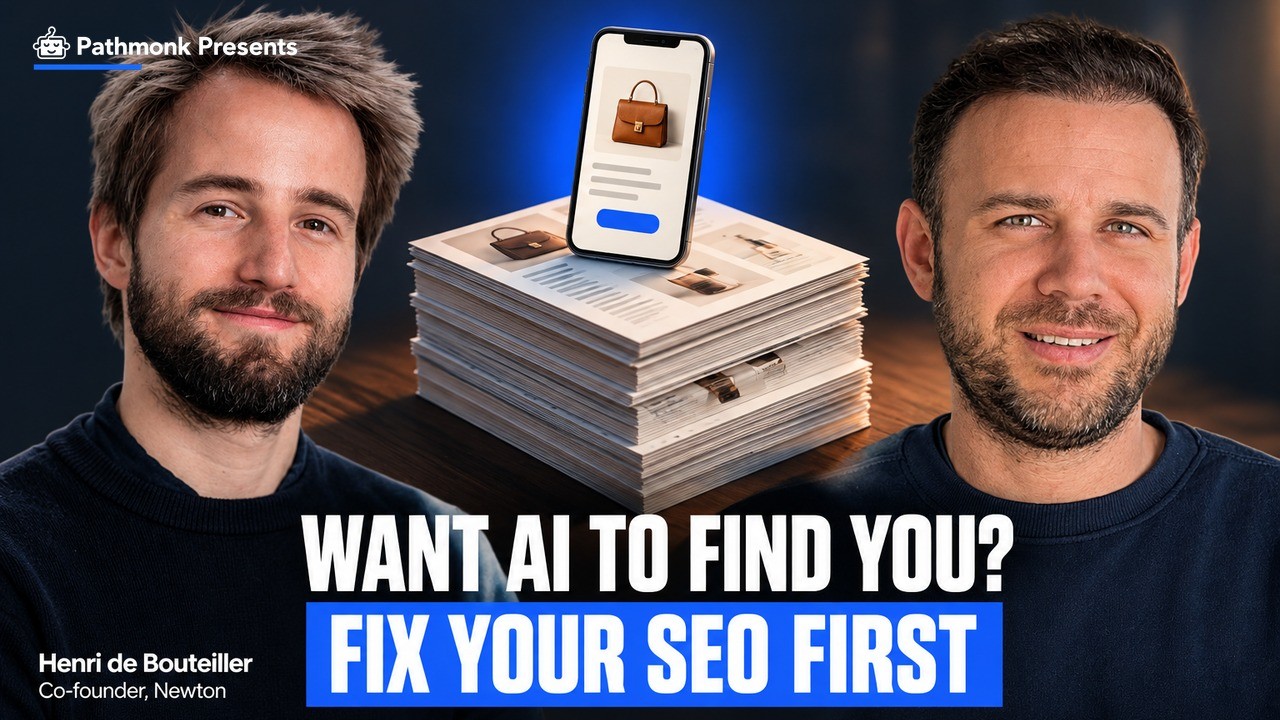
“A lot of people focus on the wrong thing. They think they will have some type of GEO shortcut, where right now they're very bad on SEO, and suddenly, thanks to a few tricks, they'll be big on GEO. That will never happen, never.”
at
- Company
- Newton, the content operating system for brands and retailers
- Speciality
- A separate AI per brand for multilingual SEO and AI search content
- Works with
- Luxury, fashion, cosmetics, pharma, automotive, FMCG and now finance brands
- Deliverable
- Website content created, translated and optimized from the brand's own data
- Growth engine
- Trade shows, inbound content and events with digital transformation agencies
Too long, didn’t listen?
Henri de Bouteiller is co-founder of Newton, a content operating system that trains a separate AI for each brand to create, translate and optimize website content. Newton launched about four years ago in fashion and luxury. It now has more than 100 clients and is expanding into cosmetics, pharma, automotive, FMCG and finance, with forward-deployed AI engineers turning each client's rules into the system.
Henri's core argument is that there is no GEO shortcut. Visibility in LLMs starts with strong SEO, and the gap between the two is maybe 5%. Because content now costs almost nothing to make, the bar for standing out is higher, so brands should publish the product storytelling they already own.
Fix SEO before chasing GEO
Quality, consistency and freshness of content drive visibility on Google and in LLMs alike. Only about 5% of the work is specific to LLMs.
Publish the product stories you already have
Swap the one sentence and four bullet points for the know-how, history and use occasions your product teams already hold. That way both people and AI can see what makes each product special.
Turn one unique asset into many
Create content your competitors can't copy, such as client cases, original research and white papers. Then cut each one into articles, FAQs and posts for every channel.
Meet senior buyers in person
Executives who get a thousand vendor emails a day reply to the people they have met. Industry trade shows were Newton's main acquisition channel for years.
Some brilliant ideas
“If you want to be very good on GEO and appear on LLMs, you need first to be very good on SEO.”
The difference between what you need to do for SEO and what you need to do on GEO is maybe 5%.
If you go on the website of many, many brands, it's very limited. It's one sentence and four bullet points.
Full transcript
Introduction
[0:00:00] ADRIAN GARCIA RAMOS: Welcome to Pathmonk Presents, where we talk with growth and marketing leaders about what's actually working right now. I'm Adrian, your host, and today I'm joined by Henri. Co-founder at Newton. Hi, Henri, how's it going?
HENRI DE BOUTEILLER: Hi, Adrian, thank you very much for having me today.
A content operating system for complex brands
[0:00:19] ADRIAN GARCIA RAMOS: Yeah, it's a pleasure to have you and know more about, you know, content, platforms, and everything that you are building. So, tell us a bit more on, you know, Newton, and what is that about?
HENRI DE BOUTEILLER: So, Newton, we launched about 4 years ago, and we are building the content operating system of brands and retailers. what does it mean, behind this quite barbaric name? Basically, when you are a brand, creating content is very complex. You have, like, data that are scattered all around the place, you have a lot of rules that you need to apply, whether they're brand rules, turn of voice, regulations, and so on and so forth.
HENRI DE BOUTEILLER: And you cannot just use ChatGPT to do it. Many tried it, and when you're a big brand, it's complicated. So what we're building is a platform that, automate this for complex, for brands with complex, content needs. Think about luxury, think about pharmaceutical, cosmetics. Right. A very international brand with very complex content creation workflows. And yes, we do that with AI. We train brands, we train specific brands and specific AI for each brand that we work with. And, we make it international, multilingual, and optimized for SEO and AI search.
Website content for e-commerce at scale
[0:01:39] ADRIAN GARCIA RAMOS: Amazing. So, you… I mean, there are different questions that, come to my mind. The first one is, when you say about a corporation, or let's say a company might be, you know, small, medium to big, are you talking about the content for the corporation itself, or are you talking about the different voices that a corporation might have? And that could be, you know, the employees of a company, or that could be, you know, the marketing leaders in the company, or that could be the C-level part of the company. You know what I mean? Like, there are different approaches to, at least what I think it is, social content that might be produced.
But perhaps you are focused on the SEO and more on the blog posts and everything that is related to the website. So, can you explain us a bit on those different, you know, approaches to content generation?
HENRI DE BOUTEILLER: So, we focused, mainly on the contents you will see on the website. And mainly for retailers and, yeah, retail luxury brands that have, like, e-commerce needs. So they have a lot of, new collections, new products going out, they have new, different, categories of products that they need to promote onto force. And this is something that, is mostly done by, I mean, like, manually, right, of today, as of today, and that's where you are bringing brands with thousands of products every year, doing this.
Right.
From fashion to pharma and finance
[0:03:09] HENRI DE BOUTEILLER: in multiple languages, it's super complex, super costly, so you do it wrong, or you don't do it really well. This is where we arrived. Yeah, as a matter of fact, I would say that these guys need an ad hoc platform for their particular needs, right? Because it's not the same having a pharmaceutical company, then having a fashion brand that is going to be launching, you know, every 3 months, like, new pieces, new collections, new everything. So, tell us a bit more on the different… Kind of a… Verticals or classes that you are approaching, for your business? So right now, we started with fashion, because, well, I don't know, it was part of our network, and so we got a first brand and a second, and we got all… most of the main luxury group in Europe, plus a bunch of other fashion brands. We have more than 100 clients now.
HENRI DE BOUTEILLER: And, and then we saw that, the need of fashion actually were very, very, complex, but could be applied to pharmaceutical, cosmetic, automotive, FMCG. And basically. With the same platform, we could, actually attack all these different industries. Because the needs at the end, yes, they're a bit different, but they're also very, very similar. At the end is a need of precision, a need of no hallucination, a need of quality, and so on and so forth. And the platform is the same for everyone, but the AI behind the scenes are unique to each of our clients. So at the end, we can…
HENRI DE BOUTEILLER: actually, actually work for all the industries. Actually, right now, we're starting to have clients in finance coming to us, and if you think about it, I mean, on a… On a higher level, finance and their needs are very linked to regulatory, what they can tell, what they cannot tell, but it's the exact same for cosmetic, and the exact same for biopharmaceutical. So, what we apply for all these different industries, we can apply it for finance, and tomorrow for other industries.
Upload a file, click three buttons
[0:05:13] ADRIAN GARCIA RAMOS: Right. So, can you make an example for an audience on what is, you know, the process of creating a piece of content within your platform, just, you know, to bring it to the earth and understand that it's not about AI, it's… You know, a number… a numbered, Different steps that you need to follow, and how it works.
HENRI DE BOUTEILLER: So, at the end, it's not about AI, you're totally right. It's about the jobs needs to be done. Point. And it needs to be done in a certain way, with a certain set of rules. The thing with AI is, today. It's relatively complex, so we both work in the tech industry. I use Clode every second of my life, even for personal stuff now, I mean, it's kind of crazy. It's not the case of everyone, and most of the companies that we work with
HENRI DE BOUTEILLER: Yes, people know AI a bit, but either because they're not allowed to use the tool they want, or they don't know how to use it. Just having this complexity or disgusting with AI is not something we want them to have, because at the end, we have big sets of data that need to be transformed, that needs to be then created, translated, optimized, it's quite complex. So, what we're trying to do, and the way our clients use the platform. is, we spend time understanding first how our clients currently create their content. Where is the data, what type of data, what are the rules, what needs to be done in the middle, and so on and so forth. And then we create, we try to create, and most of the time we succeed, to create all the set of agents that will actually
HENRI DE BOUTEILLER: and all this process, so the only thing at the end someone in the e-commerce team or the SEO team of a company needs to do Just to upload the file he has, or the multiple files he has to create the content. And click on three buttons. That's it. Because when As a platform to be as simple as possible and to handle all the heavy lifting of data transformation, analysis. creation, translation, optimization. The only thing with the personality is, I upload the content, click on three buttons, and that's it.
Forward-deployed AI engineers
[0:07:21] ADRIAN GARCIA RAMOS: Right. So, speaking about that onboarding process, or, you know, the first steps that you're going to follow up with your customers, or your customer is going to follow up on its own, how have you approached that? Like, do you… involved, you know, a member of your team. You have kind of a… you know, a companion for setting everything up, because I believe that it could be daunting for a big firm, right? Saying, okay, I'm going to trust these guys, and I don't really know the platform, and I don't really know what's going to be out of it. Am I using right at what I'm seeing, or maybe I'm not, you know, looking at everything that I should.
How, how, how does… How does it work?
HENRI DE BOUTEILLER: Yeah, that's actually a very good question, because, we need to demystify a bit AI, but in the meantime, we need to do a lot of hand-holding, because things… I mean, I don't know if you heard the concept of forward deploying engineer. Yes. or these, like, engineers that you send to the clients to work with them, to actually make AI or whatever you're selling work for them. We do the same, basically. So, we're working with very, very big companies. Okay. complex companies, and each of them will have, from our team, one to three AI engineers working alongside their team to understand all the complexity, all the rules, all the…
HENRI DE BOUTEILLER: all the rules there, basically, and to encode them into the AI and set up the AI and the platform properly. So this is how we work. We have someone working with you, alongside your team, if you're a company, alongside your team to understand all your complexity, and make the AI work with this complexity. So it's, It's… it's… it's not complex for the clients. Also, sometimes I have to, you know, agree on different things. A lot of those… a lot of those processes are not, like, are not, like, in a… in a very, you know, updated version, and they don't exist in very, very fixed versions. So we have to also, it's part of our jobs to understand exactly what is.
Right.
HENRI DE BOUTEILLER: written what is actually done and what is said in between the people, and to make this complexity… to simplify this complexity and make the AI understand this complexity. So we have four audible engineers working alongside our clients with the project managers. And, to make sure that What our clients and our prospects have to do is very minimal. And that's… most of the thing is done by our team, and we make it work for them. Right, Amazing. Actually, that's what I thought, but I just wanted to confirm it with you, because I believe that this is a
Who owns the data and the IP
[0:10:17] ADRIAN GARCIA RAMOS: You know, a challenging quest from both ends. Actually, I wanted to follow up with a question, in regards of the data, right, and all the processes that you are… putting in place for your customers, and in a way, that intelligence that you are building along with them, right? So… Don't you have a claim or a question from your customer saying, yeah, but what happens in… in two years, if I don't want to work with you anymore, or if you, you know, do your work, wrongly, what is going to be a lift for me in terms of, like, my content marketing, right? You have to keep it already, and I cannot take it back.
Is that a conversation happening, or how do you reply to that approach?
HENRI DE BOUTEILLER: Yes, of course, because IP at the end is something very, very important for those brands. I mean, you think about the big luxury group, some big automotive group, FMCG, of this world. The IP, I mean, an IP, like, a brown tone and everything, is part of this IP, is extremely important, it belongs to them at the end, so they want to leave. At the end, the models are ours, but the IP, the data, the rules, and so on and so forth are theirs, they're free to go with them.
Okay, right, so it's something that you put it on front, like, when you close a partnership, like, everything that's going to be created together, it is going to be for you as a customer, and you're just providing, let's say, the technology, the deployment, and everything, but the data and everything else is going to be for the customer forever.
Why there is no GEO shortcut
[0:12:00] HENRI DE BOUTEILLER: Yeah, the data belongs to the customer, the content generated belongs to the customer, and the thing that belongs to us is the model that we use and the agents that we create, because this is our IP as well. So, very transparent in this way. Yeah, yeah, yeah, yeah. So I want to have your opinion, Henri, on You know, the shift that we are seeing, especially for organic traffic, especially that you're working on content marketing, we have… you know, every day, more and more agents browsing the web. We've seen numbers, we've seen, you know, the last report from Google, they are not doing very well on the stocks, due to, you know, the change in the traffic and everything that is happening.
So, I would like to have your opinion on what's going to be the future of content marketing, and whether or not that is going to be influenced by agents and how.
HENRI DE BOUTEILLER: It's a very good question, and I would say that it fully depends on the industry. You have some industries, like the SaaS industry. where everyone now is looking for a new tool or a new AI through AI. There are… there is an e-commerce industry where, depending on what you're buying. You will go through AI, or you will go through, through the website of the clients. For example, you're looking for a new, I don't know, a new piece of, a new piece of equipment to record your podcast.
HENRI DE BOUTEILLER: Probably, you will start by asking Claude or ChatGPT for which… what is the best mic, what is the best recorder, and so on and so forth. You're looking for a new piece of clothes? it's something that is much more personal. And it's very much likely that you know a few brands that you like, and you will go to these brands. So it really depends, and actually, I was, A wife on the… I was in an event organized by Entropic in Paris not long ago, and the chief detail officer of Garia LaFayette asked a room full of some of the biggest luxury and fashion group in France, and asked them, what is a part of your traffic that comes from ChatGPT, or Claude, or the LLMs?
HENRI DE BOUTEILLER: Do someone in this room have more than 0.4%? No one. The Mac was 0.4% of the traffic, which is… Yes. At the end, yes, it doubles every 12 months, but it's not a lot. Right. Yeah, so it's, for now, I would say that… everyone is speaking about geo, about discoverability, about where people will find my product, my brand, and so on and so forth. A lot of people focus on the wrong thing. They think that GEO is… they will have some type of geo shortcut, where right now they're very bad on SEO, and suddenly, thanks to a few tricks, they'll be big on Geo.
HENRI DE BOUTEILLER: That will never happen, never. And Google said it many times, ChatGBT is actually, OpenAI said it many times, at the end, what will make your brand, goes, like, out on LLM, but also on SEO, is the quality of the content, the consistency of the content, the freshness of the content. And, and what has been true for SEO for years and years and years. So if you want to be very good on geo and appear on LLM, you need first to be very good on SEO. Do it, like. very, very, very well, and then you'll be good, maybe, on geo. And the difference between what you need to do for SEO and what you need to do on GEO is, like, maybe 5%. There is maybe 5% of things that are really specific to LLM, and that didn't exist in SEO. So you need to be very good at both.
HENRI DE BOUTEILLER: And I think, well, I mean, Google and the fact that the share drop I don't know, I mean, I don't have any opinion on this, to be honest, but I think there's a best… They are probably the company that is the best position to own all those channels in the future. Right. there will be others, because it's good to have competitions, but I think it's the best one in this case.
Product storytelling for AI search
[0:16:01] ADRIAN GARCIA RAMOS: Okay, so… I wanted to be specific on… on the geo, right, and everything related to AU search, and… Agentic browsing, because at the end of the day, you are creating content that is not going to be searched by humans only, but also by agents, I guess. So, I would like to, you know, to have your insights, or any piece of advice that you might share with the audience about, you know, this new positioning and what's going to be more relevant in terms of positioning a brand, not only for SEO, but also for GEO and AI search?
HENRI DE BOUTEILLER: It's a good… it's a very good question. At the end, there are two parts. One is technical, and I'm not the best person to answer this part, which is that basically make websites readable by agents and bots, that's it. And you will find on the internet everything you need to understand how to do that.
HENRI DE BOUTEILLER: And the other part is more, like, editorial. What needs to be done, and what… changes between the unchained world of search and the new world of search. I think I partly, I partially answered it in the previous answer, is… what you need to do to be good at geo is basically what you need it to be… to do. in the SEO world. two differences. The first one is the way you present, of course, the data to a robot, which is the technical part. The second is, geo raised the bar. Why? Because Creating content, the cost of creating content.
HENRI DE BOUTEILLER: It's now down to almost zero, if you don't have a lot of complexity. So you need to understand very, very precisely where you can shine, and what's… Different… what differentiated content you can generate, create, or generate. compared to your competitors. So this will be client business case. This will be, research that you've done on your sites, with your clients, about your industry, or with partners. This will be a white paper. This will be every Things that you can create, and that will be unique to your brands, and unique to your,
HENRI DE BOUTEILLER: To your… to your knowledge, and unique for your, audience at the end. And this, you need to grate it, and then you need to make it… a huge piece of content. So, one article, one FAQ, one post, one, like, you need to use it and to put it into the different pieces for the different channels. And this is, I think. what AI made possible, but this is also what AI needs to understand who you are, what you are, and what you are good at. This is in general. When it comes more to e-commerce and brands, which is what we are working, and the people are working with.
HENRI DE BOUTEILLER: It's gonna be quite similar, but it's gonna be centered around your product, because what is unique to a brand, to take, like, a Henkel, take a Nissan, take a Chanel, they have all very specific products, and… their, the storytelling they need to have and the content they need to create is around their product and their brands. So, what is the product? What is different on this product? What is the know-how that they have that makes this product better than others? What is… what people should do with this product, what is the occasion that you wear or use this product, and so on and so forth.
HENRI DE BOUTEILLER: And right now, if you go on the website of many, many brands, it's very limited. It's like a one sentence and four bullet points. And you have, like, people, product designer, product managers, that spends years working on this product, that have a lot of knowledge, a lot of history about this product. And you go on the website, and you have nothing. You go on the stores, you have the story, you have the product. You go on the website, you have nothing. Absolutely nothing. And those brains right now, they're sitting on a treasure of…
HENRI DE BOUTEILLER: data, history, storytelling, and so on and so forth, that is, they don't use it at all. And this is how, as a brand, they should differentiate, and then they should use this data that exists somewhere. And that, that fits to crates. articles, blog. descriptions, FAQ about the product, each of the products they sell, to make it different, and for the LLM to understand when you, as Adrian, is looking for, like, a new car, or a new shampoo, or a new piece of clothes. AI can relate and understand what you want, and
HENRI DE BOUTEILLER: which is a brand that is the best for exactly your needs, because you have all the storytelling, and they can… they put the storytelling out there in the internet, which I don't do today. So it's a bit of a long answer, but basically, message to all the brands that are listening today. You have a lot of data about what you build, you're building amazing products, just put it out there somewhere, so both people and AI can relate to it and understand what makes it so special.
Go-to-market: trade shows, inbound and agencies
[0:21:21] ADRIAN GARCIA RAMOS: Okay, you mentioned before about, that you, you surpassed 100, customers. in your portfolio, some of them are big customers. I wanted to ask you, how did you manage to, you know, to get from zero to hero, in a way? What's been your go-to-market strategy last year? And, in a way, what's limiting your growth these days? It's maybe the four-way engineers. You have no more people. When the rest kills. You tell me, yeah.
HENRI DE BOUTEILLER: So, how do we acquire our customers? This is a… Yeah, they go to market. How do you get more customers? Yeah. I'm… Wow, it's a continuous and ongoing discussion with our go-to-market team, with my co-founder, about how we should do, and what are we doing today to improve it.
HENRI DE BOUTEILLER: It's fun, because at the age of AI, meeting people in person has been more important than ever. So… Okay? We do a lot of trade shows, so industry-dedicated trade shows. You have many in the retail and luxury industry, you have ShopTalk, NRF, I mean, you have many of them. And this is actually, it makes a lot of difference. Why? Because… imagine, like, you're a head of e-commerce, or VP e-commerce, or chief digital officer. You get a thousand emails a day from thousands of vendors that want to get to you, and you don't have
HENRI DE BOUTEILLER: You don't have, like, a single minute to, to process those emails and to answer to each of the individuals, so at the end. You will go to the people you met. And to meet them, there are a few possibilities, and one other possibility, and the best one is to go to trade shows, where you have a booth, and you're here with your booth, and then you contact people, and you meet the people, and they know your face. And at the end, because they know your face, that you're different already, there's a thousand of other people out there that they didn't… that they never met.
HENRI DE BOUTEILLER: So that's… this was one of our main acquisition channels for years. Second one, because we also want to apply what we tell our clients to do, we do a lot of content, not enough, and we're starting to accelerate in this part. So, we're creating a lot of content, hopefully. Interesting one. And we get more and more referrals from LLM and from Google, and the content creates, and it attracts at the end. I mean, classical inbound, it attracts more and more people. That are the people that are looking for a specific
HENRI DE BOUTEILLER: way to solve the problem at a certain period of time. Those people are normally highly qualified, and they're very interesting for us. They're very interesting for us, because there are people that look for, okay, how to automate my SEO content creation for my e-commerce website. Okay, very… very straight to the point, we are the right people to help them. This is the second way for us to attract people, so it's basically in bounds. A lot of people, a lot of content creation, a lot of, of, we tried to do more and more press, and we try to go to more and more specialized.
HENRI DE BOUTEILLER: blogs and specialized, medias, and to work with them to work and to create content around it. Third one, it's, it's… I mean, we are in a very competitive industry at the end, so we need to have Credibility, and when you're small companies, working against very big, big, big, competitors that To a certain extent, are here since, like, 20, 25, 30 years in the industry, while you're here since 3-4 years. It's always a bit complicated, but what we have for us, it's very innovative. We don't have, we are very creative, we are very, also technical. Right. And this is something that, all the digital transformation agencies.
HENRI DE BOUTEILLER: are looking for to put in front of their own customers. So, the third thing that we are doing is, more and more, we are, like, organizing events around all specific topics with these people that are in charge, these agencies that are in charge of, The digital transformation of all of our potential customers. to create credibility and to bring to those customers a knowledge of the industry, what we discovered, what we're experimenting, what we're seeing in the industry, and so on and so forth. So this, I would say, are the three main, the three main,
HENRI DE BOUTEILLER: a way for us to acquire a customer, and yeah, so far, I mean, it's working well. Okay. Never enough, of course, so if you have anything to share at the end. Yeah. Pleasure to know what you've seen on your site, but yeah. This is what we. Okay, so, Henri, it's been, you know, a super insightful discussion. Thank you so much for coming onto the show. I would like to pass you the word now, just in case you want to promote a Newton, or if you want, you know, to share your… your LinkedIn profile so that people can reach you out from the audience, just for free.
HENRI DE BOUTEILLER: Okay, thank you very much. Well, one thing to promote… If you have complex content creation needs, for ICO and GEO, we are the right person. And, yeah. I mean, thank you very much, Ariane. Perfect.
Got a growth story worth sharing? Tell it on the show.
We talk with founders and marketing leaders about what actually moves their pipeline. If you’ve built something other marketers can learn from, we’d like to hear it.
- 01Apply
Tell us who you are and the story you’d bring to the show.
- 02We get in touch
We review every application and reach out if it’s a fit.
- 03Record your episode
A remote conversation, published as video, audio and a full transcript.