Absurdity is the best paid social tool for smaller brands
Can absurd ads win paid social? Dhruv Patel of Dell Technologies shares how big brands measure ad returns, use AI content and keep up with change.

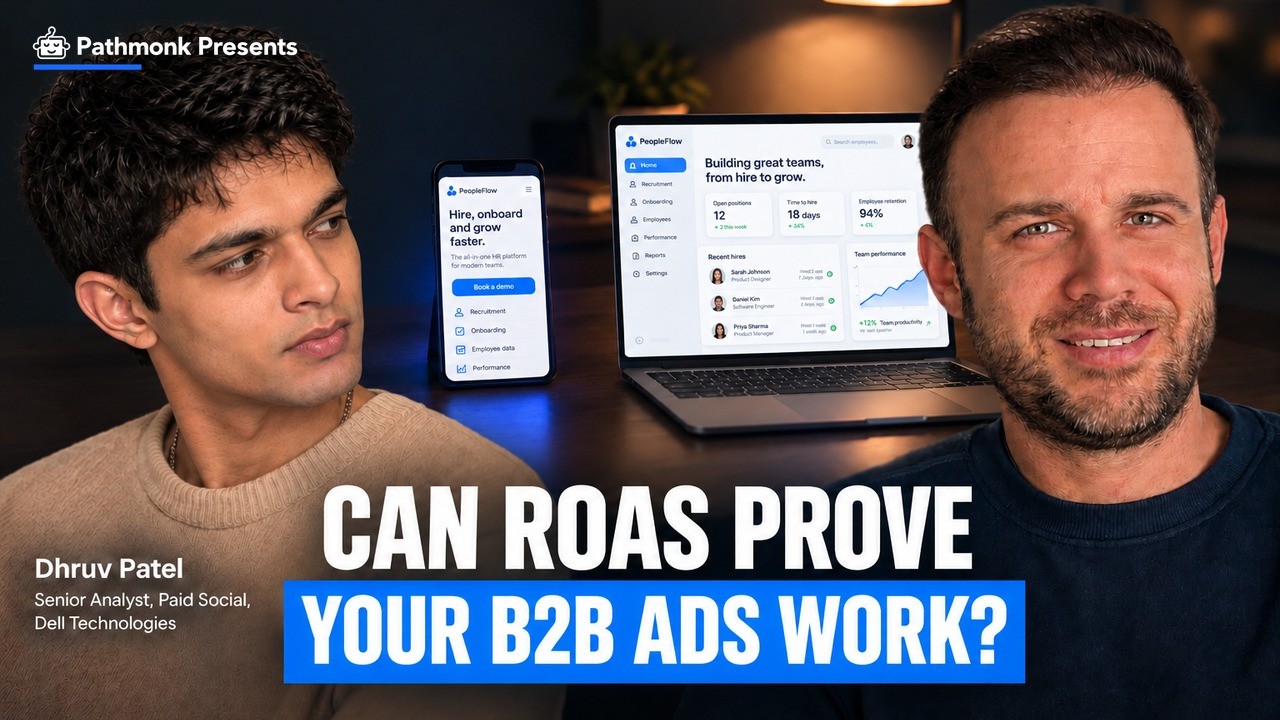
“If you are a medium-sized company or small-sized company, I think absurdity is your best tool right now.”
at
- Company
- Dell Technologies
- Role
- Senior Analyst on the paid social team
- Focus
- B2B paid social, mostly LinkedIn and Reddit
- Background
- Computer science bachelor's, management master's at Cornell
- Path
- Freelancing, Marriott Vacations, a healthcare startup, then Dell
Too long, didn’t listen?
Adrián García Ramos talks with Dhruv Patel, Senior Analyst on the paid social team at Dell Technologies, where he runs B2B ads mostly on LinkedIn and Reddit. Dhruv explains why large companies start from brand awareness and then measure returns with marketing mix modeling and correlation analysis instead of simple ROAS, and how four years of freelancing, not formal study, taught him paid ads.
On creative, he sees trend-based content and absurdity dominating right now, though Dell's positioning calls for value-driven content and AI with strong human involvement. His answer to the race to keep up with AI: an outcome-based approach that starts from the goal, not the latest launch.
Lead with brand awareness at scale
Large companies need to be present across almost all their products. Stay visible first, then build frameworks to check whether the spend is generating enough returns.
Measure beyond simple ROAS
Use marketing mix modeling to see what paid social contributes to the whole funnel, and correlate engagement and CPM with revenue. Revisit the metrics whenever the goal of the ads changes.
Match creative to your positioning
Trend-based content works because the format is already proven. Absurdity suits small, mid-sized or quirky consumer brands, while technology brands get more from value-driven content.
Start from the outcome, not the launch
Don't chase every new model or source. Define the outcome you want, work backwards to the information you need, and surround yourself with smart people.
Some brilliant ideas
“There's one main rule: if you are a large corporation, you need to focus on brand awareness, because there are so many brands out there, and attention span of every person is going down.”
Be a polymath. The pace at which we are evolving, one field is not gonna help you.
Don't try to pick everything that gets launched. Instead, what's the outcome that you want to achieve?
Full transcript
Introduction
[0:00:14] ADRIAN GARCIA RAMOS: So, welcome to Pathmonk Presents, where we talk with growth and marketing leaders. About what's actually working right now. I'm Adrian, your host, and today I'm joined by Dhruv Patel. Senior Analyst at Paid Social Team in Dell Technologies. Welcome to the show, Dhruv.
[0:00:36] DHRUV PATEL: Thank you so much, Adrienne. Yeah, glad to be here, and thanks for this opportunity. I'm definitely looking forward to this.
From freelancing to Dell
[0:00:43] ADRIAN GARCIA RAMOS: Great to have you on, absolutely. So… Dhruv, I just wanted to ask you about, you know, a short introduction about yourself and… the things that you're doing in Dell. Yeah.
[0:00:56] DHRUV PATEL: Sounds good. So I'll start, with, like, I'll give a quick summary of how my journey looked like. Till high school, it was, like, a normal student as other people. after high school, I realized that, okay, scores is not something… so I have been someone who loves exams in my childhood, but then I realized scores are not something that interests me, so I started freelancing, and I did freelancing for 4 years. This was… before I started my bachelor's, but during my bachelor's as well. So, that was the period that's the most important phase of my life, or the most transformative phase that I considered. That phase allowed me to, like, grow, and then
later I realized that I wanna… Study abroad, and then, like, get more exposure, or learn about global companies and not just focus on something local. So that's when I applied to U.S. universities and got into Cornell. I graduated. After graduating, I interned at Marriott Vacations. I was on the product management team. After that, I worked at a startup. It was a healthcare startup when I was leading the growth marketing team.
What paid social really means
[0:02:05] DHRUV PATEL: And then now I'm at Dell, I'm on the paid social side, so basically LinkedIn, or LinkedInX, Meta, TikTok, and Reddit ads. So yeah, we run end-to-end ads.
[0:02:16] ADRIAN GARCIA RAMOS: Amazing. So, yeah, I'm wondering about this, kind of a paid social, right? So, for me, when we put those two words together, it sounds like, influencers, something like that. But might not be the case, so I just wanted to You know, have an explanation from you in terms of, like, what paid social means.
[0:02:38] DHRUV PATEL: This is confusing, and this was confusing to me as well, because I come from a freelancing side, but the scale is not big. So, we call it digi… in digital marketing, we have paid media marketing. Paid media is basically anything, like, any ads that we run anywhere. So that's paid media. But Dell is so large that they have broken paid media into different vehicles. So, there's, yeah, CTV and LTV are a different team that there's search, that's a different team. So there's paid search, which is, like, Google Ads and all, and then there's paid social, which is, like, all the social media platforms and the ads that are run on that platform, so…
[0:03:15] ADRIAN GARCIA RAMOS: Okay.
[0:03:15] DHRUV PATEL: the definition of paid social, but I would simplify it to say paid media.
[0:03:20] ADRIAN GARCIA RAMOS: Okay, so at the end of the day, you'd be running, like, a PPC, right? A pay-per-click, advertisement? Exactly. In social networks, such as, you know, Facebook?
[0:03:32] DHRUV PATEL: In meta, yeah.
[0:03:33] ADRIAN GARCIA RAMOS: in… Okay, and yeah, that's interesting. Are you handling a bunch of them, or are you focused in a particular one? How is that working?
[0:03:44] DHRUV PATEL: I am focusing on the B2B side more, so it's mostly LinkedIn and Reddit. Also, we do it on other platforms, but I think we are heavy on that, so yeah.
[0:03:55] ADRIAN GARCIA RAMOS: Right. Right. That's my fault.
[0:03:57] DHRUV PATEL: Peace.
[0:03:58] ADRIAN GARCIA RAMOS: Yeah, I guess, you know, everybody, knows Dell. It's such a big company, but I wonder how, does the image or the concept that we have from Dell distills into the paid social, right? In the end. that is connected to the ads that you are creating, and, you know, the ethos of the company that you are portraying to, you know, the people on the social networks. Can you tell us a bit on the… on those connections, like, are you just running ads for computers, or it's more about services? What kind of things do you, you know, convey in your ads?
[0:04:43] DHRUV PATEL: So, first of all, I would say this, like, if you are a large company, if you are at a scale where Dell is right now, you need to be out there, and you need to spend dollars on almost all of your products, so it's not always like, okay, this is our focus, and this is the only thing that we are gonna run paid ads on. That's not possible when you are at this scale, because you need to be out there, you need to have your word amongst people, like, people need to recognize your brand. So it's like, almost on all products, you're gonna spend your dollar. The strategy might differ. at this strategy, like, if you wanna get… I'll answer it for Dell, but in general, it's like.
look what's driving the most profit for that particular company, and that will answer your question, like, what are they most spending on, or where are they trying to push their dollars on? So, Dell is currently leading this AI revolution that we are seeing, right? So, Dell is very big on that, like, Dell… as Dell we are, like, at the frontier of it. If you follow Michael Dell, you might be seeing numbers for the AI infrastructure things that's been going on at Dell.
[0:05:50] ADRIAN GARCIA RAMOS: Right.
[0:05:51] DHRUV PATEL: That's how I would like to… answer it for Dell, and I would also say that this is the same thing for almost all companies. Wherever, like, look at the shift that they are moving towards, and that's where they are gonna focus on for paydays.
Brand first, then measure the returns
[0:06:06] ADRIAN GARCIA RAMOS: Yeah, that makes me, wonder about the branding, the differentiation between branding and performance, right? So… When you are working in a small company, you are rather focused on performance for a particular product and service, and you need to return on the investment that, you know, you are spending for that particular ad. But things might change when it comes to corporate, right? Because you have different goals. So, when it comes to strategizing the whole You know, paid social budget. Do you guys have, like, a different buckets? Like, okay, this is going to be full performance, or this is going to be full branding, or we are going to do a blend? How does it work?
[0:06:50] DHRUV PATEL: Yeah, okay, that's a very good question, and I think this is something that most companies struggle with, like, I have… almost all the big companies that I have worked with, they struggle with this, because when you are at a small company, it's very easy. You're spending this much, you need… you're basically focusing on ROAS, like, what's the return on ad spend we are getting for the dollars that we are spending. But when the company is big, you can't do that, especially on the B2B side, it gets even more complicated, because you don't see immediate value for the dollars that you are spending. Like, people might see your ad and then convert from a different channel. So, the question becomes complicated, but it's like.
There's a one… one main rule, that if you are a large corporation, you need to focus on brand awareness, because Right now, keeping up with, like, there are so many brands out there, and attention span of every person is going down. So, you need to be out there. Now, if you're focusing on them, that's the first rule that you start with. On top of it, I think the companies move it… move backwards. Like, they want to stay out there, and then they start building frameworks to calculate if the dollars that they are spending on, is it, like, are they generating enough returns? And for this, it's like, there are different metrics that you can focus on, but it's also more like.
what… what is exactly the outcome of your ads? And it's not… like, there's not a… not a one particular answer, one generic answer to this, because let… let me give you an example. For now, we are, like, seeing that we are… if we are running ads, maybe our Dell computers are selling, like. quickly, and that's helping with our Dell computer sell. Now, let's say tomorrow, if it changes to more, like, giving out our name on the B2B side. we might not be able to follow the same framework that we are following, or we might not be able to look at the same metrics that we are looking at. So it's a continuous evaluation, but you can…
There are a bunch of different ways. First thing, you would look at multimedia multi-mix modeling, MMM. So, by MMM, you can contribute how much paid social is contributing in your whole funnel. That's one thing. On top of it, you can run correlation metrics. So, basically, correlation means if your engagement rate, or if your CPM goes down, if your engagement rate goes up. is that correlating to Dell's overall revenue or something? So those… these are some ways Companies figure out if paid ads are working or not, but it keeps evolving based on where you are spending the dollar.
[0:09:26] ADRIAN GARCIA RAMOS: Yeah. Yeah, it's a complex topic, right? I guess that, you know, for people running, kind of, e-commerces or, you know, something that has a purchase pixel, at the end, it's pretty easy to understand whether or not the ads are working. But when you get in such a large, You know, environment with different, kind of,
Learning by doing and the polymath approach
[0:09:50] ADRIAN GARCIA RAMOS: by using statistics running behind the engagement data and such, it's more complicated. Actually, I wonder if… you studied these things, in your prior education, right? Because those are the things that, I guess, are not taught before. Like, many people are learning about marketing, but they don't really know about those things until they get into the beast, right, in… to the mouth of hell.
[0:10:21] DHRUV PATEL: This is gonna be a… like, this is the su… this is a very interesting question, because… my education was nothing related to marketing. My bachelor's was in computer science engineering, my master's was in management. Whatever I just said, or most of what I do, is not that I have studied formally. So, this background, or this thing, comes from the freelancing part that I had mentioned, because as I mentioned, it was the most transformative year. So, it's like… that's something that I pursued on my own, and I was marketing for clients on my own, and in that whole process, I learned about social media marketing, and in that process, I learned how to run paid ads. So it was like, I learned it by trying, I was like.
there was no formal education, I was just doing the things, and if you keep at it for 4 years, you learn it in a… this is just my, philosophy, that If you are learning it practically, it's much better than starting with a theoretical education, or focusing, or dedicating a few years on just theoretical education. And also, like, one key takeaway that I would say from this answer is that it really helps when you try to optimize for your time. Like, let's say you are in your bachelor's, there's always more things you can learn outside of what's being taught, and if you pursue them, and if you do it practically, that teaches you all, that makes you learn about, like, that makes you learn it in a very deeper way. So that's the answer to your question, like.
since I was doing it, I would find out, oh, this is a new problem, or this is a new thing, like, how do I go about it? And once you have developed that framework, like, you start solving those kind of problems, it… It kind of puts you in a position where you are able to deal with Anomalies or gray areas as well.
[0:12:08] ADRIAN GARCIA RAMOS: Right. I'm wondering here about your, again, like, your education, because I believe that you had some, technical or science education, right? And at the end of the day, you were handling complex marketing mix modeling for, you know, the work that you are carrying out at Dell. And it is my belief that having a, you know, strong technical knowledge or, you know, science-based approach to problems That could help… help you at a time that maybe, you know, more, let's say, qualitative marketing profiles good and move the needle for you and your team. Is that the case?
[0:12:54] DHRUV PATEL: Yes, that's definitely true. Like, being tech proficient definitely helps you on the marketing side. It's like… in my case, it was… I was studying tech, and then on top of it, I did marketing in my… as my practical experience. Let's say a person who is studying marketing can do the other thing, it's like, they are studying marketing, and then they can focus on learning tech, or practically doing technical stuff. You can now vibe code, or… there are so many things that you can do to learn, or get the fundamentals. write for yourself. Do that on the side. So it's like… B… I'll say this, be a polymath, like, have a polymath approach, and don't be focused on that, this is my career, or this is my field. The pace at which we are evolving, one field is not gonna help you. So…
Yeah, I would definitely say that tech definitely helps in the marketing field, and if you are in tech field, there are other fields that are gonna help you, so it goes both ways. It's not, yeah, just that tech is superior to marketing.
Trend-based content and absurdity
[0:13:59] ADRIAN GARCIA RAMOS: You know, one of my favorite subjects in the uni was statistics, and it's something that we apply every day in marketing. You know, they go hand in hand, for sure.
[0:14:11] DHRUV PATEL: Exactly.
[0:14:12] ADRIAN GARCIA RAMOS: I wanted to ask you about the trends, right? The marking trends that you see these days with all the changes that we have seen over the last years, increasing, you know, PPC costs and, you know, a lot of evolution in terms of… like, you know, the new formats and such in paid social. What can you tell us about that?
[0:14:40] DHRUV PATEL: Okay, I'll answer it in a generic way. I'll answer it in a way that applies to all industries and all people that are running ads. This is, like, from my, experience throughout. The first trend that I would, like, say… let me, set the, Base for now. Our attention span is going low, and everyone is fighting for attention, like, people are scrolling, like. if you can't get their attention in the first 3 seconds, it's done. Like, yeah, people will scroll past. And it's like, it could be any platform. You need to… have your content in a way that it catches the attention. Now, how do you do this? So, there are different trends, on social… since I'm on social media side, there's one thing which is
picking up on trends. So, people… any… if anything is trending, then that's a proof, or there's data attached to it that it works. People are liking this format. So, let's say there's a trend going on. If you can replicate it into your content, or if you can Advertise your product in that particular format or that particular concept.
[0:15:45] ADRIAN GARCIA RAMOS: it becomes…
[0:15:46] DHRUV PATEL: much more rewarding, because people are familiar with that trend, and since it's more likely that people are gonna, like, it's gonna catch people's attention, it works out. So that's… one thing is trend-based content is going up a lot. Then there's the second thing, which is absurdity. This might sound weird or fun… funny, and also it becomes very hard for large companies to adopt this or play around this in a safer way, but if you are a medium-sized company or small-sized company, I think absurdity is your best tool right now. Things that don't make sense at all. Like, if you are seeing an ad, or if you are seeing a content that doesn't make sense at all, it's, like, very weird.
[0:16:27] ADRIAN GARCIA RAMOS: Right.
[0:16:28] DHRUV PATEL: This is a very dominant trend right now, and there are… yeah, I don't want to name companies, but there are some companies who are at a large scale, and yet, because they are not in a tech side, or their whole product is very fun or different, they can do such things. So if your product is somewhat, like, that allows you to be quirky, definitely go for absurdity trend. So these are the two top ones that I don't want to give a long list, I will focus on these two, because these two are the dominant ones right now.
[0:16:58] ADRIAN GARCIA RAMOS: Right, right. So, I have two follow-up questions. The first one is how you handle absurdity within Dell, which I guess is such a challenge. You explain all that, and. And the other one is about AI, but let's focus on that one first.
[0:17:15] DHRUV PATEL: So, at Dell, I was… I answered this in my previous, explanation as well. At Dell, it becomes hard because Dell's positioning is not quirkiness. Like, Dell itself is a… brand that people look up to, and it's… it's in the technology domain, so you can't be very quirky. So that's a… That's more like… it depends on the positioning, what suits you. You can't change how you position yourself. So, for Dell, it will be value-driven concepts, or those kind of things make more sense.
[0:17:47] ADRIAN GARCIA RAMOS: of that.
[0:17:48] DHRUV PATEL: If you are… Teaching other people, or if you are delivering value, or if you are providing meaningful content, that helps a lot, and that's the right way to go about it. the quirky or the absurdity thing that applies very well if you are a small company, or if you are a large one, but on a quirky side. Like, let's say there are different… like, there are many products. Also, consumer products would be one thing. I would say things that we use in our day-to-day life, maybe consider a shampoo or things like those. So, those kind of things, yeah, you can go absurd, but not in a technology domain. I think positioning also matters a lot.
[0:18:25] ADRIAN GARCIA RAMOS: Okay, I have to stop it, because I'm recording your call, it's no problem, like, just…
[0:18:30] DHRUV PATEL: Take a good day.
[0:18:31] ADRIAN GARCIA RAMOS: Damn. See? a cada. Okay, okay, ciao, te paso numero, cacha. Sorry about my wife, it's just, with one thing, I need to send her, Oh, good. A number, just a sec. Okay, here… Aw, man. Okay, sorry for that. All good. Yeah, so, I just wanted to ask you, like, you know, to spice it up, if you cannot reply, don't reply, but… have you had any kind of a problem within Dell in terms of, like, you know, crossing some lines in terms of, like, creating, So crazy ad, or maybe, you know, being so absurd in a way. You know, when crafting their credivities and such.
[0:19:43] DHRUV PATEL: So, the thing is, I am on the paid social execution side, so we run the ads, we don't… like, my job is not making content or looking at, so I'm in clear, and I'm safe there. However, I would say. this is, like, from a very genuine and good perspective. I would… this is also an insight that I would pass on to the viewers or listeners. If you are at a large scale, and if you have organized your team in a very good way, like, you have structured workflow, it helps a lot, and it avoids getting such… getting into such problems, because if you have it very structured, and you think through it in a very good way, you are taking feedback from the team, and you know, like, you are flexible to changing it. The leadership team is flexible of making different rules, or changing how they do things.
In that case, you are very likely to face such problems. There would be complicated projects, like, once in a while, that definitely occurs, but on the absurdity front, we have not had that, so that's one good thing, and the whole credit goes to how well it's organized.
AI content with humans in the loop
[0:20:51] ADRIAN GARCIA RAMOS: Fair enough, fair enough. Okay, so the follow-up question is about, like, you're talking about content, you mentioned that you were not taking care of creating that content, but you are in the team who's, in a way, running the whole process, so at the end of the day, it's going to be you handling, you know, different pieces and seeing what of those are going to work better, and such. So, my question is, like, what's happening with the content, and especially the AI-generated content? How do you see… The industry now, and how do you see it in the future?
[0:21:27] DHRUV PATEL: First thing, this is me, being disappointed a few years ago, a few years ago, I had this insight that many large corporations are not adopting AI at the pace they should. Like. it's… they were very cautious, and they were like, oh, we have protocols, oh, we have guidelines, we have this AI privacy team, and they won't allow it, this, that, etc. The good thing is, when you are in a company who is leading the AI wave, it changes, you get to see the other side. So, yes, I'm getting to see the application of AI in a much better way. However, I would say this, like, when you're using AI in a large corporation, especially for content, there's always human involvement, and
A very dominant side of human is involved into it, because you need to take care of the branding, like, there are so many formal aspects of it. At a large scale, it's not easy, like, you can't put out any content. Let's say if I generate an image, and then if I put it out, if I'm at a startup, it's very easy, it's okay. The founder might not have an issue. But if you're at Dell, there are certain guidelines, there are brand guidelines, and there's a different bunch of protocols that they go through. So, in all of that, it's like, you integrate AI tools into your workflow, and that's usually the case right now for most companies. It's like.
You get access to these tools, and then you can leverage them, but it's always gonna be on humans how, like, the whole content strategy, and what type of content comes out, and the whole validation process.
Full-funnel spend and landing pages
[0:23:03] ADRIAN GARCIA RAMOS: Okay, okay. I wonder about the… You know, the follow-up that you have with all these I don't know, thousands and, you know, hundreds of thousands of dollars that you spend in paid, Adele, what happens afterwards, right? So, you usually get the… the people engaged to a website, or is maybe a WhatsApp, or… What is the destination pages that you use in your ads? And, yeah.
[0:23:41] DHRUV PATEL: Now, yeah, this is another good question, like, this is an actually good question. Let me answer it in two ways. I'll also answer it in a normal, like, normal-sized company format. It's like, when you are a startup or a mid-sized company, you have a clear goal, you know what you want to do, like, it's… you don't have… You're not spending enough to cover everything, so it's like, let's say you are a startup, and you are… your strategy is to maybe convert users, or something like that. You're focusing on that, so it's… comparatively simpler. When you are at a large scale, your strategy is, like, you need to focus on everything. The ratio differs, like, how much budget you allocate to what differs, but it's almost like you need to focus on brand awareness, which is
the top of funnel, think of it like, okay, people are engaged… the content is basically to stay on top of a person's head, then there's engagement funnel layer as well, where it's like, you are… focusing on people to get engaged to your content, then there's conversion funnel. So there are campaigns, and you spend dollars on all three funnel layers. This focus where you, like, where you want to spend more changes every time, or depends on the period itself. But to answer your question, it's more like it's a funnel-based approach, and not one size, or one answer to this, yeah.
[0:25:06] ADRIAN GARCIA RAMOS: So, I wonder that, given that you have this funnel approach, you need also to catch up or structure your website design according to that funnel, right? So, like, you're going to have different let's say, stages in the website itself. So, how does it work within Dell? Like, you guys design that along with the team taking care of the website development? How do you combine those… those initiatives?
[0:25:38] DHRUV PATEL: So, this question does apply for most cases, but when you are at a large scale, your teams are divided. So, it's like, there's a completely different team that will take care of websites, or the tracking links, or where do we want to lead the users to. So, it doesn't fall on the media execution team themselves. It's like.
[0:26:00] ADRIAN GARCIA RAMOS: Right.
[0:26:00] DHRUV PATEL: all these, like, okay, where do you wanna, make the users go, or what's the page that we… where you wanna drive traffic? All that is sorted by the team that's… taking care of this, but when you are not having different teams, yes, it's very common to have, like, the paid media team taking care of this. In most cases, in my past experiences, I've observed that it's like, you have a product team, and then you have media execution team. Media execution team will Feed in this strategy that we might need such a base, or we might need this positioning, but then the product team will own the final output, like, they will decide what goes in there and what
Like, shows on the webpage, yeah.
Keeping up with the AI wave
[0:26:46] ADRIAN GARCIA RAMOS: Interesting. Okay, so… you know, we're getting to the end of our interview, so I wanted to follow up with a couple of questions. The first one relates to… What is the largest problem, right, that you face If not every day, most of the days. That you would like to get rid of. You know, in your, kind of, operation. Huh.
[0:27:16] DHRUV PATEL: first of all, if it's the biggest problem, I would not say I want to get free from it, because I am a person who gets excited by it, so the answer to this question is in a way that this problem is something that I don't want to get freed from, but actually ace it. And the problem right now is, with this whole AI wave, how do you keep up? Like, there's so much going on, and then… if… Let's say you are focusing on optimizing everything, and you are trying to optimize everything, yet… there might be something that you might miss, and that might give you a big disadvantage. So there's this constant pressure, or this constant problem that, okay, how do you exactly keep up, and how do you dominate it? And it's a race. The race itself is a problem, and I think…
that's an exciting thing, or exciting challenge to have, not something that I want to be freed from. And also, the solution to this is having smart people around you choose the right environment, and If you have right people around you, they are gonna motivate you, or you're gonna get into conversations that will spark different things, and that's how you stay tired of the curve, yeah.
[0:28:30] ADRIAN GARCIA RAMOS: So, I wonder that that's kind of an anxiety, in terms of if there are so many things happening, and I'm just grabbing a fraction of them. what is actually what I'm missing? It's probably much of the things that I'm just getting, right? So, it's like…
[0:28:47] DHRUV PATEL: Yeah, it's an anxiety thing, and… I come from a product management background as well, so usually the answer is, like, prioritize the things that you need to do, and go for the one that makes the most sense. But in right now… right now days, we do… those things are not explored, like, we don't know what's most impactful and what's least impactful. Like, things are coming up, it might be a big thing, it might be a small thing. Like, how do you go for it? So yeah, it's an anxiety thing, but you need to work around it.
Start from the outcome, not the source
[0:29:16] ADRIAN GARCIA RAMOS: Okay, good. You know, to be fair, the follow-up question and the last question is probably related to that one. And that is about, separating the noise, from the signal. Right? Obviously not the noise. So, if you were to recommend a single source of information, you know, to our audience, or a friend, or a family. In terms of business, right, and what you do? What that would be.
[0:29:52] DHRUV PATEL: Okay, so there were two parts to this answer. I think the main question I see is, like, how do you separate yourself from the noise? And the biggest insight for, like, the thing that has worked for me is, like, I believe in outcome-based approach. Don't try to learn, or don't try to pick everything that gets launched. Let's say, if OpenAI launched Astra model, don't go for it. Instead, what's the outcome that you want to achieve? Like, if you are trying to boost your ROAS, or if you're working on your startup, or there's some other thing, you should know what's your outcome, and then for that outcome.
do everything that's needed. So, don't go by, okay, psychology is an interesting subject, or in marketing, I need to understand consumer behavior. Don't go looking for different things and then find out, is it important, is it not? Instead, keep a clear outcome, and then do whatever is necessary Now, to answer the other part of the question, like, what's the source of information? I think one source can never help you in this approach. If you are working your way backwards, it's like you figure out, where will I find this information? This is my outcome, and then all… this is all that I need to do, where will I find the best information for that particular thing? So that… that approach helps you.
[0:31:08] ADRIAN GARCIA RAMOS: So, you know, to put it another way, it'd be something, instead of focusing on the sources, Focus. On the right questions. Right? Exactly. And so, once you have a question, I have a goal! Go for it.
[0:31:25] DHRUV PATEL: Exactly, yeah. That's a very simple and good way to put it.
[0:31:30] ADRIAN GARCIA RAMOS: Yeah, amazing. Okay, so, Dhruv, thanks so much for coming on. I would like to, you know, allow you to, to… share your socials, or, you know, if the people in the audience is interested about what you do and your work, and they would like to reach you out, how they might, you know, get in contact with you and your company as well, if you want to, in a way, promote it.
[0:31:57] DHRUV PATEL: Yeah, so I work at Dell, we had a fair amount of discussion on that, and for my LinkedIn and Instagram, I'm happy to share the link, or if you want the username, it's… If you search Dhruv Patel maybe Dell, or Dhruv Patel Cornell, you might find up, because I keep my LinkedIn updated in a way that it comes up on SEO. So, that's my LinkedIn, and for Instagram, it's P underscore Dhru, but the spelling of Dhru is D-H-R-O-O-V, and I think I'll share the link as well. Yeah, so Instagram and LinkedIn is something where I'm usually most active.
[0:32:32] ADRIAN GARCIA RAMOS: Perfect. So, thank you very much, Dhruv. It's been a pleasure to have you. Tell us in touch, okay?
Got a growth story worth sharing? Tell it on the show.
We talk with founders and marketing leaders about what actually moves their pipeline. If you’ve built something other marketers can learn from, we’d like to hear it.
- 01Apply
Tell us who you are and the story you’d bring to the show.
- 02We get in touch
We review every application and reach out if it’s a fit.
- 03Record your episode
A remote conversation, published as video, audio and a full transcript.