Your ICP is a group of people, not one industry
Struggling with a multi-industry ICP? Melissa Kwan of eWebinar shares how AI tagging of 7,000 companies found hers and how Claude rebuilt her positioning.

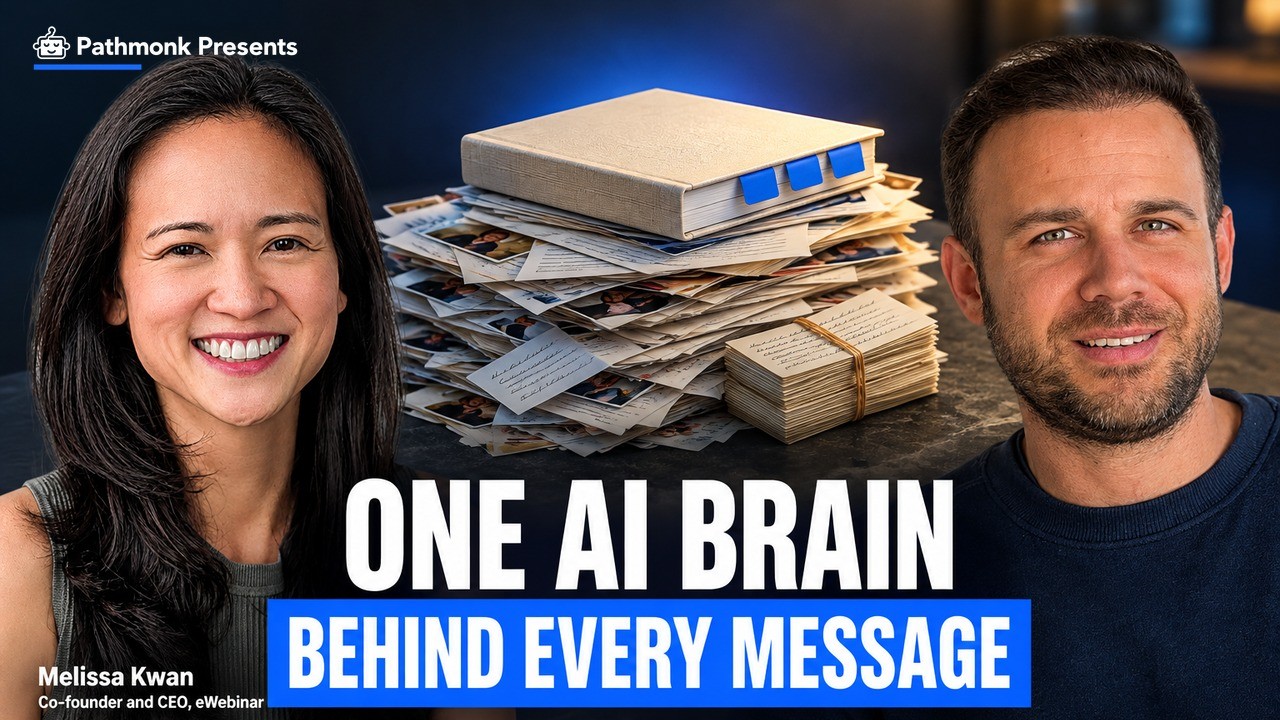
“I started off thinking that an ICP had to be one industry. But our ICP is many industries, but it's role-specific.”
at
- Company
- eWebinar, on-demand video software with chat
- Speciality
- Automated demos, onboarding and training that still feel personal
- Works with
- Sales, marketing and customer success teams training people who don't work 9 to 5
- Deliverable
- Interactive videos with polls, questions, quizzes and live or email chat
- Growth engine
- LinkedIn, Substack and SEO, with Reddit and cold outreach next
Rapid fire
- One source of information
- Her AI, cross-checked with Google and another human
Too long, didn’t listen?
Melissa Kwan, co-founder and CEO of eWebinar, joins Adrián García Ramos to explain how on-demand video with chat lets companies automate demos, onboarding and training without losing the human touch. Her customers train real estate agents, insurance agents, doctors and nurses, people who don't work 9 to 5, and eWebinar averages 83% attendance versus 30 to 40% for live events.
She shares why her multi-industry ICP is defined by role, not industry, and how a detailed AI prompt tagged over 7,000 companies to find it. She also walks through a repositioning project built as a company brain in Claude, which now powers the website, demo, emails and social content.
Define your ICP by role, not industry
If your product spans many industries, look for the job your best customers share. For eWebinar, that is people who deliver information to independent contractors.
Let AI tag your customer base
Self-reported industry fields are unreliable because people pick the first option. A detailed prompt that tags every company the way you would lets you see which industries really lead.
Sell the pain before the product
In a blue ocean category, buyers don't know they have the problem. Show them their life today and how it can be better before you pitch features.
Build one brain for every message
Feed customer stories, testimonials, objections and your sales philosophy into one AI project. Use summaries of it to keep the website, demo, emails and social content aligned.
Some brilliant ideas
“When I first started this 5 months ago, I was like, oh, I just gotta change the homepage a little bit. And I realized then that a repositioning project is actually pulling a piece of yarn on a sweater, and before you know it, the entire sweater is just on the ground.”
SEO, we've invested in heavily over the last few years. It is not working nearly as it used to. I think everyone's also struggling in that department.
I realized that our company is a blue ocean company. We're not educating them on the pain that they don't know they have.
Full transcript
[0:00:13] ADRIAN GARCIA RAMOS: Fantastic. So, welcome to Backbone Presents, where we talk with growth and marketing leaders about what's actually working right now. I'm Adrian, your host. And today, I'm joined by Melissa Kwan, co-founder and CEO of Webinar, eWebinar. Good to have you, Melissa, how's it going?
[0:00:33] MELISSA KWAN: It's going well, thanks for having me.
Automation that feels personal
[0:00:36] ADRIAN GARCIA RAMOS: Amazing. So… Melissa, first of all, what is what you do? What is your company about?
[0:00:43] MELISSA KWAN: Yeah, so eWebinar is an on-demand video software with chat. So we help companies automate demos, onboarding, training, with a video, without losing the human touch. So, it's, automation that feels personal.
[0:01:01] ADRIAN GARCIA RAMOS: Okay, so at the end of the day, are they, like, real persons, you know, recording these videos, or it's just, kind of AI running them? How does it work?
[0:01:11] MELISSA KWAN: Well, AI is not good enough. To generate a full-length video right now, at least not… not this year, 2026. But, well, I mean, how it works is people record, like, say, a demo, or an onboarding demo, whatever you call it, onboarding session. You upload it into eWebinar, we make it interactive, we layer in, like, polls, questions, quizzes, and then there is a chat where you can respond live, or you can respond later through email. So it's just like a support chat.
[0:01:40] ADRIAN GARCIA RAMOS: Huh. That's interesting, because you said that this is used for kind of a customer support, onboarding, maybe short sales, but have you considered Including it in, kind of, e-commerce sites and things like that, or…
[0:01:54] MELISSA KWAN: We do actually have, because it's self-serve, there's a lot of different you know, companies that come and sign up. We do have a lot of consumer products, actually, so, like, things that require more explaining. So, like, peptides or vitamins, you know, but it's sales, right? Like, the role is… I mean, the goal is to sell something, so I think whether you're selling software or, you know, vitamins, it's kind of the same thing. Yeah, it's just a delivery method.
[0:02:21] ADRIAN GARCIA RAMOS: I'm sorry. Boom! Something went wrong. Okay, I'm feeling better now.
Serving people who don't work 9 to 5
[0:02:30] ADRIAN GARCIA RAMOS: This is the part that we edit, okay?
[0:02:31] MELISSA KWAN: Yeah.
[0:02:34] ADRIAN GARCIA RAMOS: Yeah, I'm just wondering about the people that you serve, right? So, you were mentioning, maybe a B2B SaaS, right, with the onboarding, an e-commerce site, it could be, you know, a service business. So, what it is?
[0:02:50] MELISSA KWAN: I… I hate to say this, because it sounds like we have no focus, but it's all of those. And that's the thing, right? Because it's, we have… our ICP is really sales and marketing and customer success, right? So we do have… I would say, like, 50% of our customers are in software.
[0:03:09] ADRIAN GARCIA RAMOS: Yep.
[0:03:10] MELISSA KWAN: But, like you mentioned, you know, there's… there's consumer product, there's professional services, there's health, like, there's, like, health tech. But mainly I'll say that The biggest use of our software are people who use it to deliver information to people who do not work 9 to 5.
[0:03:28] ADRIAN GARCIA RAMOS: Okay.
[0:03:29] MELISSA KWAN: So, where our software really shines is for people who are training real estate agents, insurance agents, doctors, nurses, people who work for themselves.
[0:03:40] ADRIAN GARCIA RAMOS: Right. Right.
[0:03:41] MELISSA KWAN: Or, like, consumers, right? Because maybe they're at work, right, 9 to 5. So, when you aren't required To go to our training, or sit through a demo between 9 to 5, how are you going to make people show up? You can't.
[0:03:55] ADRIAN GARCIA RAMOS: Okay.
[0:03:56] MELISSA KWAN: Right, so that's where, kind of, the on-demand piece really comes in, and so just to give you an example, like, the average attendance rate for a live event might be, like, 30 to 40%, but the average attendance rate on eWebinar is 83.
[0:04:10] ADRIAN GARCIA RAMOS: Okay, hmm. Yeah, at the end of the day, you are buying people's time, in a way, you know?
[0:04:15] MELISSA KWAN: Yeah.
[0:04:16] ADRIAN GARCIA RAMOS: the video. I don't know if you have any numbers in terms of, like, the length of the videos that are uploaded in your platform. Are they kind of a, you know, short videos under a minute, or are they, like, a long format, maybe 20 minutes, something like that?
[0:04:30] MELISSA KWAN: Yeah, so short-form video doesn't really work for us, like, short-form video is like a story, right? Or like a YouTube thing, right? But ours is really kind of… mid to long. I'll say, like, the shortest is probably, like, a 5-minute. 5-minute demo, because if it's so short, then it should be delivered through another medium. Because where we really shine is where we make the video interactive.
[0:04:56] ADRIAN GARCIA RAMOS: Okay.
[0:04:57] MELISSA KWAN: We asked you a question, like, where did you hear about Pathmonk? You know, what are you using today? Who refers you to us? So as you're watching, you're actually collecting insights.
[0:05:06] ADRIAN GARCIA RAMOS: Absolutely.
[0:05:07] MELISSA KWAN: from this person, and then you can pass those into your CRM or marketing automation to trigger different things. But it's also, because of the chat, it feels personal.
[0:05:17] ADRIAN GARCIA RAMOS: Trump.
[0:05:17] MELISSA KWAN: Even if it's automated. So I could be sitting at dinner. and someone's in my demo, and I can sit there and answer them.
[0:05:25] ADRIAN GARCIA RAMOS: Right.
[0:05:26] MELISSA KWAN: You know, and they'll feel… they'll feel, like, taken care of.
[0:05:29] ADRIAN GARCIA RAMOS: 100%.
How interactivity keeps viewers to the end
[0:05:30] ADRIAN GARCIA RAMOS: Actually, explain to us, like, how does it work, interactivity, right? Because, you mentioned before that that's a key.
[0:05:38] MELISSA KWAN: Yeah.
[0:05:39] ADRIAN GARCIA RAMOS: But is it the end customer working on that, or you have kind of a service package in which an expert is going to deploy it for them? How does that work?
[0:05:50] MELISSA KWAN: Our expert is the AI we now have. Okay. Yeah, so, I mean, it didn't start that way, because we're, you know, we're 6 years old.
[0:05:58] ADRIAN GARCIA RAMOS: Right.
[0:05:59] MELISSA KWAN: But the experience is quite simple. You know, you upload a video, you're brought to a screen where you can play the video, and then you can hit, like. it's almost like video editor, where, like, at a certain point, say, at minute one, I want to add a question. At minute two, I want to add a poll, and then I want to add a quiz, and I can make those conditional if I want.
[0:06:18] ADRIAN GARCIA RAMOS: Yep.
[0:06:19] MELISSA KWAN: Right?
[0:06:19] ADRIAN GARCIA RAMOS: Yeah, absolutely, but what I'm asking you is, do you have any kind of a know-how repository of things that work, or, you know, practice cases, so that people can have a reference? Oh, that's a way of doing it, right? Or…
[0:06:32] MELISSA KWAN: You know, it's… it's content, so it's pretty dynamic. Right. There is… I wish there was, like, if you do it this way, then it's more effective, but what we tell people is, like, you should have something every 2-3 minutes.
[0:06:44] ADRIAN GARCIA RAMOS: Yeah.
[0:06:44] MELISSA KWAN: Because actually, the byproduct, like, you as the host, you are collecting information and insight and signals from the person watching. But the person watching, they're being entertained by those things. So it keeps them until the end.
[0:07:00] ADRIAN GARCIA RAMOS: Sure.
[0:07:01] MELISSA KWAN: Right? Like, a lot of times we're watching some webinar, some live event, and it's kind of boring, we're on our phone. Right? Everyone's done that. But when you have something where you can participate, and actually, this is the thing that also makes it feel personal, and that it's for me, is I'm also doing something. While I'm watching this thing. Yeah, exactly. So our completion rate is actually quite high because of that. So we don't have best practices as to, like, oh, you should do this here, you should do this here, but we have general best practices. Like, you should have something come up, like, every two or three minutes. Imagine you are the person watching, like, how do you want to be entertained throughout?
Go-to-market: content, SEO, Reddit and cold outreach
[0:07:35] ADRIAN GARCIA RAMOS: Yeah, yeah. Absolutely. So, before you mentioned about the ambiguity of your ICP, in a way, and I have the intuition that that might be related with your go-to-market strategy, right? And how you approach your customers, or how their customers find you. So I just wanted to ask you, what do you do to, you know.
[0:07:58] MELISSA KWAN: Not enough. Nobody's doing enough. Right. Well, I mean, content's a big strategy. It used to work a lot better. I think a lot of people are suffering with content right now. I don't know if it's a function of AI, or it's a function of there just being too much content, but definitely, like, LinkedIn, Substack, you know, I post Substack notes, like, twice a day, I do a long article once a week, sometimes on founder stuff, sometimes on, like, company things that are more related to my company. Linkedin, I'm posting, like, 4 or 5 times a week, depending on the week, if there's a holiday. And then, of course, SEO, we've invested in heavily over the last few years. It is not working nearly as it used to. I think everyone's also struggling, kind of, in that department.
Right. I am actively looking at Reddit, and how to create kind of an authentic presence there, because as you can imagine, like, I've been writing on LinkedIn for, like, over 3 years.
[0:09:03] ADRIAN GARCIA RAMOS: Oh, yeah.
[0:09:04] MELISSA KWAN: So… and also, like.
[0:09:06] ADRIAN GARCIA RAMOS: For the audience to know, you have more than 44,000 followers in your account.
[0:09:10] MELISSA KWAN: Yeah.
[0:09:11] ADRIAN GARCIA RAMOS: Is that correct?
[0:09:12] MELISSA KWAN: Yeah, and also, I just have so much content, so… how I think, kind of in ways of business, is… has been downloaded in some way.
[0:09:22] ADRIAN GARCIA RAMOS: Oh, yes.
[0:09:22] MELISSA KWAN: So… I don't know where that can be applied to, but I think there's something there, like, if I can take, you know, how I think, my brain, with my experiences, my stories, and be able to find, like, Reddit threads where I can help people, you know, I think… I think I could get a bit of a head start there. I'm not sure how that platform works right now, but that's the next platform that I'm looking into. But I'm also, gearing up for something we haven't done before, which is cold outreach. Okay. But I want to do it myself. So I actually hired… An expert, like a go-to-market expert. to teach me the tools that I should have learned how to use, like, over 10 years ago. So, you know, like the Apollo or Play, or whatever people use, like, I just don't know how they work.
Okay. So, I'm getting, like, a crash course on, like, how to build a list, you know, because now we have, like, customers and You know, for example, like, we find new use cases all the time. So last week, there was a lawyer in the U.S. that uses us to Deliver information in a class action lawsuit.
[0:10:37] ADRIAN GARCIA RAMOS: Okay.
[0:10:37] MELISSA KWAN: So, for example, if everyone's suing McDonald's. They have to… they have to share. have to share what the case is about, how do you participate, what do you have to do? Previous to that, it was text and email and phone calls. Which they said was, like, unmanageable. Absolutely. But now, with the webinar, they feel like they're in a meeting room, they're asking questions through chat, and they actually… they've increased their participation rate by 25%. Right. And that's a great use case, but my first thought is. How do I find all the class action? law firms.
[0:11:13] ADRIAN GARCIA RAMOS: Right?
[0:11:13] MELISSA KWAN: how do I do that? And I don't know how to do that, so, This type of cold outreach is something that… we're going to be starting, but I want to be able to manage it myself, because I want to see how it works, and if it works, before I even consider, like. maybe hiring someone. Maybe I don't… maybe I don't even need to, like, I have no idea.
[0:11:34] ADRIAN GARCIA RAMOS: But…
[0:11:34] MELISSA KWAN: Well, how we try to get visibility is not just through, like, one way, it's like… We just try to be everywhere.
[0:11:41] ADRIAN GARCIA RAMOS: I'm super interested at the… kind of a…
Finding an ICP across many industries
[0:11:44] ADRIAN GARCIA RAMOS: demand capture approach that you have had over the last years, you know, writing content and being present in SEO, you mentioned before LinkedIn, now you're getting into Reddit. But at the end of the day. there's not a super clear ICP for you, right? So, of course, you can write content about your use cases, or the people that are using your software. But you don't really have, let's say, an ABC when you talk about it. So, I wonder if you have had any trouble in terms of, like, creating or, you know, personalizing the things that you create for the people that are reading you or listening to you? How do you approach that when you have this kind of a spread?
[0:12:29] MELISSA KWAN: Yeah.
[0:12:29] ADRIAN GARCIA RAMOS: Yes, great question.
[0:12:30] MELISSA KWAN: Massive issues.
[0:12:33] ADRIAN GARCIA RAMOS: Yeah, it's true.
[0:12:35] MELISSA KWAN: Massive issues. You basically just summarized my entire, the bane of my existence. Right. It is a challenge, right? Okay. Because we are not, like, software for car dealerships.
[0:12:48] ADRIAN GARCIA RAMOS: Yep.
[0:12:49] MELISSA KWAN: That's very easy, you know? I will say that I started off thinking that an ICP had to be one industry. But, as you know through this conversation, our ICP is many industries, but it's role-specific, right? So they use it for either sales and marketing, or customer success. There is… it doesn't go outside of those two. We do have companies that use it for recruiting, but in those companies, recruiting is sales. Okay. Like, it's how they make money. So I would, I would categorize that as, like, a, you know, as a sales use case. What I now understand, what I now know, is that our ICP is not so much one industry.
[0:13:34] ADRIAN GARCIA RAMOS: Okay.
[0:13:35] MELISSA KWAN: It's actually what I said, which is… a group of people, so our ICP are people who deliver information to independent contractors.
[0:13:44] ADRIAN GARCIA RAMOS: Yep.
[0:13:45] MELISSA KWAN: So… how do I find that? Well, first of all, I pulled up, like, my top customers, and I just looked at who they are.
[0:13:53] ADRIAN GARCIA RAMOS: Right.
[0:13:54] MELISSA KWAN: And, now with AI, we're able to do things that we're not able to do before. So everybody who's signed up now, like, everyone who's a customer now, and everyone who signed up in the past. tag them with industries in a way I would tag them, as if I'm researching. And that was never possible before. Right? Like, if I tell somebody to sign up, and they tell them, what industry are you in? What do they do? They choose the first one. So now we have a lot of people choosing, like, who's a course creator, but that was just, like, the first one.
[0:14:25] ADRIAN GARCIA RAMOS: Nope.
[0:14:26] MELISSA KWAN: And then there's a lot of, like, you know, CRM that has industries as well, but they just put it in one category. Right. They never put, this is real estate and software. and prop tech. They just say, real estate.
[0:14:39] ADRIAN GARCIA RAMOS: Right.
[0:14:39] MELISSA KWAN: But that's not… it's not representative, actually, of that company, so we were never really able to understand who our customers are, because we have so many of them. It's a self-serve company, it's not enterprise. So we don't know all of our customers. So, actually, recently. I built this, like, 20, say, 6-page prompt, specifically to tag the companies. in my list, according to how I would tag them if I were to look at every single website.
[0:15:06] ADRIAN GARCIA RAMOS: Yep.
[0:15:07] MELISSA KWAN: So now. with everyone that, you know, has signed up in the past, and active customers, we've got, like, over 7,000 companies. So now I can ask really interesting things.
[0:15:17] ADRIAN GARCIA RAMOS: Trump.
[0:15:18] MELISSA KWAN: What are the top 5 industries? Yep. Okay, it's these ones. Okay, within professional services, what's in them? So, when I look at the top 5, They are all training people who don't have schedules.
[0:15:33] ADRIAN GARCIA RAMOS: dressing.
[0:15:34] MELISSA KWAN: So I think… that's… I don't know how to, like, group… like, say that, but I think that now I know that's our ICP.
[0:15:41] ADRIAN GARCIA RAMOS: Yeah. So I'm gonna…
[0:15:42] MELISSA KWAN: I'm gonna really focus on those companies, and actually, we have a lot of real estate companies, because I spent 10 years in real estate tech.
[0:15:48] ADRIAN GARCIA RAMOS: Yeah, that's a wonderful approach. With a couple of prompts these days, you can cluster your, you know, customer base, 7,000, 8,000, whatever they are.
[0:15:57] MELISSA KWAN: No.
[0:15:57] ADRIAN GARCIA RAMOS: A matter of seconds. And based on that, you can define your strategy.
Using AI signals to spot hot leads
[0:16:02] ADRIAN GARCIA RAMOS: I'm curious about the… We talked before about the engagement, right? So the engagement was the key for the success of customers using your tool. Have you considered using AI? In order to define The engagement with the selections and the things that are happening across your experience. And I can give you an example, right? So, for example, a visitor getting to a website, depending on how he behaves.
[0:16:34] MELISSA KWAN: Hmm.
[0:16:35] ADRIAN GARCIA RAMOS: the experience might change, right? Maybe you have someone looking at a video, and you can track where the cursor is, right? If it's moving, if it's going to the exit, if it's just following along. I don't know, something that tracks, in a way. How the other part of a table is behaving So that you can catch up and follow along with the different experience that you are showing to them.
[0:16:59] MELISSA KWAN: So, it's not to show the different experience, because the, the video itself is static.
[0:17:05] ADRIAN GARCIA RAMOS: Yeah.
[0:17:07] MELISSA KWAN: But actually, you raise a good point, and I had this exact conversation with a friend earlier today, where… for example, I've run a demo now, like, because we do our demo for, you know, for years. So my last demo, I did, like, it ran for 3 years. Could we take everyone who's converted Like, sign up to a trial, that's our conversion. and tell the AI, these are the 3,000 people who converted. And apply that to people who are watching. So, for example, a new person comes in. If the AI detects a pattern, I send a notification to you, the admin of the account, and say, hey, Adrian, you should come in now.
[0:17:47] ADRIAN GARCIA RAMOS: Yep.
[0:17:48] MELISSA KWAN: Because this person's a hot lead.
[0:17:50] ADRIAN GARCIA RAMOS: Oh, yep.
[0:17:50] MELISSA KWAN: I… I think we can do that. Like, I think that would be interesting. It just… I just thought about that. And, you know, everyone's obsessed about signals now, right? Everyone's obsessed about that. And also, like, how do we now package these signals. In a way that maybe it's usable. Or can we do that, right? Like, say, if you said these few things in the session, if you interacted with this thing, if you asked about pricing. Yep. Then I output you know, some sort of signal, and then you can push it into your CRM for, you know, whatever cold outreach. So we are thinking about that stuff.
[0:18:30] ADRIAN GARCIA RAMOS: Interesting.
The AI tools behind the team
[0:18:31] ADRIAN GARCIA RAMOS: Yeah, that's super cool. Actually, I'm wondering about the, you know, AI tools you mentioned before, like, you were prompting Claude, or prompting, I don't know, an agent? You didn't mention anyone. What kind of AI tools do you use in your day-to-day work?
[0:18:50] MELISSA KWAN: So I… use Claude, almost exclusively.
[0:18:56] ADRIAN GARCIA RAMOS: Okay.
[0:18:56] MELISSA KWAN: My team, has started to get on GrockBot. They've been… trying to get on my case about moving that myself. I haven't yet, but I… but I said I would. And we used to use Cursor up until last month, because it was burning so much money. You know, they don't even tell you when they charge, they just charge. And you know, we're very bootstrapped. So, every 2-3 days, it's like, 800, 900 bucks. It's like, these are not small charges.
[0:19:28] ADRIAN GARCIA RAMOS: Yep.
[0:19:29] MELISSA KWAN: So I'm like, what are you doing? And, you know, I see people will be like, oh yeah, I ran this thing, and I forgot… I forgot it ran this… I forgot I did it in this way, and then it burned all these credits. And I'm like, I can't be spending an extra $5,000 just on credits for you trying things.
[0:19:46] ADRIAN GARCIA RAMOS: Nope.
[0:19:46] MELISSA KWAN: And actually, a friend of mine said that he had signed up for, like, a Claude20Max account? So we got rid of… the Cursor account, because he said the Claude one was actually pretty good. And the reason he was using Cursor and not Grok was because, like, it was just smarter, and it was using Opus. And so, then we changed to this Claw 20 Max thing, and he's saying that it's equally as good, and it's, like, 300 bucks.
[0:20:15] ADRIAN GARCIA RAMOS: Yep.
[0:20:17] MELISSA KWAN: Except I only learned that… I only learned that after, like, 4 months of him burning.
[0:20:21] ADRIAN GARCIA RAMOS: That's what we have, that's what we have. We have, Clock Pro Max, you know, the C-level in our company, all of us have 1H. And our CEO, I think he's got, like, 10 or 20, you know, just to cycle them, because he's kind of doing, you know, building things, and having some agents building on top of others, and he's running just, you know.
[0:20:48] MELISSA KWAN: Well, I think my CTO uses, like, a personal one, because he says the company one, like, they… like, the cost goes up, like, a lot, so then he was like, why don't I just do, like, just do a personal one, and then…
[0:21:01] ADRIAN GARCIA RAMOS: That's exactly what we realized, that having a couple of personal ones stacked, right?
[0:21:06] MELISSA KWAN: Yeah, yeah.
[0:21:07] ADRIAN GARCIA RAMOS: Company credit card, and…
[0:21:08] MELISSA KWAN: Yeah.
Repositioning the company with Claude
[0:21:09] ADRIAN GARCIA RAMOS: Let it go, yeah. So, I wonder about, you know, a specific use case that you have had presently regarding AI that, in a way, blew your mind, or made a significant change in the way you did the things before, right? I don't know if you can share it for the audience, something that is… wow, like.
[0:21:29] MELISSA KWAN: Yup. Yeah, I've yet to write about this, because I'm lazy, but I want to. So, it took… in the last 5 months, and it really took 5 months for us to do our whole company repositioning. Yep. So, like, redo all the marketing language that touched, like. Every word on the website. And you know, copywriting is just extremely difficult. And then, of course, that then becomes a foundation for every onboarding email, churn email, nurture email, every communication in and out. Every sales pitch.
[0:22:06] ADRIAN GARCIA RAMOS: Yep.
[0:22:06] MELISSA KWAN: Right? The way you interact with customers at events, it's your entire… it's how you talk about your company.
[0:22:12] ADRIAN GARCIA RAMOS: Yep.
[0:22:13] MELISSA KWAN: And… when I first started this 5 months ago, I was like, oh, I just gotta change the homepage a little bit.
[0:22:18] ADRIAN GARCIA RAMOS: Hmm.
[0:22:19] MELISSA KWAN: And I realized then that a repositioning project is actually, like, pulling a, like, a piece of yarn on a sweater, like, and you're just… before you know it, the entire sweater is just on the ground.
[0:22:30] ADRIAN GARCIA RAMOS: Yep.
[0:22:31] MELISSA KWAN: And that's what it felt like. And so, what I did, and I did this project all by myself, Had AI not… exist. It would be a very expensive multi-month project with an agency. And they still wouldn't have done a good enough job. Because what I had to do was… I wanted to write our repositioning in a very… in a very specific way, because I realized that our company is a blue ocean company, so everybody… everyone that's coming in, we're not educating them on the pain that they don't know they have. So they think, oh, maybe I need this, I'm not sure, but we were not giving them the information. To be like, this is your life today, here's how it can be better. Before, we're just like, hey, this is our product. So when they see that, they're like, but why do I need it? And that was happening a lot. And so I'm like, okay, we're missing, like, step zero of step one.
So Blue Ocean. So what I did was, first, I read, I re-read April Dunford's book, Obviously Awesome. Okay. On repositioning, I think a lot of people have read that. wrote down the things I wanted to keep. That I thought were important. And then… I took over 50 customer stories. over 650… quotes, like, testimonials we've collected from review sites, I extracted them from customer stories, like, you name it. And then I basically created just kind of whisper flowed into, like, every objection that I can remember from the beginning of this company. how I would respond to that objection.
[0:24:13] ADRIAN GARCIA RAMOS: Right.
[0:24:13] MELISSA KWAN: who are, like, our ICP research, so what I believe her ICP is, how they use it. And I created this massive brain in Claude, so that was the brain, to write all these, all these pages. And then I was like, okay, in the page. My own sales philosophy is this.
[0:24:32] ADRIAN GARCIA RAMOS: Like.
[0:24:33] MELISSA KWAN: This is how I want to communicate.
[0:24:35] ADRIAN GARCIA RAMOS: Right.
[0:24:35] MELISSA KWAN: And based on all the information that you have. What people have actually said, what real customers have said about their life before and after, what they cared about, the features they love. right You know, the homepage.
[0:24:49] ADRIAN GARCIA RAMOS: Right.
[0:24:50] MELISSA KWAN: And that's what I did for, like, I think 2 months straight.
[0:24:53] ADRIAN GARCIA RAMOS: Wow.
[0:24:54] MELISSA KWAN: and I wrote… every single word on our new website. It was also the foundation that powered our new one-minute commercial. Which is the script. Empower the demo, which is, like, 30 minutes. And then it also… and then from that project, I can create summary documents.
[0:25:14] ADRIAN GARCIA RAMOS: Fair.
[0:25:15] MELISSA KWAN: Put it into other projects, because now this is our re… this is our repositioned brain. So then we basically create this other document to put in another project, and we make that project the project to write all of our… like, all of our… all of the emails that go out, so everything that goes in a customer.
[0:25:31] ADRIAN GARCIA RAMOS: Wow.
[0:25:32] MELISSA KWAN: So now, yeah, so every voice is aligned.
[0:25:35] ADRIAN GARCIA RAMOS: Yeah.
[0:25:36] MELISSA KWAN: And that would not have been possible before. Like, I sent my COO to a live event to test the messaging.
[0:25:42] ADRIAN GARCIA RAMOS: Yep.
[0:25:43] MELISSA KWAN: Before we started writing it. when he did that, I had this project create Like, a multi-page summary.
[0:25:51] ADRIAN GARCIA RAMOS: Hmm?
[0:25:51] MELISSA KWAN: Of how he would speak to… how he would speak about the product and the company to people.
[0:25:56] ADRIAN GARCIA RAMOS: Right.
[0:25:57] MELISSA KWAN: So, and that's how he was able to learn it really fast.
[0:25:59] ADRIAN GARCIA RAMOS: Yeah. It's amazing, it's, someone… I call it, like, a second brain of a company, right? Yeah. So that everyone can… be fed in a proper way and in a consistent way, so it's replicable.
[0:26:14] MELISSA KWAN: Yeah, now I put that… that is also… it also powers my content bank. my social content bank. So now it knows, like, the stuff that I care about. Every time I talk about my company, it has to be talked about in this way.
[0:26:27] ADRIAN GARCIA RAMOS: Yep.
[0:26:27] MELISSA KWAN: And you know you get a lot of forms if you have to apply something, right? Like, 20-question form that you have to fill out.
The one source of information to rely on
[0:26:33] MELISSA KWAN: I basically just paste that into there, like, what does your company do? Give me a short summary, give me a long summary. Then it just spits all of it out, and I just copy and paste.
[0:26:42] ADRIAN GARCIA RAMOS: Yeah. So, last question, and this is a bit for the audience, okay? Well, given all the noise and things that are happening, these days, what is a single, Source of information that you would Rely on if you were to have just one.
[0:27:06] MELISSA KWAN: Oh my gosh. One source of information?
[0:27:11] ADRIAN GARCIA RAMOS: Yeah.
[0:27:13] MELISSA KWAN: like, for… what's the context if I was to, like.
[0:27:15] ADRIAN GARCIA RAMOS: It's a business-wise, right? Like, for your business, and running your operation.
[0:27:22] MELISSA KWAN: Oh, man. I don't know, that's really hard, because I know that my AI, like, flat.
[0:27:29] ADRIAN GARCIA RAMOS: Don't say one, say maybe the most important for you.
[0:27:33] MELISSA KWAN: I mean, I think the… I mean, the most important is definitely Kwan.
[0:27:36] ADRIAN GARCIA RAMOS: Okay.
[0:27:37] MELISSA KWAN: And then I will… I will cross-reference that.
[0:27:40] ADRIAN GARCIA RAMOS: Right.
[0:27:41] MELISSA KWAN: with, like, Google, of course.
[0:27:43] ADRIAN GARCIA RAMOS: Yeah.
[0:27:43] MELISSA KWAN: And maybe another human.
[0:27:46] ADRIAN GARCIA RAMOS: Right, so every question that comes to your mind, you type it.
[0:27:49] MELISSA KWAN: Yes, absolutely.
[0:27:50] ADRIAN GARCIA RAMOS: try to find… a proactive approach, so you don't rely anymore on, like, a, you know, a Twitter feed or something in which you are reacting to it. You are rather proactive, and you go for it. Is that right?
[0:28:05] MELISSA KWAN: Yeah, I mean, I think you have to, you know, nowadays, like, information is power, right? So I think you have to, but I mean, it's just so easy. I mean, even at this height, you just… Speaking your phone. It tells you exactly what you need to know.
[0:28:19] ADRIAN GARCIA RAMOS: So, Melissa, thank you so much for coming on. It's been a pleasure having you. I think that you've got an amazing business, and again, like, a lot of insight for our audience. I just wanted to pass you the word in case you want to, you know, refer the people to your website and to your LinkedIn, how to reach you out. and such.
[0:28:41] MELISSA KWAN: Yeah, if you want to connect with me on LinkedIn, it's Melissa Kwan, K-W-A-N, and if you want to see The eWebinar can be valuable for your business. It's ewebinar.com, exactly as it's spelled.
[0:28:55] ADRIAN GARCIA RAMOS: Amazing. So, thank you, Melissa, for coming on, and let's keep in touch!
Got a growth story worth sharing? Tell it on the show.
We talk with founders and marketing leaders about what actually moves their pipeline. If you’ve built something other marketers can learn from, we’d like to hear it.
- 01Apply
Tell us who you are and the story you’d bring to the show.
- 02We get in touch
We review every application and reach out if it’s a fit.
- 03Record your episode
A remote conversation, published as video, audio and a full transcript.