Founders on YouTube have a confidence problem, not a gear problem
Is camera confidence your real bottleneck? Learn YouTube for founders with Carlos Magno of carlosmagno.me: long-form video, scripting and lasting leads.

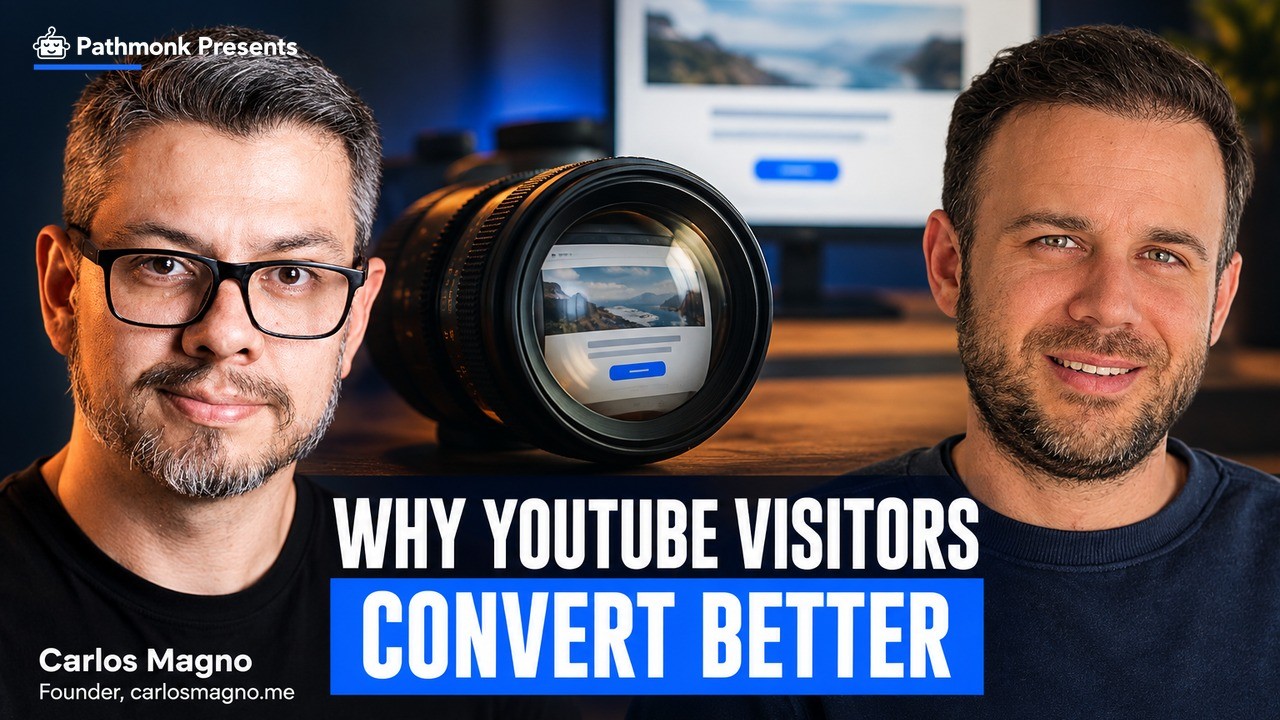
“With YouTube, you create one video, and that video can be selling for years.”
at
- Company
- carlosmagno.me
- Speciality
- Long-form YouTube channels for founders
- Works with
- Founders who already know how to get customers
- Deliverable
- Full production, or a YouTube system clients run themselves
- Background
- Ubersuggest, Answer the Public and Neil Patel's YouTube channel
Rapid fire
- One source of information
- Books, and the older the better
Too long, didn’t listen?
Carlos Magno, founder of carlosmagno.me, turns founders who already know how to get customers into long-form YouTube channels. During his work with Neil Patel, the channel passed 35 million views, and YouTube visitors converted at around 15.6% against an 8% baseline. His argument: YouTube qualifies buyers before they reach your website, and one video can keep selling for years.
He tells founders their real obstacle is camera confidence, not gear or posting volume. Script only the introduction, drop the teleprompter, and talk to one ideal viewer. He also explains YouTube's longer shelf life, the limits of recycling content from other platforms, and why AI harnesses are ways to deploy your own opinion.
Judge YouTube by conversions, not views
Channels with a few hundred or a couple thousand subscribers can still bring in a significant number of customers, because YouTube matches the viewer to the content. Carlos saw YouTube visitors convert at 15.6%, compared with an 8% baseline.
Build confidence before buying gear
Founders get stuck on preparation, studios and polished scripts. Put your first effort into thinking clearly on camera, and bring in strategists, thumbnail designers and editors later.
Script the intro, outline the rest
Script only the introduction that raises the stakes and sets up the big promise. For the rest of the video, follow a hierarchy of ideas and speak to one ideal viewer.
Test winners from other channels before recycling
Your best tweets or reels can suggest topics, but only if that audience is the one you want on YouTube. Rhythm, length and format are different on YouTube, so a hook may carry over while the concept often won't.
Some brilliant ideas
“The first and most important thing is for you to gain confidence on your ability to think clearly in front of a camera.”
The first myth that we need to overcome is the myth that volume is going to be a competitive advantage. It's not.
AI harnesses are ways for you to deploy your opinion about how to do things.
Full transcript
Introduction
[0:00:14] ADRIAN GARCIA RAMOS: So, Welcome to Pathmonk Presents where we talk with growth and marketing leaders about what's actually working right now. I'm Adrian, your host, and today I'm joined by Carlos Magno, founder at carlosmagno.me. Hello, Carlos, how are you doing today?
[0:00:34] CARLOS MAGNO: I'm great, Adrian. It's nice to be here. Thank you for having me.
[0:00:38] ADRIAN GARCIA RAMOS: Amazing. So, what is that carlosmagno.me does? Can you introduce, a bit about your website and yourself?
Turning founders into YouTube channels
[0:00:50] CARLOS MAGNO: Of course. Well, I've been working with founders, typically founders who already know how to get customers. Maybe they're doing outreach, or LinkedIn, or Instagram. They have a presence somewhere, but they notice that it's coming at a cost, right? So if your Instagram You need to continually be working every day and publishing, TikTok the same, and other platforms the same. If you're doing outreach, it's a lot of messages, right? So all of these things, you run out of bandwidth. But with YouTube, you create one video, and that video can be selling for years. So I turned these founders into channels where one video keeps putting new customers in front of them in a targeted way.
Because a lot of times they're looking for targeting and YouTube does a great job with that.
[0:01:36] ADRIAN GARCIA RAMOS: Nice. So what kind of formats do you work with? Is kind of a long format, short format, clips, vertical format?
[0:01:43] CARLOS MAGNO: Yeah.
[0:01:44] ADRIAN GARCIA RAMOS: That's interesting, yeah.
[0:01:46] CARLOS MAGNO: Yeah, it's typically long form. I find that long-form formats tend to outperform short form, primarily because people establish, like, this parasocial relationship with you, right? Where they get to know you, they get to know your mental models, the way you think and operate, so it's easier for you to sell when they have spent all that time with you, right?
[0:02:08] ADRIAN GARCIA RAMOS: Yeah, absolutely. So, I've talked with, you know, a couple of guys like you, that they are super bully on you know, X and LinkedIn, they said that if you have a B2B approach, you should, you know, hammer on those. Now you're bringing a different approach over here, so I guess that's super kind of interesting. I don't know if you have any kind of a reference on the numbers that you have achieved with this Approach, you know, by tackling YouTube, and… What are the questions or the validations, the heuristic, if you wish, to know whether or not this channel is going to work for a given person?
Why YouTube traffic converts better
[0:02:50] CARLOS MAGNO: Yeah, I think, you know, in the context of Pathmonk, I think that's an interesting conversation to have, because you guys can do a lot to improve what happens when someone lands on your website. And that's really important, but what happens before someone gets to your website is also very important. So, I think YouTube, for example, back when I was working with Neil Patel in his business, we got over 35 million views to his channel, and the conversion rate for people who were coming from YouTube was around 15.6%. And that's against the baseline of 8% for all the other visitors from other sources. So it's quite impressive how this qualifies people before they even get to your website.
And I think that's the kind of conversation you want to have. As far as in comparison with other platforms, I think there's simply just too much noise these days.
[0:03:52] ADRIAN GARCIA RAMOS: -H.
[0:03:52] CARLOS MAGNO: For example, on LinkedIn, it has become easier for everyone to be out there putting content out with AI and stuff like that, and outreach has become so aggressive that the amount of noise has turned the competitiveness and the effectiveness of the platform just not viable for a lot of smaller business owners or busy. Business owners.
[0:04:17] ADRIAN GARCIA RAMOS: You too, bye.
[0:04:17] CARLOS MAGNO: I think has this scale component that allows you to qualify customers before they even touch your website.
[0:04:24] ADRIAN GARCIA RAMOS: Okay. Yeah, in terms of qualifying, I was wondering about the founders, right? So, maybe a founder of a B2B SaaS with, let's say. you know, some customers, it's not qualifying because he doesn't have the infrastructure, or it's so small, right? But rather, this is focused for larger accounts. I don't know if you can give some… tips on, okay, I qualify for this strategy, or so I can test it out. So, how can people get into it by, yeah, some filters?
[0:04:55] CARLOS MAGNO: That's a great question, Adrian. And I think it boils down to how YouTube created one of the best recommendation platforms out there, right? One of the best recommendation algorithms out there. I've seen channels that have a little over 2,000 subscribers, sometimes even hundreds of subscribers. They're not getting a lot of views. But they are getting significant amount of customers from those channels. And the reason why that happens is how targeted YouTube is at pulling content for the ideal viewer, right? So, it's not about… actually, it's not about even matching the content to the viewer, it's matching the viewer to the content, right? And a viewer may be interested in different things throughout their life cycle.
So, what YouTube does is, if you're getting 50 views to a particular video. Rest assured that from those 50 views, if someone is spending 15, 20 minutes watching your content piece, it's way easier for you to close a customer, even if it's a high ticket product, than it is for you to close someone who just saw a LinkedIn post or an Instagram reel or a TikTok or something along those lines.
[0:06:11] ADRIAN GARCIA RAMOS: That's why I think…
[0:06:12] CARLOS MAGNO: long. Yeah.
[0:06:14] ADRIAN GARCIA RAMOS: I was saying that I fully agree with that, because at the end, it's a matter of time and attention that you're getting from the videos, right? So if you have a 20 minutes long that is going to deliver on value, you're going to be 20 minutes on the head of that people, and all the viewers that are looking at your video, so it's not just a message, but also your face, your voice, your tone. And that social connection that we have over video, right?
[0:06:37] CARLOS MAGNO: Yes.
[0:06:37] ADRIAN GARCIA RAMOS: So I'm I mean, I'm super interested at this thing, and I would like to know more about kind of investment, right, that could be from from a brand that would like to explore this. What would you recommend to start with this approach, right? You know, a number of months… I mean, the amount of videos, maybe per week that they should post, one per week, or… I don't know, you tell me. And then also, in terms of, like, Whether or not they need a super quality studio, you know, to go on with the video, if they need to invest anything just to get started, how important is the quality for those videos? I guess, maybe you can give us some insights, about the topics that they should cover, right? Should that be related to their brand, or to their… the, you know, it should be a learning material, it should be something relevant to the industry.
And this is coming into the interrogation space, so I don't want to get into that, but it's so interesting that I really, I'm fed with questions for you.
Confidence beats gear and volume
[0:07:39] CARLOS MAGNO: Yeah, of course. So let's break it down, because there's a lot there, right? When we talk about investment for founders, money is typically not the biggest issue. I'll be transparent with you. More often than not, it's about the founder's time than anything else. So, I found that a lot of the founders who are not yet on YouTube, or have tried YouTube, but haven't really continued. The biggest issue for them is kind of how much preparation goes into it. And I think, if you look from a volume perspective, for example. Volume has become completely commoditized, and there are plenty of channels out there that have begun producing content that goes out multiple times a day. For example, in the SEO space, there's a guy who publishes, I kid you not, 8 to 16 videos a day. It's almost more than one video per hour, depending on the time of the day.
And some of his videos do really well, but they're all AI-generated. It's not like the guy's hiding that. He says, hey, I'm this guy's avatar, I'm an AI avatar, and this is me, blah blah blah. But volume has become commoditized. So the first thing that we need to… this minute, like. The first myth that we need to… overcome is the myth that volume is going to be a competitive advantage. It's not. It's much preferred having a targeted approach to YouTube than it is for you to have a volume-based strategy. However, volume has some… something else that becomes an advantage for a founder, which is the ability to do more While feeling comfortable in your own skin.
And not having to do as much preparation every cycle. Right. So here's what I mean by that. When a founder is starting off. What happens is, they're gonna spend too much time in their outline, writing the script. Oh, yeah. They're gonna spend too much time gaining confidence on the content that they're putting out, because they don't want to say things that they don't, like, they don't feel comfortable with.
[0:09:53] ADRIAN GARCIA RAMOS: Sure.
[0:09:54] CARLOS MAGNO: We're gonna do all this preparation.
[0:09:55] ADRIAN GARCIA RAMOS: Mmm.
[0:09:56] CARLOS MAGNO: Right? Now, by the time they decide that they're ready to record, then they need to set up the studio.
[0:10:03] ADRIAN GARCIA RAMOS: the.
[0:10:03] CARLOS MAGNO: together their camera, they're gonna see if their cameras have their batteries recharged, if the memory cards are ready, all that kind of stuff. Like, is my room tidy and everything else? All of this, I came to realize, is a confidence problem more than anything else. So the technical abilities, all of these, they're becoming commoditized. It's easier than ever for you to create content. You can create scripts very easily and very fast. You can create the preparation work can be done very fast. But the confidence work is the area where founders lack the most. So here's my advice to someone who's starting.
[0:10:44] ADRIAN GARCIA RAMOS: you.
[0:10:44] CARLOS MAGNO: Don't think about the investment that goes into the technical stuff. Don't think about the investment that goes into having the perfect strategist working with you, or someone who's going to be designing your thumbnails for you, or someone who's going to be writing the scripts for you. The first and most important thing is for you to gain confidence on your ability to think clearly in front of a camera.
[0:11:06] ADRIAN GARCIA RAMOS: CIC.
[0:11:07] CARLOS MAGNO: articulate your ideas in a clear manner because here's the thing, Adrian. The way people relate to you as the person behind your brand is by actually resonating with the way that you think. And how you articulate your ideas. It's not because your background is polished. It's not because… Your camera's amazing. It's not because your script is so well written and made for the highest retention or Right. Of course, all of these things help, but when you're getting started, the most important thing is for you to gain that level of confidence that allows you to get in front of an audience without feeling so uncomfortable that you can barely articulate yourself.
Sure. So, that's the first thing. Now, what's the investment after all of this, right? Well, if you don't want to spend a lot of time, it's good to have a good thinking partner with you. Someone who can bounce ideas with you. And think about how your content is going to be structured, and what kind of content resonates with your target audience to gain the most viewership possible. At that level, yes, you do need someone to be behind your back, like, someone to be working with you. Someone who can look at the data and say, okay, I'm looking at your ideal viewer, and here's what's pulling viewership.
As of September 2026. 6, right? They're gonna say, hey, here are the topics that are working the best, here are the framing. that are working the best, the different angles for topics that are working the best, and even the kinds of thumbnails that resonate with your type of audience. Because if you create, like, these clickbaity thumbnails with your mouth open, like, man, some audiences don't resonate with that. Like, it may be true for maybe. Fearmongering financial coaches or something, but not for someone who's talking about business in a serious manner. In a way that's, you know, educational. So there are all these things, right? So, there is an investment that goes into that, having.
the right thinking partner with you, who's capable of looking at the data, understanding the patterns, and helping you structure your thinking in a way that's not going to bore people to tears. Because when someone is watching your content, like, the thing you want to do is have them watch from the beginning to the end, right? And there's ways for you to increase the likelihood of that happening. So having that kind of partnership is helpful, but should it be done from the beginning? No, that's not how it should do.
[0:13:43] ADRIAN GARCIA RAMOS: Okay. Then, I guess that, you know, I fully agree with you that being lonely in this path, it could be really, really hard. I have a couple of, short questions, because otherwise that could be, you know, super extensive. First one is, when is the right moment to buy a teleprompter, right? That's one. Second one, when is the right moment to call you up? because I guess, like, you are the… the mate for the battle, right? So, it's like, Carlos, can you help me out? I've been running videos for the last two months, I think that I have the confidence, but I need more help. I need to structure what I'm doing, right? So, that could be the second…
And the third one, yeah, it's related to the first, it's… Whether or not to go for kind of a, You know, a transcript, or kind of a script, when delivering on the messages and such.
Throw the teleprompter away
[0:14:43] CARLOS MAGNO: Yeah, those are good questions. So I think I'll just flip the first one because when it's the best time for you to throw your teleprompter away?
[0:14:52] ADRIAN GARCIA RAMOS: never.
[0:14:52] CARLOS MAGNO: use it again.
[0:14:53] ADRIAN GARCIA RAMOS: Okay, okay, okay.
[0:14:56] CARLOS MAGNO: Because here's the thing, that's one of the obstacles, right? When you think about all the prep work that goes into creating a video, one of the things that makes people anxious and kind of ruins the authenticity and how presentable they are in front of a camera is the fact that they're reading from a script. Like, that kind of thing, it works for some people, because they're good actors. They can read live from a teleprompter and sound natural. Sure. But that's a unique gift. It's not something that we're all born with. So my recommendation instead is, think about the ideas in terms of a hierarchy, right?
[0:15:36] ADRIAN GARCIA RAMOS: Right.
[0:15:37] CARLOS MAGNO: So if I'm creating a video, the things that I need to have scripted are only two most of the times. Okay.
[0:15:43] ADRIAN GARCIA RAMOS: Right.
[0:15:44] CARLOS MAGNO: First one is the introduction. You want to make sure that you're setting The scene in a way that's attractive. I'm raising the stakes, I'm creating a big promise, I'm telling about the big idea, and I'm walking you through my plan, and why you should care, why you should listen to me. That's really important for you to script, that's fine. If you want to follow a script with that. follow a script. That's an important part, okay? Right. But with the rest, it's usually better if you have a hierarchy of the big ideas that you want to go through. So if you have a roadmap of the ideas, right? And if you own the ideas enough.
You're gonna know them so well that you're gonna be able to speak off the cuff. Okay? And when you do that, people actually connect with you in a more direct way. They can see your mental models.
[0:16:37] ADRIAN GARCIA RAMOS: Sure.
[0:16:38] CARLOS MAGNO: They can see the way you think, the way you articulate your thinking. And guess why that's important? Because they want to see you as the person that they're going to be working with.
[0:16:48] ADRIAN GARCIA RAMOS: Right, right, right.
[0:16:49] CARLOS MAGNO: If they listen to you and they say, "I'm bored," or, "That doesn't make sense," or, "I can't connect the dots between one thing and the other," or, "Hey, this actually sounds like Claude," like, they're not gonna connect with you.
When to get help, and Algo Farming
[0:17:03] ADRIAN GARCIA RAMOS: that.
[0:17:03] CARLOS MAGNO: That's the most important thing. Now, when should people look for someone like me, or look to work with someone like me? It's when they have their time poor, right? Okay. And they want to shortcut their way out of The shyness… The preparation syndrome, like the thing of being overly prepared, that spending 15 hours before feeling ready for a video, over-scripting things, overthinking the topic selection, not having a set system to have things in place. Because the truth is. There is a system to YouTube. You can actually run things through a system. And there's plenty of data to support that system. You can… there are plenty of tools with, you know, harnesses like Claude Code and Codex and things like this. You can actually orchestrate things in a way that's really helpful.
And that's really gonna save you a lot of time. Okay. So working with someone like me can definitely speed run through this whole process, right? You can actually acquire a system that will get you started, and will get your things running in a way that you wouldn't if you were doing this yourself. And I tell you this because A lot of the editing work today can be done with the help of the harnesses, like Cloud Code and things like this. A lot of the like, imagine this, right? We're just recording this podcast, you need to cut all the silences you need to.
[0:18:34] ADRIAN GARCIA RAMOS: Oh, yeah.
[0:18:34] CARLOS MAGNO: best takes, all that stuff. All of this today is facilitated with AI. You don't need to have an editor from the beginning.
[0:18:42] ADRIAN GARCIA RAMOS: Sure.
[0:18:43] CARLOS MAGNO: Right? We're finally there, man. Like, we can actually do this thing, right?
[0:18:46] ADRIAN GARCIA RAMOS: Right, it's real.
[0:18:47] CARLOS MAGNO: It's real!
[0:18:49] ADRIAN GARCIA RAMOS: the.
[0:18:49] CARLOS MAGNO: The next thing is kind of how you mobilize data. Hey, for example, I have a system that I call Algo Farming, which is basically, I use a synthetic persona that is run by an AI harness that simulates Human behavior, browsing videos that are related to my client accounts. In a way that helps me understand what YouTube will put in front of someone who's actually interested in my client's content. So every week I can do a harvest.
[0:19:22] ADRIAN GARCIA RAMOS: a.
[0:19:22] CARLOS MAGNO: Claude, let's run a harvest in that account because I want to see what YouTube's pulling as far as this space is concerned. And guess what? It will show me all the outliers, all the videos that are doing well, all the videos that are pulling the most viewership. But that's because I've created this system and I run this system with a lot of automation and things like this. So if you want to buy leverage, that's when you want to work with someone like me. If you want to buy more time, that's when you want to work with someone like me. But I can't do the work that you should do, right? So, as far as becoming more… so, to your last point, right, about, hey.
how do you address this thing of, you know, should you have a script? Should you, like, how do you prepare to record a video, right? I say it's a process of becoming less and less dependent on having cues. To follow, it's the process of getting accustomed to speaking off the cuff. In a natural enough, involving enough way that will keep your audience engaged. Right? So you need to pretend as if you were speaking with an audience of just one person, and it's your ideal viewer, right? Like, if I were speaking with one ideal person, oh, that guy would be, you know, Marcus, whatever name you want to give him, right? And I'm gonna pretend that I'm talking with Marcus, and I'm going to explain and express myself
in a way that resonates with markets. So who's Marcus? Oh, it's a 40-year-old marketer from Spain.
[0:20:58] ADRIAN GARCIA RAMOS: something.
[0:20:59] CARLOS MAGNO: Aubrey.
[0:21:00] ADRIAN GARCIA RAMOS: It is the same thing as defining the ICP, right? So, when you go.
[0:21:03] CARLOS MAGNO: Yes.
[0:21:03] ADRIAN GARCIA RAMOS: You have a business vertical, you have a customer persona, you have whether it's a male or female, so you pretty much can draw the thing, so you have to talk to that person and make your mind in that way. So, I'm super interested about the… Compounding effect, right? Because, assume… I mean, we cannot hide that this is kind of a marginal, in a way, initiative compared to SEO, you know, social posting, and many other things that are out there. So I'm wondering if you have had any customer who's running a bunch of different you know, content generation machines or factories, right? Where they can scale with volume, as you said before, but they don't need to commit their time, right? So they can say, okay, I'm going to post
500 social posts this month, and out of that, I'm going to select what are going to be the best ones, right? So, based on those, I'm going to leverage a video. Okay, so…
[0:22:09] CARLOS MAGNO: let's.
[0:22:09] ADRIAN GARCIA RAMOS: Any sense at all, or is it something that you have seen or you have worked with?
YouTube's long shelf life
[0:22:15] CARLOS MAGNO: Okay, let me see if I understand the question, right? So, you're talking about the compounding effect. of YouTube compared to other platforms, right? So let's look at how things work across different platforms first, and maybe this will give you some perspective, right? Right. If you think about Instagram or LinkedIn, for example.
[0:22:40] ADRIAN GARCIA RAMOS: Right.
[0:22:41] CARLOS MAGNO: Every social post. Typically has a shelf life. Okay. Right? Where… it has that recency component to it. And you're gonna see the majority of the traction occur in the first. 24 hours. Sometimes, maybe a week. Sometimes, like, if a post goes really… does really well. You're gonna find it getting some new likes and comments and engagement over time, but it's not really the core mechanics of those platforms, right? They're typically going to be pushing your content for a few days. And then it's gonna be forgotten for the majority of cases. Yes, I've seen lots of Instagram reels, for example. which have been posted a long time ago, and they're still pulling viewership, but I would say that's the minority of the videos there, right? Maybe it's something that goes viral, and then, yeah, sure, that has a shelf life.
That that's extended. That's not usually true for LinkedIn, for example, LinkedIn.
[0:23:48] ADRIAN GARCIA RAMOS: Okay.
[0:23:48] CARLOS MAGNO: Shelf life is roughly a week. We're doing really well, and people are continually sharing that. Maybe 15 days, right? Okay. Thinking about TikTok, which I'm not as familiar with, I think it has a more extended shelf life. But it's… it's still kind of like Instagram. The majority will get, like, the early traction, and then will be forgotten. Now, what I've seen with YouTube is that it does have For, let's say, the majority of videos, you do have a similar effect in which the earliest moments of your video are going to be the platform testing it against viewership. So, we'll see what kind of viewer gets interested by this content, and it will… if it finds a really rabid audience that's hungry for that kind of content.
Maybe it will explode and go indefinitely for a long period of time. And that's the interesting compounding effect where.
[0:24:50] ADRIAN GARCIA RAMOS: E.
[0:24:51] CARLOS MAGNO: When YouTube finds a rabid, hungry audience for the kind of content you have, it can keep serving your content for years on end.
[0:25:00] ADRIAN GARCIA RAMOS: Wow.
[0:25:00] CARLOS MAGNO: I've seen clients with five-year-old videos that are still selling, like five-year-old videos that are still producing leads, that are still bringing in clients and things like this. It's not what happens with the majority of videos. But it's something that the other platforms can't say. Like, you can't say you're getting new leads from a 5-year-old TikTok video or a 3-year-old Instagram reel. Like, that's a very, very uncommon occurrence, let alone a LinkedIn post or something like that. So, YouTube has this extended shelf life. That… not with those who get that initial traction, but also with videos that sometimes they do terribly
Bad in the first few days.
[0:25:48] ADRIAN GARCIA RAMOS: Okay.
[0:25:49] CARLOS MAGNO: But man, five months later, for some reason, YouTube picks an audience for it and it spikes and it goes up and it starts getting viewership.
[0:25:59] ADRIAN GARCIA RAMOS: Yeah.
[0:26:00] CARLOS MAGNO: So there's these interesting behaviors of the platform where it pulls new viewership for years on end, sometimes with videos you didn't expect, and I think that's the uniqueness of YouTube, where it has better longevity overall.
Recycling winners from other platforms
[0:26:17] ADRIAN GARCIA RAMOS: Right, right, right, right. So, my question originally was directed to other fields. The thing is, when you make a video, you know that you have limited resources, right? And you might have other pieces of content that you have published across other means or other channels that you know. So. Would it make sense to take the winners out of those channels, let's say SEO, social posting, or whatever it is, and then make videos for the winners on those. That, you know, that are resonating with the audience that you have.
[0:26:52] CARLOS MAGNO: Oh yeah, that's… that's a great framing for this, right? Where you're actually using audience intelligence about your ideal viewer or your ideal buyer. Across different platforms. Now, there are important assumptions, though, that need to be tested, right? Because famously, Alex Hermosi, for example, used to take his tweets that were the most popular ones, and then create YouTube videos out of these concepts. Famously, like, that's something he's done for a long time. Allegedly, it's not working that well, now that.
[0:27:31] ADRIAN GARCIA RAMOS: Okay.
[0:27:31] CARLOS MAGNO: Elsa is doing that.
[0:27:32] ADRIAN GARCIA RAMOS: It's so neat, yeah.
[0:27:33] CARLOS MAGNO: Yeah, but it is something you can do. Yes. Assuming that and that's a very important assumption, assuming that the audience you have on these other platforms is the kind of audience you want to have on your YouTube channel.
[0:27:49] ADRIAN GARCIA RAMOS: Alright, bye.
[0:27:50] CARLOS MAGNO: Because, for instance, if you want to do, like, demographics differentiation with Instagram, maybe you're catering towards, like, a younger audience that's… you know, fast-paced content consumption patterns, whereas on YouTube. you're appealing to a maturity level that's a little higher, and you want to get people in a different stage of their journey. So it all boils down to whether or not those things are transferable. But I have this firm belief of… Once you know your ideal buyer. You may adjust your content platform specifically, but overall, you're using that knowledge about your ideal buyer across the board, so it is an asset that you carry over from one platform to another. But I don't know… I don't know if the concepts for the video concept…
content you create from one platform to the other will be as transferable. In my experience, not so much. Maybe the hook that worked on an Instagram reel, for example, can work well in a YouTube video. But it's not always transferable. It's sometimes the dynamics are so different that the content is not as appealing. Specifically because of the way you have to develop on a YouTube video, the rhythm is different, the length is different, it's kind of tough.
[0:29:20] ADRIAN GARCIA RAMOS: It could be kind of a proxy or a signal that you get from the things that you have, but then you need to understand and realize that the audience is going to be different and the format might be totally wrong or totally, let's say, unfit for that particular topic that you want to talk about, right?
[0:29:37] CARLOS MAGNO: Yes.
[0:29:38] ADRIAN GARCIA RAMOS: Having that in… in… into account, you…
AI harnesses as opinions
[0:29:41] ADRIAN GARCIA RAMOS: Have to proceed as you wish, in a way. Yes.
[0:29:44] CARLOS MAGNO: I agree. Okay.
[0:29:46] ADRIAN GARCIA RAMOS: Okay, so you mentioned before about the tools that you have built on your own in terms of like harnesses and different kind of Agentic, you know, protocols or orchestration, of course. We don't want you to tell us your secret sauce. Well, maybe you can give us a clue on the things that you might do, or that you can expect out of this new generation of, you know, tools and and LLMs and architectures that are brought every day and how you can add value with them.
[0:30:25] CARLOS MAGNO: Yeah, you know, as someone who's been a CEO for two tech companies before, I can tell you, you know, I used to work at Ubersuggest and Answer the Public as my last full-time job before founding this business. And… We had fundamentally different products compared to the rest of the industry, where we deliberately made choices to make them simpler. And as a result of that, we were acquiring customers that were different than the rest.
[0:30:59] ADRIAN GARCIA RAMOS: That's.
[0:30:59] CARLOS MAGNO: tools. Right? Our customers were, you know, startups, solo founders, people with not-so-deep pockets and not-so-large teams and things like this. And a lot of that is baked into the philosophy of how the product is built. Now, what I think about AI and how it will affect this field, and it's already affecting, is that you're gonna get a lot of opinionated articulations of how to use AI to achieve certain results. Right? So, for example, right now you hear a lot about faceless channels that are basically copying the style of some other channel that's doing great, and they can copy the thumbnail style, they can copy the scripting style, they can copy the editing style. Like, they can basically create something really, really similar just using AI, and there's all this orchestration that goes into that.
[0:31:55] ADRIAN GARCIA RAMOS: I think.
[0:31:55] CARLOS MAGNO: That element, I don't think, I don't know if it will have that much longevity because people will start getting fed up or overfed with this kind of rehashed kind of content, right? But as far as, let's say. Creator-based content is concerned. I think the way that these harnesses, the way that these methods will be used and deployed will be following opinionated views on how to use the data that the market makes available to you in a way that informs good decisions for the content you should be creating, right? So, for example, if I'm… the founder at Pathmonk, I may say, okay, now I know that besides having a healthy website that is optimized for conversions.
It's also ideal if they have a targeted way of acquiring visitors, because this will do half of the job. Like, people who land on the website, they're already going to be aware of what the product is, what the solution is, so they're just seeking confirmation about certain things, and finding the ideal path for conversion, right? So, if I know that, I may adopt as my philosophy creating content. Okay, I'm gonna talk about traffic generation. If it's important for website owners. This is something I should also be talking about. So, that's an opinion you have, and you can mobilize your harness, your, like, your Agentic systems.
[0:33:38] ADRIAN GARCIA RAMOS: So.
[0:33:39] CARLOS MAGNO: to help you with that. So I guess that's a long-winded way of saying this. AI harnesses. Are ways for you to deploy. Your opinion. About how to do things. So, my opinion, for example, is that, yes, you can create videos based on what's working out there.
[0:34:03] ADRIAN GARCIA RAMOS: you.
[0:34:04] CARLOS MAGNO: But you should also create videos that are brand aligned. Sure. That solve problems that you know belong to your audience. Yeah. And that if you're creating videos for the sake of viewership alone, you're not gonna get very qualified customers anyway.
[0:34:18] ADRIAN GARCIA RAMOS: Oh.
[0:34:19] CARLOS MAGNO: So that's my opinion. So, the way I run my… harnesses to find data to support those decisions is specific, right? It goes in both directions. Yes, it looks at the outliers, it looks at the videos that are overperforming out there, but it's also thinking from the brains of my client's brand. Hey, does this help Does this help Marcus? Or IVP, or Ideal Viewer Persona, right? Does this help Marcus with that mission that Marcus has of growing his business in the third quarter when things get rough on the outreach, or when things get rough on SEO, or whatever?
[0:35:00] ADRIAN GARCIA RAMOS: have.
[0:35:01] CARLOS MAGNO: So that, that's like… That's my viewpoint here, where… Harnesses and systems? They're gonna be… they're not gonna be as commoditized as people think. Because there's no one way of solving an issue.
[0:35:17] ADRIAN GARCIA RAMOS: Yeah.
[0:35:17] CARLOS MAGNO: There is no one way of solving a problem. And the more ways there are. the more different solutions you're gonna see out there, right? So, in my case, for example, the way I'm finding to scale my weight, my ability to work with clients is. I do have one-on-one clients that I do the full production for them. But the next big thing that I'm working on with new clients is, hey, I'm gonna build the system with you. And you're gonna drive this thing. I don't want to drive this for you. I want you to know how to drive this on your own. I can help you with your camera confidence, I can help you with all this stuff. I can help you, like, get unblocked when the system itself is not giving you the answers you're seeking. But the ideal world is you running your thing.
Right. On the other side, this allows me to have more clients. I can work with, instead of 5 full production clients, I can work with 50. Done with you, quote-unquote, because I hate this. this… this framing, but working with multiple clients that I'm… I'm helping in a more scalable way, so that's kind of how I see it.
[0:36:30] ADRIAN GARCIA RAMOS: Okay, good. Okay,
Why books beat the information loop
[0:36:36] ADRIAN GARCIA RAMOS: I've got a last question for you. This is a bit off-topic on the discussion that we have had, but it's something that I also, let's say, reserve for our audience, and it goes for sources of information that you might use, right? So today, we are living in a world with a lot of noise and little signal. Many things are interfering with our thoughts and with our line of work and all the things that we do. So, if you were to select one single source. Of information in your day-to-day work, what that would be.
[0:37:10] CARLOS MAGNO: Books. And the only reason, and the older the better, to be honest with you, because Here's the thing, right?
[0:37:19] ADRIAN GARCIA RAMOS: Okay.
[0:37:19] CARLOS MAGNO: We're like… do you know the Ouroboros metaphor? Like, the snake eats its own tail? I think we're getting there right now, right? So everything is, like, reprocessed, reprocessed, reprocessed, and it's kind of like this infinite loop. And those sources They're no longer gonna be helpful. They're not gonna feed our creativity. Yes, they… because here's the thing, man. You can use Perplexity. You can use ChatGPT. You can use Claude. You can create your own deep research framework in a Claude harness, or a Codex harness. So information is the easy part. Okay? Information is super easy. Like, if I want to know something about outreach.
Because I like to do outreach with really high-targeted clients, right? Like, the dream clients, those I do outreach, like, and I reach out to them, and I say, hey, I have this full thing for you to implement if you want, and I give it to them, right? But… so, I can do this with Claude and Perplexity. I can ask Perplexity, how much… how much time should I spend warming up the emails, the domains, blah blah blah. It tells me everything I need to know. I don't need to watch 10 YouTube videos about this, man. Like, I'm not going to. Right? I'm gonna watch YouTube videos about people I relate to, and I like to connect with their way of thinking, but not necessarily because of their information.
[0:38:50] ADRIAN GARCIA RAMOS: nicely.
[0:38:50] CARLOS MAGNO: Right? So with books, we get access to ancient wisdom that's been out there for ages. But they're getting lost in this shuffle of the reprocessed consumption patterns that we see today. So, it's kind of like, almost like. You know, just diversity and difference for the sake of it.
[0:39:15] ADRIAN GARCIA RAMOS: Okay?
[0:39:16] CARLOS MAGNO: Of having something that's so… outside… Of this. that it makes your brain more healthy. That's kind of how I think. I was telling my son, like, man, this is, brain rot. And he was like, no, it's not brain rot. I was like, yeah, it's brain rot. Like, it's making you consume fast food information very quickly, makes you get bored very easily, it teaches you… Gives you that satisfaction very quickly that you're learning something, but you're not. You can't retain anything. And next thing you know, you're looking for the next video. So it's brainwashing.
[0:39:50] ADRIAN GARCIA RAMOS: Right.
[0:39:51] CARLOS MAGNO: And with books, you have to train yourself. To stay in a page, like, fully focused, full attention, fully present, for sometimes hours on end.
[0:40:02] ADRIAN GARCIA RAMOS: Oh, yeah.
[0:40:03] CARLOS MAGNO: to get information that's from other times. And I do like You know, contemporary stuff as well. Like I'm, I'm reading this book by, by near, a all indistractable.
[0:40:13] ADRIAN GARCIA RAMOS: Yeah.
[0:40:14] CARLOS MAGNO: And it's a really good book. It told me that, hey, you need to learn about the triggers that make you a bit distracted. Sometimes you're avoiding something, and I didn't know that. So.
[0:40:24] ADRIAN GARCIA RAMOS: Good to know. I love the books, so it's something that I follow along. So it's I'm on your boat, right? So we all know about books. Nice.
[0:40:34] CARLOS MAGNO: Nice man, yeah.
[0:40:34] ADRIAN GARCIA RAMOS: I would add to that that I find them, you know, that increase your taste about life.
[0:40:43] CARLOS MAGNO: Yes.
[0:40:44] ADRIAN GARCIA RAMOS: How you feel things. And also, enrich you in the way that you want to be enriched with, right? So, it depends on you. It's you that you choose your book. It's not that the book is choosing you, it's the other way around, so… You have a full control of, you know, the inputs that you're having you, and how you consume them, because there are different ways as well to consume books, so it's an interesting, revealing insight. Carlos, thank you so much for coming on. It's been a pleasure having you in the show. And last words, I would like to you know pass it to you in case you you just want to mention how to reach you out or know more about your brand and and everything that you're building with your website.
Just let us know, and notice as well.
[0:41:32] CARLOS MAGNO: Yeah, of course. So, I'm actually in the process of building, like, this first cohort of people that are working with me in this more scalable manner, where they can actually work with my systems. And work with me, helping them deploy those systems, right? So I have over 90, harness automation skills and things like this that I deploy with my clients. And so, I'm building this first cohort, it's coming live in the middle of next month. So, towards the… October 20, I think it's the first week of this cohort. People want to take part of that, head over to carlosmagno.me, book a call with me, or just email me, talk to at carlosmagno.me.
And let's have a chat. I want to learn about what they're doing, what they're trying, why they're getting blocked. Sometimes people get blocked for really random reasons as far as.
[0:42:28] ADRIAN GARCIA RAMOS: Okay.
[0:42:28] CARLOS MAGNO: Concerned. Yeah, and I love just helping them out. And I want to do this in a scalable way, and this this is gonna be a really interesting thing to do with them.
[0:42:38] ADRIAN GARCIA RAMOS: Cool, cool. So, Carlos, again, thanks, and let's keep in touch, okay?
Got a growth story worth sharing? Tell it on the show.
We talk with founders and marketing leaders about what actually moves their pipeline. If you’ve built something other marketers can learn from, we’d like to hear it.
- 01Apply
Tell us who you are and the story you’d bring to the show.
- 02We get in touch
We review every application and reach out if it’s a fit.
- 03Record your episode
A remote conversation, published as video, audio and a full transcript.