Google sees what the validator sees, not what you see
Why do handmade websites beat templates? James Osguthorpe of DoveCreation UK shares why error-free code drives SEO and conversions, and how to treat AI.

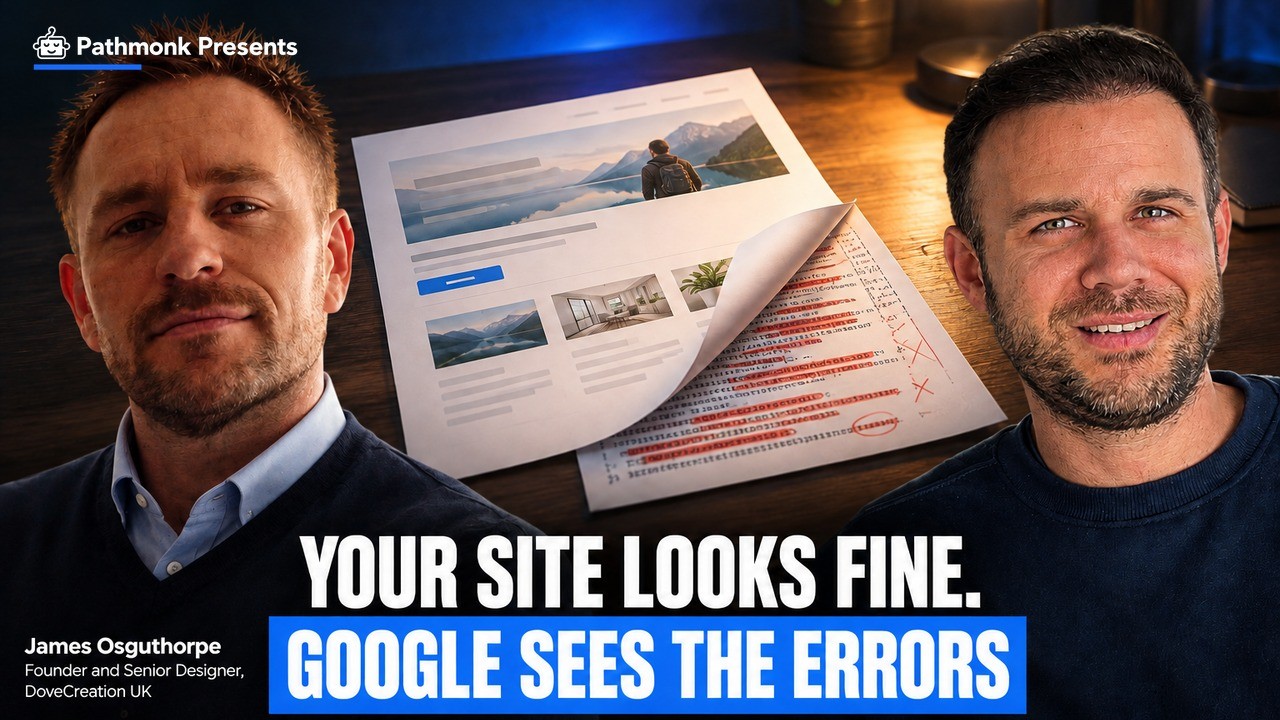
“If you run the validation and there's loads of bugs and errors, Google doesn't see what you see. Google sees what the validation software sees.”
at
- Company
- DoveCreation UK
- Speciality
- Websites built by hand, with no templates and no plugins
- Services
- Web development, software development and marketing
- Works with
- Small and larger businesses across the UK and Europe
- Based in
- Yorkshire, with an office in France
Too long, didn’t listen?
James Osguthorpe founded DoveCreation UK, a Yorkshire agency that does web development, software development and marketing for businesses across the UK and Europe. For more than a decade it has built websites by hand, with no templates and no plugins, after seeing drag and drop builders leave rogue code and dozens of conflicting plugins behind.
In this episode, James explains why a working site has to come before conversion, why Google reads your code rather than your design, and how a free W3C validation test shows the errors you cannot see. He also calls AI a yes man, says clients now ask for work that is not made with AI, and warns that buzzwords rarely help.
Validate your code before buying traffic
Run your URL through the free W3C validator. Google reads your code, not your design, so hidden errors still count against you.
Distrust anyone promising number one
Nobody outside Google can guarantee the top spot. Build a solid, fast, error-free foundation first, then add relevant landing pages.
Treat AI as a collaborator, not a judge
AI tends to agree with whatever you suggest. Check its ideas against evidence before you act on them.
Pick the hammer, not the gadget
Clients often ask for trendy tech they cannot explain. Choose proven tools that do the job instead of chasing buzzwords.
Some brilliant ideas
“I will use AI as a collaboration tool, but AI is a yes man.”
Number one on Google can't be promised, and anybody who says we'll get you number one on Google, unless they are working at Google, then probably be a bit cautious about that.
It's actually becoming a bit of a sales pitch to say it's not AI.
Full transcript
[0:00:12] ADRIAN GARCIA RAMOS: So, James, welcome to Pathmonk Presents where we talk with growth and marketing leaders about what's actually working right now. I'm Adrian, your host, and today I'm joined by James Osguthorpe, founder and senior designer at DoveCreation UK. Great to have you on, James. Thank you for having me.
JAMES OSGUTHORPE: Having me, Adrian. Thank you. Pleasure to be here, sir. Yeah. Absolutely. So, first of all, what is what your company does? Sure, yeah, so our company is, web development, software development, and, marketing. For businesses throughout the United Kingdom, which includes Wales, Ireland, and Scotland, and of course, England. We also help businesses across Europe as well. We have an office in France.
JAMES OSGUTHORPE: I don't speak French that well myself, so hopefully I don't deal with the calls. But we do help with marketing through throughout throughout Europe as well, yeah.
Why build websites by hand
[0:01:17] ADRIAN GARCIA RAMOS: Right. So I catch the sentence of on your website, it says like a handmade by proper web designers. So, where is that idea coming from?
JAMES OSGUTHORPE: Yeah, sure, Adrian. So, so, when we first originally started, about 12, maybe 13, 14 years ago, quite a few years ago, yep. The trend had just begun where people were starting to use WordPress and the templates and then things like Wix and GoDaddy website builder and all these things started to just come out really. And people were using them a lot. Now, the problem we was finding. Was when you are dragging and dropping things using software like Elementor, it can leave.
JAMES OSGUTHORPE: Like, rogue divs and containers and things all over the place, and the plugins as well. Throughout our career, we've had people Having some serious problems with the website. Right. And just not being shown on Google. And when we've looked, they've had maybe 40 plugins, all conflicting with each other. And we just… The best way I can say it, Adrian, is if you want a cheap table, you go to IKEA and you buy one. If you want a properly built table that's going to last you for a long time, you go to a proper carpenter.
JAMES OSGUTHORPE: And that's what we do. We build proper websites, no templates, no plugins, no… I'm sorry, sir, but that's how the plugin works, so… Yeah. Gonna have to do no, whatever you want. Of course, we'll build it. We're building it by hand.
Who needs a properly built website
[0:03:11] ADRIAN GARCIA RAMOS: So you are kind of an artisan of website, in a way. I'm wondering, what kind of customers do you have, and, you know, who are the ones that really appreciate that differentiation?
JAMES OSGUTHORPE: Yeah, sure. So, we do… obviously, people buy IKEA tables, and it's the same with the websites. People, they have a small business, and, you know, a website can be expensive, so they will simply build it themselves on Wix. Okay. It doesn't… it doesn't take long before we get the call saying, I've clicked something, it's all gone… it's all gone terribly wrong, and I've spent.
Yeah.
JAMES OSGUTHORPE: 5 days trying to fix it. Or, I would like this to do this, but… You know, it won't. So that's where we come in. We deal with small businesses, we deal with larger businesses. Our mission, really, is to get rid of the rubbish websites plaguing the internet. And replace them with honest. properly built websites, and I'm sure you've had it yourself, Adrian, where you click something, and it just doesn't load, or it doesn't go to the page, or something happens. That's usually plugins. Yeah, that's… not with our websites.
On top of that, I would also like to add the word taste, right? There are so many websites out there. without, you know, any minimal amount of taste, so having that differentiation factor, I think it could be very, very relevant for many people. And. I'm wondering, in your agency, do you focus exclusively to the web design, or do you also cover other services, such as, you know, SEO services, or, you know, media, PPC, all these kind of things?
JAMES OSGUTHORPE: Yeah, of course, my friend, yeah, we, we, anything we can do to help a business, we do. We, we simply just want to help, me myself, I'm a very helpful person and, you know, friends, family and, and.
JAMES OSGUTHORPE: clients we've had for 10 plus years will always tell you, you know, if you read our feedback on Google and Trustpilot. Pretty much all of them say They were really helpful, because that's our mission. So, so yeah, you know, we, we do.
Conversion starts with a site that works
[0:05:44] ADRIAN GARCIA RAMOS: I'm.
JAMES OSGUTHORPE: Sure. And stuff like that, yeah. I'm… I'm wondering now, you know, most of the digital marketing stuff, stack goes for acquisition of traffic and then conversion of traffic. So, when you work on a website, you're more focused on the conversion side of the traffic that you are receiving into the website, right? So… I'm wondering if you guys that have been in the business for more than a decade, Have any insights or, let's say, learnings about the personalization And things that, our audience could use to improve, you know, the conversions, either, you know, could be, like, e-commerce for purchases, or maybe lead generation businesses.
Is there anything that is supporting the conversion of websites according to your what website web design standpoint?
JAMES OSGUTHORPE: Sure. Sure. Yeah. Well, this is quite a multiple topic thing here, Adrian. So I'll try and cover it as quickly as I can on each thing. Having a nice website, having a website found on Google. Okay. That doesn't necessarily mean conversion, right? If somebody comes onto your website and it simply doesn't work very well. They're not going to hang around to try to purchase items or investigate your services any further. They'll simply leave.
JAMES OSGUTHORPE: So there's a big difference between conversion, somebody actually coming onto your website, and a bounce rate, which is Well, that's rubbish, and I'm sure we've all done it before where we've we've number one on Google, we clicked it and it just doesn't work.
Google sees what the validator sees
[0:07:37] ADRIAN GARCIA RAMOS: Yep.
JAMES OSGUTHORPE: In my, my suggestion and, and my advice for anybody who's trying to establish. You know, obviously, number one on Google can't be promised, and anybody who says, well, we'll get you number one on Google, Right. Unless they are working at Google, then probably be a bit cautious about that. You can run a free validator test on W3C validation. If you Google that, it'll come up. You can put your website URL into the search box, and it will tell you any errors or information. Now, when Googlebot actually reads your website, that's not a person.
JAMES OSGUTHORPE: Looking at it with eyes, going, oh, I like that button, that button's nice. It's actually looking at your actual physical code. So I… Google is an advertisement company and a good advertisement company. They want to show you the best things because if they show you rubbish, you're simply going to use Bing or another search engine. Right. So Google will look at your website and say, is this going to load fast? Is this actually covered with bugs and broken? Somebody's gonna click and go, oh god, what's Google giving me? Because Google will be the first person you blame.
Right.
JAMES OSGUTHORPE: and Google will check that, and it's common sense if you think about it. And… If your website is full of errors and bugs, Google sees those as well. And if your website works perfectly fine. Yep. And it looks perfectly fine, but if you run the validation and there's loads of bugs and errors, Google doesn't see what you see. Google sees what the validation software sees. Right. And… Not to blow one's own trumpet, but feel free to use the validation on our website. No errors.
Okay.
JAMES OSGUTHORPE: We provide that to all our clients to prove this is properly made. So that's, let's say, one of a piece of advice that you can share is, rely on a proper, technical SEO implementation for anyone's website, so that They can build from that. Both. 2am.
Build the foundation, then do SEO
[0:10:04] ADRIAN GARCIA RAMOS: of positioning for Google and then for their own sake, with the visitors that they have on the website, that nothing is going to break and they're going to be able to transform that visitor into value downstream. Okay, yeah, good.
JAMES OSGUTHORPE: So, so once you've got your foundation, you don't want to build a house on a swamp. Once you've got your foundation solid, then you can actually make sure your website, I mean, you've run the validation, there's no bugs. Make it friendly for your users. Once that's done and it's loading quickly, then of course, start looking at proper SEO, such as landing pages and things like that, but make them relevant.
JAMES OSGUTHORPE: And, and yeah, I mean, we're, we're on Google, we're, we're page 1 on Google and, We just followed those simple steps, my friend, so… It works, it works, right?
AI as a yes man and the demand for human work
[0:10:58] JAMES OSGUTHORPE: Yes! laughter. Yeah. Okay, so, I. I'm wondering now, like, you do a lot of work in terms of, like, not only technical SEO or, you know, the development of the websites and implementation hosting. I guess that you also go beyond, that implementation and steps into. Design, you know, creatives, maybe pictures, video, creative assets. So with all these a feeble of AA tools, I wonder, you know, what's your opinion on on these kind of tools, maybe not for creating the whole website, but you know, including some assets within it. Yeah, sure, we don't use AI. I'm not against AI. Right.
JAMES OSGUTHORPE: And, I think people use it wrong. within. My only suggestion, I see AI as a collaboration tool and sometimes. Me personally, I will use AI as a collaboration tool, but AI is a yes man. And it can… oh, that's the best idea I've… that's the best idea since ideas have ever existed, even if it's not. And when you actually come up with an evidence to suggest it's not, and go, well, actually, this… oh, yeah, you're right, yeah. Yeah, it's not a good idea, is it? And it's , you just said it was the best. So you have to be careful with ai.
Yeah.
JAMES OSGUTHORPE: Again, images. People want… Images and things that have taken by a human being. And I found it a lot in the industry lately in these past few months, Adrian. It's actually becoming a bit of a sales pitch. To say it's not AI, And… People are actually, clients are actually saying, is that going to be AI? And I'll say, no, they'll go, oh, thank God. Okay, good, good. I hate it. So, yeah, it's a weird one. Yeah. I follow you on, first of all, the images. I was just browsing the other day, and I found a couple of pictures.
With three fingers, you know, like.
JAMES OSGUTHORPE: Yes. But that was flagrant. I mean, of course, like. And there were all the horrifying scenes, you know, like a gentleman trying to drink from a glass of water, but the glass was cutting his face. Yeah. Really, I mean, difficult, I mean, it was, like… difficult. to see. Yeah, yeah. And then, on the other hand, as you mentioned, it is going to be AI, right? Like, people are, in a way. thinking, or skeptical to all these AI tools, like… Lately, I included my emails, like, you are going to talk to a human person, or you, you know, there's going to be human interaction in this kind of exchange, because people don't expect it anymore, so…
I guess that something's changing in a way. Not necessarily to a good way, you know, to a better world, in a way, for some things, right?
Buzzwords and the hammer
[0:14:16] JAMES OSGUTHORPE: Mmm. So, yeah, I wanted to ask you also, you know, given all this, you know, noise and things that are happening, not only with AI, but in general, like. things are going so fast. If you keep any source of information to keep up with, you know, like, the knowledge. You know, like, an inside, what will be it? Yeah, no, we… We, we used to do that quite a lot, and have the magazines around the office, and… it. And things like that, but… We get a lot of clients with buzzwords and it needs to be in react, it needs to be so and so it needs to be this.
Okay.
JAMES OSGUTHORPE: And I'll always say, oh, so you know about the, you know. No, no, I don't know anything about that, I just know, I know that that's what we need to use. So you don't actually know anything about it. And that is happening quite a lot. And we try to stop that. And the best way I can say is, and I tell our colleagues and our clients this, if you want to put a nail in the wall, you use a hammer. Right. What you don't do is invent a new hammer with all these gadgets and all these buttons, and it tells you how many times you've, you've hit the nail. Right. Just put the nail in the wall. That's all I want. And.
Hmm.
JAMES OSGUTHORPE: In today's society and with technology advancing. You know, my wife bought me a toothbrush for my birthday. Right. It tells you how many times you've brushed your teeth, how strong you've brushed them. Recommended I just want to brush my teeth, sir. And it's the same with websites and for me it's the same with marketing as well. Right. And. You know, so we do keep up to date with some things, AI. But again, it's normally just buzzwords and… Okay. It just ends up not really going anywhere and you kind of feel like, well, I've just wasted a year.
JAMES OSGUTHORPE: Learning that where, when we're building our websites, I would rather use, like, PHP, which Is the industry standing, like, it's been there for, like, a decade, and we know how to use it, so…
Why marketing will get more intrusive
[0:16:41] JAMES OSGUTHORPE: Yeah. Yeah, absolutely. Okay. I also wanted to ask you, like, if, you know, in more than 10 years, like. If there is a significant trend that you believe that you know, we all have to pay attention to for the knowledge that you've got in the industry and your experiences and your work. What that would be, and if you have any other kind of a insight or key, for… for audience. Yeah, sure, So I think AI is going to be useful, but maybe it's not for the consumer. I think people are using chat GPT a lot, which is pleasant and people are using it for a communication tool and a social tool as well.
Yes.
JAMES OSGUTHORPE: I think we, I don't see that going too, too much higher personally, I'm sure. Scientists and, and things like that will be using it more efficiently than what, what a consumer would. Websites are still important. The internet is, is still very important. Social media as well. You know, people care about what other people are saying and, You know, things are, things are progressing, people, People don't want old websites, and You know, marketing as well is becoming.
JAMES OSGUTHORPE: For a better word, aggressive, so I, I can see it being more intrusive. As time goes on as well, I'm a big Futurama fan and, for any viewers who watch Futurama. When Fry starts having dreams about adverts, you know, that maybe that's not too far away, my friend. Yeah. You know, maybe that's what we'll be having dreams about new iPhones and things.
Where to find James
[0:18:36] JAMES OSGUTHORPE: Who knows? Yeah, yeah, yeah, absolutely. Okay, James, so thank you so much for coming on. I would like to give you the word in case you want to, mention your website, your company, and anyone in the audience that would like to reach you out, how to do it. Yeah, sure, I mean, we're here just to help people, if you are interested, website development, or perhaps your plugin doesn't work and You want something, I don't know, you've got an idea. Jump on, call with us, and and yeah, we'll have a chat. We are from Yorkshire, so, which is in the United Kingdom, known for being,
JAMES OSGUTHORPE: Well. Hard working. Hardworking. You tell us to do something, it gets done. And, and yeah, and other than that. You know, I hope everybody, you know, does well in the business, and, and, yeah, yeah. Perfect. Thank you. Thank you, James. Let's stay in touch.
Got a growth story worth sharing? Tell it on the show.
We talk with founders and marketing leaders about what actually moves their pipeline. If you’ve built something other marketers can learn from, we’d like to hear it.
- 01Apply
Tell us who you are and the story you’d bring to the show.
- 02We get in touch
We review every application and reach out if it’s a fit.
- 03Record your episode
A remote conversation, published as video, audio and a full transcript.