Stop building dashboards: the strategy is already in your data
Is your revenue intelligence stuck in dashboards? Marta Turek-Olearczyk of Valmaris Group shows how to find your best next customers in your CRM data.

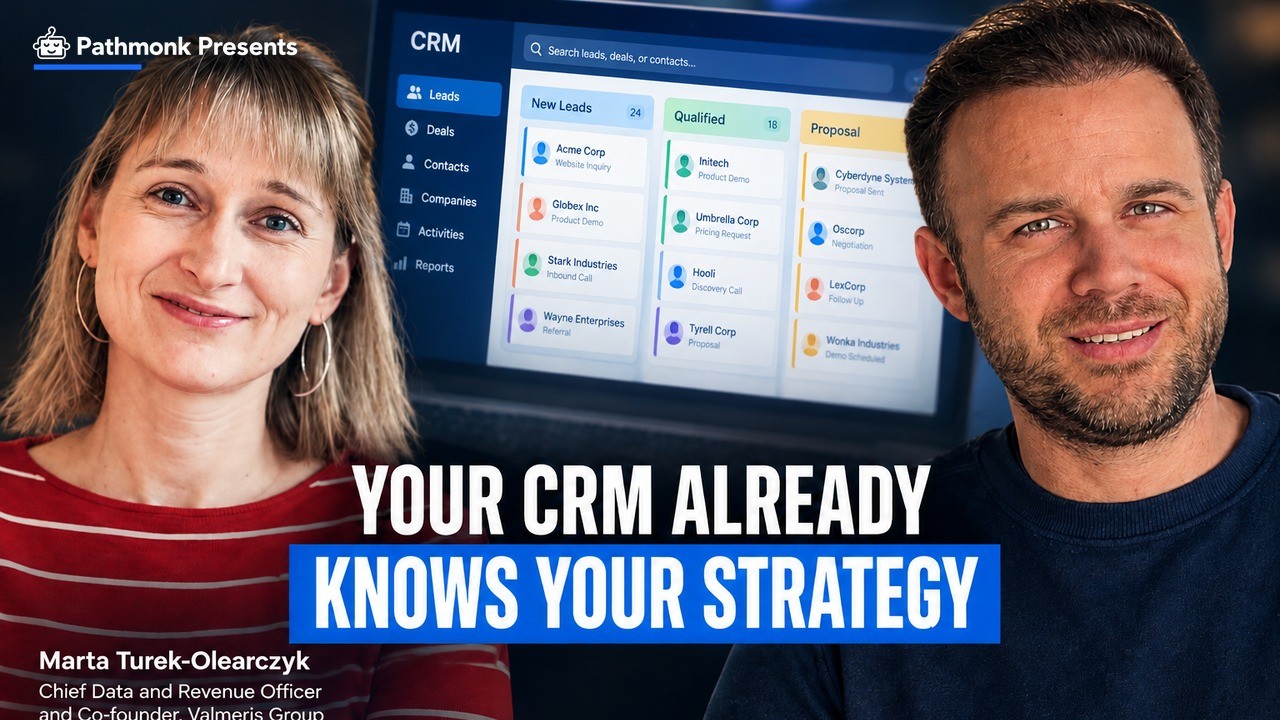
“When a new president starts in their role, they get multiple intelligence briefings, but a new head of sales or marketing gets a Salesforce login.”
at
- Company
- Valmaris Group, the revenue system behind your GTM strategy
- Speciality
- Revenue analysis from CRM and marketing platform data
- Works with
- Mid-market B2B companies with $50M to $500M in revenue: SaaS, tech, fintech, health tech, cybersecurity
- Deliverable
- The data briefing CMOs and CROs never get, plus a plan to find the best next customers
- Model
- A service that aims to work itself out of the job
Rapid fire
- AI tools she relies on
- Clay for research, Claude Code for coding and learning
- Her source of signal
- DeepLearning.AI and books, LinkedIn for the market pulse
- Automating LinkedIn
- Never, she scrolls manually to avoid a ban
Too long, didn’t listen?
New heads of sales and marketing get a Salesforce login instead of a briefing. Marta Turek-Olearczyk, co-founder of Valmaris Group, builds that missing briefing from the company's own CRM data and marketing platform data. Her team works with mid-market B2B companies between $50 million and $500 million in revenue, starts from a business question such as missed targets, and treats the work as a data science problem, not a dashboard problem.
On AI, she sees two needs: a shared semantic layer so the CMO and CRO bring the same number to the board, and training people to ask their data better questions. She also shares how she uses Clay and Claude Code, and where she finds signal.
Start from a decision, not a dashboard
Begin every analysis with a main business question, such as why you keep missing target. Each answer points you to the next question.
Don't wait for clean data
Run an exploratory analysis first, drop the columns that are not good enough, and clean up as you go. You only learn what to fix once you start using the data.
Find the 20% driving 80%
Break down revenue by business size, geography and client type. You will see where you lose money and where you could make more.
Fix meaning before you add AI
Agree on what each field means in each system. Without that context, an agent gets the analysis wrong, and your CMO and CRO end up presenting different numbers.
Some brilliant ideas
“The biggest challenge is that most businesses don't understand the goldmine that they're sitting on, because they're so used to just receiving dashboards.”
We have combined 80 years of experience. Well, that's fantastic, but you're still making decisions off gut.
Most companies still run their data off tribal knowledge. An agent doesn't know that. You don't give the agent that context, and your whole analysis is wrong.
Full transcript
Introduction
[0:00:14] ADRIAN GARCIA RAMOS: Okay, so welcome to Pathmore Presents where we talk with growth and marketing leaders about what's actually working right now. I'm Adrian, your host, and today I'm joined by Marta Turek-Olearczyk. Chief of Data and Revenue Office, and co-founder at Valmaris Group. Hi, Marta, how's it going?
[0:00:37] MARTA TUREK-OLEARCZYK: It's going very well. Thank you. Thank you for having me.
The briefing new revenue leaders never get
[0:00:40] ADRIAN GARCIA RAMOS: Absolutely delighted to have you over here today. So, Valmaris, calls itself the revenue system behind your GTM strategy. In your own words, what does that mean in practice for a CMO or a CRO?
[0:00:58] MARTA TUREK-OLEARCZYK: Okay. So… I'm going to… I'm going to go with an analogy. So, you know how… You hear when a new president starts in their role. They get multiple intelligence briefings, but a new head of sales or marketing gets a Salesforce login. And then, weeks later, they're getting questions from the CEO about. targets, and are we gonna hit it, and why didn't we hit it? And they're getting all of these questions that they're on the hook for. And that's where we come in. We have this philosophy that the strategy is already sitting in the company's data. And so we… that… we will build them that briefing that they never receive, that they should be receiving. Instead, they're relying on tribal knowledge and asking the person who's been there the longest.
And then we will analyze their data. To give them that evidence, so that they're not working off gut. And then we'll work out for them who are their best customers, and that's the companies and the people within them. Right. And then we will look for clues to… identify, how… how do you find companies that might be a best next customer? So what are those clues in the data? So that's where we combine the first-party and third-party data. And then, so then we will use that information to help find those best next customers. So that's, in a very simple way, how we would build that system.
[0:02:42] ADRIAN GARCIA RAMOS: Absolutely, that resonates to me a lot, especially because I joined a company not so far in the past, and I had to do that on my own.
[0:02:51] MARTA TUREK-OLEARCZYK: is.
[0:02:52] ADRIAN GARCIA RAMOS: Without any tool.
[0:02:53] MARTA TUREK-OLEARCZYK: sorry.
Where the data lives and messy CRMs
[0:02:54] ADRIAN GARCIA RAMOS: knowledge. So I was you know forsaking so to so to so to say it. So I'm wondering what are the main sources of data that you retrieve from a company when you start this methodology or or this procedure?
[0:03:10] MARTA TUREK-OLEARCZYK: So, the main source of data really is the CRM, and so, basically, CRM and also their marketing platform data. So, if they're using, you know, Marketo, for example. But so, because, you know, Marketo and those marketing platforms, they will give you the data before something becomes an opportunity or gets into the CRM. But the CRM really contains all of the history that the company has, with… so, every account that they've ever tried to pitch, every… every opportunity that they've ever lost, every opportunity that they've ever won. So, you really have a… a cross-section of the business in the CRM.
[0:03:54] ADRIAN GARCIA RAMOS: Sure. I'm wondering here about the… the CRM itself, because the problem is that, I mean, oftentimes, the problem is not, like, many things in the company, but rather the CRM, which is a fiasco, you know? So, I wonder… What do you do when you see a CRM that is, you know, maybe not optimized, or there are not rules, or it's very, you know, missing in terms of, like, the key features or the structure? Is that something that you take care of?
[0:04:28] MARTA TUREK-OLEARCZYK: So, it's interesting, you know, this question comes up a lot whenever I talk about the CRM, and so we work with mid-market companies, so we typically don't work with, you know, a startup who's just starting, or, you know, 2 or 3 years in, because They typically won't have a very rich data set. And so, with… Those bigger companies, you find that the CRM is… is going to be… one, is cleaner, and two, it just… it has the volume of data where you can still get the averages out of that data. So, what we typically find is that Sure, you might have a CRM where… literally, I've pulled data from CRMs where there's over 500 fields. And so, part of the process is looking at the health of the data, and we will throw out the columns where it's not good enough. But one of the things that.
So one of the objections that you get about working with the data is people say, well, my data isn't clean.
[0:05:30] ADRIAN GARCIA RAMOS: you.
[0:05:31] MARTA TUREK-OLEARCZYK: It's only when you start working with your data that you really start to understand what you can get out of it, and what you need to clean. And then… and then as you work more with it, then you do that cleanup in the process. So yes, to answer your question. We do a… we will do an exploratory data analysis of the data set before we start analyzing it, and you will get our feedback and our output from that.
Who Valmaris works with
[0:05:54] ADRIAN GARCIA RAMOS: Right, so you mentioned that you work with, medium-sized companies. I don't know if you can, you know, kind of highlight some verticals, just for audience to understand what kind of companies are you targeting or supporting. And not only in terms of the vertical, but also the size might be related to, you know, like, a revenue they have, or the number of employees, just to have an idea.
[0:06:17] MARTA TUREK-OLEARCZYK: So, typically, mid-market B2B companies, so SaaS, tech, fintech, health tech. cybersecurity, those types of verticals. We do work with B2C clients as well, but those, more typically, they'll be on the data layer, so when we're working to, like, actually fix the data pipeline. And then $50 million to $500 million is kind of like a, you know, it's a pretty big range, but yeah, but, you know, companies that have pretty complex sales cycles and have a lot of stakeholders that are involved in making the decision.
From business question to revenue insight
[0:07:00] ADRIAN GARCIA RAMOS: Sure. So, I'm wondering now, like, this is, in a way, a high liability job, right? In a way that if you make a wrong recommendation for For a 15 million company, that means a lot of money, and probably some heads are going to, you know, to be cut in a way. So. What is the process when… because one part of the thing is to. Understand everything from a company, you know, study a CRM, follow along with the people handling the thing and, you know, catching up. What comes next and how do you implement your solutions?
[0:07:42] MARTA TUREK-OLEARCZYK: So… you know, I mean, you know, CRM has a lot of data, so you.
[0:07:48] ADRIAN GARCIA RAMOS: Right.
[0:07:48] MARTA TUREK-OLEARCZYK: It's not like you go in and you're like, okay, let's analyze all of your data. You always… you always start with an overarching business question, a decision that someone needs to make. So, for example. If the CRO is coming to us with a problem that they're not hitting target, then that becomes the overarching question that drives the investigation. So, we treat the analysis like a data science problem versus a dashboard problem. So we're not just… we're not going in, building a, you know, a few random charts and saying, let's analyze the charts and find the story in the charts. We're asking business questions, and then really what happens is that we… and this is why we say the strategies and data, is because you ask one question, and then it leads you further into… you investigate that, that piece that you find, and then you go into the next question, and the next question, and so…
there is a high level of accountability. I mean, we make sure… we double and triple check all of our analysis and make sure that the numbers that we're producing are correct. We have manual checks and checks within the code. But the thing is that We're typically giving a company intelligence that they're sitting on, but they didn't even know that.
[0:09:06] ADRIAN GARCIA RAMOS: surprised.
[0:09:07] MARTA TUREK-OLEARCZYK: how few companies can tell you where 80% of their revenue comes from. So… so, that's where we, you know, we will take the data, we will analyze it, and then we will share with them our strategic perspective of how… what… what we… what this means, what the implications are, but oftentimes. you know, the data we provide is so revealing. If I can… if I can show you a chart where I can show you where the 20% that's driving 80% of your revenue when it comes to business size, geography, types of clients, and where you can suddenly see in a visual where you're losing money and where you could be making more money, we don't really need to tell them how to use that data. They know how to use it, they just… they weren't…
I think the biggest… I think the biggest challenge is that most businesses don't understand What they're sitting on, the goldmine that they're sitting on, because they're so used to just receiving dashboards.
Working themselves out of the job
[0:10:05] ADRIAN GARCIA RAMOS: Yeah, absolutely. I wonder about your business, like, do you provide a service or a product? How do you structure the thing?
[0:10:12] MARTA TUREK-OLEARCZYK: It's a service, and so our goal is to… Our goal is to empower the teams that we work with. So, for example. you know, sometimes we're coming in to solve a small problem, and sometimes we're coming in to solve a much bigger, longer-term problem, like, you know, fixing the data layer, which is a big thing in today with AI, it's a whole different conversation, but, you know, most… most companies still run their data off tribal knowledge. Oh, I know that this thing means this in this data set, which means I know I have to change it here. An agent doesn't know that. You don't give the agent that context, and your whole analysis is wrong.
And so you have to so those any data layer related engagements will be much longer. Right. But really, our goal is to… empower the people that we work with, so we don't… you know, we try to work ourselves out of the job. And what that means is, you know, we… either it means that we help you set up whatever systems and processes that you can continue to do it yourself. Or, you know, you might need a one-off analysis, and then we'll work with you and do that for you. So, for example, if someone is, a CMO is going into a board meeting, and they need help to prepare for that, and they need a narrative and a data analysis and a strategy, then we can do that. But, you know, the board meeting's done, and you've got what you need, and… and you've secured, you know, our goals… your goals to secure budget, we're gonna help you to secure the budget, and that's… and that's how, kind of, you know, did we succeed or fail, is kind of measured by that.
What makes a client call
[0:11:53] ADRIAN GARCIA RAMOS: Yeah, actually, that goes in line with my next question, which is related to the incentives, or the motivations, the pains, right, that your customers have when hiring you. Not only to hire you, but actually to find you, right? Because In a way, To solve a problem, you first need to know that you have a problem, and as you portrayed it before. oftentimes, it's kind of a black hole of opportunity sitting on your CRM that no one is looking at, and you are making $50 million a year, so you could be making maybe $100 or $200 million a year, but no one is really looking into it, right? So. how are your… what is the spark, right? That… that says to one of your customers, okay, I need to talk to Marta, because he can… I mean, she can support… support us, finding this opportunity.
[0:12:51] MARTA TUREK-OLEARCZYK: So really the the problem and the spark is a simple one, is that they have revenue problems. So yeah, and that's and and the we missed target or we're not going to hit target, and then that's repeating itself consistently.
[0:13:07] ADRIAN GARCIA RAMOS: Okay.
[0:13:07] MARTA TUREK-OLEARCZYK: example. So that's… that is, it's a simple problem, but it doesn't always have a simple solution. And, and the… and, you know. The truth is that in the market, there's so many different companies that can support a business that is struggling with revenue, and so we… we speak to the people that are… that like the idea of, like, making decisions from data versus just making decisions from gut. Because the truth is that most businesses run of, you know. you've got your C-suite or your senior people in the company that have some combined… we have combined 80 years of experience. Well, that's fantastic, but you're still making decisions off gut, and you are still… most… most people in their, you know, in your day job, you're so entrenched
In the things that you have to do today, that you don't see the big picture. And so that's really where an outside perspective is valuable. Yeah.
[0:14:17] ADRIAN GARCIA RAMOS: Yeah, as a matter of fact, I guess that, and this is my assumption, that for larger companies, the point is that they have some Marta's working exactly for running the thing in-house, right? I'm making sure that, you know, the whole business, there's a business controller, or Someone related to the C-level, as you said before, is going to be looking after it, and it's going to be iterated on that, dedicated exclusively for that. Whereas for small companies, they are in kind of a transition from, you know, SMBs to something else. It might be the case that they need to hire someone for this particular job. What do you think about?
[0:15:02] MARTA TUREK-OLEARCZYK: I think that… so… there's… there's definitely opportunity in both. Like, we've… there are some really big companies that don't have… they don't have a dedicated data department. They don't have a dedicated data team. They've got… they are relying on their marketers to do… to pull data from the CRM, or to do the analysis. Right. And so, there is really… we find You know, the people that we work with and the teams that we speak with, there's the opportunity on the big company side, and then what you're describing. Absolutely. I think the, with a smaller company, it's going to really depend on the revenue problem that they're trying to solve. So, for example.
We might… they might not have enough data. for us to be able to analyze that data and reasonably say, well, these are… this is a picture of what your best customer looks like. They might still be developing that, but… If they want to be targeting their customers in a, like their idea, they have an ideal idea of who their ICP is now. In this really noisy market that we're sitting in in 2026, how do you target that customer? And so what you want to do is you need to, A, you need to really understand very well what problem it is you solve and who do you solve it for. And so that's your… that starts to become, you know, the profile, the thermographic, and the demographics of the companies that you want to work with. But then you need to…
Think really strategically about what are the signals that could indicate that this might be a company that is ready to work with me. And that's where your third-party data comes in, and so that's, you know, that's another piece of the work that we do, is combining that first-party and third-party data to come up with a strategy where you're not, you know, where you're fishing in the right places. Like, we're all fishing for business and for clients. But it's about making your fishing a little bit more targeted because today in the, you know, the thousands of automated outbound emails that are swimming around everywhere, you want to have a very. You want to pick your lane and you want to have a clear strategy.
AI, semantic layers and data training
[0:17:23] ADRIAN GARCIA RAMOS: Yeah. So, I would say that it is for all known, that our, you know, AI is coming big, and as a matter of fact, there are some, you know, announcement. related… relating the, for example, the CEO of Salesforce with, Anthropic, right? And they are looking forward to have a full integrated solution that could allow anyone using Salesforce to, in a way, retrieve data, but not only, you know, data points, but also insights from their Crm. in a different way, let's put it this way, right? So I wonder what's your take on that, and whether or not that could be. You know, not a threat, but maybe a compliment, or an add-on for your service in the future.
[0:18:18] MARTA TUREK-OLEARCZYK: So. you know, measurement and what we measure and how we use data to inform our decisions is absolutely changing, and I, you know, I spent… I think I spent a good decade building dashboards. I don't know if I would build a dashboard again. So I have changed my methodology of how I work with data and how I interrogate data, and so, I think there's going to be… more and more ways to query your data and to get… to use your data to get answers. And I think that there's… There's two areas that businesses are going to need help with. And one is… one is that, you know, the semantic layer, the meaning. What do… what do different things mean in different systems, and making sure that everyone has the same understanding of what something means, because if you don't, you're going to get a different… you're going to do a different analysis, or you're going to get… the AI is going to give you something different from another team, and then suddenly you have big problems because you're coming into
a board meeting, and the CMO is presenting one number, and the CRO is presenting another number. So that is… that is a really key area, and that's one of the areas that we work with in terms of, like, fixing that data layer, because now you have to think about meaning. What do things mean? The fancy word for that is semantics. And then… but then the second piece is people are going to need to be trained on How to… how to ask… AI or any system questions of their data, because it's one thing to go and build 20 charts or… or ask 20 different questions and get, you know, the LLM will spit out a whole bunch of data at you.
But it's another thing to be able to understand, okay, what is the decision that I'm trying to improve? And what are the questions that I need to ask that'll help me to improve that decision? And then what are the sub-questions that I need to ask? And what is the data that I need? to… to get at those answers. And so that is, that is an area where I think. Companies will need help in terms of learning and training and understanding how to work with data.
[0:20:34] ADRIAN GARCIA RAMOS: Yeah, I'm just asking like who better than you for providing that training, right?
[0:20:38] MARTA TUREK-OLEARCZYK: Oh. Thank you.
[0:20:41] ADRIAN GARCIA RAMOS: We've got a… no, but this is, you know, honest feedback, like, we've got a couple of, interviews in which The ultimate question is that, okay, so you are the expert, we know that this is coming big. There's no one else better than you to train people on that. And maybe you need to start thinking instead of. Retainers. To think more on? training models, right? So that you can keep the bank word in the industry. But at the end of the day, you, in a way. Accept or understand that most of the things that you are doing today are going to be mainstreamed in the future. And it is going to be your customer who's going to be using that knowledge or that methodology to keep going, whereas you are going to be focused specifically on innovation and, let's say, getting the most out of all the tools that we have in the market.
Before?
[0:21:40] MARTA TUREK-OLEARCZYK: No, no, I… and, you know, I completely agree with you that, the… even… I think the… the profile of customer in general is changing. The AI world has resulted in… everyone… everyone wants to be able to do everything themselves. So I think that the more that you can enable As a service, rather than just doing the service itself. That is definitely where, I think that's where a lot of business models will move, is… is just… especially people that have expertise, is disseminating that expertise so that other people can do the work themselves.
[0:22:26] ADRIAN GARCIA RAMOS: Yeah, as a matter of fact, I see it as a… in a way, a medium that is going to be needed to facilitate the spread of technology, because nowadays we have the technology. The expertise is so little. And then there is a huge, you know, consumer base that is, as you said, looking forward to have more and more, not access, because the access is, in a way, warrantied. but also… but I would say the knowledge to use that technology in a proper way, right? Yep. Without going to the board of directors and presenting two different things from the CMO and the CSO, right, or something like that. So…
[0:23:05] MARTA TUREK-OLEARCZYK: you.
[0:23:06] ADRIAN GARCIA RAMOS: That's, I would say the… the untapped opportunity, in a way. Of course, you know, combined with many other things, but… This is coming very across for people like you and me.
Clay, Claude Code and the speed of learning
[0:23:23] ADRIAN GARCIA RAMOS: Anyway…
[0:23:24] MARTA TUREK-OLEARCZYK: I.
[0:23:24] ADRIAN GARCIA RAMOS: I wanted to ask you about, you know, these AI tools and things that we are all using these days. If there is something that, you know, you've seen. Super relevant change that makes your life easier, because if you can use it, you know, in your day-to-day work, or with your colleagues. If there's anything that you can share with the audience that could be relevant for them as well.
[0:23:54] MARTA TUREK-OLEARCZYK: So, you know, I work with data, so my work is quite specific, but the, you know, the tools that… so one of the things that. I have… realized myself with AI is, you know, at the beginning, we were down this path of everyone wants to build their own agent, everyone wants to build their own thing. And… but I… I work… I work a lot in clay, and clay has… really strong research agents built into the tool. And so… I, I use… so for the type of research that Clay can do, I will use Clay. But then, if, for example, I need very specific data that I need to pull, then I might use, you know, another scraping tool to get at that data from a specific website. So… so that's… so that's one thing, is I think we're starting to get to…
Maybe an understanding of, well, yes, I could build it, but should I?
[0:24:57] ADRIAN GARCIA RAMOS: Right.
[0:24:58] MARTA TUREK-OLEARCZYK: Like, is that… is that where my time is best spent? So that's… that's where I think Clay is really… For first party data, like combining a first party data and your third party data, they are one of the companies that, like, they launched audiences at the end of June. So they're one of the first companies to do that. And so they're really at the forefront. And then, honestly, I use Claude Code a ton.
[0:25:22] ADRIAN GARCIA RAMOS: Okay.
[0:25:22] MARTA TUREK-OLEARCZYK: Because… because I code, and because… and also because I work in different technologies, and so, you know, I'm… I'm more of a snowflake, like, I have more experience in Snowflake, but I'm working in BigQuery. And so… What, what Claude Code allows me to do. And I think this is an underutilized use of AI, is the speed of learning. Because I can figure out BigQuery. so much faster by using Claude code versus… versus reading the develop… like, if I had to read all of the developer docs myself and find everything myself, that's gonna take me a lot longer. But I can really get into the weeds of a technology by using Claude. And because I'm coding, I use Claude Code a lot. And those are two of my biggest use cases for AI.
Finding signal in the noise
[0:26:19] ADRIAN GARCIA RAMOS: Absolutely, yeah. So that, brings us to the last question, and this is also related to. you, you know, your experiences and your insight. We all live in a very noisy, you know, world, with many You know, sources of information trying to reach us, and sometimes it's a bit complicated to follow them up. The question is about what is bringing you signal if you were to, you know, select a single source of information that brings you signal out of those Different noise sources, right? What would that be, and how you use it?
[0:27:07] MARTA TUREK-OLEARCZYK: Okay, So, I have, like… We could say, like, I have a filter mechanism, because, And so I'm gonna answer your… I'm gonna answer your question by not answering, I'm gonna answer it in a slightly different way. I'm gonna get to my signal, but I… so, I still think… Having some of the noise is important, because the noise… So I… LinkedIn is my noise. I follow a lot of different people, but I use LinkedIn as… and I X to a lesser degree, for my pulse on… what… what is the market talking about? What are the early… the kind of early innovators? What's, you know, suddenly everyone's talking about Jet. I'm like, okay, this is a thing. This is a thing that I need to pay attention to. So… so there's a lot of noise on LinkedIn, but I'm picking out the things that are new, or trending, or important, because part of… part of my job is
to be more knowledgeable than my customers, and so I need to know what's happening. That's right.
[0:28:07] ADRIAN GARCIA RAMOS: much.
[0:28:07] MARTA TUREK-OLEARCZYK: Well, exactly. But then, in terms of really getting into the signal. I go… so there's two… two resources that I use. I use Andrew Eng's deeplearning.ai to… and that's… that's like a, you know, he founded Coursera, so, like, deeplearning.ai, it's about… it's all about AI. So, this is where I am, you know, if… If I want to know how to build an agent from scratch, this is where I'm going. So I'm going to a known resource to hone my skills.
[0:28:41] ADRIAN GARCIA RAMOS: Okay.
[0:28:42] MARTA TUREK-OLEARCZYK: And then, and then I'm using, and then books. So I am, I am in terms of understanding how data architectures are changing in the world of ai. I buy books and I read books because I think data is so dense and complex. I don't feel like I can get everything that I need out of a podcast or an article. So I go deep into the subject matter.
[0:29:02] ADRIAN GARCIA RAMOS: Super short follow-up question on the first two items that you mentioned. Do you do that, like, manually, or programmatically?
[0:29:13] MARTA TUREK-OLEARCZYK: On LinkedIn?
[0:29:15] ADRIAN GARCIA RAMOS: Yes, MX.
[0:29:17] MARTA TUREK-OLEARCZYK: No, you know, I am really afraid of doing anything programmatically on LinkedIn, because they're so good at. Like, when it comes… you know, I've done scraping in my… in my time, and so, you know, I know how… I know how to get into a website, but, Linked… if LinkedIn picks up anything automated.
[0:29:40] ADRIAN GARCIA RAMOS: I know, I know.
[0:29:41] MARTA TUREK-OLEARCZYK: The chances of getting banned are so high, and there's so… you know, it's years of investment building up your LinkedIn profile, and so I just… I don't want to risk it. But then the other thing that I find is that If certain things in order for me to absorb it, it really helps if I do it manually because because yes, I'm scrolling, but. I'm absorbing so many things peripherally that I think I wouldn't get if I was just getting a clean one page summary out of an LLM, for example.
[0:30:11] ADRIAN GARCIA RAMOS: Right, right. Okay, so Marta, thanks so much for coming on. It's been a pleasure talking to you. I think, you know, we go with a lot of insights and relevant, you know, comments on the points that you discussed. I would like to give you the word, in case you want to mention, you know, the URL of Valmaris, or anything that you consider is important for our audience, also to reach you out on LinkedIn, or whatever it is.
[0:30:40] MARTA TUREK-OLEARCZYK: Yes, thank you. So yes, please do find me on LinkedIn. I am Marta Turek on LinkedIn. Don't worry about the last name. That is easy to find. And then Valmarisgroup.com as well is where you can find us on our website.
[0:30:55] ADRIAN GARCIA RAMOS: Amazing. Thank you, Marta. Let's stay in touch.
Got a growth story worth sharing? Tell it on the show.
We talk with founders and marketing leaders about what actually moves their pipeline. If you’ve built something other marketers can learn from, we’d like to hear it.
- 01Apply
Tell us who you are and the story you’d bring to the show.
- 02We get in touch
We review every application and reach out if it’s a fit.
- 03Record your episode
A remote conversation, published as video, audio and a full transcript.