AI writes faster, but it can't tell you why buyers buy
Content strategy starts with why buyers search, not who they are. Gary Parkinson of garyparkinson.net shares his framework and where AI falls short.

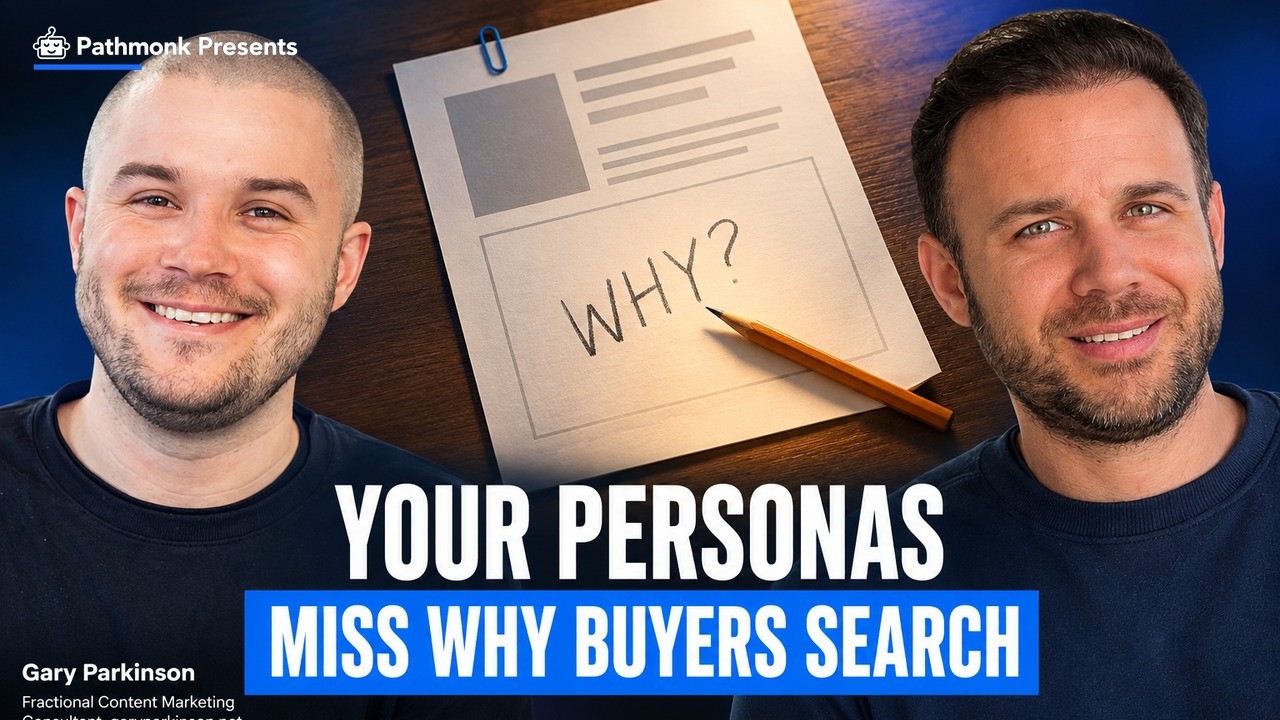
“You could do that, but you may just be creating things without actually targeting the right people with them and getting the right message out to them, and so it's going to be a lot of effort for very little return.”
at
- Company
- garyparkinson.net, fully freelance and independent
- Speciality
- Fractional content strategy and execution
- Works with
- Small and mid-sized businesses in B2B software, financial services, travel, food and beverage, sports marketing and media
- Deliverable
- Content roadmaps and assets tied to conversions, leads and new business
- Thinking partner
- Claude, trained as a strategic sparring partner
Too long, didn’t listen?
Gary Parkinson is a fractional content marketing consultant who embeds with small and mid-sized businesses as a senior content partner, without an agency markup or a full-time salary. He tells Pathmonk co-founder Adrián García Ramos that many clients assume they just need to create content, which risks a lot of effort for very little return. His fix is to start with psychographics: why people look for a solution, not just their job titles.
Gary also shares the know what fight you're in quadrant he learned from a fractional CMO mentor, which matches messages to each stage of the buying journey. He closes on AI: 2025 hit his business hard, but he now uses Claude as a strategic thinking partner.
Find why buyers search, not just who
Go past job-title personas to the psychographic reason people look for a solution like yours. That underlying problem is what your content has to speak to.
Set the message before making content
Work in sequence: understand the audience, shape the message, then build the strategy and choose the assets. Making content first means a lot of effort for very little return.
Match each message to a buying stage
Split your audience into four stages, from people who have never heard of you to people ready to buy. Tailor the message and format to move each group to the next stage.
Use AI for speed, humans for insight
AI helps you produce more, faster, but it can't read the emotional reasons behind a purchase. If you work alone, train a tool like Claude to act as the thinking partner you lost when you left a team.
Some brilliant ideas
“Let's go deeper than that and try to understand, beyond the demographics, what is the psychographic reason that people are actually looking for a solution like what you have to offer?”
Many businesses have realized that it's a very effective tool at helping you produce more faster, yes. But it doesn't have the ability to do that psychographic analysis of people in the same way that human minds are able to do.
When you step away from that and you're just a team of one, you lose that groupthink.
Full transcript
Introduction
[0:00:14] ADRIAN GARCIA RAMOS: Okay, so welcome to Pathmonk Presents where we talk with growth and marketing leaders about what's actually going right now. I'm Adrian, your host, and today I'm joined by Gary Parkinson, fractional content and marketing consultant at garyparkinson.net. Hi Gary, how's it going?
[0:00:34] GARY PARKINSON: Doing well. Thanks for having me.
Turning content from a cost center into a revenue engine
[0:00:37] ADRIAN GARCIA RAMOS: So, it's a pleasure to have you. So, what is that you do, and Yeah, tell us about your business.
[0:00:46] GARY PARKINSON: Yeah, my, the. long and short of my business is I'm a fractional content strategist, meaning that I embed myself with SMBs and other marketing teams as a senior content marketing partner. But without the overhead of an agency or the commitment of a full-time hire. So I handle both strategy, execution, whatever is required for my clients, building them content roadmaps, creating the assets, making sure everything is tied back to business outcomes. And not just vanity metrics, but the outcomes that really matter. Conversions, leads, and actual new business. And the tagline that I like to use is that I help brands turn
Content marketing from a cost center into a revenue engine.
Serving SMBs stuck between an agency and a full-time hire
[0:01:38] ADRIAN GARCIA RAMOS: Perfect. So I'm wondering here about the the type of customers that you you you serve, right? Because you might be, let's say, focused on big corporations or rather kind of startups. What is it?
[0:01:53] GARY PARKINSON: Yeah, it's kind of a hybrid between. I tend to not do early-stage startups, but also not do large corporations either. It's more that small to mid-sized SMB niche in the middle. Typically, these are busy marketing leaders that, and they're working in industries like either tech and B2B software to financial services to travel and tourism to, I've done some work with food and beverage, sports marketing companies, and a lot of media and publication businesses as well. Most of these businesses and their leaders, they know they need better content, and in a lot of cases, they either don't have the bandwidth to manage another vendor.
And they simply don't have the capacity to train a junior creator from scratch, and they also don't have the budget to hire someone, who requires a much larger full-time salary with benefits to do all of these things. So they're kind of caught between I I don't want to say bad options, but but options that are not as feasible and practical to their businesses. And so the core problem that I solve is giving them that senior level strategic thinking and reliable execution all in one package without that, you know, 150K salary or whatever an agency is going to charge as a markup.
Content as a full funnel experience across channels
[0:03:26] ADRIAN GARCIA RAMOS: Yeah, absolutely. I'm wondering now about the, the content landscape, right? Because, I guess that you're going to have a lot of insights on that. We are… to me, we are experiencing a transition from, let's say, blog posts and content that is going to leave life, you know, leave in the websites, to content that is going to be spread across different platforms, right? Not only your money sites, but rather, you know, the social networks. or even in videos. I'd like to have your… your… your thoughts on… on how we are transitioning from different formats of content, and whether or not you are also focused on these kind of new formats, not only including the platforms, but also the, you know, the shape of the thing, right? Like a video, or any other, you know, meme that you might find out there.
[0:04:21] GARY PARKINSON: Yeah, I think it's… it's a good point to raise, in that the… the best approach to a content strategy, from everything that I've seen and experienced, is you want to treat it like a full funnel experience, meaning it should cover many different assets. It shouldn't just be writing blogs and those typical articles, but creating videos, creating case studies, creating testimonials, creating UGC community content, pulling in comments, and trying to generate assets that you can then use to promote across all of your channels, be it social, email, your websites, podcasts, videos, webinars, and anything… any PR pickup as well. You.
you want to make sure that you're covering the whole spectrum there. And I think also with. the rise of AI and its influence on marketing and content marketing as well, you need to be adapting to those requirements, too.
Where a content strategy should start
[0:05:30] ADRIAN GARCIA RAMOS: Sure, sure. Actually, I'd like to ask you, you know, if you were in the shoes of, let's say, the customers that you have, right, and you are considering about building a content strategy. what would be the first things that you would consider when it comes to create the whole strategy, right? Before just getting in contact with you, and what are the important things, or the heuristics that you can have into account when drafting What are the things that you need to do?
[0:06:01] GARY PARKINSON: Yeah, it's a great point, because a lot of the time when I first, start working with a client, their assumption is that, well, we just need to create content. And I always say, well, you could do that, but you may just be creating things without actually targeting the right people with them and getting the right message out to them, and so it's going to be a lot of effort for very little return. And so, one of the things that I… and I have worked in companies as well before starting my own business in my own capacity. So I've lived these challenges and these problems firsthand, and the thing that I always tell clients is, first thing that we need to understand is, who exactly are you trying to reach?
And I don't mean just, what are the… those, you know, those little… marketing profiles that you get created, like, like Dapper Dave, or, or… Savvy Sam, you know, these clever little taglines with just, you know, job titles and roles and responsibilities. I always say, let's go deeper than that and try to understand, beyond the demographics, what is the psychographic reason that people are actually looking for a solution like what you have to offer? What's that underlying problem that they have that they're looking for in a solution? And by starting with that, we really start getting inside the heads of the people that we're trying to reach. That information then informs
the message we want to be creating to bring your brand to market. We can optimize what you have and make sure it's tailored to speak to those underlying needs. And then from that message, that's where you can build a content strategy to get that message to market, and then figure out what are the assets that we need to best do that. So it's sort of a… It's sort of a sequential process in that way.
[0:08:04] ADRIAN GARCIA RAMOS: Yes. Yeah, I think that that's super relevant, and not only for content, but also for, you know, many other things within the company. You need to know not only the pain of your customer, but also the language that you should use in order to reach out. And that goes for the marketing, but that also goes for outreach. For example, or maybe for running ads, or for, you know, defining the email nurturing strategy that I want to
What clients already know about their audience
[0:08:35] ADRIAN GARCIA RAMOS: rely on for bringing back, you know, the leads that they have generated on the website. So, I wonder if you, in a way. ask for this kind of, work already done within the companies that you work with, just to have, you know, some, start point instead of just creating everything from scratch. And what do you find? What do they reply? Do they have anything at all, or it's just, like a wasteland?
[0:09:00] GARY PARKINSON: It's a mixed bag. Some of them have done a lot of that work. And so it makes stepping in to help translate that into how do we bring that message to market a lot easier. And in some cases, they haven't done that. They just have the basic demographic information, but it really doesn't tell you anything about… they have information that tells you excuse me, who they're trying to reach, but nothing that really explains why they're looking for you in the first place. And so that's where…
The know what fight you're in quadrant
[0:09:33] GARY PARKINSON: I try to step in and help them think, okay, let's go a step deeper here. I worked with a great fractional CMO once. who actually became a bit of a mentor for me as well, and he… he introduced me to this framework that I now bring to a lot of clients as well, which is this know what fight you're in quadrant, and sort of breaking down not just the audience you're trying to reach, but then at what stage are they in their buying journey with you? And sort of summarizing that into four quadrants, from… The ones that are right there on the tipping point, ready to make a purchase, to as early as they haven't even heard of you yet, and have no idea.
what it is that you have to do, and then you segment them by those different quadrants. And so the message you're taking to people at each one of those stages needs to be tailored for where they're at in that journey. And then that. Message then informs what are the types of content best suited to reach people and then move them to the next stage of that journey.
[0:10:42] ADRIAN GARCIA RAMOS: Right. Is that public? Just for me to know.
[0:10:45] GARY PARKINSON: It's not public yet. I am working on a framework for that that I am going to be publishing soon, though.
[0:10:53] ADRIAN GARCIA RAMOS: Sure. So, is that going to be soon on your website?
[0:10:56] GARY PARKINSON: Yes.
[0:10:57] ADRIAN GARCIA RAMOS: So probably by the time, the audience is going to be listening to this podcast or interview, might they have it in a website?
[0:11:04] GARY PARKINSON: Yes, my goal is to have that live and consumable by the beginning of November. Excellent. Which I think should be before this actually goes live.
How AI shook up content marketing
[0:11:17] ADRIAN GARCIA RAMOS: Right, right, right, excellent. So that's a great adding to the show, I would say. So, Benny, I would like to know about you. positioning and, and thoughts, on, on AI, right, and content, because there are many, you know, different angles, I think that the question is obvious, right? Like, people are… more and more every day using AI tools to create content.
[0:11:44] GARY PARKINSON: I.
[0:11:44] ADRIAN GARCIA RAMOS: What do you think about that?
[0:11:47] GARY PARKINSON: It's, it's been quite a, a journey with that, I would say last year, in 2025, I think is when it really started exploding to the point where a lot of businesses thought, well, we can just do a lot more with AI, and that's that. And it did put a real dent into my business, and a lot of people like… like me as well last year. Last year was a very difficult year, I won't lie. I've seen the pendulum swing back the other way this year, though. I think people have realized that they are still… AI is here to stay, and it is going to change the way that we go about, not just with content marketing, but marketing in general, and just business development in general. It is going to continue to change and evolve the way that we do things, and you either have to adapt and keep up with it, or you get left behind. That is the facts.
What I will say about that, though, is that Many businesses have realized that it's it's a very effective tool at helping you produce more faster, yes. But it doesn't have the ability to do what I was talking about in terms of that psychographic analysis of people in the same way that human minds are able to do. It can't really connect… it can do a lot of logical analysis, but it can't really understand how does the emotional and underlying psychological reasons that make people look for solutions, how does that also inform the logical decision-making? And so… There are still gaps in what AI can and can't do for a business.
And that's where I've certainly been moving my business and my services to help fill those gaps and be that added piece that can also take on a lot of the work in managing your AI and creating prompts and generating more assets at scale, but doing so while incorporating all of that That, psychographic, emotional, humanistic analysis into the work we would need to do.
Claude as a solo strategic thinking partner
[0:14:15] ADRIAN GARCIA RAMOS: Right. So…
[0:14:16] GARY PARKINSON: I hope that answered that.
[0:14:17] ADRIAN GARCIA RAMOS: Yeah, yeah, yeah, yeah. I would like to, you know, boil that down into one specific case that you might be using with AI that could be helpful not only for you but also for audience. That could, in a way, make it concrete, right? Something of the things that you're doing. Yeah. Do you have anything in mind? Yeah.
[0:14:39] GARY PARKINSON: Absolutely. Yeah, I think, so in my particular case, you know. as a… I call myself a solopreneur, when you're a team of one. what I've found is that… and I use Claude more than anything else, that's the agent that I rely on. It functions very well as a thinking partner. You know, when I worked in companies and was part of broader marketing teams. There were opportunities to, you know, go and bounce ideas off of other people. and sort of use groupthink to really analyze a challenge we were up against and figure out what's the best way to get these things done in service of growing the business. When you step away from that and you're just a team of one, you lose that groupthink.
Yeah. And so what I've done is really trained Claude to function very much as a strategic thinking partner, and so I'll feed it a lot of information about if I have a particular project for a client, the information about the client's business, the audience we're trying to reach, the proposed messaging that we want to take to market. And start formulating, you know, how do we package that into a strategy and just sort of use. various prompts to have it run that analysis, feed me scenarios, and then from that, I can take those scenarios and polish them and finalize it into something that is presentable to the client, or not just to the client, but also their customers as well.
Right. And from that, you know, it's… it's become a very important time saver. It allows me to, offer more… service and more support in a way that I don't think I'd be able to do without having that ability to move at the speed that AI has allowed me to do. So, you know, going back to what we discussed earlier. my point about AI is changing the way things get done, and it is going to continue to change that. My approach to that is. Make sure you're… you're keeping up with it, and you're using it and testing it, and don't get left behind.
Where to find Gary
[0:17:07] ADRIAN GARCIA RAMOS: Sure. Okay, Gary, thank you so much for coming on. I would like to pass you the word in case you want to, you know, tell the audience how to reach, to you and to your company. Yeah.
[0:17:19] GARY PARKINSON: Yeah, appreciate, appreciate the time and the conversation. Anyone who is looking for services like mine who could benefit from someone like me, my website is garyparkinson.net. You can fill out the form on my site and get in touch with me, and happy to book a time to discuss however best we can work together. You can also find me on LinkedIn, you can find me on Substack, and, keep up with a lot of the information that I'm putting out there, including this, this, framework that I am building that will be coming in the next few weeks.
[0:17:57] ADRIAN GARCIA RAMOS: Absolutely, looking forward to have it. So, thank you so much, Gary, and let's keep in touch.
Got a growth story worth sharing? Tell it on the show.
We talk with founders and marketing leaders about what actually moves their pipeline. If you’ve built something other marketers can learn from, we’d like to hear it.
- 01Apply
Tell us who you are and the story you’d bring to the show.
- 02We get in touch
We review every application and reach out if it’s a fit.
- 03Record your episode
A remote conversation, published as video, audio and a full transcript.