Sustainability is about to decide who gets research funding
Will lab sustainability decide who gets research funding? Maz Corrales of LabZero explains how labs measure, cut energy and waste, and prove their impact.

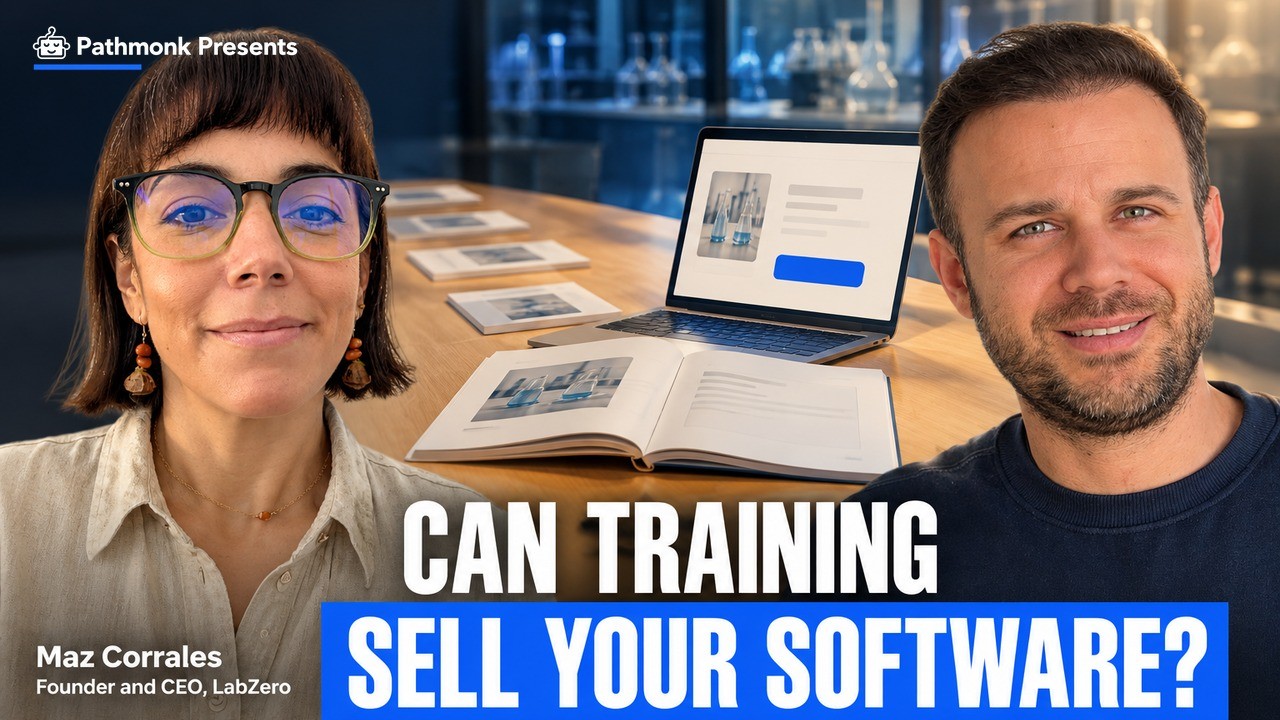
“We're better off thinking about it now, rather than 2 years, 3 years, 4 years down the line, when we're starving for funding and we're not necessarily sure how to run business in a green way.”
at
- Company
- LabZero, Australia
- Speciality
- Sustainability software and Green Champions training
- Works with
- Wet and dry labs, research institutes, universities, hospitals, biotech
- Deliverable
- Baseline, simple actions and estimated impact reports
- Growth engine
- Academic networks, word of mouth, talks and newsletter
Too long, didn’t listen?
Maz Corrales is the founder and CEO of LabZero, an Australian business that makes sustainability simple for laboratories and data-heavy research teams. Its certification platform measures a team's baseline, suggests simple actions and produces estimated impact reports, while the Lab Zero Academy trains Green Champions to drive change. Labs typically use 3 to 5 times more energy than offices, yet some jurisdictions don't require them to report it.
Maz explains how one client cut its annual energy baseline by 40%, why UK funders are building sustainability benchmarks into grant applications, and how LabZero grows through academic networks and word of mouth. She also shares her take on using AI and storing data sustainably.
Measure the baseline before anything else
You cannot improve what you cannot measure. LabZero starts every team with a baseline, then gives it simple actions and a savings assessment to show the real impact.
Look at who and why
Aggregating team-level data shows leaders where the hotspots are and why some teams do much better than others. The point is not only how much, but why and who.
Treat your network as a growth engine
LabZero grew through relationships, word of mouth, public talks and a newsletter. Building genuine relationships and showing people you are trying to help them takes you a very long way.
Train people instead of banning tools
Maz argues that blanket bans on AI are not based in reality. Upskilling teams to use AI and manage data sustainably is simple and achievable.
Some brilliant ideas
“For a lot of founders and a lot of businesses, or even individuals, we don't use networks to the best of our ability.”
It's like anything else. You just need to upskill, you need to train individuals. And I think if you were to blanketly say, don't use this, this is terrible, I don't think that would be based in reality.
Data and knowledge give you influence, and it can build a case for a lot of things in your life.
Full transcript
Introduction
[0:00:14] ADRIAN GARCIA RAMOS: So, welcome to Pathmonk Presents, where we talk with Grow, the marketing leaders about what's actually working right now. I'm Adrian, your host, and today I'm joined by Maz. Founder and CEO at Lab Zero. Hi, Maz, how are you doing?
[0:00:30] MAZ CORRALES: G'day, Adrian! Lovely to be invited on this podcast, thank you so much, coming from the land down under Australia.
What LabZero does
[0:00:40] ADRIAN GARCIA RAMOS: Okay, okay. So, what is LabZero? And what do you guys do?
[0:00:46] MAZ CORRALES: Yeah, so, really good question, and hopefully I can answer this very simply. So, LabZero, we're a business, and we're in the business of trying to make sustainability simple for many different workplaces. So, essentially, we have two arms of our business. We have our software, which is an online platform that mainly, you know, scientists and laboratories, they can subscribe to for 12 months on average. Or even more beyond that. And then we also, provide…
[0:01:26] ADRIAN GARCIA RAMOS: Yeah. So, Maz, what is LabZero about, and what do you guys do?
[0:01:32] MAZ CORRALES: Awesome, thanks, Adrian. So, what LabZero is all about is that we, essentially have two services. So, we have our software service, and that pretty much provides, I guess an easy platform for laboratories and resource-intensive spaces, you know, scientists that wear the white lab coats. to go into, and then measure how their performance is currently, so their baseline. Then we give them simple actions on how they can improve their operations to make it greener and more sustainable, and then they fill out a savings assessment, so they can really see the, overall impact of what their changes have made. So, it's a sustainability software program.
But we also provide it to dry laboratories, and that's, like, high data teams, for example, so data scientists, computational biologists. They're teams that use and generate a lot of data, and that data is stored, not in the cloud, but on the ground, you know, on data servers and so on, that use a lot of energy and water to cool down. So we give them the resources and the tools to really measure, and then improve. So, we make sustainability simple in that sense. And then the second arm of our business is our Lab Zero Academy. it's great that, you know, we're able to offer software and tools online for people to access to make climate ambition, climate action, you know, how there's that implementation gap? But really, beyond that, it's people that have to do the action.
And so, if people don't have the skills, or the training, or the confidence, and they don't feel empowered, then it's harder to make those changes. And so with our Lab Zero Academy service, what we do is we provide Green Champions training, and that really is for any type of workforce, but predominantly we do service you know, the healthcare industry, laboratories in public and private sectors, so medical research institutes, universities, but generally speaking, we could theoretically provide that training to any kind of workplace, because You know, climate change is here, it's a climate catastrophe, and we really do need climate action, and we need simple ways of solving that, so that's generally Lab Zero in a nutshell.
Why science needs sustainability
[0:03:46] ADRIAN GARCIA RAMOS: Right. Wow, amazing. So, you know, believe it or not, I spent 9 years of my life working for renewal energy and, sustainability, yeah? There you go. And I know a bit out of it. I'm wondering, the relationship between Sustainability, and the service that you provide, or the software you provide, and science and laboratories, because People might think about, you know, clean energy or sustainability for, let's say, industries, for fossil fuel extraction, you know, manufacturing processes, transport. But why does the science need sustainability?
[0:04:31] MAZ CORRALES: Yeah, and that's a very good question as well, and I think it's often a sector that's not necessarily thought about in the area of sustainability, like you mentioned, so… You know, scientists and researchers, and even people who work in healthcare, they generally want to, you know, help society, they want to help our planet, but as a consequence, it can be very resource intensive. And in some jurisdictions and some countries, it's not mandated to report on environmental sustainability or, you know, different utility metrics as it is in other sectors, like the construction industry. And so we don't necessarily have as much data as we could theoretically have.
You know, globally speaking. But from the data that we do have, and the science that we have, on average, when we compare lab work to office work, lab work tends to use up significantly more resources. It generally tends to be around the figures of 3 to 5 times more energy, 4 times water.
[0:05:34] ADRIAN GARCIA RAMOS: Right.
[0:05:34] MAZ CORRALES: This figure that I'm about to give you is from 2014, so it's incredibly outdated, so imagine how much more waste labs tend to use globally. I think the estimate is 5.6 or 5.8 million kilograms of plastic waste that's generated globally per year, so it would be, theoretically, a lot more than that. And it can be really demoralizing for a lot of teams, because they're there to do good, they're there in the pursuit of something very noble, but as a consequence, to try and better the world, there can be some damaging aspects of it as well. But luckily, there are a lot of solutions and easy answers to that, too.
Built for one lab or three hundred
[0:06:12] ADRIAN GARCIA RAMOS: Right. So, I'm wondering here about your target customer, right? Because you might have, like, research lab of 2 to 3 people to, you know, conglomerate with hundreds of different researchers. So, are you focused on, you know, the smart ones, or rather the big ones? How do you structure your business and your software?
[0:06:32] MAZ CORRALES: Yeah, and again, that's a really good question. So, the beauty of our software, and this is why I specifically built our software, our LabZero certification platform, in this distinct way. It's flexible enough So that it can really capture unique environments, and theoretically any kind of environment, whether or not it's just one lab, or a department of 12 labs, or an organization or institute that has 200 or 300 laboratories as well. And that includes dry lab scientists, so people in the office that aren't wearing necessarily the white lab coats, that are doing a lot of intensive computational work, generating a lot of data, storing it.
Perhaps duplicating it, not archiving the storage as well. But the beauty of it as well is that we can tailor it so that the estimate impact reports that you receive, so it's environmental sustainability outcomes, but then So your financial savings and those outcomes are not only specific to your country, to your state or territory or jurisdiction, but even specific to your institute. We have a lot of algorithms embedded in our platform that can be intertwined, and make it so that you can put in, you know, how much it costs per your organization to run electricity per kilowatt hour, or how much it costs per kilogram, or XYZ of particular types of waste streams.
[0:07:56] ADRIAN GARCIA RAMOS: Right.
[0:07:56] MAZ CORRALES: That's the real beauty of the software that we provide. It can really be applicable to any and all organizations.
Results: energy, waste and CO2 savings
[0:08:04] ADRIAN GARCIA RAMOS: I'm wondering about the impact of your service, and I guess that you've got, like, some numbers, perhaps, for different, you know, labs and different groups. Because at the end of the day, you rely on accountability, and basically you have a team that is not accounting for anything, and then there's that to, you know, count for the kilowatt hours, the waste materials that you're using, the reduction in CO2 emissions, Scope 1, Scope 2, you know, you know everything. What kind of numbers are you managing, or are you handling over here in the before and after, right, the implementation of your software? I don't know if you have any kind of a flagship, let's say, project or example that you'd like to portray.
[0:08:53] MAZ CORRALES: I guess what I could say is that it's really diverse. what the numbers and the metrics are and the output of the teams and the organizations that do use our software. Because, like I said, it really depends. The beauty of it is that when organizations subscribe to our platform, they can get individual teams subscribed, but then their organization can then get an aggregate of all of the teams combined. So, you really get all of that granular data. Right? That you wouldn't necessarily have. So it's really visible, and it's helpful for a lot… I'm not answering your question, sorry, but I will in a second. But it's really helpful for, I guess, executives, directors, or managers to get that high-level information as well.
[0:09:37] ADRIAN GARCIA RAMOS: I would say, understand the weight of the different persons and the different projects that they are handling under their umbrella, right? So they can say that this guy's, you know, a high offender, in a way, and this other guy…
[0:09:50] MAZ CORRALES: Exactly it.
[0:09:51] ADRIAN GARCIA RAMOS: Yeah, yeah, yeah, so it's not about how much, but why, and who, right?
[0:09:56] MAZ CORRALES: Exactly. So, the beauty of it is, you'll be able to see where the hotspot areas are, but also where the real improvements are as well. For example, if you have a team of maybe 5 researchers or 5 team members, why are they doing so, so much better than perhaps A team that only has one person or two people, or maybe you could magnify that significantly higher as well.
[0:10:18] ADRIAN GARCIA RAMOS: Yeah.
[0:10:18] MAZ CORRALES: And you really get that granularity as well, in regards to how much water each team is using, energy, emissions, waste, and even data usage per calendar year.
[0:10:29] ADRIAN GARCIA RAMOS: Yep.
[0:10:29] MAZ CORRALES: But generally speaking, I mean, we have one of our clients, obviously we have to de-identify, I think they reduced 40% of their original, annual energy baseline. And I think it was around 20% to 40% for some clients as well, in waste reduction, too. But our platform has… Currently, I think a combined reduction of over 40 tons of CO2 emissions equivalents that is being reduced, or avoided, I should say. So, it's quite significant. We're almost at a point where we're willing to provide a warranty. If you don't make a savings on our software, then something's wrong. Because there's no way you can't save.
Hardware, impact reports and grant funding
[0:11:14] ADRIAN GARCIA RAMOS: You'd be the one to say this, but you cannot improve what you cannot measure, right? Exactly. And that goes in line with my next question, because at the end of the day, you are distributing and commercializing software. But… for measuring, let's say, water, or waste or energy, you need some hardware, right? And you need to integrate with that hardware. Most of the labs are going to have some measure, in place for these kind of utilities and such, right? But there are others that might be optional in a way, especially for, you know, specific cases for, I don't know, lab researches, infrastructure, etc.
Do you also provide the hardware itself, or do you have a partner that is going to implement it? Do you, I mean, do you require your customers to deploy it? How does it work?
[0:12:05] MAZ CORRALES: Good question. So, a lot of organizations and institutes, especially if they're larger ones, you know, we're talking thousands, if not tens of thousands of employees as well, they generally would have a facilities team that would have an aggregate of all of their utilities, their expenditure for the year, you know, in electricity, gas, water, so on and so forth, waste. We do provide a consultation service, and through Green Champions Training Workshop, and we also do Grant Review Service. We link organizations or even individual teams and lab groups with services that can provide the hardware. So, for example, Ukraine.
[0:12:45] ADRIAN GARCIA RAMOS: somehow.
[0:12:45] MAZ CORRALES: an energy timer outlet. So, if you have an instrument that doesn't need to be on overnight, you can plug this device inside the PowerPoint, connect it to your instrument, and have it so that it's turned off for a period of 10 hours overnight, and then, you know, you're saving 10 hours of electricity. And there's a lot of other small Mmm… components like that. It can be utilized to many different teams and their advantage that don't necessarily cost that much. But I would say, with our software, what it is, it is an estimate impact report, but we do often say that it can then go hand-in-hand. You can export the impact reports per team, or per lab group, or even if you're an admin as an organizational aggregate.
[0:13:33] ADRIAN GARCIA RAMOS: Right.
[0:13:34] MAZ CORRALES: you can utilize that data, you know, as supplementary material that you can embed into annual reports, ESG reports, performance reviews, you know, funding proposals, and so on. And that tends to be, especially in the research sector, is something that's becoming more prevalent. In the UK, it's really common. So, say, Snow Fellowships, Welcome Trusts, they're embedding Sustainability benchmarks into grant and funding applications. And so, it's going to be something that's necessary as everyday operations in the future. So, we're better off thinking about it now, rather than, you know, 2 years, 3 years, 4 years down the line, when we're starving for funding, and we're not necessarily sure how to run business in a green way.
[0:14:16] ADRIAN GARCIA RAMOS: Yeah. Actually, you've touched a very relevant point. I was about asking you, why did you go for, like, lab… laboratories and research facilities and such, but I guess that's the answer, right? So you… they are driven by the grant requirements in terms of, like, being sustainable and account for the materials and electricity and everything that they are using. Is that correct?
[0:14:45] MAZ CORRALES: It's definitely the reason why we positioned ourselves in the market with laboratories first, because they are so resource intensive, and we do need to build more data and science and evidence in that sector. But I would also say we do cover, you know, high data or high data impact teams. And our transition in the future as well, what we'd like to do is to be able to offer this service really at an enterprise level, and in a position where it can be of value to many different sectors and many different workplaces, because just imagine, like, all the different organizations that people work for, and then beyond that, it's like, I really believe in people and the power of humans.
And how necessary it is for people… I mean, we spend most of… the majority of our lives at work. More than we do with our partners, our friends, and our family. And so people need to have a sense of agency, a sense that they have a freedom and creativity to actually make positive changes in their workplaces, and that's another thing that I've noticed with our academy, is that you really see that empowerment and that energy sort of start to ramp up, and people recognize that they have influence, and they have agency, and they go from being
Go-to-market: from Australia to the world
[0:15:57] MAZ CORRALES: perhaps cynical, to then skeptical, to then actually being believers and transforming into agents of change themselves as well. It's actually really rewarding and really nice.
[0:16:08] ADRIAN GARCIA RAMOS: 100%. Tell me a bit more about your go-to-market strategy, right? Because you started with the labs, and then you're getting into data. Maybe, you know, private sector, I would say hospitals is, you know, a no-brainer for you, because it's so close to the whole thing. What do you think about that? Go-to-market? What you've done, and what, yeah, what are next steps? Go-to-market is, like, how do you approach customers, what kind of operations are you following for sales and such?
[0:16:39] MAZ CORRALES: Yeah, certainly. Like, like I mentioned, so, at the moment we're focusing on laboratories, but really we're spanning every and all type of laboratory that could theoretically exist. So, we're quite separate in the market compared to other competitors that may only offer their software to public or non-profit laboratories. But we also offer our services to, you know, industry, biotech. And then beyond that, high schools, tertiary education, TAFEs in Australia. But we make it very specific initially to the Australian market, because we have that information, you know, it's obviously very close to my heart, this is somewhere where I live, but beyond that, we're expanding to New Zealand, and then transitioning from there to the global market as well, because.
You know, I don't think… essentially, I want to try and help as many people as possible. We're not talking about thousands or tens of thousands. We're talking millions of individuals globally around the world that could benefit from software like this. And many institutes as well at a higher level, where they can really get that granular information and make sure that they have that data, and they can utilize.
[0:17:51] ADRIAN GARCIA RAMOS: Right.
[0:17:51] MAZ CORRALES: data in a positive way. And perhaps in the future as well, part of the strategy is that we really have an environmental intelligence engine in the back end, and we can de-identify and aggregate all of the data in different regions around the world, in different jurisdictions, to then say, alright, in this regional area, or in this specific continent or country, they're really struggling with problem or Y problem to make their operations more sustainable. And so we will be able to have that data to then inform governments and hopefully create, you know, better policies, better grants, and we'll know how to fund
different workforces in different sectors in a… but in a way that is… and I hate to use this word because it's so overused, but in a way that is data-driven.
Growth through networks and word of mouth
[0:18:38] ADRIAN GARCIA RAMOS: True. Yeah, so that's kind of a strategy for the go-to-market. I would like to know your thoughts on the tactics, right? So, I don't know if you are relying on kind of inbound or outbound. What is, driven your business these days?
[0:19:00] MAZ CORRALES: It's… it's really a surprise, honestly. So, I have been in the medical research field for over 14 years, so for a big proportion of that period, I was also an eco-chair for what's called a Greenlands Working Group, and I was a sustainability coordinator. I'm now an enterprise fellow at the University of Melbourne. I'm an industry supervisor for, you know, digital master's students as well, running my own research and experiments, and so I think, for me, I've been embedded in a lot of the academic networks, pardon me. So I've been embedded in a lot of these networks, and so it's generally relationships that you form, and through word of mouth, but I find that if you…
if you have connections to networks, and you can build a genuine relationship and show them that you're trying to help them, I think that takes you a very long way. And I think that's often, for a lot of founders and a lot of businesses, or even individuals, it's like, we don't use networks to the best of our ability, and to the.
[0:20:01] ADRIAN GARCIA RAMOS: Okay.
[0:20:02] MAZ CORRALES: that we generally can, so… Yeah. For example, you know, Public Pathology Australia, I've done. presentations for many of their services, and many pathology services across Australia. And then beyond that, you know, we even have external, you know, Nerd Night or Pint of Science I've been invited to present publicly as well, and you really spread the message, I think. And we've been very lucky in some instances where we've had one laboratory and organizational institute mention that they've gained a lot of benefit from our software and our academy.
[0:20:38] ADRIAN GARCIA RAMOS: Right.
[0:20:38] MAZ CORRALES: I think the results are in just simply because the product is good and fabulous, and I think we're.
[0:20:45] ADRIAN GARCIA RAMOS: Yeah.
[0:20:45] MAZ CORRALES: proud of what you've been able to achieve, so… We also actually, I should say, we have a newsletter, which we do circulate, and we have our impact network that involves many different sectors as well. Like I said, public and private, academic, you know, medical research institutes, hospitals and pathology, and industry and biotech.
[0:21:05] ADRIAN GARCIA RAMOS: Right.
[0:21:05] MAZ CORRALES: It's generally not a network that's seen globally, and we're also in the process of hopefully creating another network for data-intensive teams as well.
[0:21:15] ADRIAN GARCIA RAMOS: Yeah, actually, I would say that the Academy, it's a great community to, you know, foster your software at the end of the day, because you don't have any kind of a limited issue regarding your location in Australia or anything like that, because the community is… You know, formed by researchers all across the world. And they're gonna spread the word about what you guys are doing and how they have found value out of the software that they utilize, either in Australia or anywhere else. Is that correct?
[0:21:46] MAZ CORRALES: Yeah, exactly, exactly. That's… you're right on target there as well, and I think… Data is such… An important thing that every individual in the workforce should think more about, because data and knowledge give you influence, and it can build a case for a lot of things in your life.
[0:22:09] ADRIAN GARCIA RAMOS: Yup.
[0:22:09] MAZ CORRALES: Whether it's a promotion, whether it's, you know, you need funding for equipment, or, you know, better resources, or even if people want cookies and milk in the kitchenette for their lunch breaks or tea breaks. It's… you need the data a lot of the time to then convince other stakeholders, or directors, for example, or executives, or even funding bodies, investors, or consumers. Like, consumers are becoming more and more aware of the need to purchase… Services or, you know.
[0:22:42] ADRIAN GARCIA RAMOS: Consumer.
[0:22:42] MAZ CORRALES: that are made in a way that is a lot lighter and is a lot greener, and it creates a lower footprint for our globe.
Entry offers and pricing
[0:22:51] ADRIAN GARCIA RAMOS: Yeah, I'm thinking now in our audience, and specifically this case that you've got with the community and the network that you've built over the last 10 years, or 14 years. But the academy itself, I wonder if you have any kind of a, entry product, like a free offering for researchers, so that they can have a, let's say, 101, or super simple certification about awareness in terms of sustainability for research, or something like that, that they can get accustomed to, and… Then they can, you know, spread across the community or their lives with the colleagues, whatever it is, they can find out Tell us a bit more about that. I find it super interesting.
[0:23:31] MAZ CORRALES: I'm so sorry, Adrian, I'm not necessarily sure if I understand your question.
[0:23:36] ADRIAN GARCIA RAMOS: Yeah, sorry for that. Too many things. Basically, I was, Interested about the approach that you have with the community, and how the community can spread with the service offering that you have with the software, right? So, my question is, within the academy that you have for researchers, do you have an entry product or certification that is kind of free for the researchers getting into it?
[0:24:02] MAZ CORRALES: That's a very good question. So when we were, I guess, opening, or we sort of launched our beta software into the market, we were offering the product at a heavily discounted price, so I would say that that was one strategy. But obviously, you know, as businesses, you have to make it viable. We do have, you know, individuals that their livelihoods rely on, you know, being able to be employed and sort of continue building the capacity and building and scaling Lab Zero as well is… super important, but I think the most important thing is that we're globally, I would say, confidently, the cheapest version of this software that exists on the market to date.
So I would say that is probably the most, competitive form, sort of offering that we can have. I mean, we're more than open if, different organizations or institutes may want to trial it for a period of one week or two, feel free to reach out to us, and we would be able to consider it on a case-by-case basis, but yeah, good, good,
AI, tokens and sustainable data
[0:25:07] MAZ CORRALES: Good thing to contemplate as well, Adrian, yeah.
[0:25:10] ADRIAN GARCIA RAMOS: Yeah, yeah. So, my last question, goes, toward, something that I, I saw recently on the news, and I was thinking all, all, all the time about it when we were talking, and it's about the, Navi-Stokes equation resolution. I think that you have heard about it. Never Stokes, you know, one of the mathematical problems of a millennium that wasn't solved until OpenAI published their results, and they are in the process of, you know, figuring out whether or not that's valid. Yes. It's a crazy thing, right? So, we have been talking about sustainability, and we, Went over, kind of, a kilowatt hours. waste, plastic, maybe, you know, like, whatever it is, like, it could be CO2. But I'm wondering about token sustainability right now, and whether or not you've got integrated that into your platform, and what's your take on that?
[0:26:08] MAZ CORRALES: So, in relation to, I guess, Agentic models and AI overall.
[0:26:13] ADRIAN GARCIA RAMOS: the use of, specifically LLM models to, in a way, solve math, right? Because that's, at the end, is a research process. And once again, like, you can have, let's say, an oven that is going to reach out 1,000 degrees Celsius, because you need to create a molecule or something, but you could either way, you know, run service for… years to have the solution of a… of equation that it's been, you know, thousands of years without a resolution. And the other day, the same thing, pretty much, so I What is your B2B, SaaS standing, in front of.
[0:26:51] MAZ CORRALES: This is such an energizing question. I really am glad that you asked this, actually. And I also think it's super polarizing. Like, often, I feel like, you know, you have dozens, if not hundreds, of conversations every year around this topic. Or, like, the essence and the core of AI and LLM models, or just servers in general, right? And generally speaking, for me personally, I'm really on the fence about this, because, again, it's difficult to know… I guess, if I could take it one step back, I think we're on the precipice of something incredibly… groundbreaking, we don't really know where the future is heading, where is this going to lead us, and what if AI could theoretically create so many solutions a lot quicker? And especially in the realm, if it's, like, simulations and mathematics, if it's incorporated into environmental sustainability, can it solve a lot of the problems that we have for the future in a lot shorter time, in a lot shorter time frame?
I would say that… I can relate it back to where I live. So, in Australia, I live in a state called Victoria, and our regulators and government actually put in a mandate for any new data center that is built in this state. They need to bring their own renewable energies, and then some, so storage batteries as well, to supply the state grid with renewable energy. And then beyond that, they need to utilize recycled water, or non-potable water, and be away from residential zones, so it doesn't impact, you know, schools or communities and houses as well. I'd say that I'm very much for that Really being a trajectory that we move towards.
But I think even then, it's kind of like, you know when you have… and I'm not saying this to yourself, or your listeners, or anyone listening to this podcast as well, but you know when you say, to younger kids or teenagers, don't do that, and they really want to do that, or you know they're going to do that? It's like, there's a lot of… I think, a lot of… before, maybe two to three years ago, people would… wouldn't necessarily say that they were using LLMs, or they were using.
[0:29:07] ADRIAN GARCIA RAMOS: Yeah.
[0:29:07] MAZ CORRALES: or Perplexity, or so on and so forth. But I would be surprised if, in our era now, most of the workforce, especially, I think, millennials and Gen X and so on, Gen Z especially, aren't using AI. But what we tend to do, also in our Lab Zero Academy, is we offer digital sustainability champions workshops. So, there are so many ways in which you can learn. how to prompt AI to make it more sustainable. And then beyond that as well, there are other ways in which we can manage our data to reduce the amount of energy that's needed and unnecessarily… the unnecessary storage of data, even small things like unsubscribing from emails or deleting, you know, junk and spam folders, it doesn't necessarily feel like something huge to one individual, and we have critics that say it's not that big of a deal. But the UK actually sent out, you know, a mass government statement that was saying, delete your emails to save water in the UK.
And this.
[0:30:07] ADRIAN GARCIA RAMOS: Right.
[0:30:07] MAZ CORRALES: not that long ago. So, I would say if people were able to sort of learn how to utilize LLMs and AI in a sustainable way, I think that's very simple and very achievable. It's like anything else. You just need to upskill, you need to train individuals. And I think if you were to blanketly say, don't use this, this is terrible, I don't think that would be based in reality.
[0:30:30] ADRIAN GARCIA RAMOS: Yeah, so, follow up, short follow-up, are you incorporating, features in your software to track, like, a token utilization by research groups?
[0:30:44] MAZ CORRALES: We… we don't have that currently embedded in our software, but I can see the trajectory of us utilizing AI to some extent, once we have big data. So, we're talking about, you know, thousands, if not tens of thousands of organizations and de-identified data, so that we can actually utilize all that information for the better good. And like I said, to inform certain nations, jurisdictions, and improve policies. Like I said, with the mandates that are occurring with data centers in Victoria, that's just one example of what we could theoretically provide in the future as well. But it is of interest. I mean, I'm…
immensely curious. I love learning about it as well, and then beyond that, I love learning about how we can use AI in a sustainable way as well. And even beyond that, kind of going a bit offside, so for dry lab researchers, so the researchers that are, you know, data scientists, computational biologists, they run simulations. These are individuals that are… and even beyond that as well, we have other services, so core facilities. So, histology services, microscopy services that have images. They generate so much data. They generate so much more data than one individual generating a comic book picture of their family on ChatGPT.
So, we're not focusing on those hotspots, we're not training those sectors and that entire workforce on how to manage their coding in a sustainable way. We have, you know, websites that are free to access, like Green Algorithms. That is available to a lot of teams, and that also reduces redundancies in code, that means you get your data back a lot quicker, and you use compute power and memory capacity a lot less. It's like a win-win! Why wouldn't you do it?
[0:32:37] ADRIAN GARCIA RAMOS: Yep, absolutely. So, Maz, thank you very much for coming on to the show. It's been a pleasure having you. Now, I would like to pass you the word in case you want to, you know, mention your business URL and how the audience could reach you out.
[0:32:56] MAZ CORRALES: Thank you so much, Adrian, for having us on in the land down under, for letting LabZero and myself speak today. You can reach us at labzero.eco, that's our website. You can contact me at Maz at labzero.eco, or even our support team at hello at labzero.eco. We also have our newsletters and our impact network, so feel free to pop along, put your email on the list, and then we might be able to see you online as well as well. We have our LinkedIn page as well, and our Instagram page, and that's Lab0AU, if you want to search that up in the search engine, or the search bar, I would say, on those platforms.
[0:33:32] ADRIAN GARCIA RAMOS: Absolutely. Thank you very much, Maz. Let's stay in touch. Bye.
Got a growth story worth sharing? Tell it on the show.
We talk with founders and marketing leaders about what actually moves their pipeline. If you’ve built something other marketers can learn from, we’d like to hear it.
- 01Apply
Tell us who you are and the story you’d bring to the show.
- 02We get in touch
We review every application and reach out if it’s a fit.
- 03Record your episode
A remote conversation, published as video, audio and a full transcript.