Grow without ads with automated agents | Cris Kinross from Corzen
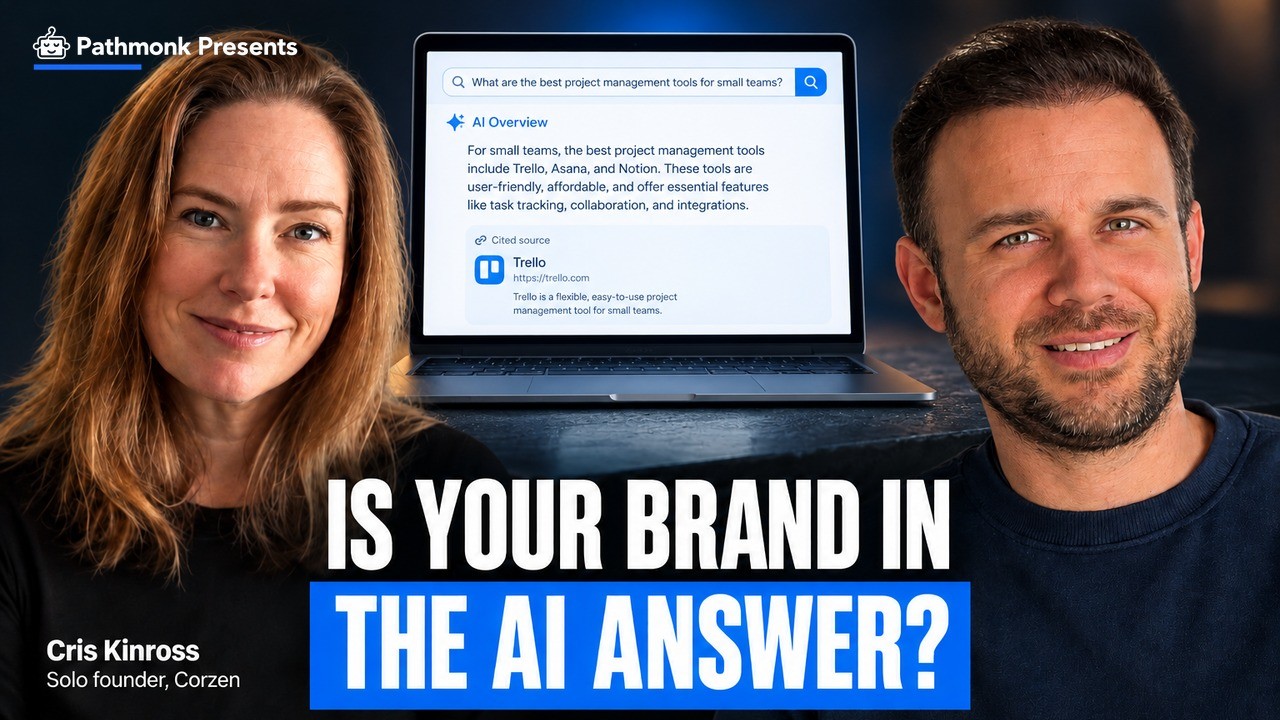
Can you grow without ads? Cris Kinross of Corzen explains goal-first go-to-market, AI agents that run the plan, and why photos of people win on LinkedIn.
“We watch over humans. We should be watching over our agents, too, in my opinion.”
at
- Company
- Corzen
- Speciality
- Goal-first go-to-market without paid ads
- Works with
- Solo founders, side hustlers and teams of up to 100 people or more
- Deliverable
- A week-by-week plan with agents that run each task
- Growth engine
- A free plan, free one-time agents and hands-on coaching
Too long, didn’t listen?
Cris Kinross is the solo founder behind Corzen, a tool that helps businesses find customers and grow revenue without paid ads. You give it a goal, such as finding your first 100 customers, plus your team, tools and timeline, and it builds a week-by-week plan with agents to run each task. Humans still make every decision.
Cris explains why defining the goal is the hardest step, how a free plan helps new users practice, and how she uses Corzen to rank for new search terms every week. She also shares why pictures of people beat video on LinkedIn and why agents need drift detection.
Define the goal before the tactics
Start every growth plan with a clear outcome, such as doubling revenue in six months or finding your first 100 customers. Tactics only make sense once you know why you are doing them.
Plan for a smaller team
Mid-sized and large companies are increasingly down to one person doing many jobs. Build plans around the people and tools you already have, not the team you used to have.
Lead LinkedIn with strategy and real faces
Pick content pillars you can own: topics people search for that are not well covered. Then pair posts with pictures of real people looking into the camera.
Put a watcher on your agents
If you run AI agents, add a layer that flags them when they drift from their instructions. That way you catch problems before they become catastrophic.
Some brilliant ideas
“I found that the strategy part is far more important than the content of the post.”
Your first step is to define your goal, and that's literally the hardest step. You never put your hardest step in step one, but in this case, that's what it is.
What my data shows, and what I've seen in other people's data that they shared with me, is that pictures of people resonate the most.
Full transcript
Introduction
[0:00:00] ADRIAN GARCIA RAMOS: Welcome to Pathmoon Presents, where we talk with growth and marketing leaders about what's actually working right now. I'm Adrian, your host, and today I'm joined by Cris Kinross. Founder at Zenly. Hi, Cris, how's it going?
[0:00:15] CRIS KINROSS: I'm awesome, how are you doing?
[0:00:17] ADRIAN GARCIA RAMOS: Doing pretty well.
[0:00:18] CRIS KINROSS: Thanks for having me.
Growing without paid ads
[0:00:19] ADRIAN GARCIA RAMOS: It's a pleasure. It's on us. So, what is that your company does?
[0:00:25] CRIS KINROSS: So, Zen has a bunch of different things that we do, but what we're going to focus on today is a tool called Corzen, and Corzen is a way for businesses to figure out how to generate revenue, find customers, to grow without doing ads. We generally stay away from paid ads. by taking the guesswork out of what the heck to do next. And this sounds like it should be easy, right? Like, we are absolutely bombarded with hints and tips and hack of the week, and… drowning in information, and a lot of that information's really good, but how do you know which one is actually appropriate for your business, your market, your customer? Like, where should you spend your time? And so that's what this tool does, is it takes in your goals, your business, your
What tools and team members you have available. It could be just you. Maybe you have 100 people, maybe it's just you. And it builds a plan and gives you the agents to run the plan so that you can grow your business.
[0:01:23] ADRIAN GARCIA RAMOS: Right. So, would you portray your, kind of, a value proposition as, go-to-market or GTM, or would that be something different from what you are bringing to the table?
[0:01:36] CRIS KINROSS: No, that's a great question. And so, it's actually… it does encompass… other parts of running a business, but the main benefit is the go-to-market. How do you go to market? How do you grow? How do you find your target customer? How do you attract your customers? So it's a very strong income market, yes.
Solo founders and shrinking teams
[0:01:53] ADRIAN GARCIA RAMOS: Okay, so my next question, goes for something that you mentioned already. It doesn't matter if you have, you know, you are a solo founder or solopreneur, or if you have, like, 100 people. I would say that the responsibility, right, is not actually the same, in a way that you might have a consolidated team for go-to-market if you're running a 100-person company. It might not be the same if you are just alone, and you just need some, you know, agents to work you out, because you are just under the water. So, I'd like you to explain the difference and how you approach those two different profiles.
[0:02:40] CRIS KINROSS: Yeah, I would agree with you, and I would say, from my experience, I've worked in massive companies, like. thousands, tens of thousands, even hundreds of thousands of employees, and now I'm the solo founder of Zently. So I've seen both sides of the equation, and I tend to go back and forth. So you're right, they are vastly different worlds, but they're… They're coming together, and you… the big news this week is that Microsoft offered buyouts to one quarter of their company. 60,000 people got an offer of a buyout. Microsoft. And so, when you're one person and you have to do everything, it's… it's overwhelming. Like, what do you do first? What do you do next? How do you find the time? But increasingly, even in medium and large companies, they're starting to face the same problems. They had a team of 20, and now they don't. Now it's just them.
And so, I would argue that increasingly large… well, mid-sized companies and large companies are starting to mimic the solar founder bottle. One person needs to be able to do so many different things, and how do you pick? Like, what do you do next, right? Because you no longer have a team of 20, you no longer have a team of 100. And so, if you're lucky enough to have 100 people, the software will delegate across 100 people, your plan gets bigger and more complex, you can do more things. But you don't have to be, and that's the beauty of where we are today. So it's exciting.
From a goal to a week-by-week plan
[0:04:05] ADRIAN GARCIA RAMOS: So, as Leonardo Cabre said once, you had my curiosity, and now you have my attention. So, I would really want to, to know, about what exactly that you do, guys, like, what's a framework, what's, let's say, the onboarding process. what are, kind of, the outcomes? I would be really interested in knowing more about, you know, the whole package that you are bringing.
[0:04:33] CRIS KINROSS: For sure. For sure. So, think of it as a Choose Your Next Adventure novel. If you ever read The Choose a Child, I loved these as a child. You know, you could read the same book, and the same book would give you 7 different outcomes, depending on where you wanted to go next, where your goal was.
[0:04:48] ADRIAN GARCIA RAMOS: Oh, yeah.
[0:04:48] CRIS KINROSS: Everything starts with a goal, and this is literally the hardest part of running a business, whether you're by yourself or managing a team. What exactly is your goal? We get so stuck on tactics. What are the things we're going to do? Well, why are we doing them? What's our point, right? So, a goal would be, for example. double revenue in 6 months in order to hire 2 people. That's a big goal, so you don't have to have that big of a goal. Your goal could be, find my first 100 customers. That's your goal. At that point, once you're clear on your outcome, you tell it your goal. And it starts to ask you a series of questions. Do you have people available to help? Free or paid? It doesn't matter. What do they do? What tools do you have available? What does your tech stack look like, right? Because it's never going to tell you to use tech that you don't already have. It uses only what you already have.
you know, what is your timeline? Are you flexible on your timeline? Do you want to go as fast as possible, or do you want to go methodically and pace yourself? And so it asks you all these different questions, and then it gives you a full plan. And the plan tells you, week by week. what you and anyone you're working with should do. And so, for example. In my company, I work with a lot of, other founders of companies. We work together and collaborate on a lot of different projects. This will allow it to say, okay, I'm responsible for these 3 things. I know exactly what I'm responsible for, and everybody can see it.
The next person is responsible for those two things. Everybody can see it. We don't have to do Slack, we don't have to do email, we don't have to do Zoom meetings, we don't have to do webinars, we don't have Teams chat, we just look at the board and we know when we're done, right? And so it speeds things up. Significantly. Everybody knows what they do. What'd they do next. And it'll even call out dependencies, so if I can't get started until my coworker finishes their part, I know that, and that's fine. But the other person knows it, too.
Humans decide, context builds up
[0:06:48] ADRIAN GARCIA RAMOS: Right, right, right. I'm wondering, you know, a bunch of things, let's go one by one. First off, it's, the human interaction, right? I guess, At the beginning, there's going to be a human behind running the show and, you know, replying to these questions, or maybe a group of humans, because you need different inputs to have the full picture. How do you do that? And once you have the initial seed of information. How often do you correct the algorithm to keep it going?
[0:07:23] CRIS KINROSS: So that's what's interesting, is it's really up to you as the user. Okay. the way it's designed is to be human-centric. So, not the human has to do all the work, but the human makes the decisions. I'm a huge fan of AI, but having worked with it all day long, every day, I also know I don't trust it completely, so I want the human to make the decision, right? And so, how it works is that you give it the initial input. And then you get your plan. And on your plan, you have… 20, 30 different things, different task cards, over the course of, say, a few weeks, depending on how big your plan is. each task card, click a button, it will go and run the task, but if it needs information, it will ask for it. And so what happens is that you build up this huge context layer within the project itself.
So if you want to do another project, or another plan for that project, maybe now you've got your first 100 customers, now you want to generate your first $200,000 in revenue. It remembers all of that, and it leans on it. So you can do… a lot of people just upload all their documents, so their internal notes, they link in Notion, they link in Google Docs, wherever they have their files. They tend to bring it all in as context so that they don't have to answer all these questions. But anytime you want to make a change, you just say, nope, I make a change, and it updates the context layer, and going forward, those are your new instructions.
Right. So it's becoming a working memory.
[0:08:52] ADRIAN GARCIA RAMOS: Yeah, second brain, I've heard about it. Have you heard about it?
[0:08:57] CRIS KINROSS: I'll take every brain I can get, yes, yes.
Security and what stays private
[0:09:00] ADRIAN GARCIA RAMOS: The more, the more the better, right?
[0:09:02] CRIS KINROSS: Exactly, I need more, yes.
[0:09:04] ADRIAN GARCIA RAMOS: Do you… do you host the… this kind of, you know, harnesses in terms of, like, information, data pools, and… and such?
[0:09:16] CRIS KINROSS: So it's all custom-built and custom-hosted, so security is incredibly important. I, like I said, I don't trust AI, and I don't trust AI companies. It's just my fault, I guess. And so, first of all, I actually can't see your information. It's fully encrypted. So when you talk with Corzen, it's encrypted end-to-end. It goes into our database. behind 5 layers of security. One of those layers is, I can't even tell you what you're doing, because I can't read it. You can see it. So there's that. It's also built the way software was built before AI. I mean, believe it or not, the world wrote software before AI, it's shocking.
And so, it's written to be TypeScript, React, even C-sharp occasionally, depending on what it's doing. So it uses the base coding languages, and it only uses AI calls when it's absolutely required for reasoning, for judgment, for inference. And then it's still encrypted. Because all of the calls that go to Claude, for example, out of Corzen are coming from my account, not yours. It's not tied back to you, for starters, and for second, I've got end-to-end encryption. And so… Claude can read the prompt and quote and give it back, but as soon as it responds and Corzen has what it needs, it shuts off that second key. It has no idea what to do, and so it tosses it. And so we have tested this extensively, and we've never been able to find any indication that what people are doing in this system
has any impact, or is saved in any way. Now, things change daily, so… We take it with a grain of salt. But as far as today, it looks really tight.
[0:11:02] ADRIAN GARCIA RAMOS: Yeah, I'm wondering, if you're not able to track what your customers are doing and interacting with the system, right? You cannot, in a way, learn from them the use cases and the, you know, the different interaction that they do. So, I wonder what's the end game here? Like, could you rather sacrifice learning from your customers. and innovating on your own, or is there a metaway? How do you see that?
[0:11:35] CRIS KINROSS: Yeah, let me clarify, I think maybe I spoke too broadly. I think we're actually in the middle way, so I can see which agents people are using, I can see which tasks people are doing, I can see which templates people are using, I can see where interest is. So I can tell you there's a lot of interest in Go-to-market for new products. There's a lot of interest in go-to-market for existing products. There's a lot of interest in finally first 100 customers. But what you type… If you type financial information, if you type secret information, I can't see that. Okay. So I can see what they're doing and what they're interested in, and then we have a strong feedback loop where people can ask for new features, and that's constantly getting filled as well, what people want to be able to do with it.
Getting started with a free plan
[0:12:19] ADRIAN GARCIA RAMOS: Yeah. So, I'm listening to you, and I'm thinking about the gap, right, between a company that does not use anything at all from what we are talking about, and a company that has been doing it for 3 months, so it's like a… You know, day and night. So, at the beginning, I thought about the field of trust. But it is not actually trust, but rather understanding. of what a tool like this could do for them, and the scope, the enormous scope that that tool might feel, right? So, in terms of, what is called a call-start problem, right? Just to get someone or a company or a team started with a thing. What is the exact kind of entry point, or…
first, minimum value proposition that you are bringing to your customers for them to embrace the first steps of… of… of, Zenlia or Corzen in this case, right? Yeah.
[0:13:31] CRIS KINROSS: Yeah, so a lot of this is still very handheld and personal, so this is my baby. This is how I grow my own company. I use this on a daily basis, so…
[0:13:41] ADRIAN GARCIA RAMOS: Right.
[0:13:42] CRIS KINROSS: Right now, with our current customer base, we're almost to the point where we can't do this for much longer. I'm gonna have to start hiring people. But we… we help them, right? So we walk them through the first couple projects. We coach them through what is a goal? Because your first step is to define your goal, and that's literally the hardest step. You never put your hardest step in step one, but in this case, that's what it is. And once they get the hang of that, the rest of it seems to be fairly intuitive. But we also do test projects. So, for example, you can do a free account. You don't have to pay for it. A free account will give you a full plan, it just won't let you use the agents. That's the difference between the free account and the paid plans.
And so, a lot of people will spend time, even 2-3 months, with a free account. Practicing writing their goals, getting a feel for what the tasks are, getting a feel for how it works for them and their team. And then if it's a match, they move into a paid plan so that the agents can do the work.
[0:14:41] ADRIAN GARCIA RAMOS: Okay.
[0:14:42] CRIS KINROSS: But also, because I don't trust anyone, there's another option. A lot of the agents you can use for free once. Okay. So, many of the agents are available on our website, on courseandHub.com. And you can use it for free for once. So you can test it, see the output, you would see literally what the output would be from the tool, and then it will save it in your account if you like it.
[0:15:06] ADRIAN GARCIA RAMOS: Would you say that what you have just described is the go-to market for service as a software? Because that's what I think, and I believe that not many people out there is portraying exactly what you have just said in that end.
[0:15:25] CRIS KINROSS: I'm finding a lot of companies claim that they do, but when we go in and test them, we're a little bit frustrated because A lot of companies are saying, oh, you can… you can have our agents do anything you want, but you have to build.
[0:15:36] ADRIAN GARCIA RAMOS: Huh?
[0:15:37] CRIS KINROSS: Well, if I don't know how to build an agent, or I don't want to.
[0:15:40] ADRIAN GARCIA RAMOS: Yep.
[0:15:41] CRIS KINROSS: why… that's not a match, right? And so this was really meant for people who just really want to grow their business. They don't want to have to learn all of the coding and the security and the maintenance, and so…
[0:15:53] ADRIAN GARCIA RAMOS: Right.
[0:15:53] CRIS KINROSS: It's… It's designed for a very specific person, a person who wants to take control of their life, start a business, not get stuck in this constant round of layoffs and buyouts and looking for a job for a year. I mean, my heart goes out. It's a terrible environment right now. But I think all of us are gonna have side hustles, even with full-time jobs, and so it's really for that group of people.
Using Corzen to grow her own company
[0:16:17] ADRIAN GARCIA RAMOS: Okay, so I wanted to follow up with, the go-to market for your solution? Like, are you using your own solution for your own business?
[0:16:28] CRIS KINROSS: Yeah.
[0:16:29] ADRIAN GARCIA RAMOS: How does it go, and what kind of results have you seen? What are your learning experiences that you can share?
[0:16:37] CRIS KINROSS: So I actually use it daily. I built it for myself first. I built it because… I built it because I was getting really frustrated. I would see these fantastic stories about 17-year-old… so this one came up 2 days ago, actually. 17-year-old kid drops out of high school and builds a company in less than a year that has $650,000 recurring monthly revenue. Okay, you have my attention. Here's what actually happened. So, this is insane. This kid didn't drop out of school, he got sent to juby. He got arrested. So, he didn't drop out, so let's just start with PR number one. he got kicked out. And number two…
It turns out what he actually built was a way for the gambling markets to get around the law. for advertising and promotion, and so he… he got kicked out of high school for running a gambling ring. So he used what he knew, and while Injuvi created this business selling to poly markets and Cauchy and all of the other gambling markets. a way to get around the law that is still technically legal, but a way for them… brilliant, right? Like, this kid's going places. But that's not what the PR said, so…
[0:17:47] ADRIAN GARCIA RAMOS: Yep.
[0:17:48] CRIS KINROSS: when I think about, like. Do I use it myself? Yes, because I keep a playbook menu, and the playbook menu feeds into the tactics, so that people always have the freshest tactics, the things that are working. And so, I decided to make it public because other people started asking, can I get access to it? Can I get access to it? Because I was… generating… I was bringing in customers, I was getting my messaging done more quickly. I write these agents to my standards, and so draft one should require very little editing. Very little. I can't stand editing things that AI has written, and so it doesn't come out until you don't have to edit it much. You may want to take it.
personalize And so, yeah, I use it every day. In fact, I'm using it right now because I've got agents that will track my brand presence on Claude and ChatGPT and Kimmy and DeepSeek, because those are the four that I'm focused on. You can do complexity as well, but I'm just not focused on that. And it tracks for specific search terms. Where am I ranking? Who's ranking more highly? Do I have visibility? So it's tracking brand visibility, right? And then it gives me specific… so here's the kicker. It'll actually give me specific landing pages I need to create. I'll look at it, I'll say, yep, build it. Do I like it? Yes, I like it.
publish it, and it's connected to my website, and it automatically pushes it out. And so, I'm able to rank for 2-3 search terms every week on top of the previous ones.
[0:19:21] ADRIAN GARCIA RAMOS: Right.
[0:19:21] CRIS KINROSS: Nice. For, like, $180 a year?
[0:19:25] ADRIAN GARCIA RAMOS: Yep.
[0:19:26] CRIS KINROSS: Yeah, so I use it every day.
LinkedIn strategy and imagery
[0:19:29] ADRIAN GARCIA RAMOS: Okay, so that would be for, in a way, inbound. I've heard that you are also versed in LinkedIn, for example, like, founder-led content, things like that. I mean, are you using your tool also for creating this kind of a social posts? What insights could you, you know, share, or if you have any tips for the audience, or something that they might use?
[0:19:56] CRIS KINROSS: Sure, sure, sure. Tips for the audience, wow, that's… it feels like LinkedIn is very much in a place of transition right now, and so I think anyone who has tips is totally guessing, but that's just my view. So I use this tool for strategy, but also post-writing. I found that the strategy part is far more important than the content of the post. Specifically, it will identify what are your content pillars, what can you own? What topics can you be known for that are not well represented, but are searched for? So let's start there. Let's not say what everybody else is saying. Next, it says, okay, here are 10 posts that we recommend, because I post 2-3 days a week.
Here are 10 posts with recommended imagery. Do you like them or not? And it's important that it has, do you like them or not, because depending on my mood, frankly, it may change. I may want something a little more humorous. And so I can choose, I want humor this week, or I want a deep insight, or I want a personal story that's real. And it will write it for me. At that point. I then schedule them. So I do take them out of the tool and schedule them manually still. I'm not LinkedIn, I don't have a sync to LinkedIn to, to do that automatically. But… I find it takes the pressure off. I hate staring at a blank page. Okay, I just… I hate it.
And then I look at LinkedIn, I'm like, I'm overwhelmed. There's so much content, but I don't want to sound like everybody else. That's not my story. Yep. And so… Please, go ahead.
[0:21:27] ADRIAN GARCIA RAMOS: Yeah, I just wanted to ask you a follow-up on the imagery. I think that this is what you mentioned. How important is the format in LinkedIn? I, you know, when I connect to LinkedIn these days, I see many things moving. Animations, videos, as you put it, like a… imagery, so… There are different things. How do you… How you perceive that, and what do you do for, in a way, Grop the attention from the people reading you.
[0:22:02] CRIS KINROSS: So I've been testing this as well, because I read the same thing everybody read, right? LinkedIn announced they want to prioritize video.
[0:22:10] ADRIAN GARCIA RAMOS: Yep.
[0:22:11] CRIS KINROSS: And so that's one of the reasons you're seeing things move.
[0:22:14] ADRIAN GARCIA RAMOS: Okay.
[0:22:15] CRIS KINROSS: It's a .movie file, it's supposed to be prioritized for impressions versus an animated GIF versus a static image. It's not how things are playing out, though. What I've actually found, what my data shows, and what I've seen in other people's data that they shared with me. Is that pictures of people resonate the most.
[0:22:34] ADRIAN GARCIA RAMOS: Okay.
[0:22:35] CRIS KINROSS: My LinkedIn feed, when I scroll, I will stop and they'll get my attention if it's a picture of the person. It could be a funny picture, it could be a serious picture, it could be having coffee. You see more of these pictures showing up in posts where they're just sipping espresso, looking out at the skyline. Like, what value does that really add? It adds human connection. Puppies, kittens, and people. Eyeballs. If you can find a picture that's a real person, it doesn't even have to be you. And they have eyeballs. They're looking into the screen. That's a connection. The brain can't look away. So… I admire a lot of the creativity in the pictures, in the videos. I'm not sure they're performing as well.
I would stick with… with humans, and… Babies, puppies, if you can.
[0:23:21] ADRIAN GARCIA RAMOS: Well, maybe you might have, you might have, you know, unique content with, people talking on the camera about an interesting topic, and then publish that content on YouTube or LinkedIn, and then you are going to have the attention from other people, because that's exactly what we are doing over here, don't we?
Drift detection and shadow agents
[0:23:41] CRIS KINROSS: Exactly. That's exactly… it's why we're on camera, this is why it's not an audio podcast, right? That's why it's a video.
[0:23:47] ADRIAN GARCIA RAMOS: Yeah, yeah, 100%, 100%. So, Cris, just to close it up, I wanted to follow up with a question on, You know, a case of, AI or new technology or tool that… it's being super relevant for you in your day-to-day work. It could be a feature that you are building for your software or anything else, but something that could Touch a nerve, for the audience listening to us. And from which they can understand something relevant.
[0:24:26] CRIS KINROSS: I have been spending a lot of time thinking about drift and drift detection, specifically if an agent has been given a set of instructions. How do you know if it's following it or not? how do you know if it decides to go do its own thing? And I'm anthropomorphizing here, but… How do you know when things are no longer the way they're supposed to be before they blow up and become catastrophic? And so, increasingly, I've been building a lot of this into the agents I have, so if you build your own agents, or if you're interested in this kind of thing, I would really encourage you Put a layer on them so that you get flagged if it's not behaving the way it's supposed to.
you do this with your children, right? You constantly monitor your children, like, just don't do that, don't smack your brother. You know, it's the same thing, but it's with AI children. And so, this is a lot of what I've been doing behind the scenes in my software, is installing I think of them as, like, nanny agents, like.
[0:25:24] ADRIAN GARCIA RAMOS: Yeah, I… I would call them, like, a shadow… a shadow agent?
[0:25:30] CRIS KINROSS: Yes, exactly.
[0:25:31] ADRIAN GARCIA RAMOS: going to be… after the one doing the job, just in case.
[0:25:36] CRIS KINROSS: Exactly. Exactly. I would…
[0:25:40] ADRIAN GARCIA RAMOS: Blessing.
[0:25:40] CRIS KINROSS: like that. Yeah.
[0:25:42] ADRIAN GARCIA RAMOS: Yeah, and just for the, you know, for the sake of curiosity. Do you get a notification or alert when something goes wrong, or how does it work?
[0:25:53] CRIS KINROSS: I do. So I've set parameters if any agent… Two times or more is tender sun or greater from its instructions. my phone blows up, my email blows up, so as the developer owning the code, I get notified immediately. It happens about once every other week right now.
[0:26:15] ADRIAN GARCIA RAMOS: Yeah. I think that more big fish should be doing that as well in other levels. It is not just for the mortals, but also for… for… for the greater, living beings out there. But it's something… That goes beyond this discussion, I would say.
[0:26:40] CRIS KINROSS: I think it's probably a good idea. I mean, again, we do this for our children, we do this for our spouse. I mean, we watch over humans. We should be watching over our agents, too, in my opinion.
[0:26:54] ADRIAN GARCIA RAMOS: Yeah, 100%. So, Cris, thank you so much for coming on. It's been a pleasure to have you. Super interesting discussion. I just wanted to pass you the word in case you just want to, share your website and, you know, your LinkedIn for the people to reach you out. Feel free.
[0:27:16] CRIS KINROSS: Thank you so much, and this was wonderful. I loved it. Thank you so much for having me. I love what Pathmonk does. You guys are awesome.
[0:27:24] ADRIAN GARCIA RAMOS: Okay, Cris. So, once again, thank you very much, let's stay in touch.
Got a growth story worth sharing? Tell it on the show.
We talk with founders and marketing leaders about what actually moves their pipeline. If you’ve built something other marketers can learn from, we’d like to hear it.
- 01Apply
Tell us who you are and the story you’d bring to the show.
- 02We get in touch
We review every application and reach out if it’s a fit.
- 03Record your episode
A remote conversation, published as video, audio and a full transcript.