An AI that says no to a car shopper is a conversation killer
Is your car dealership AI killing conversations? Nick Cossette of Matador.ai explains how AI agents respond, nurture and re-engage shoppers after hours.
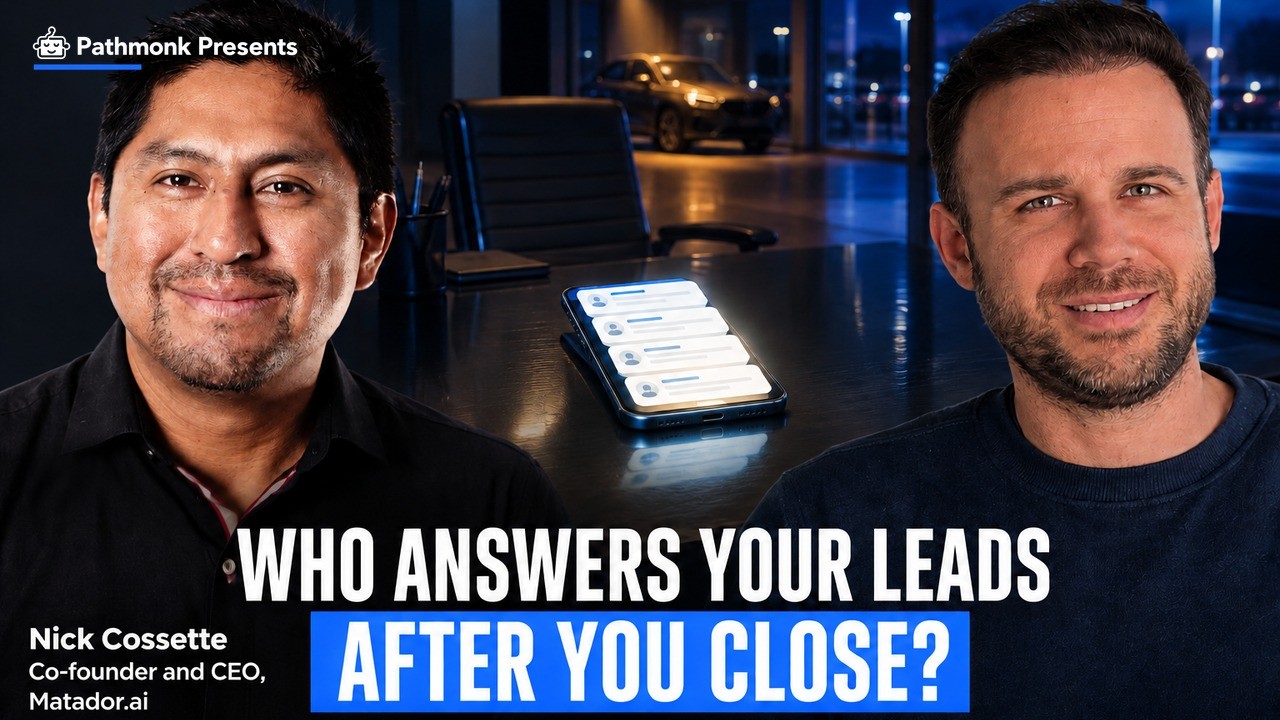
“If you ask, do you have that model in black? And the inventory file does not have this. Maybe the AI will say no, but that's a conversation killer.”
at
- Company
- Matador.ai, conversational AI for car dealerships
- Works with
- Franchise and medium to large independent dealerships in the U.S., Canada and Australia
- Deliverable
- AI agents over email, SMS, chat and voice for sales and service
- Integrations
- Inventory, CRMs and dealer management systems
- Growth engine
- Customer referrals first, then a B2B SaaS playbook with paid advertising
Too long, didn’t listen?
Nick Cossette, co-founder and CEO of Matador.ai, is building the brain and the voice of car dealerships. Matador delivers conversational AI over email, SMS, chat and voice to over 1,800 dealerships, mostly in the U.S. Separate agents respond to new inquiries, carry conversations toward an appointment and re-engage shoppers who go quiet, often when the store is closed.
Nick explains why an AI that answers a plain no is a conversation killer, how CRM and DMS integrations power personalization, and why salespeople's unrecorded conversations are the biggest untapped opportunity. He also shares how organic referrals drove early growth before a standard B2B SaaS playbook, and why companies may invest less in the UI as LLMs connect to many databases.
Never let your AI end the conversation
When a shopper asks for something you don't have, train the AI to ask follow-up questions instead of answering no. A good salesperson would ask about a dark gray option, and your AI should too.
Feed your AI richer context
Lead data alone is thin. Connect CRM and dealer management data, such as past service visits or declined repairs, so every follow-up is personal and well timed.
Capture what happens outside the CRM
Notes that never get logged and calls made from personal phones leave big gaps in the customer's story. Bringing those conversations into one place is the biggest untapped opportunity.
Let referrals prove fit before scaling spend
Matador focused on the product and on customer referrals first. It only invested more in paid advertising once the product and integrations were ready.
Some brilliant ideas
“To be fully honest with you, it took us some time to invest a lot from a sales and marketing standpoint, so the first years, we concentrated on the product and the organic growth. So, rather than identifying a clear ICP, we let our users refer or recommend other stores that might share similar needs or experience the same pain points.”
In our market, we have seen plus 10 new players in the past few months offering voice capabilities. AI makes things more accessible, and people are taking advantage of this. So that's good, because it creates more competition in the market.
I see a future where companies will invest a little less in the UI, and voice, or even text, might be becoming the interaction you have through LLMs, but connected to a lot of different databases.
Full transcript
Introduction
[0:00:00] ADRIAN GARCIA RAMOS: Welcome to Pathmonk Presents, where we talk with growth and marketing leaders about what's actually working right now. I'm Adrian, your host, and today I'm joined by Nick Cossette. co-founder and CEO at matador.ai. Hi, Nick, how's it going?
[0:00:18] NICK COSSETTE: Hey, Hedrian, I'm doing great, thanks for asking. It's a pleasure being here today with you.
[0:00:23] ADRIAN GARCIA RAMOS: The pleasure is on us. So, tell us a bit more on Matador.ai. What is… What'd you guys do?
[0:00:33] NICK COSSETTE: Yeah, absolutely. So, Matador is actually becoming the brain and the voice of car dealerships, and we are doing this by providing retailers with conversational AI delivered by real-time messaging. So, to make it concrete, we leverage multiple communication channels. Think of email, SMS, chat sessions, voice. In order to help dealers to get in contact and better engage with their shoppers.
[0:01:01] ADRIAN GARCIA RAMOS: Right. So, I'm, you know, wearing the shoes of a consumer now, and I'm thinking about how would your software interact with my day-to-day relationship with the dealership, right? And there are two things that I could do in a dealership, a car dealership, right? One is to buy a car or sell it, and the other one is to have a service for my, you know, my vehicle. So, is that a differentiation in the things that you do, or you do both with your software?
[0:01:30] NICK COSSETTE: So we do both with the software, but is there an important distinction? One of them is, like, more on the sales side of things, so working with contacts, prospects, leads, opportunities, whereas on the service side of things, like, it's after sale, so you want to create loyalty and make sure that people don't forget about you.
[0:01:53] ADRIAN GARCIA RAMOS: Right, right. So, yeah, I'm thinking that, what you're bringing to market is, the software that… In a way, creates a relationship and maintains it, right, with, with the consumer from the dealership. you are not focused on the B2B part of the dealership, is that correct? So you are not focused on, for example, spare parts and, you know, maybe, business or business, transactions for cars and such? Or are you also including these kind of features?
[0:02:22] NICK COSSETTE: So we do have customers that they will have their commercial teams involved with Matador, but generally speaking, we will help those retailers to interact with their shoppers.
Who Matador works with
[0:02:34] ADRIAN GARCIA RAMOS: Right, okay. So, I'm wondering about the scale of your business, right? Because I know that you are, you know, pretty relevant in North America. What is the typical dealership that you work with? What is the size of it? are they maybe franchises, or are they rather, like, locally owned businesses? Can you give us some more details on that?
[0:02:56] NICK COSSETTE: Yeah, absolutely. So, as we speak, we work with over 1,800 dealerships. Most of them are U.S.-based. We also have an international presence in Australia, as well as in Canada, and we work with, I'd say, pretty much all franchise and medium to large independents.
[0:03:19] ADRIAN GARCIA RAMOS: Right. So, I'm wondering now, like, what's… I mean, if I were a dealership, what would you say is the right moment to contact you, or to, you know, consider a software like yours?
[0:03:31] NICK COSSETTE: Yeah, this is… this one is a great question, because they should be contacting us the moment that they start thinking about scaling their operations with AI. So, even when they only consider what's available out there, we have content available on our website that caters to those with, like, not necessarily an immediate need. But wants to be educated.
[0:03:57] ADRIAN GARCIA RAMOS: Right. So, I guess that, you know, you're going to know pretty well the problems of the dealerships.
The dealer's real problem with inquiries
[0:04:03] ADRIAN GARCIA RAMOS: Because you… you are dedicated to this. Can you explain us a bit… a bit on… on… on the different travel, you know, and, let's say, needs that a dealership is going to face, and how are you solving those problems with your technology, especially on with, with AI and, those related tools.
[0:04:22] NICK COSSETTE: Yeah, absolutely. I believe you mentioned that you were looking for a new vehicle, right? So, often the typical behavior is to do all of your research online, so you will spend days, weeks, watching videos, and, like, reading articles and whatnot, and only at the end of the journey, you need to contact the retailer. And often what happens is that you will send an inquiry, an online inquiry, to multiple stores at the same time.
[0:04:51] ADRIAN GARCIA RAMOS: Correct.
[0:04:52] NICK COSSETTE: The real problem for dealers is to handle all those different type of inquiries. They will come in as leads, and it's not clear where to dedicate your attention. And on top of that, often people will be shopping when the store is closed. So the real problem that we're dealing with is how to automate that nurturing and engagement Process when no one's available at the store, or when they need to concentrate on people in the showroom.
Three AI agents for the shopper journey
[0:05:24] ADRIAN GARCIA RAMOS: That's… absolutely. So, what is the AI taking place in all this?
[0:05:31] NICK COSSETTE: Yeah, great question. So, we built different agents, the first one to respond to inquiries, because believe it or not, even if you submit an inquiry, it's always tricky to get an engagement from you, because you might not be in the right position to engage. So, that's one agent. Then, the moment that you are communicating and starting the discussion, there's a different agent that is responsible for entertaining that conversation, hopefully schedule an appointment, and if at some point we lose the engagement, there's going to be a third agent available to re-engage or to follow up on pending conversations.
[0:06:12] ADRIAN GARCIA RAMOS: Right. So, I'm just trying to, you know, to think about what are the dealerships doing these days without this kind of tool, right? Because it's difficult to imagine, I mean, the amount of inquiries that you might have, and follow-ups, nurturing. So, either you have a very complex system. Or you rely on someone else that is going to do it for you, like a matador, but… you know, like, what's the reality for the dealerships that don't know you yet? Like, I mean, it has to be very, very difficult for them to keep up.
[0:06:45] NICK COSSETTE: It is, actually, it's a problem. And as we speak, it's all over the place, so we have stores that they already have well-established operations, they have people responsible for each communication channel, but we have stores that, it's a little bit more the far west, so less structure, because at the end of the day, like, the, the… the dealers, they're there to, to sell vehicles, to schedule appointments, so the idea is to identify how they currently operate, and now we can scale their operations with AI, how we can assist them Make their life easier.
[0:07:23] ADRIAN GARCIA RAMOS: Yeah, I was wondering about the… this is a feature or functionality that you might have with the software, but I'm wondering about, because it's one of the things that I…
Inventory integration and the conversation killer
[0:07:34] ADRIAN GARCIA RAMOS: I feel like a consumer, right? That sometimes you have a question about a particular item or car in the inventory of the dealership. I wonder if you guys connect to the inventory in real time? So that maybe you can say, okay, so this car is not the one for you, but, you know, we have this other car, and maybe you can share some pictures, or direct the consumer to the right, you know, article in the whole inventory.
[0:08:04] NICK COSSETTE: Yes, we do have inventory integration, but I like the analogy here, because at the very beginning and, like, looking at other AI solutions, if you ask, oh, do you have that model in black? And the inventory file does not have this. Maybe the AI will say no, but that's a conversation killer. As a salesperson, like, if you talk to a human, like, you're gonna be asking more questions, though, like, would you want a dark gray, or, like, what do you like about that color? So you don't want to terminate the conversation. So the AI needs to be trained, not to simply, respond yes, no, but try to get a little bit more information, because I don't have your black model that we're not going to be working together to find that one.
Focusing on lead management, not lead generation
[0:08:50] ADRIAN GARCIA RAMOS: Absolutely. So, I was wondering about the lead generation process, right? So, most of the websites, they are… the dealership websites I'm talking about are either connected to a marketplace, right, from where they receive the leads. Or they have their own inventory where, you know, the visitors can check their… their… the different cars and such. So, I wonder if you guys do something Before the lead generation. Right? Because… to my understanding, you start working once there is one inquiry, right? And after that, once, let's say, the guy goes to the dealership and tries a car, and maybe someone has to follow him up and, you know, send some emails or some SMS, WhatsApp, whatever it is, to keep him engaged with the item.
Do you work before the lead generation itself?
[0:09:46] NICK COSSETTE: We did some experiment to leverage some identity resolution capabilities. For the time being, we decided to concentrate on the lead management, so we leave it to others to take care of the audience mapping, to identify the anonymous visitors, to generate leads, as per se, and Matador comes in the moment that there was an inquiry generated generated from the marketplace or the DRO website, but I see a future where potentially we'll get involved, upper in the funnel, higher in the funnel, if that makes sense.
Personalization with CRM and DMS data
[0:10:22] ADRIAN GARCIA RAMOS: Yeah, absolutely. I wanted to ask you, also ask you about the personalization that you have for your agents, especially for, let's say, the loyalty agents, right? The ones that are nurturing once there is a visit to the dealership, or something like that. what can you tell us about the experiences that you have had with the personalization? How does it work, and if it brings results when, you know, you have maybe a vanilla message against a really personalized message in which you know, you treat the visitor by his name, and, you know, maybe make some notes about the visits, or the car that he wanted. How does it work?
[0:11:00] NICK COSSETTE: Yeah, so… we need to leverage systems integrations in order to gather better context. If we only have the lead data, often that this is going to come with a vehicle of interest, like customer's first name, last name, phone, and email, but we have in-depth integrations with the CRMs and the dealer management systems, so we can get much more relevant information. So on the loyalty side of things, maybe we want to look at the last time that you stopped by the service bay. If you declined services, so you were not ready to do the brake job, but now, like, it's a better time. So all that type of, like, historical data that we can have access will allow us to better personalize the journey.
The biggest untapped opportunity
[0:11:48] ADRIAN GARCIA RAMOS: Right. I'm thinking, and this is a bit off topic, a futuristic, you know, feature or something, but say that you give a possibility for the sales, commercials, right, or the sales reps on the dealerships to have a hardware or an app. That is going to record, for example, the exchanges that they have with the different, you know, visitors to the shop, and they know exactly What's the problem, or, you know, how the conversation went, and what they're interested at? So, maybe you can automate the process, so you have that transcript in the CRM, and then you can utilize that information to feed it back to the personalized messages and the nurturing messages. It's something, you know, maybe part of the future, but I just wanted to…
to have your opinions and your thoughts on that, is that possible, or it is far from reality?
[0:12:35] NICK COSSETTE: 100% possible. So what you just described, Adrian, is the biggest untapped opportunity. As we speak, the AI will only get as better as the context we can provide him, and what you just described with the commercial, not leaving notes in the CRM or having a phone call from his personal phone number, we're missing an important part of the stories. So the moment that we can centralize everything, the better we'll be. That's the reason why our mission and the vision for the future is to be coming That brain and that voice, so we can get information from different data sets, the end user will benefit from a better shopping experience.
Go-to-market and referral-driven growth
[0:13:20] ADRIAN GARCIA RAMOS: Amazing. I wanted to follow up on, you know, you mentioned 1,800 dealerships across the U.S. and other parts in Canada and Australia. How have you built your go-to-market strategy, and what would you say it's, you know, the key point for you to enable growth? Across, the whole country.
[0:13:45] NICK COSSETTE: So, we haven't, reinvented the wheel here, decided to follow the typical B2B SaaS playbook, with BDRs, account executives, inbound strategies, outbound strategies, trade shows. So, very, very similar to a lot of companies that, you might be, meeting with. I guess the difference is the data-driven approach, so making sure that we actually measure every single part of the journey, so we can make better decisions. But to be fully honest with you, it took us some time to invest a lot from a sales and marketing standpoint, so the first years, we concentrated on the product. And the organic growth. So, rather than identifying a clear ICP, we let our users to refer or to recommend other stores that might share similar needs or experience the same pain points. So, a lot of early growth came in from those organic referrals, and at some point when, like, the product was there, integrations were built.
Then this is where we started investing a little bit more when it comes to paid advertising.
[0:15:02] ADRIAN GARCIA RAMOS: Right. Just out of curiosity, like, do you know how many dealerships are there in America?
[0:15:10] NICK COSSETTE: I am.
[0:15:10] ADRIAN GARCIA RAMOS: what's… What's your time, in terms.
[0:15:13] NICK COSSETTE: So the franchise dealers in America give and take 17 thousands. Those are the franchise with banners. Now, there are a ton of independents. We work well with the bigger ones and the mid-sized ones, the ones that have enough leads and advertising dollars to justify optimizing that process.
[0:15:37] ADRIAN GARCIA RAMOS: Right. So, I mean, would you say, if you said now that the total addressable market is around, like, 17,000, and you are around, like, 1,800 customers, you have more than 10% of the market, is that correct?
[0:15:51] NICK COSSETTE: Yeah, so, like, some of our stores are also Canadian and Australian, but yeah, give and take, we have, like, a small portion of the market.
More competitors and fewer UIs: where AI is heading
[0:16:00] ADRIAN GARCIA RAMOS: Pretty cool, pretty cool. Okay, so I would like to close it up with one follow-up question on AI, right? And it's a bit general, but what are your thoughts on AI? What's the future of AI? And I would also appreciate for our audience if you can highlight a case that it's been, you know, working for you lately. It could be a new feature, or it could be something that you do in your day-to-day work. Related to these new technologies that are changing, for the greater good, in a way.
[0:16:35] NICK COSSETTE: So, what changed from a macro standpoint is it makes things easier for someone to launch a venture. To give you a specific example, in our niche. in our market, we have seen, I would say plus 10 new players in the past few months offering voice capabilities. That's a lot of companies, so this is actually more companies that launch a business than, like, during the previous 10. So, AI makes things more accessible, and people are taking advantage of this. So that's good, because it creates more competition in the market. That's the first answer. Now, going back to the second question. I would like to say that,
to share a case, right, in regards to AI, I'm thinking of all those connectors and MCPs. Right. Rather than using the actual UI, like, you stay in the LLM, And that also fast-tracked things, so I see a future where companies will invest a little less in the UI, and voice might be becoming, or even text might be becoming, like, the interaction you have through LLMs, but connected to a lot of different databases.
[0:17:59] ADRIAN GARCIA RAMOS: Yeah, amazing. So… Nick, once again, thanks you for coming on. It's been a pleasure to have you. I would like to pass you the word, just to mention your URL, and also if someone in the audience wants to reach you out, what's the best way to do so?
[0:18:18] NICK COSSETTE: so you can find me on LinkedIn, Nick Cossette. Email nick at matador.ai, and the website is matador.ai.
[0:18:27] ADRIAN GARCIA RAMOS: Perfect. So, Nick, thank you very much for coming. Let's stay in touch.
Got a growth story worth sharing? Tell it on the show.
We talk with founders and marketing leaders about what actually moves their pipeline. If you’ve built something other marketers can learn from, we’d like to hear it.
- 01Apply
Tell us who you are and the story you’d bring to the show.
- 02We get in touch
We review every application and reach out if it’s a fit.
- 03Record your episode
A remote conversation, published as video, audio and a full transcript.