Stop fighting for the same traffic and catch demand waves early
Why chase the same costly traffic? Learn how to read market demand early with Rodrigo Pozo of mytelescope.ai, plus why ad spend should come last.
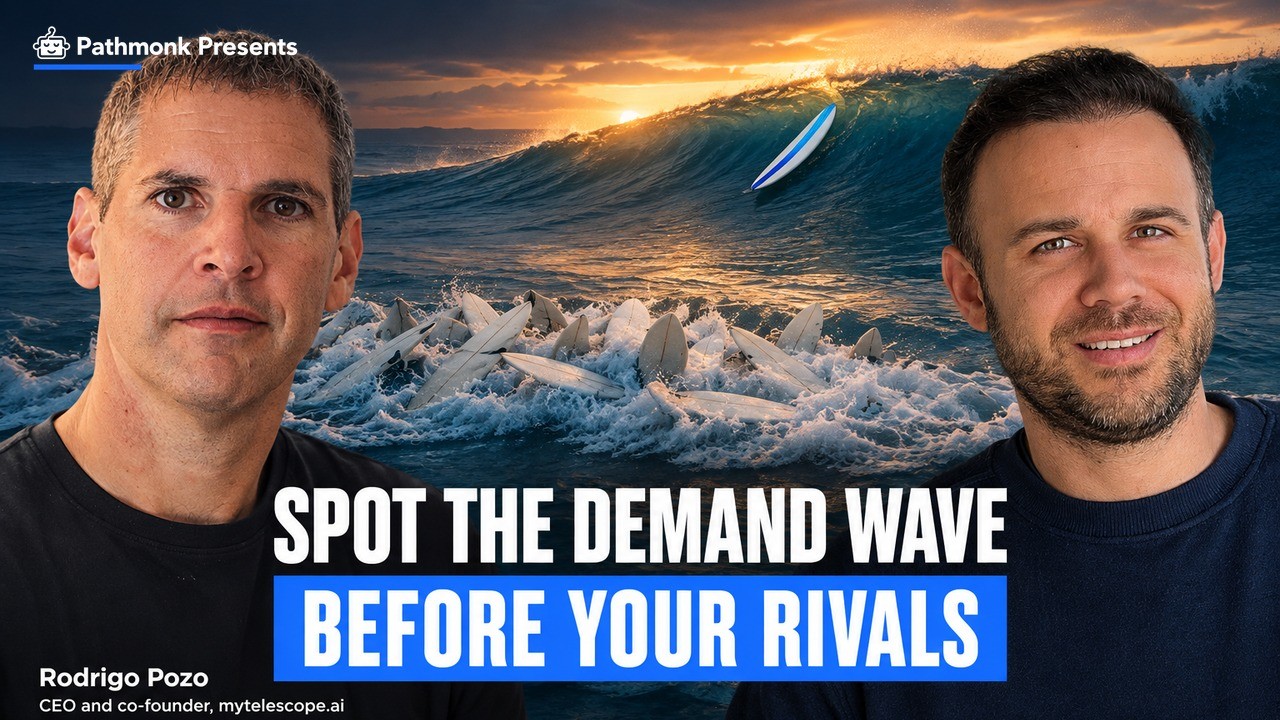
“When you work in marketing, you need to understand those waves before they happen, because the other part is more optimizing something that is already happening.”
at
- Company
- mytelescope.ai
- Speciality
- AI research assistant trained to understand market demand
- Works with
- Consumer brands, enterprises and agencies
- Pricing
- Consumption-based, starting at $25 per month
- Growth engine
- Word of mouth
Rapid fire
- Problem to make disappear
- Finding the message that creates more word of mouth
- One source worth the noise
- Podcasts like Lenny's Podcast, plus talking to friends
Too long, didn’t listen?
Rodrigo Pozo, CEO and co-founder of mytelescope.ai, has spent four years building an AI research assistant that helps consumer brands, enterprises and agencies understand true demand. He argues that optimizing traffic and conversions only works on demand that already exists. Marketers win by spotting demand waves early, the way Lovable rode vibe coding. To do that, they need to read behavior, like what people search for and ask online, rather than what people say.
He also explains why he chose consumption pricing starting at $25 per month instead of seats, why a low average spend makes word of mouth essential, and why ad spend should only come after product, pricing and distribution are right.
Spot demand waves before they peak
Optimizing demand that already exists means competing with everyone for the same traffic, so acquisition costs go up. Look for growing pockets of demand early, the way Lovable did with vibe coding.
Trust behavior over what people say
Searches and questions online show demand before it reaches your website, and people often say one thing and do another. Work out the intent behind ambiguous terms before you trust the data.
Make ad spend the last step
Get a good product, the right pricing and the right distribution first. Otherwise advertising just buys growth at a higher and higher cost.
Match acquisition cost to customer value
When customers spend around $300 a year, acquiring them has to be very cheap. That makes brand, top of mind awareness and word of mouth more important than paid traffic.
Some brilliant ideas
“Adding ad spend, that's something, according to me, that you should do the last part. Because you first need a good product, the right pricing, you have to know that you have the right type of distribution.”
I think we've been fooled because it's been so cheap to drive traffic. It's been very, very cheap, and I think now the prices have gone up so high, so now all of a sudden you have to rethink.
Sometimes people say one thing, and they do another. So we truly believe much more in looking into the underlying behaviors.
Full transcript
Introduction
[0:00:00] ADRIAN GARCIA RAMOS: So, welcome to Pathmonk Presents. Where we talk with growth and marketing leaders about what's actually working right now. I'm Adrian, your host, and today I'm joined by Rodrigo Pozo, CEO and co-founder at Telescope.ai. Welcome, Rodrigo! How are you doing today?
[0:00:23] RODRIGO POZO: Hi, thank you, and thank you for having me. And just a small correction, mytelescope.ai.
[0:00:29] ADRIAN GARCIA RAMOS: Oh, I'm sorry for that. I got it wrong, mytelescope.ai, that's…
[0:00:34] RODRIGO POZO: Corey.
[0:00:35] ADRIAN GARCIA RAMOS: So, what is that your company does?
[0:00:39] RODRIGO POZO: Yeah, well, what we have built is a research assistant, so a market researcher. So, if you think about, today people are using ChatGPT, or Perplexity, or Claude, and the others, which are fantastic, of course, but they are general knowledge, but what we have is a trained agent that is trained on understanding markets, and that is trained on understanding growth patterns and how to build brands, etc. So we've been building For 4 years, the technology. And we're actually launching, now, the, the, this… assistant, because until today, we've been mostly building, but more like a data set. But now we're becoming a true research assistant. You could say you're a new
Your new, colleague, in your team, so that you always can be insights-driven and data-driven in your decision-making.
[0:01:30] ADRIAN GARCIA RAMOS: Amazing. So, I'm wondering, you know, what is the core problem that you solve for the companies that you serve?
The core problem: understanding true demand
[0:01:37] RODRIGO POZO: Yeah, so many, the biggest challenge in marketing has always been understanding true demand. So, a lot of optimization has, of course, been doing, you know, how do we optimize traffic or, you know, conversions. It can be either traffic digitally, but also traffic on the street, right? How do you get people into your retail? Right. But how do you understand demand. And that's the core problem that we have set up to solve, so that the Companies and teams and agencies can have Full check on where demand is going, what demands… what problems people are trying to solve, so in that sense, you as a company can find a proper fit of where to sell your product, how to price it, how to communicate, etc.
[0:02:27] ADRIAN GARCIA RAMOS: So, I guess, you know, we're referring GTM to demand capture and demand generation. I guess that you are supporting companies to understand how to, let's say, pursuit, the demand generation, and have the right intel for doing so. Is that correct?
[0:02:47] RODRIGO POZO: Yeah, correct. I mean, if you think about demand generation, I haven't done so much work in that myself, so you will have to correct me here when I'm wrong. But you have one part which is converting, right? What people are asking for, right?
Riding demand waves before they happen
[0:03:00] ADRIAN GARCIA RAMOS: Like.
[0:03:01] RODRIGO POZO: But that means that you're going after pools that might exist, and what you want to do is to find new pockets of growing waves. think about… If you think about Lovable, for example, right now, you have Vibecoding, which… not invented by them, because it was a wave that was growing, thanks to Replit and many others, and now, all of a sudden. you have… a brand like Lovable that is fantastic at riding that wave and capturing a lot of that wave into their product, because they have built a fantastic product, so they could meet that. And… When you work in marketing, you need to understand those waves before they happen, because the other part is more optimizing something that is already happening, and then your competition is going to be much more costly, because if everybody's riding the same wave.
That means that the cost of acquisition is going to be much higher, because you're gonna have a… you're going to be competing about the same… Send traffic, so to speak.
[0:04:01] ADRIAN GARCIA RAMOS: Okay, absolutely. So, I'm wondering about the, you know, the companies and the customers that you have. I would like to understand what is their nature, and I would like to now also know about how they find you, right, if you can describe it.
Who the customers are and how they find mytelescope.ai
[0:04:18] RODRIGO POZO: Sure, so… We could say we could work with two types of companies, so either mostly consumer brands, so bigger, like, large companies or enterprises that Or multinational, and wants to understand their consumers across markets. Right. So they find us as an alternative to classical research, or as a complement to research. And then you have agencies that uses us for pitches or helping and supporting their customers in their daily work. Because, as you know, many big brands have very small teams, so then they delegate a lot of that work to their consultants or to their agencies. So those are the kind of two big cohorts that we work with.
And how they find us has mostly been word of mouth, due to the fact that we have been building the technology, because as you understand, I mean, if you're going to say that you're going to understand demand, which has been very… fairly difficult to do in the past, we really need to make sure that it's done correctly. So, we've been building a lot of technology, so… I think, if you ask me today, it's mostly word of mouth, but hopefully tomorrow we're gonna have more, you know, added other sources where it's gonna be, maybe. Through the web, or, you know, events, or, I mean, we're… we're looking for multiple ways of finding them, so to speak.
Behavior data, intent and fighting hallucinations
[0:05:48] ADRIAN GARCIA RAMOS: Yeah, absolutely. I'm thinking now about the, you know, the technologies that you are using. I understand that most of them might be, you know, kind of intellectual property and things like that, but there might be things that you might share. You know, how he works, and… what differentiates you over other, let's say, tools that were already there, right? Especially thinking about all this AI revolution in which we are living. So, what could you tell us about that? Could you tell us? Yes.
[0:06:21] RODRIGO POZO: Yeah, so… so basically, I mean… There are tools, I mean, as I said in the beginning, like ChatGPT, Perplexity, and all these new chatbots that have general intelligence, and then you have pure SaaS tools, like SEMrush, RF, Google Trends, SimilarWebs, I mean, you have, like. That are more pure data sources.
[0:06:44] ADRIAN GARCIA RAMOS: Right.
[0:06:44] RODRIGO POZO: And if you think about the challenge when you're understanding demand, one way of doing that is Interviews can be one way of doing that. Another way which we believe the most is behavior. Like, what people… what are people asking on the internet? Like, what are the questions people are asking? What are they searching for? And that type of behavior, because that tells you something before it hit your website, before it hit your, you know, before you actually could see them. And also, sometimes people… They say one thing, and they do another. So… so we… we truly believe much more in looking into, you know, the underlying behaviors, and
And if you think about them, for example. I'm gonna be a bit technical here, but if you think about a word like apple. That can be an apple, the fruit. Or the company. So, if someone is looking for or asking for Apple. You need to know, is it the company? Right. Or is it the fruit? And that type of clustering and understanding of what the actual intent behind the behavior is, that's where the complex part comes. And that's what we, like, how do you cluster that, and how do you build a true entity where you can trust the data? That's kind of where we… the algorithms that we have built has been mostly focused on. And then…
We do, from a UI point of view, we do combine, you know, OpenAI, Anthropic, Perplexity, etc, for the interface facing you as a customer, but then, of course. those are only as good as the input that you give them, so that's kind of where we have made sure that those AIs hallucinate as little as possible, because I can't promise zero hallucination, but of course, when you give it input with more information, it's going to give you up-to-date data. Right. And also, we have fine-tuned our own models, where we can then make our AI understand more from a research point of view.
Making market research accessible
[0:08:58] ADRIAN GARCIA RAMOS: Right. So, you know, the things that you're telling, are a bit, in a way, complex, and I guess that they might be purposed for big corporate guys, you know, with, huge retail accounts and things like that in the consumer space. But I believe that that technology could be, in a way, democratized, right? And maybe used by more small players, so that they have insight about the market. But… I'm not sure if we have the bridge, you know, to distribute that. And that could be limited by the go-to-market, right? Because again, like, you need to, in a way, sustain an acquisition channel that it's profitable, right?
And on the other hand, how difficult is it to implement your tool, right? Because if you need months, you know, talking to people, or if you need a consultant, you know, doing all the things just to implement it, that could be a barrier for your spread. I wanted to ask you your insights on this possibility for the democratization of these kind of tools.
[0:10:03] RODRIGO POZO: Yeah, so, I mean, our ambition is to be a very accessible platform, so actually it's just about pressing ask a question and start asking. So it's actually a pure chatbot, so in that sense, it's very easy to start using, so the complex things I'm talking about is more what's under the hood.
[0:10:22] ADRIAN GARCIA RAMOS: Okay.
[0:10:22] RODRIGO POZO: So, so our starting point, it's $25 per month. And you can then grow used on consumption, so it depends, like, so if you're a small player, you don't need much spending, because you're only going to need that amount of queries. Whilst, if you're a large enterprise, of course, you're gonna need much more data, because you're gonna have more people or more questions that you need to ask. So, in that sense, we made it, that's why we're actually so proud of what we're releasing right now, so I think the timing of this interview is great, but so… Because we… hopefully, it is as easy as I say. You can just ask a question and get an answer. That's… that's the ambition.
[0:11:04] ADRIAN GARCIA RAMOS: Right.
Consumption pricing instead of seats
[0:11:05] ADRIAN GARCIA RAMOS: This is super interesting. Actually, I'm curious about the price model that you have. concreted, right? Because you have small players that maybe have a URL and, you know, some information about the business verticals, but then you have a super big player in the consumer, space. So, what is going to define the price for you? How do you make it?
[0:11:29] RODRIGO POZO: Yeah, so it's a pure consumption, so we see it as driving your car. I mean, the more… the longer you're gonna drive it, either more electricity or more gasoline you will need. So, if you're a small player, you don't need to consume as much, so your net… Cost will be stay, and then if you're a big player. you will need to have a lot more data, because, of course, you're gonna either have much more users, or you're gonna have one super user maybe asking a lot of questions, or wanting to automate stuff, and stuff like that, so… I think this is the new way of… I think this is AI's.
[0:12:08] ADRIAN GARCIA RAMOS: Yep.
[0:12:09] RODRIGO POZO: My point of view is that I, myself, because we started this price model, we thought about it even before, OpenAI and the others, I don't like seating. I think that's a strange way of charging, because I think I want to pay for stuff that I want, when I want it. And then, of course, I'm… prepared to commit if I love something and I like it a lot, then I might commit. But I think if a product is very, very good, you will want to use it, and you will have it in your workflows and everything. Then I think you got… I think it's much more honest to allow people to use, depending on how much they need.
Of course, from a business point of view, that can become complicated, because you need economics, etc, etc, but you still have averages on cohorts, and how much they're using it, and the types of questions, and as you say, if you're a small agency, only small questions, of course, the cost of acquisition can't be too high, because if you have an average spend of, let's say. $300 per year.
[0:13:08] ADRIAN GARCIA RAMOS: Right.
[0:13:09] RODRIGO POZO: The cost of acquiring that customer has to be very, very low, and that's where word of mouth becomes very, very good, because then it's more about brand in general, building top of mind, and not so much traffic acquisition.
Brand and word of mouth before ad spend
[0:13:22] ADRIAN GARCIA RAMOS: is that the real kind of approach that you are following? Kind of a distribution based on, you know, macro-influencers or agencies, word of mouth, for a load years? Is that it?
[0:13:35] RODRIGO POZO: Yeah, I mean, I'm a former creative director, building brands, so I'm… I'm a strong, strong believer that the only thing that matters in the end is how good is… how good is your ability to build top of mind and awareness of what you do. And, I think there's two… I mean, there's several things that will impact that, and I think that… communication, I mean, if you think about what we're talking about now, adding ad spend. Yep. That's something, according to me, that you should do the last part. Because you first need a good product, the right pricing, you have to know that you have the right type of distribution.
When you have that, then you can start adding shitloads of communication or advertising, but… because if not, your cost is just gonna just… Because everybody can grow, depending on how much money you have, then depending on how much you want to pay for your growth. And if you can solve the other three first. Yep. Then this one becomes fairly easy, and I'm saying easy, because I know it's not easy, but
[0:14:33] ADRIAN GARCIA RAMOS: But yeah, so…
[0:14:34] RODRIGO POZO: So…
[0:14:35] ADRIAN GARCIA RAMOS: You need to prove that the wheel is going to spin before you pour money into spinning the wheel, right?
[0:14:42] RODRIGO POZO: Yeah, exactly, and I think… I think we've been fooled to… because it's been so cheap to drive traffic. It's been very, very cheap, and I think now the prices have gone up so high, so now all of a sudden you have to rethink. But, until, I don't know, a couple of years ago, driving traffic was super, super cheap.
Rapid fire: messaging and sources
[0:15:00] ADRIAN GARCIA RAMOS: Excellent.
[0:15:00] RODRIGO POZO: So, I understand why we've kind of forgotten the other parts.
[0:15:04] ADRIAN GARCIA RAMOS: Okay, so Rodrigo, last two questions. They are not related to your business, but more about your day-to-day operations and, you know, things that you might do in in your work that could support an audience to have more insight. So, the first one relates to… You know, if there was a problem today that you run every day that you could just resolve, right, or cancel away, just, you know, what would that be?
[0:15:36] RODRIGO POZO: The problem, you mean?
[0:15:37] ADRIAN GARCIA RAMOS: Yeah.
[0:15:38] RODRIGO POZO: Wow, that was a… that was a tough, a tough question.
[0:15:44] ADRIAN GARCIA RAMOS: Makes you think, right? Just to…
[0:15:48] RODRIGO POZO: No, I think it depends on the perspective at that given moment, and where you are in your head currently, and I think…
[0:15:55] ADRIAN GARCIA RAMOS: I agree.
[0:15:56] RODRIGO POZO: Right, and I think right now, where my head is, is finding the right message of, like, how do I create more word of mouth? Like, what is the… how do I talk about what we do, and help you to… help you to talk about our product? So that is, I think, right, because that's where my mind is now. If you would have asked me…
[0:16:21] ADRIAN GARCIA RAMOS: It's totally fair. It's an open question, it's fine. I guess we all struggle with positioning, and what is the right message that clicks and makes other people click when they hear about you, right? So that's a totally fair reply, and I guess it's pretty good. So the second question is about, you know, we are surrounded by noise, and many things are, you know, shouting at us every day. So, if you were to mention one single source of information that you use, and it's, let's say, value for you, what would that be?
[0:17:00] RODRIGO POZO: I'm gonna say podcasts, so… and now I'm trying to learn a lot about building products, so I've been listening to a lot of podcasts on that, so you have Lenny's podcast, for example, or you have How I Build It, and stuff like that, so… I think, for me, yeah, that's, has been a very strong source of information. Perfect. And, And then the other part is talking to friends. Because… because they… I mean, if you have… if you're good… I mean, for me at least, I think it's important to have a wide network of people. And because then you get different perspectives, and I think that is a very good way of solving stuff, because people have experiences. So, I think that sometimes is a faster way to get, like, a, hmm, this is how I should think about it. So…
[0:17:54] ADRIAN GARCIA RAMOS: Absolutely, I couldn't agree more. At the end of the day, we work in the… most of us in startups, and we have, you know, small teams, in a way. So, one of the things that we like, even if most of the time we are, you know, superstars in a way that all the chosen ones are the right ones. we don't have that many people, right? So, diversification of mindsets and approaches and experiences Oftentimes is lacking. Having a nice network of, you know, friends and people close to you from different angles.
Where to find Rodrigo
[0:18:31] ADRIAN GARCIA RAMOS: It's super useful, absolutely. Okay, so Rodrigo, thanks so much for coming on. I don't know if you have any last word, about, you know, mytelescope.ai, how to find you, anything you want to share?
[0:18:50] RODRIGO POZO: No, so please, if you want to reach out, find me on LinkedIn. I'm always there, it's a good channel to find me, and then please use the product and test it, because every feedback we get is very, very good. So please go in, try to break it, and tell us what didn't work.
[0:19:09] ADRIAN GARCIA RAMOS: Perfect. Thank you, Rodrigo.
Got a growth story worth sharing? Tell it on the show.
We talk with founders and marketing leaders about what actually moves their pipeline. If you’ve built something other marketers can learn from, we’d like to hear it.
- 01Apply
Tell us who you are and the story you’d bring to the show.
- 02We get in touch
We review every application and reach out if it’s a fit.
- 03Record your episode
A remote conversation, published as video, audio and a full transcript.