Stop chasing data, start getting answers
Why is data still a struggle for every business? Barrett Johnson of Nexus Cognitive shares how Easy Analytics turns scattered data into clear answers.

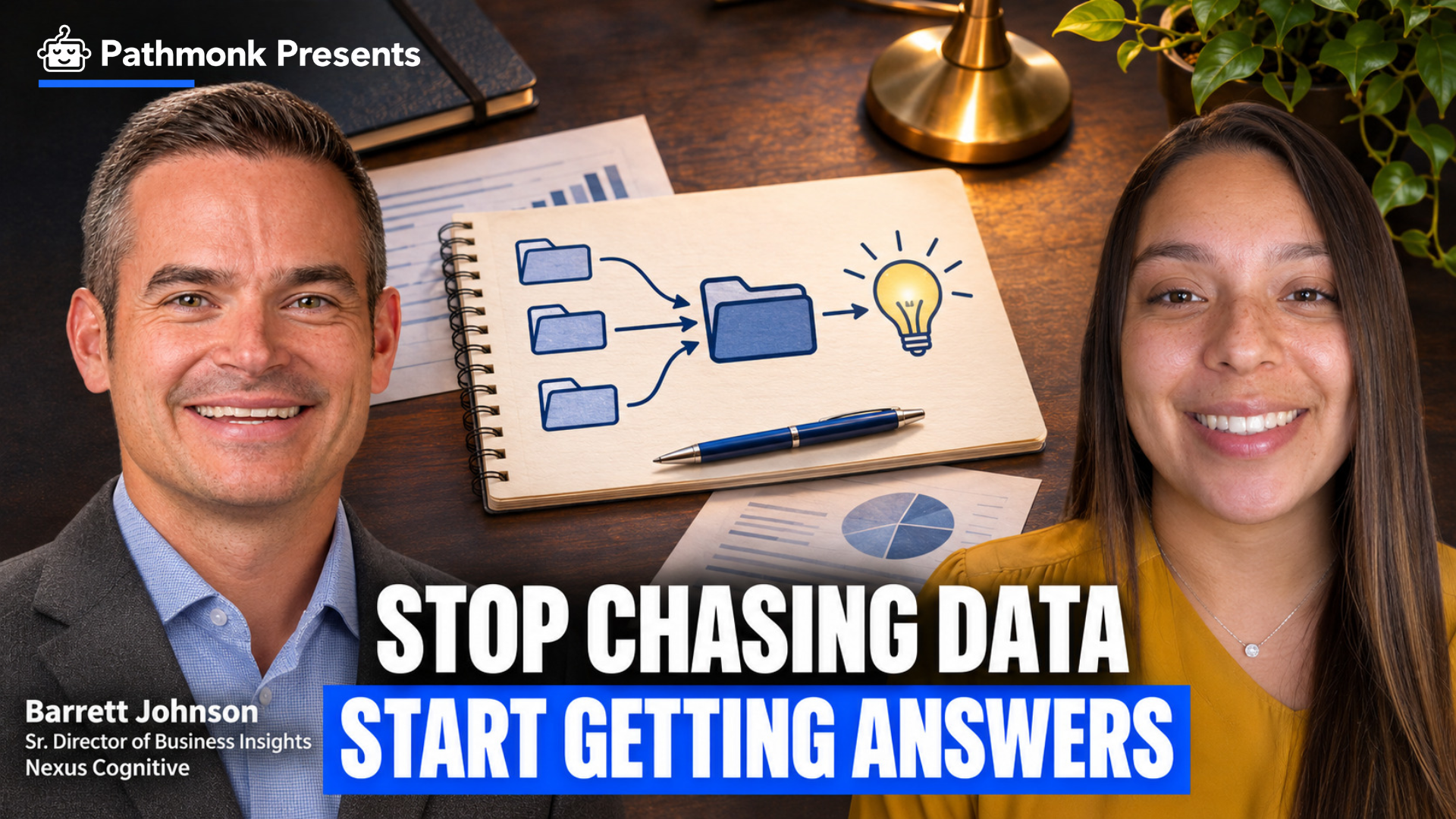
“Data is a journey, not a light switch.”
at
- Company
- Nexus Cognitive, technology firm that separates data from software
- Role
- Senior Director of Business Insights, leading Easy Analytics
- Focus
- Answering business questions with reports and dashboards
- Customers
- Multi-location retail, manufacturing, distribution and value-added resellers
- Growth engine
- Referrals, with organic search in progress
- Website
- A brochure that evolves with acquisitions
Rapid fire
- Current reading
- The Wager by David Grann
- Also reading
- Talking to Strangers by Malcolm Gladwell
- One thing to fix with no tech limits
- Faster data from source to audience
- One thing to remember
- Data is a journey
Too long, didn't listen?
Barrett Johnson, Senior Director of Business Insights at Nexus Cognitive, explains how the company separates data from software so businesses can stop fighting spreadsheets and start answering real business questions with reports and dashboards.
Discover why the spreadsheet world grows out of control, why websites should evolve like good reports, and why data is a journey that needs a plan rather than a light switch.
Start with the question
Find the business questions you can't answer yet; the answer is probably in your data.
Escape the spreadsheet world
Manual tabs and formulas erode trust and invite errors.
Keep evolving
Static reports and static websites are never a good thing.
Plan the journey
Data is a journey; a plan keeps you on track even when you veer off.
Some brilliant ideas
“Data is a journey. People sometimes think it's like a light switch, but it really is a journey.”
No matter the size of the company, data is a struggle.
Websites are a lot like reporting. If they're static, it's never a good thing.
Full transcript
What Nexus Cognitive does
MARIAH: On today's episode of Pathmonk Presents, I've got a very special guest joining me. Please welcome Barrett Johnson, Senior Director of Business Insights at Nexus Cognitive. For all of you who don't know, Nexus Cognitive is one of the big technology firms in the US, and they have a lot of exciting things coming down the pipeline. Barrett, thank you so much for joining us today. It's an honor to have you on our show.
BARRETT JOHNSON: Thank you, Mariah. Really looking forward to it.
MARIAH: Absolutely. For all of our listeners out there, tell us: what does Nexus Cognitive do overall?
BARRETT JOHNSON: Our goal at Nexus Cognitive is to separate data from software. Data and software are so combined right now that businesses have a hard time getting their data out and actually doing something with it. Through our platform, we help companies get that data out, and then we manage and operate the platform, so businesses can use their data to innovate instead of spending all their time just trying to get to it and use it.
My line is Easy Analytics, where we focus on reporting, though we also do governance, AI, machine learning and other things to help companies. With Easy Analytics, we use data to help answer business questions. That's usually where we start with clients: what business questions can't you answer easily, or at all, even though the answer is probably somewhere in your data? We get that data, pull it into one place, transform it, join it with other data, which is a really key piece, and then put it into a form they can consume, like reports or dashboards, so they have the answers they need when they need them.
Escaping the spreadsheet world
MARIAH: That's incredible. What your company does solves the problem for so many people who struggle with reading analytics.
BARRETT JOHNSON: It's interesting, because no matter the size of the company, data is a struggle. There are all the innovative terms out there, AI and machine learning, and most people say that would be great to do with their data. But it's not easy. You have to start somewhere. A lot of companies use spreadsheets to get data out of a software system into tabs and tabs of spreadsheets, manipulate it with formulas and VLOOKUPs, and send it to somebody who does something else and sends it to somebody else. By then, all the information has been manually interpreted. Sometimes there's a lack of trust, or it's the wrong data because somebody typed a plus instead of a minus. That spreadsheet world can grow out of control.
Or companies depend on reports out of software that don't address the specific business question. They're just a data dump: here's your report, it has everything in there. We want to help companies get out of that world and build the foundation: get the data into a central spot, understand it and structure it, so they can start the path from very simple analytics to machine learning and AI.
Who they serve
MARIAH: It's great what you're doing. Would you say your company is industry agnostic, or do you focus on specific sectors?
BARRETT JOHNSON: Data is data, so we can help anybody who has it. But we do focus on some areas, especially on the Easy Analytics side. We have a lot of experience in multi-location retail, where you have a lot of inventory and want to understand where one product sells better than another. Product A might sell great in one market but not in another, and you don't want to send the same product amounts to markets that don't sell the same. You really need to understand your data to see what's going on. That carries into marketing too: who do you market to in each market, since locations can have very different demographics?
We also do manufacturing and distribution, which is a data-rich area, and value-added resellers. And we've worked with healthcare, nonprofits and a variety of other clients.
Referrals and the marketing challenge
MARIAH: Wow, that's awesome. How do your clients typically find you? What would you say is your top client acquisition channel: referrals, word of mouth, organic search, paid search, digital marketing, or a mix?
BARRETT JOHNSON: I'll speak specifically to Easy Analytics, since Nexus as a whole has a lot going on. Through our growth so far, it has mostly been referrals. We're working on getting more customers through organic search. It's funny, because we've actually done some work with marketing groups, and one thing I've learned is that marketing is very difficult. Defining success in marketing is very difficult. That's the exact problem a lot of our clients have, in marketing or elsewhere: there's a lot of data, but how do you use it to pivot and innovate as fast as possible? It's something we're working on as well, always trying to figure out new ways to bring in customers.
Websites are like reports
MARIAH: Absolutely, always optimizing. Now let's switch gears and talk about the website. What would you say are the major strengths of your company's website, and where are the opportunities for improvement?
BARRETT JOHNSON: In my mind, websites are a lot like reporting. If they're static, it's never a good thing. They should always be evolving, just as your reports should. Usually, once you start answering one question, you have five or six more. A website should evolve the same way as you interact with more customers and see what they're looking for, how they found you and what the website helped them answer.
Our website is more like a brochure. When we give our name to someone, the first thing they usually do is go to our website, so you want it to show who you are and what you do, confirming the handshake or call you just had. It's definitely evolving right now. My company was acquired and brought into Nexus Cognitive, a couple of others have come in too, and we've had to evolve the website to align with those acquisitions and how they've changed the business.
MARIAH: That's exciting. I agree that reporting is a perfect comparison. Whatever update you put on the website moves the company forward.
BARRETT JOHNSON: They're also aligned in another way. The website is the art form behind marketing, and reporting is the art form behind data: what lets a person get the most out of it quickly. Some people love their spreadsheets and text tables, but our minds can't read those reports very well. Some prefer scatter plots or bar charts to get the answers they want. Websites are the same. You're trying to answer a question for a lot of different people with different opinions, and that's not an easy thing to accomplish.
Many hats in Easy Analytics
MARIAH: Exactly. Now let's talk about you as a leader. You mainly work in Easy Analytics. What do you do on a daily basis?
BARRETT JOHNSON: One of the things I really love about my role is that when we were acquired by Nexus, it didn't change much: I still do a lot of different things and wear a lot of hats. On a daily basis I'm engaging with two or three clients, making sure the projects and the Easy Analytics platform are running well and the reports are evolving the way they need to. Some clients have a lot going on, so you're engaging with them all the time. Others are more passive and absorb things before getting back to you.
I also work with our marketing team on getting the right Easy Analytics message across and on how our marketing is doing. There's a little bit of sales, a little bit of project management and some work with the executive leadership team. Every day, you have no idea how much time you'll spend on any one thing.
MARIAH: I believe it. And I can tell you're very passionate about Easy Analytics.
BARRETT JOHNSON: It's funny, people say that to me and I don't realize how excited I get about it. There's just so much power in data. Getting a client started on that journey is exciting. Sometimes it's little things that make them say, I never knew I could do that. Once you take it further and see how they innovate on their data, it's awesome.
Rapid fire
MARIAH: That's awesome. We're getting close to the end of our interview, so I'm going to ask you some rapid fire questions. Are you ready?
BARRETT JOHNSON: I'm ready.
MARIAH: What's the last book you read?
BARRETT JOHNSON: I'm reading a book right now, more on the personal side. It's called The Wager, by David Grann. It's about a British ship in the 1740s that has a shipwreck and a mutiny. A really crazy story I never knew existed, with some good history in there. I'm also reading Talking to Strangers by Malcolm Gladwell. I have two little kids, so I don't read as much as I want to, but I love Malcolm Gladwell, so I enjoy it when I get the chance.
MARIAH: I love that. I'm the same way, I'm constantly adding to my books. If there were no boundaries in technology, what's the one thing you would want fixed in your role today?
BARRETT JOHNSON: That's an interesting question. Real time is a term used out there, and everybody defines it differently. There are usually several steps in moving data, and that's what our platform handles, but anything that improves getting data from the source to the audience becomes gold. Answering questions from the data quicker gives more power to the user.
MARIAH: You summed it up perfectly: it gives more power to the user.
BARRETT JOHNSON: Honestly, I'd probably also figure out how to not get spammed as much, with emails and phone calls taking time out of your day.
Data is a journey
MARIAH: Oh, yes. We're at the end of our interview today, and I want to thank you so much for joining us, but I also want to give you the last word. If anyone forgets everything we've talked about today, what's the one thing you want them to remember about your company?
BARRETT JOHNSON: Great question. Data is a journey. People sometimes think it's like a light switch, but it really is a journey. You need a plan of where you want to go, and even with that plan you may veer off the path, which can be painful and frustrating. But having that plan lets you get what you need out of the data, and that's what we're here to help with. Everybody in our organization loves working with clients, and what we really want is to help them through that journey.
MARIAH: And you do, especially with the software you're creating. It's already a game changer in the market. Thank you so much for joining us again, Barrett. It was our pleasure.
BARRETT JOHNSON: Thank you, Mariah. I really appreciate it.
MARIAH: And for all our listeners out there, check us out next week on Pathmonk Presents.
Got a growth story worth sharing? Tell it on the show.
We talk with founders and marketing leaders about what actually moves their pipeline. If you've built something other marketers can learn from, we'd like to hear it.
- 01Apply
Tell us who you are and the story you'd bring to the show.
- 02We get in touch
We review every application and reach out if it's a fit.
- 03Record your episode
A remote conversation, published as video, audio and a full transcript.