How companies cut acquisition cost 31%* in the first month, and run every campaign from one place
Competitor ad intelligence, campaign briefs built from the site's own first-party data, launch kits for every platform and ratio, cookieless retargeting, and analytics that show what the budget bought and which paid clicks were never people. Every platform is briefed, produced, scheduled and measured in one place instead of four ad accounts and a spreadsheet, and spend always stops for a person.
*Average reduction in acquisition cost across Pathmonk PPC customers, measured in their own ad accounts and Pathmonk analytics in the first month against the month before install.

The problem: paid costs more, and lives in four places
Paid is the one channel that bills you whether or not it works. Cost per click climbs every year, the platforms hand more of the decisions to their own automation, and the reporting you get back is written by the company selling you the clicks. Most teams respond by spending more, because the alternative is spending the week rebuilding campaigns nobody has time to rebuild.
- Cost per click keeps rising. The same result costs more every year, so a campaign that broke even last year quietly loses money this one
- The platforms took the controls. Broad match and automated bidding decide where budget goes, and the reasoning is not shown to the person paying
- Creative fatigue arrives faster than production. Performance decays in weeks, and most teams cannot produce variants fast enough to replace them
- Third-party retargeting is disappearing. Cookie deprecation and consent walls shrink the audiences that used to carry the cheapest conversions
- The reporting is marked by the platform. Attribution inside an ad account flatters the ad account, and rarely matches what the business actually banked
- Testing properly takes a team. Enough variants, enough time, enough discipline to read the result: it is the first thing to go when a team is stretched
- Every platform is its own island. A separate account, a separate creative spec, a separate report, and a spreadsheet in the middle trying to hold the picture together
None of this makes paid a bad channel. It makes it an unforgiving one: the money moves whether or not the work behind it was good. Two things changed for the companies in this story. The research, the briefs, the creative production and the measurement now run continuously from the behavioral data their own websites already produce, so waste is cut in the first month rather than the first quarter. And all of it happens in one place, across every platform, instead of four accounts nobody has time to reconcile. The spend decisions still belong to a person.
How Pathmonk does it: one engine, the whole paid workflow
Pathmonk reads the company's first-party visitor data, its analytics and its ad accounts, learns the brand through Company DNA, and watches what competitors are running. From that it briefs the campaign, writes the copy, produces the creatives, builds the retargeting audiences and reports what the budget bought, for every platform, in one place. Every step below runs continuously, and every step can stop for a human sign-off.
Competitor Spy: what your rivals are actually running
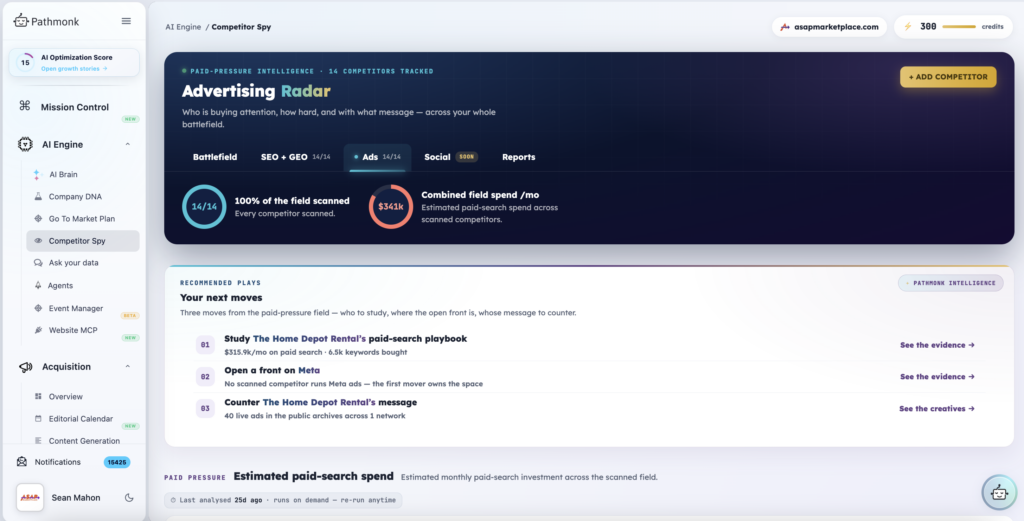
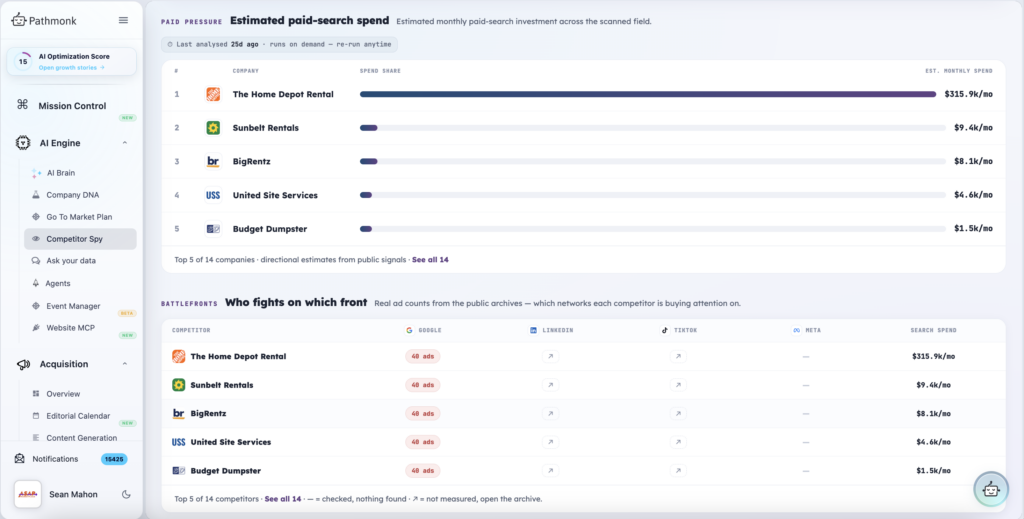
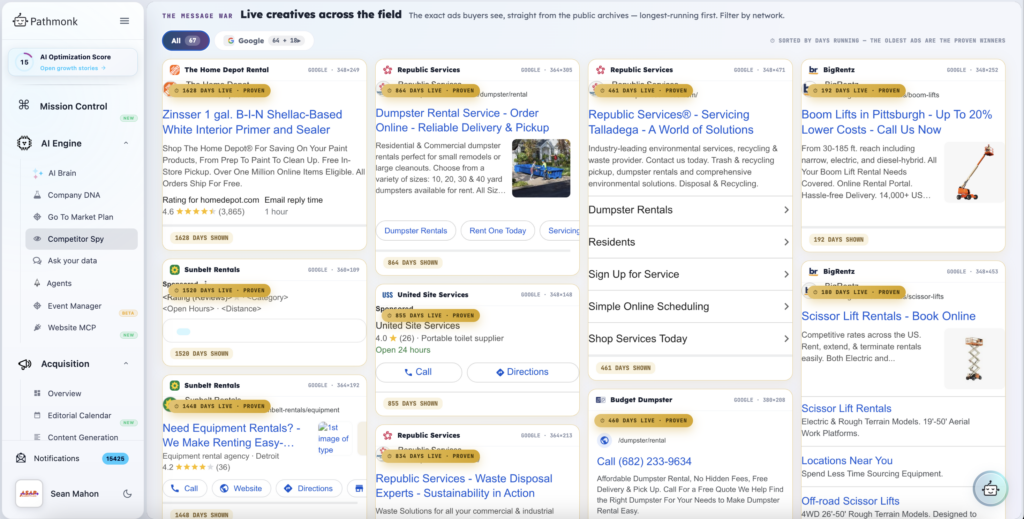
Before a euro is committed, the engine looks at the paid landscape it is about to enter: which competitors are advertising, on which terms, with which angles, and where nobody is bidding. Budget goes where the auction is winnable rather than where the volume looks biggest.
- Estimated paid-search spend per competitor, and each one's share of the field
- Which networks each competitor advertises on: Google, LinkedIn, TikTok, Meta
- Their live ads, sorted by days running, because the oldest ads are the proven ones
- Recommended next moves, including the fronts nobody is covering
Research and campaign briefs: it learns the business before it spends
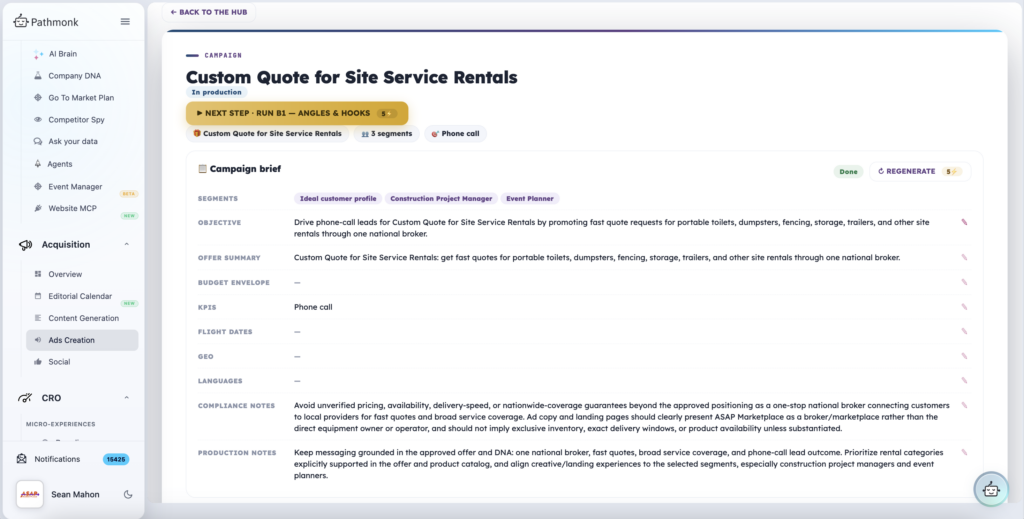
A campaign brief written without knowing the business is how budget gets wasted. The engine builds the brief from Company DNA and the site's own first-party behavioral data: the objective, the segments worth paying to reach, the offer, the KPI, and the compliance notes that keep every ad inside what the company can actually promise. It then scores each platform for fit and proposes how the budget should split across them.
- Objective, segments, offer, KPI and compliance notes, per campaign
- Each platform scored for fit, with a suggested budget share
- Built from Company DNA and real on-site behavior, not a prompt
- Every brief stops for a person before anything is produced
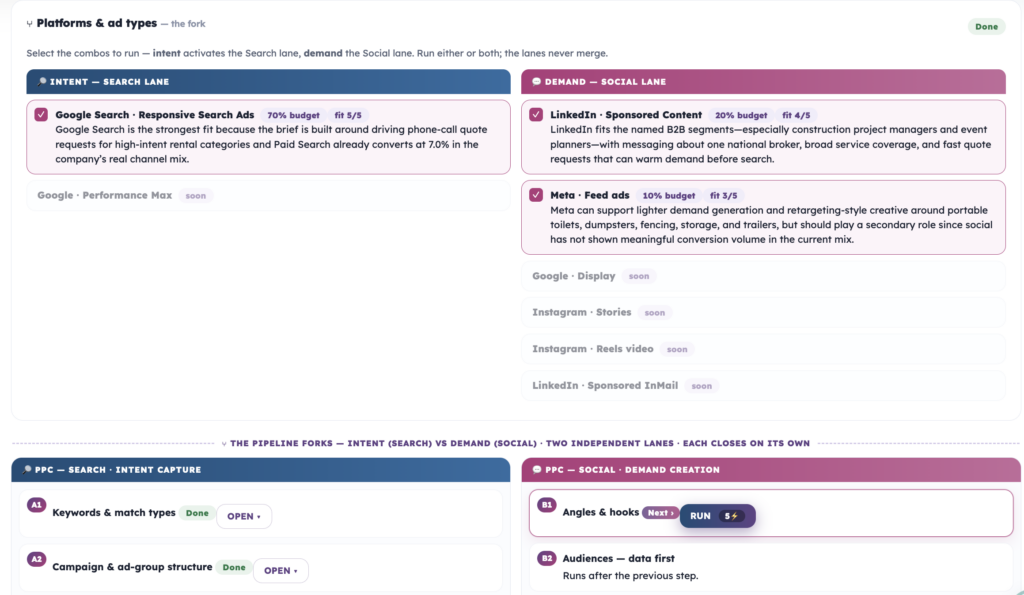
Launch kit: search and social campaigns, built from one brief
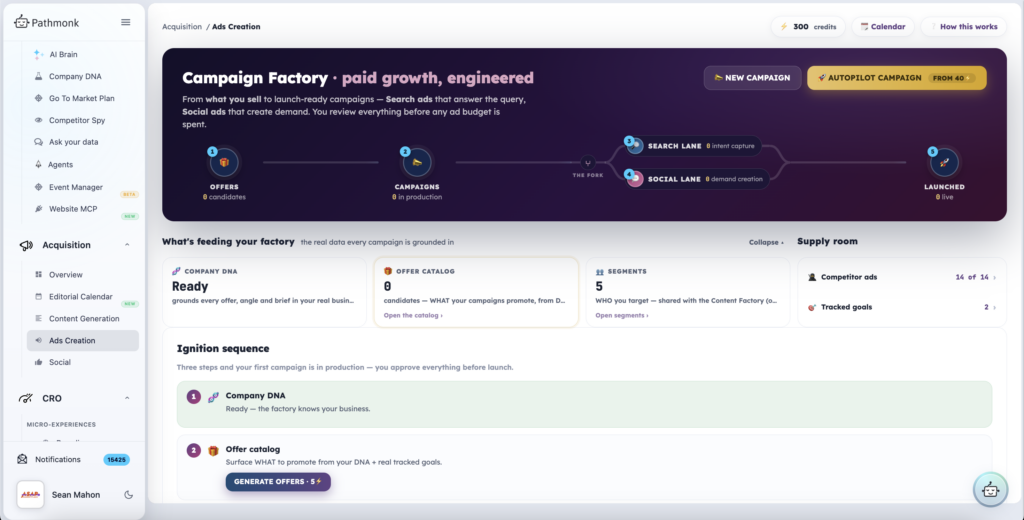
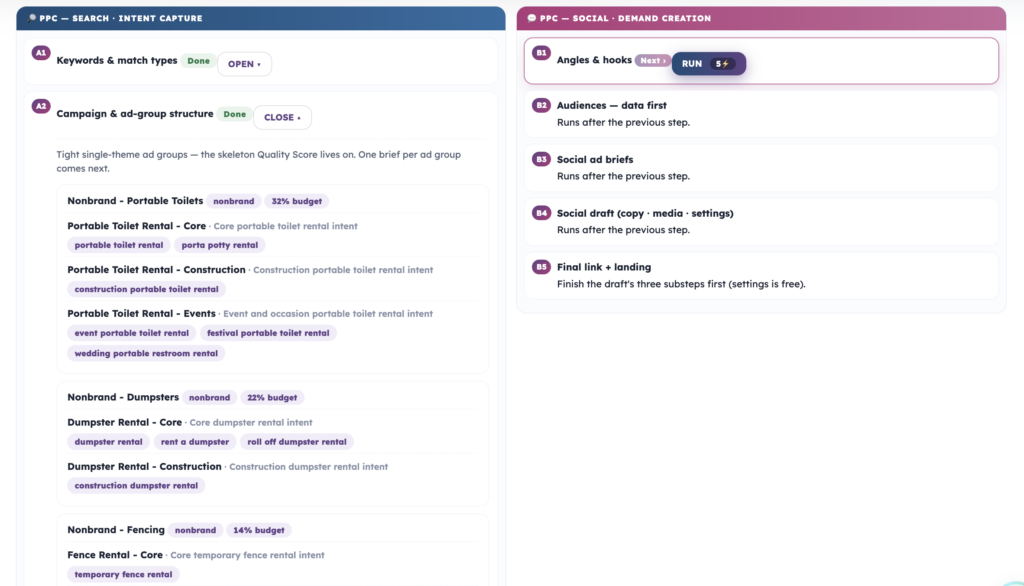
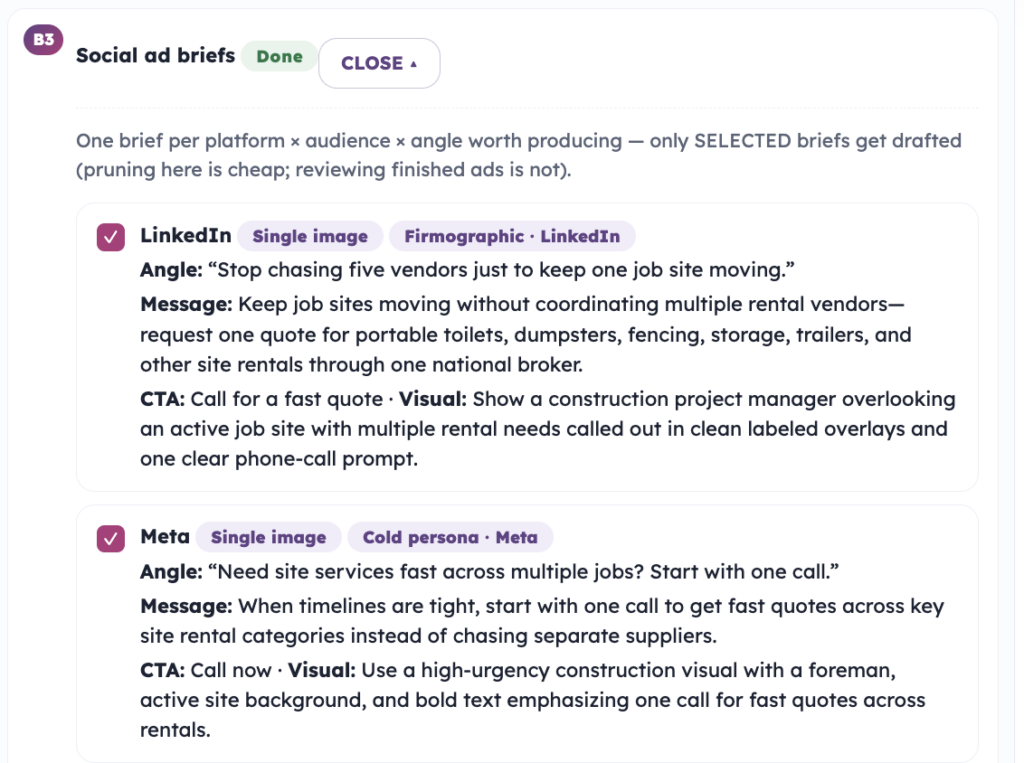
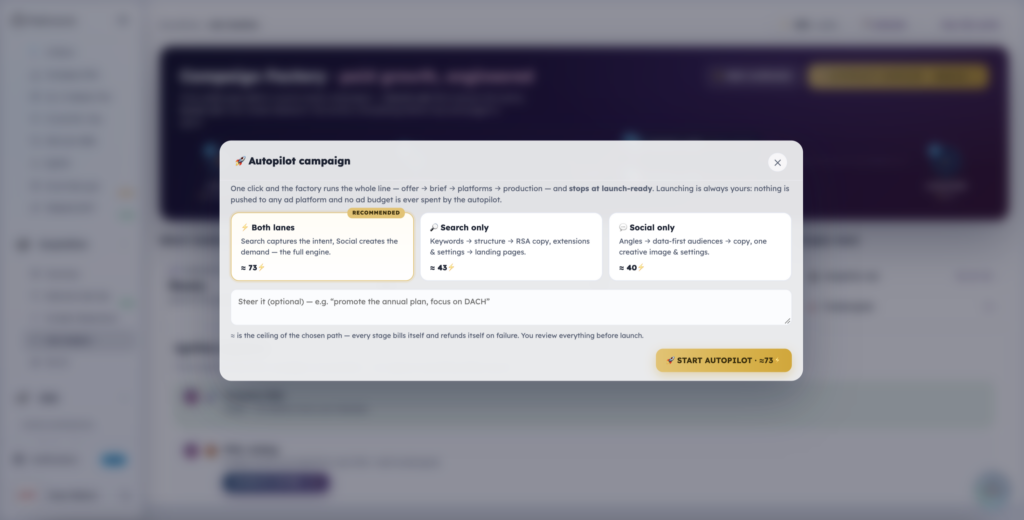
One approved brief feeds two lanes. Search captures intent: keywords and match types, tight single-theme ad groups, responsive search ad copy, extensions and landing pages. Social creates demand: angles and hooks, audiences built from your own data, and one brief, copy and creative per platform and audience. Both arrive launch-ready, with enough variants to test properly rather than shipping one execution and hoping. Brief to live campaign runs in about five minutes, your approval included.
- Search: keywords, ad-group structure, ad copy, extensions and landing pages
- Social: angles, audiences, copy and creative per platform
- Only the briefs you select are produced, so nothing is wasted on ads you would reject
One board: every campaign, every platform, one running schedule
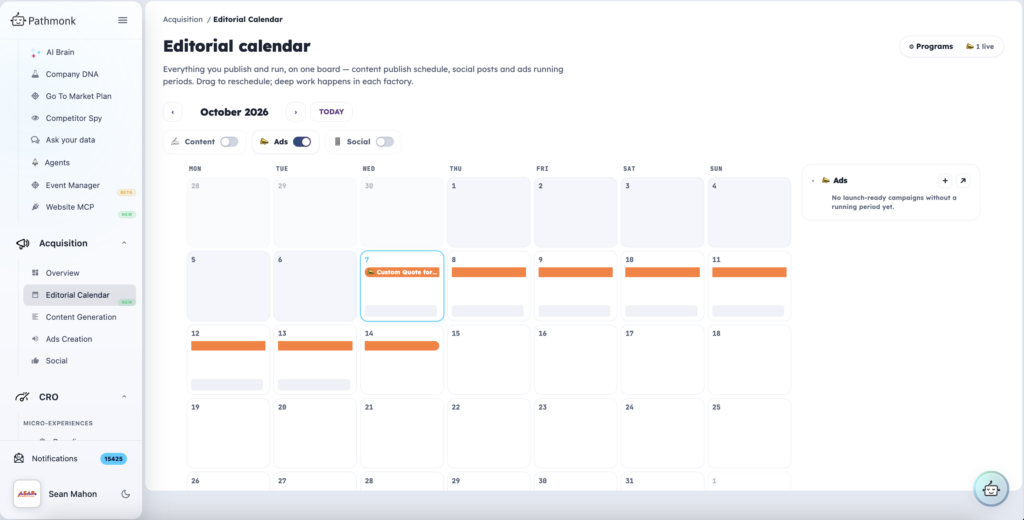
This is the part that replaces the spreadsheet. Every campaign, whichever platform it runs on, sits on one calendar next to the content and the social posts, with its running period visible. Overlapping spend, quiet weeks and clashing promotions are obvious before they happen rather than after the invoice.
- Every platform on one schedule, not one account each
- Ads, content and social on the same board
- Drag to reschedule without rebuilding the campaign
Cookieless retargeting from first-party intent
Retargeting lists built from third-party cookies are shrinking and were never accurate about intent. The engine builds audiences from what visitors actually did on the site, collected first-party and cookieless, so the people followed are the ones who showed real buying signals.
- Audiences built from on-site behavior, not third-party cookies
- Segmented by the intent signals the visit actually produced
- No consent banner needed to collect the signal
Paid analytics: what the budget bought, and which clicks were never people
The report that closes the loop. Spend, conversions and cost per acquisition per campaign, next to the same goals the rest of the analytics uses, so paid performance is compared against every other channel rather than judged inside the ad platform that sold you the clicks.
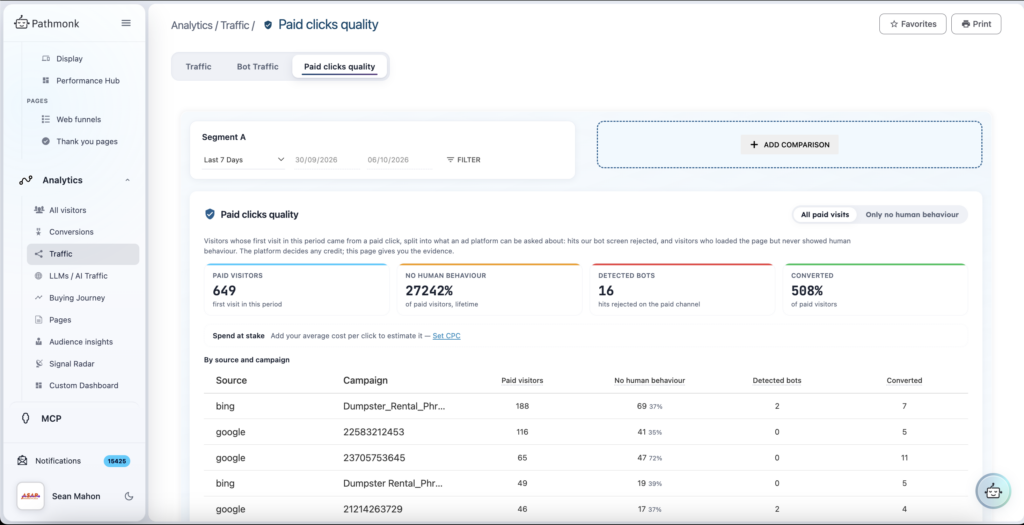
Paid clicks quality goes one step further and looks at the clicks themselves. Every visitor whose first visit came from a paid click is split into what an ad platform can be asked about: hits rejected by Pathmonk's bot screen, and visitors who loaded the page but never showed human behaviour, broken down by source and campaign.
Claim packs turn that into something you can act on. For each platform, Pathmonk prepares a downloadable log with the click id, time, IP and what each visit did, plus the steps to file an invalid clicks investigation, for example from your Google Ads account, where Google looks back 60 days at most. Pathmonk gives you the evidence; the platform decides any credit, and when a claim is accepted the usual outcome is a credit on a later invoice, never a refund. The bot screen can produce false positives, and the files contain IP addresses, which are personal data, so you decide what you send.
- Spend, conversions and cost per acquisition per campaign
- Measured against the same goals as every other channel
- Results fed back into the next brief
- Paid clicks with no human behaviour, by source and campaign
- Claim packs for Google Ads, Microsoft Ads, Meta and other networks

How much of it runs on its own is a setting, except the money
Why it does not burn budget like generic AI ads
Any tool can generate fifty headlines. That is not the expensive part. Budget is wasted upstream, in briefs written by something that has never seen the business: the wrong audience, a hook that does not match how the company actually sells, and money split across campaigns on instinct.
Every brief is written against Company DNA
Before a single campaign is drafted, Pathmonk builds Company DNA: the brand, the audience, the offers, the positioning and the tone of voice, learned from the company's own website and kept current as that site changes. Every brief, every ad and every creative is generated against that profile rather than against a generic idea of the industry.
It is not only brand knowledge. The same engine holds the first-party behavioral data from the site, so it knows which visitors actually convert and what they did first, and it holds the competitive picture of who is bidding on what. That is what decides where the budget goes, not a prompt.
That is the difference between ads generated about a category and ads generated from a company. Two Pathmonk customers bidding in the same auction do not get the same campaign, because they do not have the same DNA, the same converting visitors, or the same gap to attack.
Across industries: the same engine, a different auction
Because the engine works from each site's own data, its competitors and its Company DNA, the same features produce a different paid strategy per business. What changes is the intent worth paying for and who is already bidding against it.
The results: cost down, and one place to run it from
Paid results show up faster than organic ones, which is why the first month is the honest test: if the waste was real, cutting it shows up immediately. The comparison below is against the same conversion goals the rest of the analytics uses, and against the month before install rather than a flattering baseline.
All figures come from the customers' own ad accounts and Pathmonk analytics, measured against the same conversion goals as every other channel.
What the first months typically look like
Getting started: what happens in the first days
Pathmonk starts from what the website already knows about its visitors, and from what the competitors are already paying for. There is no account migration and no audit to run first.
- Day 1Install and connect
One SDK snippet through GTM, then connect the ad accounts, GA4 and the CMS through Data Connectors. Cookieless, no developer needed.
- Days 2 to 5Company DNA and the paid landscape
The engine learns the brand, audience and offers, and Competitor Spy maps who is advertising in the category and on what.
- Week 1First campaign, live
Once Company DNA is in place, a campaign goes from brief to live in about five minutes: copy, creatives in every ratio, the audience, your approval and launch. The approval is part of the five minutes, not a queue.
The Performance Suite add-on puts Pathmonk specialists on the account every month, working alongside the in-house team.
Find out what your budget is really buying
Run a free audit of your domain to see who is bidding against you, where the auction is open, and what your paid traffic does once it lands. No install and no dev work to get the audit.
More customer stories
How Alpine Dryers turned high-ticket browsers into consultation requests.
Read the story Education+87%How Ausbildung-Weiterbildung.ch lifted qualified leads in just one week.
Read the story Healthcare+82%How Doctoralia grew qualified B2B leads across three markets in two weeks.
Read the story