Ego is valueless in CRO: expect to be wrong 80% of the time
Is ego killing your tests? Dave Powell of Tested Growth on CRO experimentation: qualitative testing, data architecture and closing the paid traffic gap.

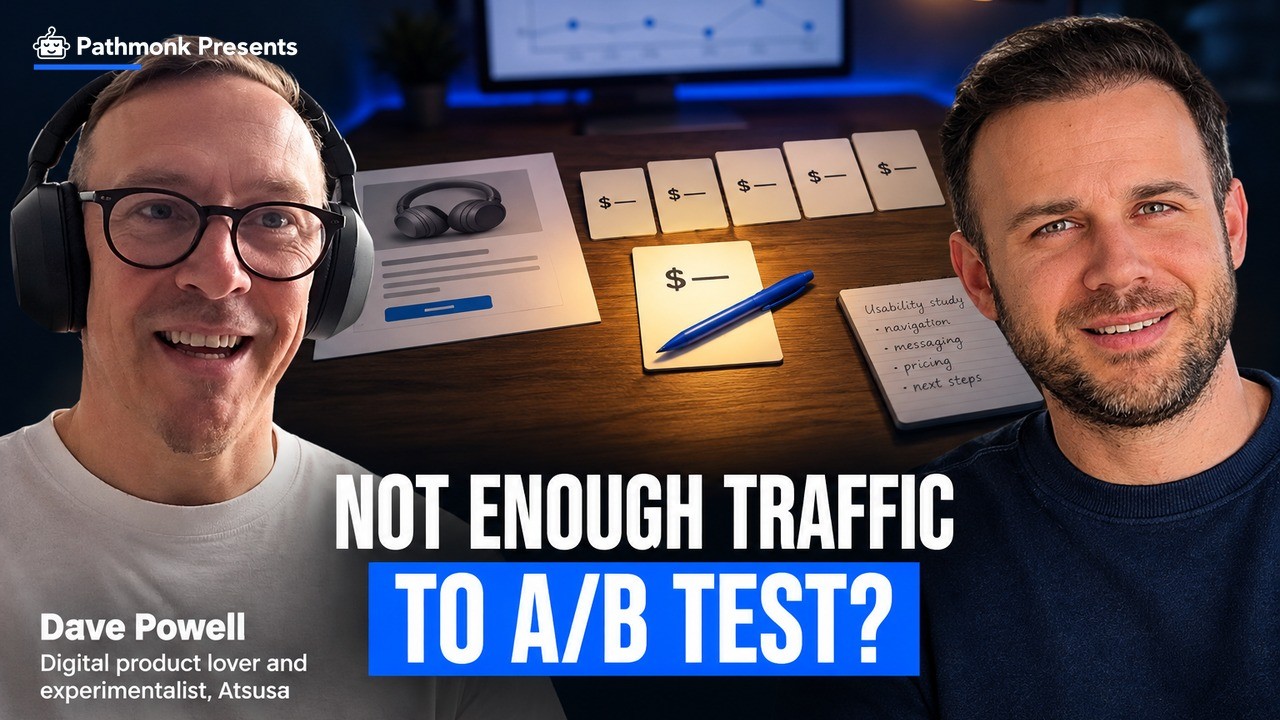
“Ego is valueless. It doesn't do anything. I can be wrong 80% of the time, and you need to be cool with that, because otherwise you're not going to move forward.”
at
- Company
- Tested Growth (testedgrowth.com), CRO and experimentation services
- Speciality
- CRO, A/B testing and digital product optimization since around 2006
- Background
- Booking.com, starting in the white label affiliate department
- Toolkit
- Claude, Lovable, Replicate, Brainsight, Amplitude and BigQuery
- Side project
- Atsusa (atsusa.app), an Apple Watch app that warns you before heat stroke
Rapid fire
- Biggest workday headache
- Social platforms like TikTok and Instagram
- Single source of information
- Your own instinct
Too long, didn’t listen?
Dave Powell has optimized digital products since around 2006, including at Booking.com, where A/B testing taught him that ego is valueless and he can be wrong 80% of the time. After surviving heat stroke during a half marathon, he used AI to build Atsusa, an Apple Watch app that estimates core temperature and sends warnings, now in TestFlight beta.
With Adrián García Ramos, he explains how low-traffic companies can validate ideas with qualitative testing and price sensitivity meters, why paid acquisition and CRO teams work in silos, and why experimentation depends on data architecture: quality in, quality out.
Expect to be wrong most of the time
Dave learned at Booking.com that what looks cool often doesn't convert. Leave ego out of design decisions and let the tests decide.
Validate with qualitative tests on low traffic
Without enough traffic for statistical significance, run qualitative tests and leap tests that bundle several hypotheses, then watch early signals like add to cart. A price sensitivity meter in usability studies shows what your product should cost.
Connect paid acquisition with CRO
Find out which ads send traffic to each landing page and check that the experience connects. Paid teams and CRO often work in silos, and that gap costs conversions.
Build data architecture before testing
Track what matters, such as which images and filters lead to conversions, then model it with tools like GTM, the Kimball approach and BigQuery. Quality in, quality out.
Some brilliant ideas
“Without customers, you don't have a business, and businesses often think that the business comes first. Well, it doesn't, customers come first.”
If you run a price sensitivity meter test in usability studies, you can very, very cheekily find out how much your product should actually cost.
It is really all down to some super quality data architecture. That's what experimentation really is. And when experimentation works well, it's quality in and quality out.
Full transcript
Introduction
[0:00:14] ADRIAN GARCIA RAMOS: So, welcome to Pathmonk Presents where we talk with growth and marketing leaders about what's actually working right now. I'm Adrian, your host, and today I'm joined by Dave Powell. Digital product lover and experimentalist at atsusa.app. Great to have you on, Dave. How's it going?
DAVE POWELL: Super! Yeah, thanks for inviting me here, Jen. It's, yeah, I'm really excited to share part of my story, and how I've ended up where I've ended up. I've got quite an extensive career, so, yeah. Yeah, so I'm interested at two things. First is who you are, if you can introduce yourself and the things that you've done, and then what is the current project that you are running these days? What are you building?
DAVE POWELL: Well, believe it or not, with this young looking face, I'm 51. I've been involved in product optimization, let's call it. Since, round about 2006. I have a degree in Internet product design, which was a degree before the iphone was invented. Wow. Yes, true, true digital dinosaur. And ever since then, you know, I've worked at Booking.com, which is where I understood A lot about optimization, let's say that planted the seed, and ever since then, I've been obsessed by digital product, measuring things, as they say here in the Netherlands, and then moving from strength to strength, refining the craft of A/B testing.
DAVE POWELL: Yeah, and being humble when being wrong. So, yes. Right, right, right. So, yeah, that's about you. I don't know if you want to mention now about what you're building, or if you want to go on with the conversation on more like a CRO and experimentation.
Surviving heat stroke and building Atsusa with AI
[0:02:05] DAVE POWELL: Sure, we'll go into what I'm currently building. Yep. I, as a lot of people you see out there on LinkedIn, they're posting things about running and endurance sports and how that connects very deeply with, with business. Well, that's what my business has turned into. Right. And that's what my focus is at the moment. I see that there's nearly 490,000 people each year die of heat stroke. I experienced it myself during a half marathon, and I thought, how can we solve this? No one's really looking into solving this. Right. So, yeah, I used AI to help me develop an app to get a prototype working. We've done field testing in that.
DAVE POWELL: And that also involves internal temperature testing, yes? Sure. I'm the tester and the test subject in all those senses. So it's really an end-to-end thing. The tracking, everything is built, set up by myself because of the CRO background. I understand what needs to be tracked, and really. Right. That granular data thing that you know when you're working in CRO, where is that tracked? Oh, that's not tracked. Oh, how do we find out? So it's, yeah, it's a culmination of skill sets, let's say, that's put me in a prime position to use AI.
DAVE POWELL: And put together a product on people's wrists that calculates your core temperature and sends you a warning when.
Apple Watch, Garmin and the TestFlight beta
[0:03:33] DAVE POWELL: The weather conditions, your current heart rate gets to a certain threshold. So yeah, that's the product in a nutshell. Right. I'm wondering about this product, like, you mentioned temperature, so I don't know if you have any kind of a hacker development, or is this just. software that you paired with, you know, other trackers in the market. Great question. Yeah. And as these things usually go, you work with what you have. And I have an Apple Watch on my wrist. Bye. And I thought, well, I can test this. I can test it on real hardware. So currently it's available for beta testing for anyone with an Apple Watch. Obviously it's paired with an iPhone.
DAVE POWELL: Right. I have plans to move into the Garmin. Okay. The Garmin owners, yeah, in that sense, because that's the, that's the second highest, product penetration. I've done my homework on that since. Apple Watch is number one, it's, it's in the… hundreds of millions in the US, next up will be Garmin, so once we've got a stable product, we've got the right feedback, then we'll move it into a different product, the next in the category, let's say. I think that you didn't mention the app, just, you know, to give some directions for the audience, and if they are listening to us now, like, what should they do? Is that available? Is there a waitlist? How does it work?
DAVE POWELL: Right now on atsusa.app, which there should be a link posted somewhere, it's open for test flight. So all you need to do, you can leave your email address if you wish to leave me more granular feedback or anonymous feedback. You can simply go there. Install it, start wearing it, go outside for a run, cycle, whatever you want, whatever strenuous exercise or not even strenuous exercise, because your heart rate will increase when your body's trying to release heat. That's how it works. So. And I will see your data in my dashboard. No personal data, I might add. It is GDPR compliant. We have to make sure of these things. But, yeah, that's… that's… it's… it's that simple, at this stage.
Booking.com lessons: ego and being wrong
[0:05:43] ADRIAN GARCIA RAMOS: Amazing. So, you know, you mentioned before the link between your CRO kind of experience and the linkage with this new product that you are developing. I think that most of our audience is going to be very interested about this kind of long-time experiences that you have collected Over the years with companies such as Booking and other big Names in the industry. If… if you were to, in a way, summarize the different experiences that you have. Carried out. What would you… highlight, right? I guess that you were working for Booking. Booking, it's kind of a lead generation. I don't know if you were working also for e-commerce. Maybe you can explain a little bit more on the experience that you have had, and
From that, we can, you know, develop the conversation.
DAVE POWELL: Yeah, sure. Originally, when I worked in booking, I worked in the white label affiliate department. we. took our software and branded it like, say, Air Berlin, for example. Okay, right. And then that led into an opportunity to begin with A/B testing. Right. And I came from, as I say, quite a design and code orientated background. And I always thought, you know, design things need to look cool and then it works. And that was the baptism of fire, really, that, you know, you think you know what looks cool.
DAVE POWELL: Yeah. It doesn't work. It doesn't work. No. In that way. Yeah. No. And I think that was for me the biggest point where you realized ego is valueless. It doesn't do anything. And yeah, it learned that I can be wrong and I can be wrong 80% of the time. Okay. And you need to be cool with that, because otherwise you're not going to move forward. So, yeah, that really instilled the ethos for me, back then. And then, obviously, you know, learning really about statistical significance, how you need a certain amount of traffic for… For you to be able to detect that change, let's say.
DAVE POWELL: was really sort of the foundation of everything. And then that got sort of deeper and deeper into, if you don't have a massive audience, how do you get things validated? So that's when I started to really look into qualitative testing. Okay. In senses like that. So, I've run, qualitative tests for, let's say, what products might work in the US versus what products might work in Europe, and those two things are very, very vastly, vastly different. No. And then things like price sensitivity meters, so if you want to find out how much something should cost, rather than just running it on the website, which is highly complex and very difficult to do, and if you're a small company, you can't do that. So if you run something like a price sensitivity meter test in usability studies.
DAVE POWELL: You can very, very cheekily find out how much your product should actually cost. So it's all these little bits and pieces and skills that I've picked up along the way that enable you to validate at whatever point you're at within your business.
Explaining CRO to new clients
[0:09:01] ADRIAN GARCIA RAMOS: Right, right. Yeah, actually, I believe that that's an interesting question. It's. once you have a new customer for your CRO, you know, practice, what are the first questions that you pose to that particular person, and how do you approach their relationship? Because sometimes it's difficult to explain or convey the value of conversion rate optimization. I wonder what you… what you do.
DAVE POWELL: Well, that is really a great question, because it is, probably one of the, love-hate things about CRO that I have. It is so hard to actually communicate what the real meaning and, you know, the underlying factors of CRO is.
Oh.
DAVE POWELL: it's so misunderstood. It's like, oh yeah, we just move that over there and it makes more revenue. No. How is that a customer problem? Because right at the underneath it is what customer problem are you solving and how big is that customer problem? Because without customers, you don't have a business, and then businesses often think that the business comes first. Well, it doesn't, customers come first. So to me, it's really trying to get underneath. Well, what problem are you having? Okay, so if you're having a revenue problem and you've got a target and you want to read it, reach it.
DAVE POWELL: we need to do what's called a reverse funnel optimization. So, what target are you trying to reach, and how do you think we can get there? And then we can, obviously, we can look at the traffic on the page, we can see… Where it's leaking the most, so, well, there's a lot of people dropping out here, so what could it be there, and really bring them along for the journey in that, when we're talking about. Possible collaboration, so that they get involved in it, so that they think about it. And then it makes it much easier once you involve somebody from their perspective, what they think. If they're open to that, maybe they just want you to get on with it, and that's also fine.
I.
DAVE POWELL: Find where that level of curiosity is within an organization, and then… Slot your CRO jigsaw puzzle piece into that as best you can. Yeah. Yeah, it's interesting that you're saying this because I'm actually very, very soon, probably the end of this week, going to launch a different website, something that has a lot more personality in it and treats everything a bit like a crime scene. So there's a bit of a cliffhanger. Okay, kind of a Sherlock Holmes style detective and how to find the right spots and the leakings and such right Is that it.
DAVE POWELL: Absolutely that, yes, yes. There's little Easter eggs on the side. It's yeah, it's it's time to break out of the AI mold, let's say, and be okay. Okay. Be genuine, yes.
Low traffic: qualitative and leap testing
[0:11:49] ADRIAN GARCIA RAMOS: Sure, sure, I fully agree on that. I'm wondering about this, you know, relationship with customers interested in CRO services, and how you position yourself, right, when you're talking to them, because I believe this is very important, especially for those prospects or companies that they don't have enough traffic, right? Because, as you mentioned before, statistical significance is very important in terms of having solid experiments that you can run samples with, right? So, if you have a customer that it doesn't have, I don't know, you tell me what's that, you know, magical number in terms of, like, a traffic.
How do you approach that relationship? You, in a way, say, okay, this is not for you, or you should wait, or we can maybe do, instead of quantitative, we can do some qualitative tests. How do you approach that?
DAVE POWELL: That's exactly the thing, it's qualitative, and that's… Kind of where I've, I've worked together with, a playground company. They sell playgrounds which people construct themselves. And they were launching in the US. Traffic was… Okay, but it meant that we had to do a lot of leap testing, which is testing a lot of hypotheses at once. But those leaps were based on the qualitative testing that we did.
you.
DAVE POWELL: Right. And then we would just look for signal in that sense. So, if we are getting a lot of people adding to cart. Then it's a good signal, but it's not yet reflected further down the funnel. Right. And obviously, in that sense, you know, we'd slice and dice, we'd look at the traffic, where it came from, and these kind of things, and make decisions also based on Well, you need to shift more spend to this… to this area, because that seems to be converting. They seem to be a bit more engaged in that sense, if that answers the question?
The gap between paid traffic and CRO
[0:13:43] ADRIAN GARCIA RAMOS: Yeah, I would say so. As a follow-up, I wanted to ask you, your approach with, you know, you've worked for large corporations in a way, and I guess that those large corporations have, resources dedicated to PPC or media buying, right? Whereas there are other companies that don't have those resources. So, I wanted to ask you the relationship between paid traffic acquisition and CRO, because I think that there are. Let's say, much more people spending money on ads than there are people focused on getting the most out of that traffic. So, I think that that's kind of an opportunity, it's something broken in the market, in the industry itself, but I would like to have your opinion on that.
DAVE POWELL: Yeah, you've really touched on something there, for sure, because… what you're… what you're saying is a lot of companies work in silos, and one of those silos is way bigger than the other, and it just… it just keeps coming, and it's, yeah, for, let's say, alone or very few CRO people. That connectivity with how that traffic is being primed is not strong enough by any means, and I see this across multiple organizations. Right. And yeah, CRO people are working like crazy to try and get the traffic, whatever traffic, to convert. But that understanding of upper funnel, what these colleagues are, you know, communicating.
Yep. Yep.
DAVE POWELL: And it's on such a vast scale as well. It's like, yeah, but what ads are you showing them? Oh, no, no, it's many things. We're showing them many things. And then as a CRO, you know, we try to map things out in our brains that I think if you look into a CRO brain. that. It's a vast… space of multi-connectional interdimensional things so that we want to understand the customer journey. So, it's a definite gap, but what you need to do is try to understand it on a surface level as best that you possibly can, and try to really communicate with those stakeholders, and keep that continuum between you actually happening.
DAVE POWELL: Right. Try to get an idea of what ads they are using to send to the landing page and see what that experience feels like and does it connect to you. I know we are not our customer, we never are, we're bikes. And that's it. But, yeah, it's a great question, and I 100% agree. it's a real friction point, let's say, to try and stay in front of it and do the CRO thing. I think that there really needs to be some dedication on that point, exactly on that point there. Done it myself, I've done reviews myself on traffic, where it's coming from, what we're saying.
DAVE POWELL: and even some of the insights that have been generated through BigQuery and things. Now, when you connect BigQuery, that makes that whole section seem a lot more visible, let's say, because then you get an idea of what other factors have changed at the same time. Yeah, I'm just wondering here, part of the conversation, right? If we try to reduce this situation to the absurd, we could say that most of the traffic that we are handling in CRO is for some of the companies, right? It's coming from paid advertising or paid traffic, right? So… Wouldn't… It'd make more sense to… to just…
consider CRO as a multiplier for the guys who are spending millions on traffic, and just say, don't think of me as a CRO guy, think of me as a supporter of you and your team. So you're going to run ads that are going to touch upon, you know, some pain or some problems that you might grab on the socials, or whatever it is. And then I'm going to use that particular problem that you have identified, and you know that the people are clicking upon. And based on that, I'm going to build the full experience on the website once they get to the Modi site, right? And I'm going to multiply the efforts that you're pouring into, you know, apps. I don't know if you have tackled that as a kind of a commercial or business pitch when you talk to customers, but…
I'm kind of a concern more and more these days.
DAVE POWELL: Yeah. For me, it's more of a sort of historical thing that I kind of, yeah, dig into. And we look back on and it's like, something's not quite right about this that needs to be solved. Yeah, being, yeah, one man with many arms, let's say, yeah, the focus for me is obviously being on those people that have got their money, got their money out, they've got their hand on the wallet, and that's the area. That's got the highest amount of traffic, most potential. So that's in the area that really garners focus, let's say.
That.
DAVE POWELL: More CRO people, more training, more learning, more connectivity, but then, yeah, time, the greatest enemy.
Data architecture with GTM, Kimball and BigQuery
[0:19:07] ADRIAN GARCIA RAMOS: Sure. So, in terms of, you know, GTM for your CRO services, I don't know if you have any particular kind of a, you know, advice or tip for the people that are listening to us, like, if something that you have used in the past, or it is working for you now?
DAVE POWELL: Yeah, as I say, I picked this up about, Six to eight months ago, being in this company and seeing, oh, that's not tracked, hmm, this isn't tracked. Hmm, okay, what does this bring? What value is this? I got myself access to Google Tag Manager, connected myself with with AI, and said, we need to sort this out. I I don't know which images people have clicked on and then converted.
DAVE POWELL: I don't know which filters they've used and converted, so I set about looking really deeply, deeply into it from a CRO perspective, like, what's valuable? And then started to look into data architecture. Right. Kind of fell in love with the Kimball approach, to build out customer facts and things like this, so that we actually do know, which content actually converts, because that's how it all started up. I looked at all the people that had converted. and. And what path have they been on? What pages did they. Oh, yeah. And then I thought, well, that's really interesting, there's a lot of patterns here, and then where you saw a lot more significant page views and content views.
DAVE POWELL: I changed that, and I put it together a new PDP, let's say, which collected all that information, and then built on that, and then obviously built the tracking at the same time. Right. Which then six months later enabled me to use BigQuery. And that was just like the best toy shop in the world. Rob. Oh, yeah. So to actually see, yeah, now this is working. Now people are spending time. Okay, they might not be adding to cart more, but we know the quality of traffic that when it does hit the checkout, it's getting through, it's working. So,
DAVE POWELL: Yeah, it is really all down to some super quality data architecture. I mean, that's what experimentation really is. And when experimentation works well, it's quality in and quality out. That's, that is, there's a 1-on-1 thing, you know, Gordon Ramsay doesn't put frozen chips, you know, on the menu, Gordon Ramsay picks. good quality ingredients. It's the. same. with CRO. All the ingredients need to be good quality and then what comes out the other side. Is more often quality, so, yeah, to use a kitchen analogy.
The AI and analytics toolkit
[0:21:47] ADRIAN GARCIA RAMOS: Yeah, yeah, 100%. I wonder about the… you mentioned AI tools, right? So, it's also, I mean, not only the tools that you're using these days, but also, like, market trends, but maybe at the beginning. were not available, because they were not embedded at all, but now we have a different toolkit, right? So, what is what you are using these days, and how has changed your workday for Xero?
DAVE POWELL: you Yeah, I… For me, marketing is one of my weaker sides. Okay. I've never really worked in marketing, just alongside. But I'm trying to understand that space because once I understand it, I can excel in it. And I've been looking into getting graphics, content, assets, all looking the same. And for that, I've been using Replicate and practicing and experimenting with different models in that sense.
So.
DAVE POWELL: I'm trying to understand that side of content generation and see how all that works, obviously in mind of what stops somebody scrolling, what visually makes them go. Oh, what's this? Yeah, yeah, yeah. It's all those triggers that we use in CRO that we know captures attention. That's another tool I would suggest. Shout out to Brainsight, which is a really nice tool that shows human attention in five seconds based on eye tracking algorithms. That's a tool I also use to assess people's websites. Obviously, no conversation is complete without mentioning Claude.
Right.
DAVE POWELL: this? Ha ha ha! Yeah, Claude, I've been using inside Xcode. Right. To generate the app, to generate all the tracking frameworks. Then I use Claude in the browser to set up the dashboards in telemetry deck. Yep. Yeah, I've used Lovable for the initial creativity side of the site. I find that is a really nice interface. It gives good feedback. the. And then, yeah, a few bits and pieces here when I'm looking into some deeper understanding of the analytics that's happening, what trends are we seeing and these kind of things. But yeah, it's mostly cloud around those, but occasionally I'll open up chat GPT to check that. Do you agree with this? So we get a bit.
Absolutely.
DAVE POWELL: Let's say AI parity. I do likewise. I do likewise. Yeah. I was wondering, you mentioned before, BigQuery, in terms of, like, a, you know, data pool, but I don't know if you also have used, other things, for tracking or, you know, analytics in terms of pure CRO and all the data that is happening on the website. Yep. Yeah, completely. I also have a bit of a fondness for Amplitude. Right. Also, the AI that's built into that is… It's sick. It's beautiful. I mean, it takes a lot of the heavy lifting out, and we know we're all pushed for time, except it's still, even though AI is supposed to be making life easier.
DAVE POWELL: It's not. It just means I'm doing more stuff, yeah, producing more things, but yeah, amplitude, yeah, it's beautiful how granular you can go into with amplitude side of things. Specifically, I mean, GA is, a little bit flaky, I wouldn't use it to make any necessarily decisions, in that sense, but, yeah, amplitude is much more… Yeah, user-based, so… Right. I've connected Amplitude to many projects.
Social platforms and trusting your instinct
[0:25:36] ADRIAN GARCIA RAMOS: Sure. So, I have two more questions. They are not off-topic, but… It might be. It's in your… in your workday, what is the largest problem that you confront and you'll be looking forward to get rid of? It's an open question, so it's related to… to your day work, right? So, yeah, what would you… what would you say?
DAVE POWELL: Yeah, for me, and I'm going to speak my edge here, I really do not like things like TikTok, Instagram. Okay. Social things, and all this, And marketing, but you have to be there. Okay. Yeah. But I feel it's feeding the beast. Right, right.
DAVE POWELL: Yeah, so for me, that's real hate-hate relationship with it. Yeah. Especially when you have a D2C product, right? Like, Atsusa.app. In a way, you need to be present over there, but you don't really like the platforms. So, in a way, you need a content factory that, you know, handles that for you, in a way. Is that correct? That is absolutely, unequivocally correct. Yes, I really, yeah, this endless thing. I mean, don't get me wrong, it's beautifully crafted and it gets people hooked. The whole addiction thing, well done, but it's too well done.
Indeed. It's, It's too much, yeah. Okay, the other question that, I had for you is about the separating the signal from the noise, right? So, we live in a world in which we're constantly, invaded by news and, you know, feedbacks and things. If you were to select one single source of information. That keeps you… You know, updated. What would it be?
DAVE POWELL: Your own instinct. If you feel something like that. Turn it off. Just then turn it off. You feel like I need to go out for it. Go out for whatever it is. Really listen to your own single source of truth because of what I've just previously said.
DAVE POWELL: Everything is vying for your attention. Sure. Pay no attention is what I'm saying at some points. And then it helps, it helps clear your mind, go for that walk, be in nature. And find your own single source of truth, because it doesn't exist anywhere. Your source of truth is your own source of truth, and you need to clear space for that. Oh. Otherwise, it's all just noise, there's so much of it. Yeah. Yeah. Yeah. Yeah. You're living in a movie. Is that it? Like nothing belongs to you. It's just whatever others, you know, decide for you to take or to buy or to leave or to feel. It's Yeah.
DAVE POWELL: Guilty, also, you know? I mean… That's what we do! We try to get people's attention! Pay attention to me! You need this thing, you know? Yeah! That's… yeah, some… some way to say that. Okay, so, Dave, thank you so much for, you know, coming on into the, into the show. It's been a pleasure talking to you. So, if you want to, you know, mention how the people in the audience can reach you out, to follow up on the Atsusa app, or, you know, CRO services, how they can find you. Sure. My two websites that I will mention, well, you can follow me on LinkedIn, which I'm sure we can put something somewhere. But my two websites is testedgrowth.com.
you.
DAVE POWELL: and atsusa.app. And, yeah, I'm always curious for anyone's feedback. Just look me up, just say hello. I'm always online apart from when I'm in bed, which is usually quite early, because that's one of the rules. Yeah, let's just let's talk. Let's get a conversation going. As you probably can tell, I'm quite enthusiastic about everything that I do. Yeah. Just look me up. Perfect. Okay, thank you, Dave. Let's stay in touch.
Got a growth story worth sharing? Tell it on the show.
We talk with founders and marketing leaders about what actually moves their pipeline. If you’ve built something other marketers can learn from, we’d like to hear it.
- 01Apply
Tell us who you are and the story you’d bring to the show.
- 02We get in touch
We review every application and reach out if it’s a fit.
- 03Record your episode
A remote conversation, published as video, audio and a full transcript.