Do AI-referred visitors convert? What the data shows
Your analytics shows a small but growing line of visits from ChatGPT, Gemini and Perplexity, and every study you read reaches a different verdict on whether those visitors buy. Here is where the published numbers agree, why they contradict each other, and how to get the answer for your own site.
- Mostly yes, and the change is recent. Large datasets now show AI-referred visits converting at or above other channels: Adobe measured US retail AI traffic converting 90% better than non-AI traffic in September 2026, after converting 9% worse in August 2025.
- The studies disagree for reasons you can check. Each one measures a different conversion, against a different channel, over a different period, so a ratio from one study does not transfer to another site.
- Rate is not volume. In a 97-site B2B dataset, AI assistants sent about 0.5% of sessions, so a higher conversion rate on that base rarely moves total revenue or pipeline on its own.
- Measure your own ratio before you act. Compare conversion rate and revenue per visit for AI-referred sessions against the site average on the same conversion goal, and treat the AI count as a floor.
Twelve months ago, the most-cited data on this question said visitors from AI assistants converted worse than almost every other channel. The most recent data says the opposite, and on most large datasets AI-referred visits now convert at or above the site average. Whether that holds for your site depends on what you count as a conversion and what you compare against, which is why two honest studies can reach opposite verdicts.
The conversion event in this article is the primary commercial action on the site: a purchase on an online store, and a demo or sales request on a B2B site. The two are never added together. Every study below is labelled with the event it measured, the comparison it used and its period, because those three details explain almost all of the disagreement.
The article covers what happens after the click. How brands get named in AI answers in the first place, and how to track that, is covered in the GEO and SEO guide and in how to measure AI search visibility.
Why the verdict flipped in one year
Adobe has tracked AI referrals to US retail sites since October 2024, measuring visits where a user clicked a link in an AI assistant and comparing them with all other traffic, including email, paid search and social. Its September 2026 report found AI traffic converting 90% better than non-AI traffic, the highest gap Adobe had recorded, and generating 83% more revenue per visit. In August 2025, the same comparison showed AI traffic converting 9% worse.

The studies offer explanations rather than proof. Visibility Labs links the rise in ChatGPT shopping visits during 2025 to the shopping features introduced in April 2025, which put products and links inside the answer, so the people clicking through were further into a purchase. The base also grew: Adobe reports AI traffic to US retail sites up 1,772% between October 2024 and September 2026, which makes a monthly ratio far more stable than it was when a few thousand visits decided it.
The direction is now clear in retail. The size of the premium is not, and it is not a forecast for your site. Adobe’s comparison group is all non-AI traffic, which includes low-intent sources such as paid social and display. A premium over that mix says little about how AI visitors compare with your branded search or email traffic, which usually convert far better than the average.
Why the published studies disagree
Put the main studies side by side and the contradictions mostly disappear: they measured different things. One counts purchases in US retail against every other channel. Another counts leads on B2B sites. A third compares ChatGPT only with non-branded organic search and leaves out homepage and blog visits. A fourth covers a period that ended before most of the change Adobe recorded.
| Study | Sites and period | Conversion counted | Compared with | Finding |
|---|---|---|---|---|
| Adobe AI Traffic Trends | US retail, September 2026 | Purchase | All non-AI traffic | AI converted 90% better, 83% more revenue per visit |
| 973-site working paper | 973 online stores, August 2024 to July 2025 | Purchase, last click | Each channel separately | Organic search converted 13% better and affiliate 86% better than ChatGPT; only paid social converted worse |
| Visibility Labs | 94 online stores, January to December 2025 | Purchase, homepage and blog excluded | Non-branded organic search | 1.81% against 1.39%; $3.65 against $3.30 revenue per session |
| Orbit Media | 97 B2B and lead generation sites, July 2025 to June 2026 | High-intent lead: contact, demo, quote, meeting, call | Other sources, pooled | About 3 times more likely to convert; ChatGPT 2.08% against Google Search 0.5% |
Figures as published by each source. The 973-site paper and the Visibility Labs study were reported by Search Engine Land; Orbit Media published its own data.
Attribution adds a fifth source of disagreement that no study can fully remove. Every figure above relies on last-click attribution or something close to it. The authors of the 973-site paper note that shoppers may check elsewhere before buying, which moves the credit to traditional channels. Visibility Labs makes the same point from the other side: people who get a recommendation in ChatGPT and then search the brand on Google are recorded as branded search.
Put the main studies side by side and the contradictions mostly disappear: they measured different things.
A higher rate on a very small base
Even where AI visitors convert better, they are still a thin slice of traffic, so the rate matters less than it looks. In Orbit Media’s 97 B2B sites, AI assistants sent about 140,000 of roughly 29 million sessions, about 0.5%, or one visit in 200. ChatGPT alone produced 82.3% of those AI sessions.
The Visibility Labs data puts a revenue figure on the gap. Across 94 online stores in 2025, ChatGPT sessions converted better and earned more per session than non-branded organic search, yet they produced $474,000 of revenue against $32.1 million from non-branded organic. That is $474,000 / $32.1 million = 1.48% of the organic figure, rising to 2.2% in the second half of the year as ChatGPT visits grew from 1,544 in January to 18,202 in December.
Both studies also warn that their AI counts are low. Orbit Media notes that visits from Google’s AI Mode and AI Overviews are recorded as organic search, and that some AI mobile apps strip the referrer, so those visits appear as direct. The real share is higher than the measured one, by an amount nobody can state.
A small channel with a high rate is worth attention when it is growing fast, when its visitors buy expensive products or become large accounts, or when they land on pages that also receive other traffic you could improve at the same time. Those are reasons to measure it carefully, not reasons to move budget on one quarter of data.
The visit lands mid-decision, on a deep page
An AI-referred visitor has usually read a summary, a shortlist and a reason before clicking, so the page they reach has to confirm what the answer said, not start the pitch from the top. That is the most consistent explanation offered for the higher rates, and also the main reason some sites see the opposite.
The engagement data points the same way. Adobe reports that in September 2026 AI-referred visitors to US retail sites spent 73% more time on site, viewed 25% more pages per visit and added products to their carts 53% more often than other visitors. Contentsquare’s 2026 Digital Experience Benchmark, built on more than 99 billion sessions, found 53.6% of AI-referred visits bouncing, close behind social and ad traffic. The two can both be true: AI visitors who find what the answer promised go deep, and those who do not leave quickly.
- Fit for the visitor’s situation
- A price expectation
- A reason to trust
- Fit has to be worked out again
- Price expectation not confirmed
- Proof is three scrolls down
- The claim from the answer, visible
- Price or price basis stated
- Proof and next step together
Common mistake: sending AI-referred visitors into the same journey as cold traffic. A homepage-style pitch, a newsletter pop-up or a long qualification form treats someone who arrived with a shortlist as if they had never heard of you. The fix is the page, not the channel, and it is the same reasoning behind not sending paid traffic to the homepage.
This is the part of the problem Pathmonk works on. It personalizes the website in real time for each visitor by where the visit came from, including AI answers, so the page opens on the reason the visitor clicked rather than on a generic message. The lift is measured against a 50/50 control on the site’s own traffic, with bot traffic detected and excluded. How that works is on the CRO and personalization page.
How to measure the ratio on your own site
Your own ratio, measured on one conversion goal over a long enough period, is the only number worth acting on. The setup takes an afternoon in most analytics tools.
- Build an AI-referred segment. Match the referrer domains of the assistants your buyers use, such as chatgpt.com, perplexity.ai, gemini.google.com and copilot.microsoft.com. OpenAI adds utm_source=chatgpt.com to ChatGPT referral links, which catches visits where the referrer is missing.
- Pick one conversion goal. A purchase on a store, a demo or sales request on a B2B site. Do not let downloads or sign-ups into the same figure.
- Compare against the right baseline. Report the AI segment next to the site average and next to organic search, for the same goal and the same dates.
- Add the value measure. On a store, use revenue per visit, not conversion rate alone, because AI visitors in the Visibility Labs data spent less per order. On a B2B site, follow requests to qualified pipeline.
- Wait for enough conversions. A ratio built on a dozen conversions swings from month to month. Visibility Labs had 15 to 37 ChatGPT conversions a month in early 2025 and flags those months as low confidence.
- Report the count as a floor. Visits from Google’s AI features land in organic search, and some app visits arrive without a referrer.
| Segment | Sessions | Purchases | Conv. rate | Revenue | Per visit |
|---|---|---|---|---|---|
| Whole site | 200,000 | 2,400 | 1.2% | $216,000 | $1.08 |
| AI-referred | 1,200 | 24 | 2.0% | $1,920 | $1.60 |
The arithmetic behind the card: 24 purchases / 1,200 sessions = 2.0%, against 2,400 / 200,000 = 1.2% for the site, a ratio of 2.0 / 1.2 = 1.67. Revenue per visit is $1,920 / 1,200 = $1.60 against $216,000 / 200,000 = $1.08, a gap of 48%, smaller than the conversion gap because these AI visitors place smaller orders.
A visitor who reads your name in an answer and later types your address, or searches your brand, is recorded as direct or branded search. Your AI segment captures the click, not the influence. Visibility Labs recommends asking buyers how they heard of you after purchase to estimate the rest; whatever method you use, keep it separate from the referral figure.
What one store measured: Tinggly
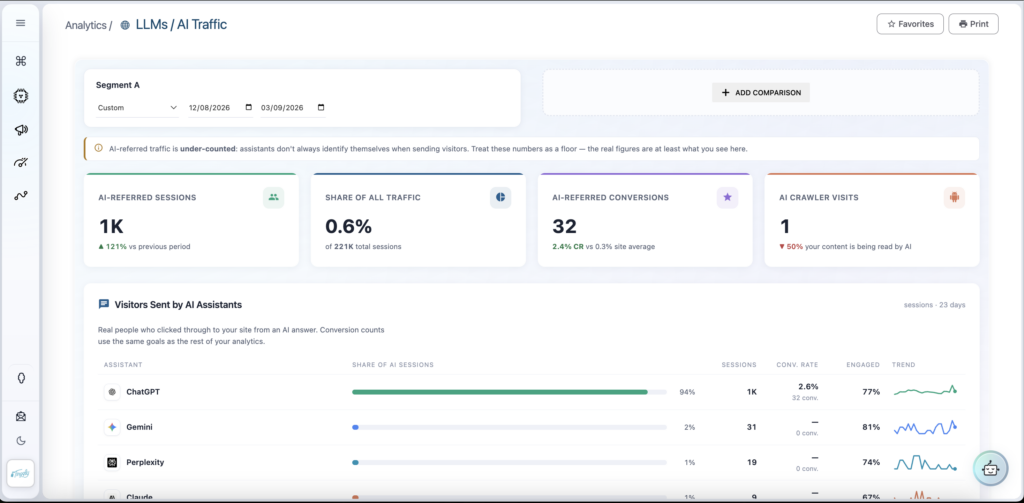
Tinggly, an e-commerce site selling experience gifts, is one of the customers in the Pathmonk AI Search case study. The page publishes two figures for it. AI-referred sessions rose 121% against the previous 23 days. And in the same period, traffic from AI assistants converted at 2.4%, against a 0.3% site average: 2.4 / 0.3 = 8 times the site rate.
The case study states that figures come from the customers’ own Pathmonk accounts. Its AI search analytics report shows sessions from each assistant, the conversions they produced and the conversion rate next to the rest of the site, and the page notes that assistants do not always identify themselves, so the numbers are a floor rather than a total.
Read it for what it is: one store, its own conversion goal, a short window. It is a clear example of the measurement this article recommends, not a benchmark for anyone else’s site. The page publishes the ratio, not the session counts behind it.
Key takeaways
- On large retail datasets, AI-referred visits now convert better than other traffic: Adobe measured 90% better in September 2026, after 9% worse in August 2025.
- Studies disagree because they count different conversions, compare with different channels, cover different periods and keep different pages.
- Purchases and leads are different events. Read each study for the one it measured, and never add them together.
- AI assistants sent about 0.5% of sessions in a 97-site B2B dataset, so a higher rate rarely changes total revenue or pipeline yet.
- AI visitors arrive mid-decision on deep pages. The page has to confirm what the answer promised.
- Measure your own ratio on one goal: AI segment against site average, with revenue per visit on a store and qualified pipeline on a B2B site.
- Treat every AI count as a floor. Google’s AI features report as organic search, and some apps send no referrer.
- Tinggly measured 2.4% conversion from AI traffic against a 0.3% site average. One store, one goal, not a benchmark.
FAQs about AI-referred visitors and conversion
Do visitors from ChatGPT convert better than organic search?
On recent data, usually yes, but by very different margins. Visibility Labs found ChatGPT converting at 1.81% against 1.39% for non-branded organic search across 94 online stores in 2025, while a 973-store study covering August 2024 to July 2025 found organic search converting 13% better than ChatGPT. The period, the conversion and the comparison explain most of the gap.
Why do AI-referred visitors convert at a higher rate?
The most common explanation is that the assistant has already done part of the evaluation, so the visitor arrives with a shortlist and a reason. Adobe reports AI-referred retail visitors spending 73% more time on site and adding to cart 53% more often in September 2026. These are explanations offered by the studies, not tested causes.
How much traffic do AI assistants send?
Still very little. In Orbit Media’s data for 97 B2B sites from July 2025 to June 2026, AI assistants sent about 0.5% of sessions. In Visibility Labs’ 2025 data, ChatGPT revenue was 1.48% of non-branded organic revenue across 94 stores. Both counts are floors because some AI visits are recorded as organic or direct.
How do I track AI-referred conversions in analytics?
Create a segment that matches the referrer domains of the assistants your buyers use, add the utm_source=chatgpt.com parameter that OpenAI appends to ChatGPT links, and report one conversion goal for that segment against the site average over the same dates. Visits from Google’s AI Overviews and AI Mode cannot be split out by referrer because they arrive as Google organic.
Is revenue per visit better than conversion rate for AI traffic?
On an online store, yes. In the Visibility Labs data, ChatGPT visitors converted 31% better than non-branded organic but placed orders 14.3% smaller, so revenue per session was only 10.3% higher. Revenue per visit carries both effects; conversion rate carries one.
Should we move budget to AI search because the traffic converts well?
Not on the rate alone. Measure your own ratio on one goal for long enough to collect a meaningful number of conversions, check the share of revenue or pipeline the channel produces, and remember that much of AI’s influence shows up later as direct and branded search. The rate is a reason to measure, not a business case.
- Adobe: AI traffic drives 83% higher revenue per visit (business.adobe.com, September 2026 data, published October 2026)
- Adobe Digital Insights: AI Traffic Trends report, July 2026 data (business.adobe.com, 19 August 2026)
- Chain Store Age: Adobe data on AI traffic to retail sites, March 2026 (chainstoreage.com, 2026)
- Search Engine Land: ChatGPT and LLM referrals convert worse than Google Search, 973 sites (searchengineland.com, study period August 2024 to July 2025)
- Search Engine Land: ChatGPT traffic against non-branded organic, Visibility Labs (searchengineland.com, study period January to December 2025)
- Orbit Media: AI traffic conversion rates, 97 B2B websites and 29 million visits (orbitmedia.com, 22 July 2026, updated 18 August 2026)
- Contentsquare: 2026 Digital Experience Benchmarks, traffic (contentsquare.com, 2026)
- OpenAI: publishers and developers FAQ (help.openai.com, read 16 November 2026)