AI search visibility as an agency service: what to offer and how to report it
Clients have started sending screenshots of ChatGPT answers that name a competitor and not them. This is how an agency can turn that worry into a retainer it can deliver and report on, without selling promises nobody controls.
- Sell a measurement and improvement loop, not a position. AI answers change from run to run, so the deliverable is the client’s share of answers on a fixed prompt panel, tracked across cycles.
- Most of the work is SEO the agency already does. Google states that optimizing for its generative AI features is still SEO; what is new is the prompt panel, off-site consistency and the reporting.
- Report three numbers that never share a total. Share of answers, AI-referred sessions, and conversions from those sessions on the client’s own goal, each from its own source.
- Protect the retainer in the scope. Write out that no citation is guaranteed, and tie the service to the client’s conversion goal so its value shows even in a month when visibility dips.
An agency that already runs SEO for a client holds most of what an AI search visibility service needs; what it usually lacks is a way to measure the result and a scope that survives a bad month. The service that works is a monthly loop: a fixed set of buyer prompts tracked across assistants, fixes to the client’s pages and off-site facts, and a report that connects visibility to visits and to the client’s conversions. Sold that way, it is measurable, it builds on the SEO work most agencies already deliver, and it does not depend on a promise that no one can keep.
This article is for agency owners deciding whether and how to add AI search visibility to their offer. The outcome the service is judged on is the client’s result: the share of tracked answers that name the client, and the conversions that AI-referred visitors produce on the client’s site, whether that is a purchase, a demo request or a booking. Those numbers are reported side by side, never added together.
Why clients are asking now, and what they expect
The three numbers explain the conversation agencies are having. Buyers use assistants during evaluations: 6sense’s 2026 Global B2B Buyer Experience Report finds 81% of buyers using an LLM somewhere in an evaluation, mostly to sort, summarize and validate what they already know, with 26% using one to discover vendors. AI referrals are growing fast from a small base, as Adobe’s retail data shows. Yet in Orbit Media’s study of 97 B2B sites, assistants sent about one session in 200.
So the client’s real worry is being left off the shortlist, not losing traffic today. That matters for what you sell. A service priced and reported on AI traffic volume will look small for a long time. A service that shows how often the client is named for the questions its buyers ask, and what the resulting visits are worth, answers the worry directly.
Clients usually arrive expecting one of two things, and both need resetting in the first call: a ranking position in ChatGPT, which does not exist in any stable form, or a technical trick, such as a special file, that Google says it does not need. The rest of this article is the offer that replaces both.
What the service includes: four modules
A workable AI search visibility service has four parts: a baseline, a tracked prompt panel, a monthly fix list, and a report tied to the client’s conversion goal. The first is a one-off project. The other three repeat every month and are what the retainer pays for.
- Crawler access and indexing check
- Prompt panel written with the client
- First full panel run
- Fact audit: own pages and listings
- AI-referral segment and conversion goal

| Module | What the agency does | What the client provides | Output |
|---|---|---|---|
| Baseline | Checks crawler access and indexing, writes the prompt panel, runs it once, audits the facts on the client’s pages and main listings | Buyer questions from sales and support, the conversion goal, analytics access | Starting share of answers, competitor set, first fix list |
| Prompt panel tracking | Re-runs the same prompts on a schedule and logs every answer | Nothing after setup | Share of answers by assistant and by buying stage |
| Fix list | Adds missing facts and direct answers to pages, corrects listings, resolves crawl problems | Approvals, product and pricing facts | Shipped changes, each tied to the prompts it targets |
| Reporting | Puts visibility, AI-referred sessions and conversions side by side | Agreement on the conversion goal | A monthly page the client can forward internally |
Most of the fix list is ordinary SEO and content work, which is the point. Google’s guide to its generative AI features, last updated on 10 July 2026, states that optimizing for generative AI search “is optimizing for the search experience, and thus still SEO”. What it rewards is content with “unique expert or experienced takes that go beyond common knowledge”, which for most clients means their own facts: prices, specifications, processes, results.
What not to sell, and what to promise instead
The fastest way to lose an AI search client is to sell a position. In research published by SparkToro on 27 January 2026, 600 volunteers ran 12 prompts through ChatGPT, Claude and Google’s AI 2,961 times. For ChatGPT and Google’s AI, there was less than a 1 in 100 chance that two responses contained the same list of brands, and about 1 in 1,000 that they matched in order. The study concludes that how often a brand appears across many prompts and runs is a reasonable metric, and that a ranking position is not.
- ✓A fixed prompt panel, re-run on a stated schedule
- ✓Share of answers reported per assistant and per buying stage
- ✓A monthly fix list, shipped and tied to the prompts it targets
- ✓AI-referred sessions and conversions on the client’s goal
- ✕A position or “number one in ChatGPT”
- ✕A guaranteed citation for any prompt
- ✕Results from special files or markup Google says it does not need
- ✕Traffic targets from a channel that sends a small share of visits
Google’s guide rules out the other common upsell. It says sites do not need “new machine readable files, AI text files, markup, or Markdown” to appear in Google Search, that there is “no requirement to break your content into tiny pieces”, and that “seeking inauthentic “mentions” across the web isn’t as helpful as it might seem”. A package built on an llms.txt file and a burst of paid mentions is selling the parts Google says it does not need.
Common mistake: letting the client check results by asking ChatGPT once. A single answer is one draw from a distribution, and the client will see a different one tomorrow. Agree in the proposal that results are read from the full panel across several cycles, and send the client the panel log so they can see the variation themselves.
Building a client’s prompt panel
The prompt panel is the measurement instrument for the whole service, so it is written once, with the client, and then left alone. Changing the wording every month breaks the trend line the client is paying to see.
- Collect real buyer questions. Sales call notes, support tickets, on-site search and review text give the wording buyers use. Keyword tools give search phrases, which are not the same thing.
- Sort them by buying stage. A spread across researching, comparing and deciding shows where the client is missing, not only whether.
- Keep brand names out of most prompts. A prompt that names the client measures recall, not consideration. Two or three branded prompts are enough.
- Choose the assistants the client’s buyers use and run each prompt several times per assistant, in fresh sessions.
- Log every answer: date, assistant, prompt, whether the client is named, which competitors are named, and which pages are linked.
- Repeat on a fixed schedule and add new prompts as a separate set, so the original trend line stays comparable.
| Buying stage (prompts) | ChatGPT | Gemini | AI Mode | All |
|---|---|---|---|---|
| Researching (6) | 3 of 30 | 2 of 30 | 4 of 30 | 10% |
| Comparing (8) | 6 of 40 | 5 of 40 | 7 of 40 | 15% |
| Deciding (6) | 13 of 30 | 11 of 30 | 12 of 30 | 40% |
Read movement across cycles with some arithmetic in hand. With 300 answers and a share around 20%, one cycle has a standard error of about 2.3 points, so the difference between two cycles carries an error of about 3.3 points even if every answer were independent. Answers to the same prompt are not independent, which widens it further. A 3 point move in one month is noise; a direction held across three or four cycles is a result.
How to report it: three numbers, three sources
A service priced and reported on AI traffic volume will look small for a long time.
The monthly report carries three numbers, each from its own source, shown side by side and never combined into one score. Visibility says whether the client is being named. Sessions say whether naming produces visits. Conversions on the client’s goal say whether those visits are worth anything.
| Measure | Source | What it answers | What it misses |
|---|---|---|---|
| Share of answers | The prompt panel | How often the client is named for the questions its buyers ask | How many buyers saw those answers |
| AI-referred sessions | Analytics segment on assistant referrers and utm_source=chatgpt.com | Whether being named produces visits | Visits from Google’s AI features, which arrive as organic, and app visits without a referrer |
| Conversions from AI-referred sessions | The client’s conversion goal, segmented by session source | Whether those visits buy, book or request a demo | Buyers who see the name and return later through direct or branded search |
Two tracking details make the middle number usable. OpenAI’s publishers and developers FAQ states that ChatGPT automatically includes utm_source=chatgpt.com in referral URLs, so those visits can be segmented even when the referrer is missing. And Google’s guide points site owners to the generative AI performance report in Search Console for Google’s own AI features, because in web analytics those clicks arrive as Google organic.
No source tells you how many people saw an answer that named the client. Orbit Media also notes that some AI mobile apps strip the referrer, so their visits appear as direct. Label the session and conversion figures as floors in every report, so the client never reads them as totals.
Which clients to offer it to
Offer the service first to clients whose buyers ask assistants during the purchase and whose sites can measure a conversion, because those are the clients who will see value in all three numbers. A client whose category is rarely discussed in assistants gets a flat visibility line. A client with no tracked conversion gets a report with no business outcome on it, and that report is the one that gets cut at renewal.
Category matters as much as size. Considered purchases, where buyers compare options and ask for recommendations, produce more prompts worth tracking than impulse or commodity purchases. B2B software, travel, clinics, education and higher-priced e-commerce usually qualify. Local trades that win on proximity and phone calls often do not.
The same fit test protects the agency’s margin. A client that needs its product facts written from scratch, its listings rebuilt and its tracking repaired before the loop can start is a project first, priced as one, and a retainer second.
- Buyers compare options and ask for recommendations
- A conversion goal is tracked on the site
- Product, price and process facts exist and can be published
- Organic search is already part of the retainer
- No tracked conversion, or several added together
- Facts the client cannot publish
- Purchases decided on proximity or price alone
If AI assistants are not yet part of how a client’s buyers choose, the honest offer is a quarterly check of a handful of prompts inside the SEO retainer, not a new service line. Selling a full loop to a client who will see a flat line for a year costs the agency more in renewal risk than it earns in fees.
What tracked results look like, and how Pathmonk runs it
The Pathmonk AI Search case study publishes results in exactly the form this article recommends reporting: a figure, a customer, a period, and a stated method. All figures come from the customers’ own Pathmonk accounts, measured against a fixed set of tracked buyer prompts re-run on the same schedule across the assistants.
| Customer | Industry | Result as published | Period |
|---|---|---|---|
| Care4Smiles | Dental | 4 of 5 buyer prompts name the brand | Month 3 |
| Allure | Medical clinic | +148% AI answer citations | Months 1 to 3 |
| Tinggly | Experience gifts e-commerce | 2.4% conversion rate from AI traffic, against a 0.3% site average | The 23-day window compared on the page |
The three rows map onto the three numbers in the report: visibility for Care4Smiles and Allure, and the conversion value of AI-referred visits for Tinggly. The page does not publish the prompt counts behind each figure, so read them as examples of the reporting format rather than benchmarks for a client.
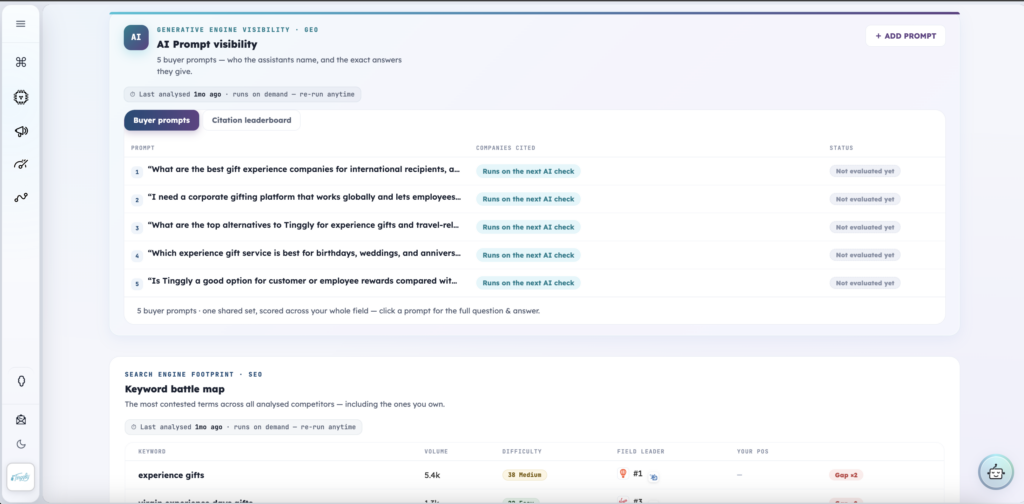
The workflow on that page is the loop described here. Competitor Spy builds the buyer prompt set for the category, runs it against the assistants on a schedule, and records who was named, in what order and on what basis. Content Factory writes question-shaped pages with the answer stated first, and before anything publishes, a GEO check marks each target prompt as answered or only partly answered. AI search analytics reports sessions from each assistant, the conversions they produced and the conversion rate next to the rest of the site. Details are on the GEO page, and how Pathmonk works with agencies is on Pathmonk for agencies.
Key takeaways
- Clients worry about being left off AI shortlists, not about lost traffic. Sell visibility and its value, not traffic volume.
- Structure the service as a setup month and a monthly loop: re-run the panel, ship fixes, report.
- Never sell a position. SparkToro found less than a 1 in 100 chance that two answers list the same brands.
- Google states that optimizing for its AI features is still SEO and needs no special files or markup.
- Write the prompt panel once, with the client, from real buyer questions, and keep the wording fixed.
- Report share of answers, AI-referred sessions and conversions on the client’s goal, side by side.
- Label session and conversion counts as floors, and read trends across several cycles, not one month.
- Start with clients whose buyers ask assistants and whose sites track a conversion.
FAQs about AI search visibility as an agency service
What should an agency include in an AI search visibility service?
A one-off baseline (crawler access, a prompt panel written with the client, a first run and a fact audit), then a monthly loop: re-run the same prompts, ship a fix list tied to the prompts it targets, and report share of answers, AI-referred sessions and conversions on the client’s goal.
Can an agency guarantee that a client gets cited in ChatGPT?
No. Answers vary from run to run: SparkToro’s January 2026 research found less than a 1 in 100 chance that two ChatGPT or Google AI responses listed the same brands. Promise the measurement, the fixes and the reporting, and state in the proposal that no citation is guaranteed.
How do you report AI search visibility to a client?
With three numbers from three sources: share of answers from the prompt panel, AI-referred sessions from analytics, and conversions from those sessions on the client’s own goal. Show them side by side, label the session and conversion figures as floors, and read the trend across several cycles.
How many prompts should a client prompt panel include?
Enough to cover the client’s buying stages and to give a stable share. A panel of 20 prompts run 5 times in each of 3 assistants gives 300 answers per cycle, which puts the error on a single cycle at about 2 to 3 points. Keep the wording fixed between cycles.
Is AI search optimization different from SEO for an agency?
Mostly not. Google’s guide, updated in July 2026, says optimizing for generative AI search is still SEO and that sites do not need special files or markup. The new work for an agency is the prompt panel, keeping facts consistent across listings and other sites, and reporting visibility next to visits and conversions.
Which clients should an agency offer AI search visibility to first?
Clients whose buyers compare options and ask assistants for recommendations, and whose sites track a conversion goal. Considered purchases in software, travel, clinics, education and higher-priced e-commerce usually qualify. Clients without a tracked conversion should fix that first.
- Google Search Central: optimizing for generative AI features (developers.google.com, last updated 10 July 2026)
- SparkToro: AIs are highly inconsistent when recommending brands or products (sparktoro.com, 27 January 2026)
- Demand Gen Report: 6sense 2026 Global B2B Buyer Experience Report (demandgenreport.com, 2 November 2026)
- Adobe: AI traffic drives 83% higher revenue per visit (business.adobe.com, September 2026 data)
- Orbit Media: AI traffic conversion rates, 97 B2B websites (orbitmedia.com, 22 July 2026, updated 18 August 2026)
- OpenAI: publishers and developers FAQ (help.openai.com, read 16 November 2026)