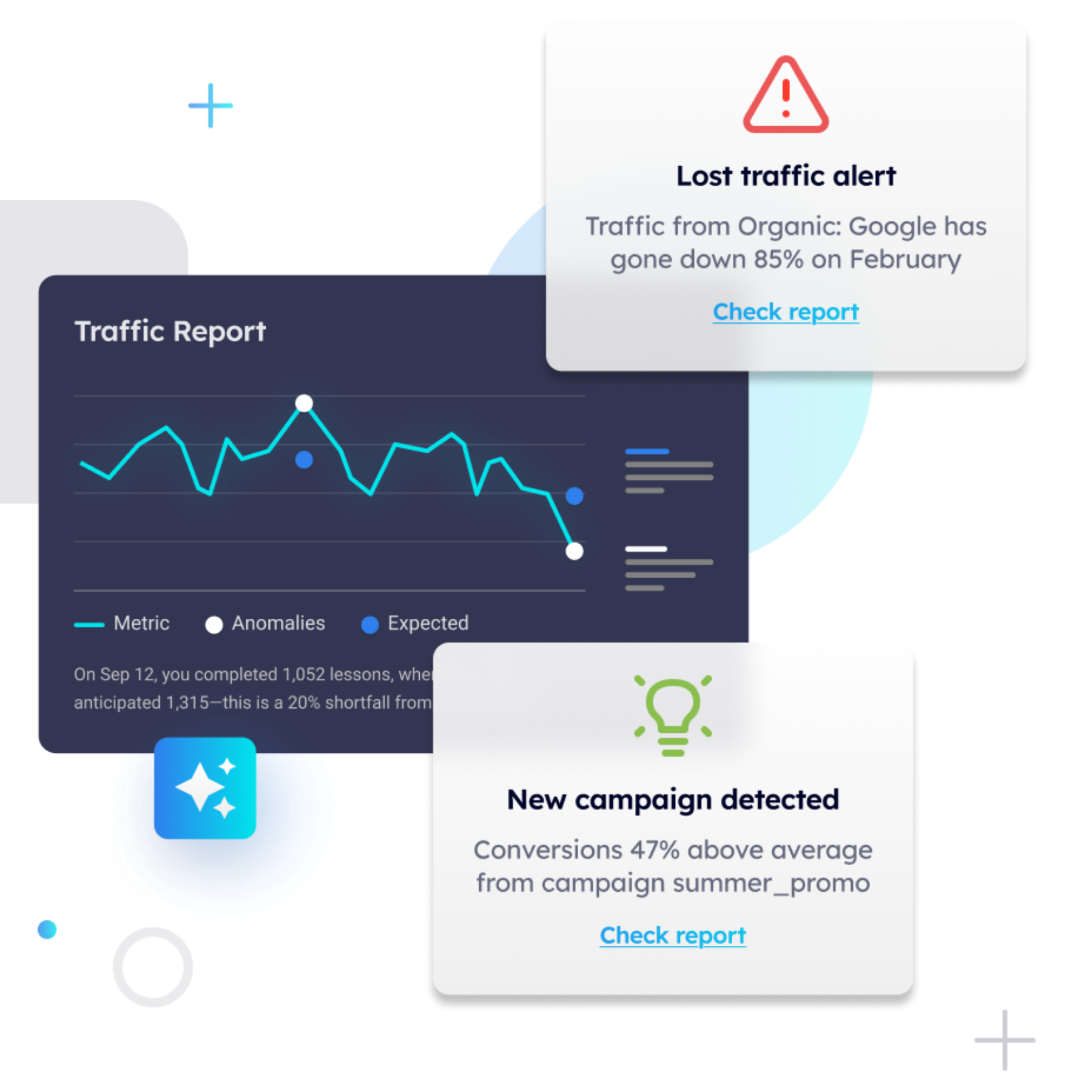
- Building an autonomous AI marketing agent is a substrate problem, not a model problem. The agent reads signal, decides, and executes multi-step tasks with minimal supervision, and it lives or dies on the four layers beneath the model.
- Those layers are the Agent Substrate: first-party behavioral data to ground decisions, a brand knowledge layer to keep output specific, a scoped action surface (tools and MCP), and governance with approval gates and control-group measurement.
- The model is the commodity every team rents, so the context you feed it is the moat. Salesforce reports 95% of AI pilots fail because they are not grounded in real business context.
- Build substrate first, autonomy last, and gate every irreversible step. Skipping the substrate is why 40%+ of agentic projects are projected to be cancelled by 2027.
Table of Contents
Gartner’s 2026 CIO and Technology Executive Survey found that 17% of organizations have deployed AI agents and more than 60% intend to within two years, the most aggressive adoption curve of any emerging technology Gartner tracks. The gap between intent and working systems is wider than the headline suggests. An MIT study of more than 300 enterprise initiatives found that roughly 95% of AI pilots deliver no measurable financial return, with only about 5% reaching production with real value. Agents that dazzle in a demo collapse the moment they meet live data.
The cancellations are not a model problem. Gartner attributes the projected 40%-plus failure rate to escalating costs, unclear business value, and inadequate risk controls. Salesforce’s Mankiran Chowhan diagnoses the root cause as grounding, not reasoning: pilots fail because they are not grounded in the context of enterprise data, run on limited datasets and isolated use cases rather than the full behavioral and operational context a real decision needs.
Two things changed in the last twelve months. The Model Context Protocol (MCP) standardized how agents connect to tools and act on external systems, removing the brittle glue code that sank the first generation of agents. And first-party behavioral data became the scarce input, because every team rents the same frontier model but only you produce the signal of how real buyers behave on your site.
What experienced marketers still get wrong is treating the agent as a prompt-engineering task. The prompt is downstream of everything that determines reliability. This article gives you the framework for that upstream work, the build sequence that survives production, the cases where you should not build at all, and how a grounded engine differs from stitching together AI agents and marketing workflows by hand.
Get your website’s conversion score in minutes
- Instant CRO performance score
- Friction and intent issues detected automatically
- Free report with clear next steps
What an autonomous marketing agent actually is
An autonomous marketing agent perceives an environment, reasons about it, calls tools, and executes a multi-step task toward a goal with limited supervision. That definition separates it from two things it gets confused with. It is not marketing automation in the HubSpot sense, where a human defines every branch of a workflow in advance and the system only fires triggers. And it is not a marketing chatbot, which responds inside a single turn without planning or taking action on external systems.
The useful way to think about agency is a ladder, not a binary. The bottom rung suggests (a human acts on the recommendation), the next drafts (a human ships the asset), the next executes with approval (the action pauses at a gate), and the top executes autonomously within hard constraints. Most production marketing agents in 2026 sit on the middle two rungs, which is the correct place given current reliability.
Reliability is the reason the ladder matters. The arithmetic is unforgiving once tasks chain: at 85% per-step accuracy, a five-step workflow succeeds 44% of the time and a ten-step workflow 20%. An autonomous agent is only as trustworthy as its weakest step multiplied across every step it takes, which is why narrow scope beats broad ambition.
Why the model is the cheapest part of the build
Frontier models are a rented commodity. Every competitor calls the same API, and the per-step quality gap between the top models is small next to the difference grounding makes. The defensible part of an agent is the context you feed it, which is yours alone. VentureBeat’s engineering analysis of 2026 deployments lands in the same place: the era of agentic AI demands a real data foundation, not better prompts, because the moat is the context, not the model.
VentureBeat’s Q1 2026 research located the failure point in the same place, calling it a runtime problem rather than a model problem. Agents built on stateless scripts lose context on a container restart, blow through token budgets, and drift their execution state across steps. The model reasons fine; the system around it cannot hold state, measure itself, or recover from a failed tool call.
This is where The Agent Substrate comes in. Four layers sit beneath the model, and each is a place an agent fails when it is missing:
- Grounding data: the first-party behavioral signal that tells the agent what real buyers actually do, not what a generic list assumes.
- Knowledge layer: a structured profile of the brand, products, positioning, and proof, so output is specific instead of plausible-sounding boilerplate.
- Action surface: the tools and protocols (increasingly MCP) the agent uses to do things, scoped to exactly what it is allowed to touch.
- Governance: the approval gates, control groups, audit log, and measurement that decide whether the agent earns more autonomy or gets cut.
Spend your engineering budget here, not on prompt-tuning. The sections that follow take each layer in turn.
Layer 1: grounding the agent in first-party behavioral data
The grounding gap is the single largest source of agent failure, and it is not a data-volume problem. Most companies have plenty of data. They lack data that carries business context the agent can act on. The signal that matters for a marketing agent is behavioral: which pages a visitor saw in what order, how long they dwelled, what they ignored, where intent spiked, and where it died. That signal is first-party by definition and impossible to buy.
This is the precise answer to the recurring objection, “why not just run my agent on Clay, Apollo, or n8n.” Those tools operate on bought lists and generic models, blind to how your actual visitors behave. An agent grounded in a third-party list can tell you a company matches your ICP. It cannot tell you that a specific anonymous session showed decision-stage behavior six minutes ago, because that signal only exists in your own behavioral data. The difference shows up directly in intent-data ROI versus traditional lead generation and in how marketers actually use AI for lead generation.
Grounding fails in a predictable way: the cold start. An agent with no behavioral history has nothing to reason from, so its early decisions are guesses. A site producing under 10,000 pageviews a month does not generate enough signal to learn reliable patterns, and pushing autonomy before that point produces confident, wrong decisions. The cheaper path for low-traffic sites is to fix conversion mechanics manually first, a point covered in whether CRO is worth it for small sites.
Doing grounding properly has a real cost: behavioral signal has to flow before the agent is useful, so instrumentation comes weeks before any autonomous action. The payoff is compounding. Each action produces a result, the result becomes new signal, and the next decision sharpens, a closed loop ungrounded agents never form. Teams moving off third-party cookies face this directly, which is why real-time personalization in a cookieless environment and the broader cookieless impact on buying journeys are now infrastructure questions. The same loop is what lets a grounded system multiply lead generation automatically, turn signal into predictive scoring of conversion likelihood, and sustain durable intent-data marketing.
Layer 2: a structured brand knowledge layer
Grounding tells the agent what buyers do; the knowledge layer tells it what your brand is. Without it, output is grammatically fine and strategically generic, the kind of copy or offer that could belong to any company in your category. The knowledge layer turns a general-purpose model into something that acts like your specific business, and it is the cheapest layer to underbuild and the most visible when it is missing.
The artifact here is a structured profile, not a prompt. It holds brand identity, the product catalog, value propositions, target audience definitions tied to buying-journey stage, social proof, competitive positioning, and dozens of other signal types. Configure it once and every agent action references it, which is the only way to keep output consistent as you add more agents. A team running an SEO agent, an ads agent, and a content agent off separate ad hoc instructions will get three different voices and three different sets of facts. One shared knowledge profile prevents that drift, the same way brand-consistent microexperiences stay native to a site instead of looking bolted on.
The failure mode is off-brand or factually wrong output that erodes trust faster than the agent builds pipeline. An agent that quotes a discontinued product, misstates pricing logic, or contradicts your positioning in an AI search answer is worse than no agent. This is the part of the build that benefits most from human review early, and it connects to a broader truth about which parts of lead generation should never be fully automated. Reliability also degrades quietly as products, prices, and positioning shift underneath a static knowledge layer, the slow reliability problem VentureBeat documents in production agents. The knowledge layer is a maintained asset, and the discipline behind high-converting experiences applies to keeping it current.
Layer 3: the action surface and MCP
An agent that cannot act is a recommendation engine. The action surface is the set of tools it can call: draft and publish content, push a qualified lead to the CRM, adjust a bid, serve a personalized experience, book a meeting. The engineering question is not whether it can call a tool but exactly which tools, scoped to what, with what permissions. A loosely scoped action surface is the most dangerous layer in the stack.
MCP changed this layer in 2026. Before it, every integration was bespoke glue code, and agents failed silently when an API version changed or a tool returned an unexpected shape. By imposing structure where systems previously relied on convention, MCP made the action surface inspectable and far more stable. It also extended where conversion happens: a buyer researching your category inside ChatGPT, Claude, or Perplexity can now book a demo or start a trial inside the conversation, rather than being bounced to your homepage at the highest-intent moment. That shift is reshaping the link between how your company ranks on ChatGPT and Perplexity and whether that visibility converts, and it is distinct from showing up in an AI answer you never ranked for.
The action surface is also your largest attack surface. MCP integrations, tool-calling permissions, and agent memory create a security boundary that most marketing teams are not equipped to defend: 88% of enterprises reported an AI-agent security incident in the past year, often an agent taking an action no one scoped. The defensive posture is concrete: enumerate every tool the agent can call, define what data each tool can read and write, and treat any irreversible action (sending external email, spending budget, deleting records) as requiring an explicit gate. The same diligence that keeps AI agents from inflating your PPC results applies to constraining what your own agents are allowed to do, and it sits at the center of where PPC is heading in an AI world.
Layer 4: governance, control groups, and the approval gate
Governance separates an agent that earns trust from one that gets cancelled. The same VentureBeat research surfaced a “Governance Mirage”: 43% of enterprises said a central team owned AI governance, 23% could not agree who owned it, and 31% named vendor opacity as their biggest obstacle. Org charts claimed control the actual systems never implemented.
The enterprises that escape pilot purgatory share one operating pattern, which Salesforce’s engineering leadership describes as a centralized governance framework with role-based access and audit trails. In practice that means documenting three answers before deployment: who can the agent contact, what can it access, and what requires human approval. Without those three answers fixed in advance, every agent decision becomes an ad hoc judgment call, and ad hoc judgment does not scale to thousands of autonomous actions.
The measurement half of governance is where marketers have an advantage, because the discipline already exists in CRO. An autonomous agent that changes the site or the funnel must prove its lift the same way any other change does: against a held-out control group, not against a month-over-month comparison that confounds seasonality and traffic mix. A clean design holds a minimum control group, splits traffic in a controlled A/B test to isolate the agent’s effect, and runs to statistical significance before scaling a winner. The reasoning behind a 5% minimum control group and the math that proves an uplift is real is exactly the rigor an agent needs, and it maps onto telling a normal conversion drop from a broken one. Attaching a monetary value to each conversion lets the agent prioritize by business outcome rather than raw event count, which is also how you defend the spend to a CFO.
The approval gate is the governance control that does the most work. A human checkpoint at the highest-risk step, the orchestration pattern of detect, enrich, draft, then surface for approval, captures most of the autonomy benefit while removing most of the catastrophic-failure risk. Autonomy without a gate fails the moment an edge case the agent never saw arrives in production, which in practice is almost immediately once it meets real traffic.
A build sequence that survives production
The sequence below front-loads the cheap, reversible work and defers autonomy until it is earned.
- Instrument first-party behavioral data first. Get the signal flowing and validated before anything else, which for most stacks is a single SDK snippet via a tag manager. Agents trained on incomplete or dirty signal inherit the gaps. This is weeks of unglamorous work and it is non-negotiable.
- Build the knowledge layer. Structure the brand profile, products, positioning, and proof once, in a form every agent can reference. Review it with a human who knows the brand.
- Pick one narrow task. Lead qualification, a single content workflow, or one personalization decision. Resist the multi-step ambition that the reliability math punishes.
- Wrap the task in an approval gate. Start on the “execute with approval” rung. Log every decision with enough granularity to audit it later.
- Connect the action surface through a structured protocol. Scope permissions tightly. Treat irreversible actions as gated by default.
- Measure against a control group. Prove lift before expanding scope, and judge the result against a realistic industry conversion benchmark rather than an internal hope. An agent that cannot demonstrate incremental lift over control is not working, regardless of how busy it looks.
- Expand autonomy only after proven lift. Move a task up the ladder one rung at a time, and only when the data justifies it.
The contrast between this and the common DIY approach is structural:
| Dimension | Stitched DIY stack (lists + generic model + glue) | Grounded engine (substrate-first) |
|---|---|---|
| Data the agent reasons from | Bought third-party lists, generic assumptions | First-party behavioral signal from your own site |
| Brand specificity | Per-tool prompts, voice drifts across agents | One shared knowledge profile, consistent output |
| Action reliability | Bespoke glue code, silent failures on API change | Structured protocol, inspectable and recoverable |
| Measurement | Month-over-month, confounded | Control-group lift, significance-tested |
| Compounding | None; no closed action-to-signal loop | Each action feeds the next decision |
The DIY stack is faster to demo and slower to trust. The grounded approach is slower to stand up and the only one that survives a year in production. This is the same calculus marketers face when choosing CRO tools actually worth paying for, or the right CRO tooling for a B2B SaaS site, rather than assembling point tools that never share data.
When you should not build an autonomous agent
Building is the wrong call in several concrete situations, and spotting them saves a cancelled project.
You should not build when traffic is below roughly 10,000 pageviews a month, because the grounding layer cannot form reliable patterns and the agent will guess. You should not build when you have no first-party behavioral instrumentation and no near-term plan to add it, because the substrate’s foundation is missing. If a low conversion rate traces to traffic quality rather than the site, an agent will optimize the wrong problem. You should not hand an agent irreversible, high-stakes actions, spending real budget, sending external communications at scale, modifying production records, without a hard approval gate, because the per-step reliability math guarantees failures at volume.
Regulated verticals add a further constraint: if you cannot produce an audit trail for every autonomous decision, autonomy is a compliance liability rather than an efficiency gain. There is a simple economic test. If the task is genuinely one-step, deterministic, and rule-based, like simplifying a funnel or adding a qualification step, classic marketing automation does it more cheaply and more reliably than an agent. Agents earn their cost on multi-step, judgment-laden, signal-dependent work, not on tasks a workflow rule already handles. Before committing, the honest version of this decision runs the same CRO-investment ROI math behind which parts of lead generation should not be automated and the shift from smart A/B testing to agentic CRO.
AI agents that run your marketing on your own data
- AI agents handle SEO, content, ads, and more across your entire stack
- Every action is informed by your first-party behavioral data, not guesswork
How Pathmonk helps you ship a grounded agent instead of a generic one
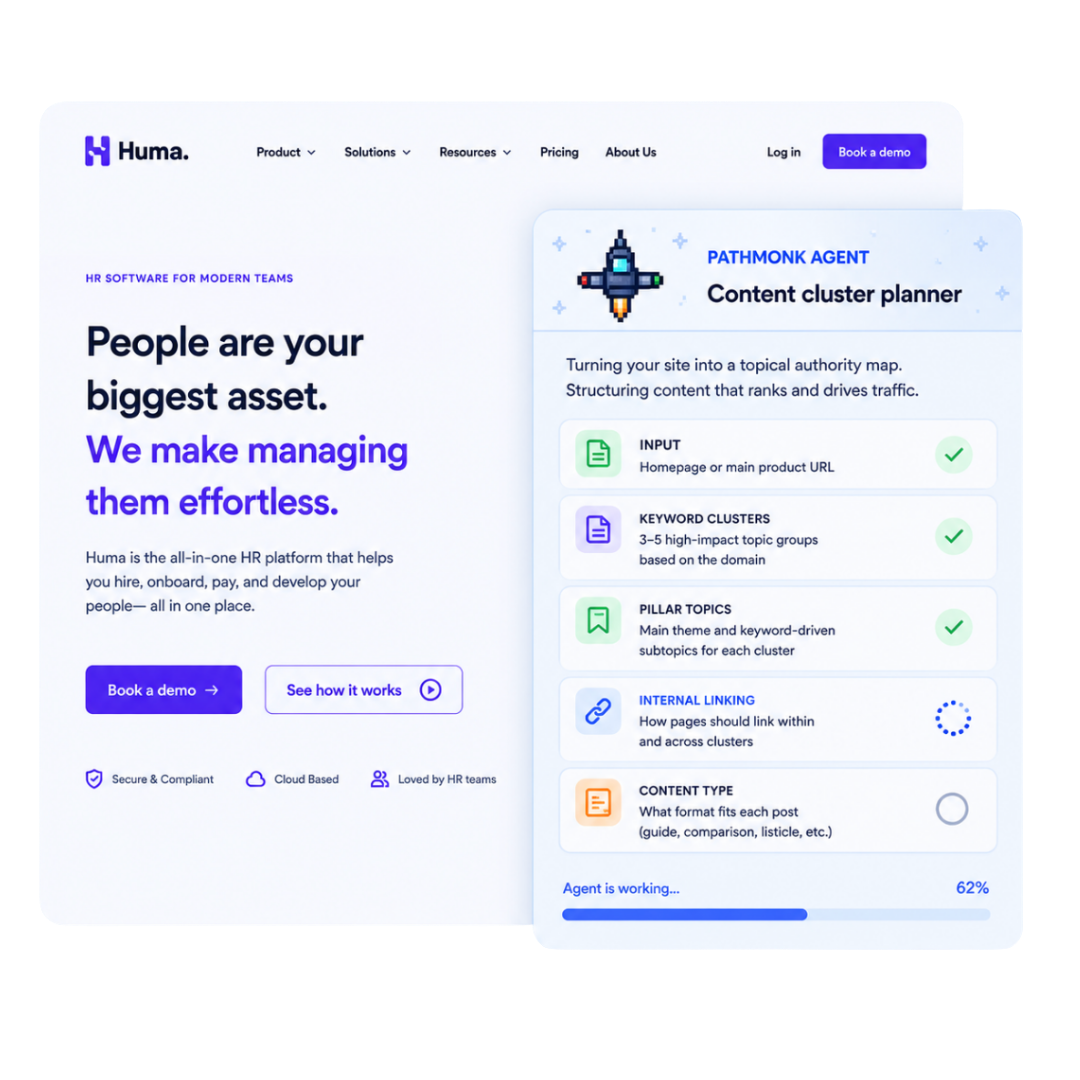
The reason most marketing agents fail, ungrounded data and a generic brain, is the exact problem Pathmonk’s agents are built around. With Pathmonk you build agents for the specific, repeatable marketing tasks you actually run: content production, SEO and AI-visibility work, ad workflows, competitor research, and outreach or backlink generation. What separates them from a generic agent is the substrate they run on: your own first-party behavioral data and a structured profile of your brand, not a rented model and a bought list.
Each agent owns one task and runs without manual triggering, and an orchestration layer chains them into multi-step workflows with a human-approval step where it matters, for example detect a high-intent lead, enrich it from your own data, draft outreach, and surface it for sign-off. Because the agents reason from a real profile of your brand and the behavioral signal your site already produces, their output is specific to your business instead of plausible-sounding boilerplate. That single distinction, agents grounded in your data and brand versus agents running on a generic model and a third-party list, is the entire answer to “why not just use Clay, Apollo, or n8n.”
The grounding is what makes the work compound. Every agent action is informed by how real buyers behave rather than by category assumptions, and each result feeds back as new signal that sharpens the next one. You add agents as new tasks come up, building the kind of marketing stack an agency would otherwise run by hand, except it runs on your own data and keeps the institutional knowledge in-house.
FAQs on AI-powered marketing agents
How is an autonomous marketing agent different from marketing automation?
Marketing automation executes branches a human defined in advance and only fires triggers. An autonomous agent plans, decides, calls tools, and handles multi-step tasks the human did not script step by step. If a task is one-step, deterministic, and rule-based, automation is cheaper and more reliable. Agents earn their cost on multi-step, signal-dependent, judgment-laden work.
Can I build a marketing agent on top of Clay, Apollo, or n8n?
You can build orchestration there, but those tools run on bought lists and generic models, which leaves the agent blind to how real visitors behave on your site. The grounding layer, first-party behavioral signal, is what makes agent output specific to your brand and your buyers. The orchestration layer is the easy part; the data foundation is the part that determines whether the agent works.
How much first-party data do I need before an agent is useful?
Roughly 10,000 pageviews a month is the practical floor for reliable pattern formation. Below that, the agent lacks enough behavioral signal to reason from and its early decisions are guesses. Low-traffic sites get more value from fixing conversion mechanics manually before adding autonomy.
How do you measure whether an autonomous agent is actually working?
Against a held-out control group, run to statistical significance, never against a month-over-month comparison that confounds seasonality and traffic mix. Hold a minimum control group, isolate the agent’s effect, and require demonstrated incremental lift before expanding scope. An agent that cannot prove lift over control is not working regardless of activity.
Should an autonomous agent run without human approval?
Not for irreversible or high-stakes actions. Place a human approval gate at the highest-risk step, the standard pattern is detect, enrich, draft, then surface for sign-off. The per-step reliability math means a five-step workflow at 85% per-step accuracy succeeds only 44% of the time, so unsupervised multi-step execution fails at volume.
Does MCP replace my website as a conversion surface?
It adds a new one. An MCP integration lets a buyer act, book a demo or start a trial, inside an AI conversation in ChatGPT, Claude, or Perplexity, rather than being redirected to your homepage. The website remains a conversion surface; the AI chat becomes an additional one at the moment buyers form their shortlist.
Why do most agentic AI projects get cancelled?
Gartner attributes the projected 40%-plus cancellation rate by 2027 to escalating costs, unclear business value, and inadequate risk controls, not model quality. The recurring root cause is ungrounded data: pilots run on generic context that cannot produce specific, reliable, measurable outcomes.
How does step count affect agent reliability?
Errors compound multiplicatively. At 85% accuracy per step, a five-step workflow succeeds about 44% of the time and a ten-step workflow about 20%. This is why narrow, single-task agents with approval gates outperform broad autonomous ones in production, and why scope discipline matters more than model choice.
Key takeaways
- An autonomous marketing agent reads signal, decides, and executes a multi-step task with limited supervision; it is distinct from rule-based automation and from chatbots.
- The model is the commodity. The defensible build is The Agent Substrate: grounding data, a knowledge layer, an action surface, and governance.
- Roughly 95% of enterprise AI pilots deliver no measurable return (MIT) and 40%-plus of agentic projects are projected to be cancelled by 2027 (Gartner), driven by ungrounded data, cost, and weak governance.
- First-party behavioral signal is the grounding layer and the moat, because only your site produces it; bought lists and generic models cannot replicate it.
- A structured brand knowledge layer keeps output specific and must be maintained, since reliability degrades as products, prices, and positioning drift underneath a stale profile.
- MCP standardized the action surface and extended conversion into AI conversations, while also creating the largest attack surface that needs explicit scoping.
- Governance means three documented answers (who the agent contacts, what it accesses, what needs approval) plus control-group measurement; the teams that escape pilot purgatory share this pattern.
- Build order is substrate first, autonomy last: instrument data, build knowledge, pick one narrow task, gate it, connect the action surface, measure against control, then expand.
- Do not build below 10,000 pageviews a month, without first-party instrumentation, for irreversible actions without a gate, or where you cannot produce an audit trail.