
Why paid lead generation brings volume but not qualified buyers? Paid lead generation doesn’t inherently produce low-quality leads, but it often does when it’s optimized primarily for volume. Paid channels can reach high-intent buyers, especially in search or well-targeted ABM-style campaigns. The problem appears when success is measured by CPL and lead count, which pushes teams toward low-friction offers and broad messaging. In those cases, platforms optimize for ease of conversion, not depth of intent, and volume grows faster than buyer readiness.
So the issue isn’t paid lead gen itself, but how it’s designed and evaluated. When campaigns skip intent validation, remove all friction, or ignore downstream signals like pipeline and revenue, qualification suffers. Paid works well when it’s treated as part of a buying journey with built-in intent signals and sales-aligned goals, not as a standalone lead factory.
Table of Contents
Paid lead generation has a reputation problem. Many teams invest heavily in paid search or paid social, see lead volume increase, and still struggle to turn those leads into real opportunities or revenue. The conclusion is often that paid channels attract low-quality leads or people who are not serious buyers.
The reality is more nuanced. Paid lead generation does not inherently produce unqualified leads. In fact, paid channels can be one of the most effective ways to reach high-intent buyers, especially through search or tightly targeted campaigns. The problem appears when paid lead generation is designed and measured primarily for volume.
When success is defined by cost per lead and total lead count, campaigns are pushed toward low-friction offers, broad messaging, and fast conversions. Platforms then optimize for ease of conversion rather than depth of intent. Lead volume grows, but buyer readiness does not.
So the issue is not paid lead generation itself. It is how it is structured, optimized, and evaluated. Paid works best when it is treated as part of a buying journey, with built-in intent signals and goals aligned with pipeline and revenue, not as a standalone lead factory.
Get your website’s conversion score in minutes
- Instant CRO performance score
- Friction and intent issues detected automatically
- Free report with clear next steps
What paid lead generation is actually good at
Paid lead generation is often judged by its worst outcomes, but that ignores what paid channels are designed to do well. At their core, paid channels are distribution systems. They excel at putting an offer in front of a specific audience at scale.
When used correctly, paid lead generation can reach high-intent buyers, especially in scenarios like:
- Paid search campaigns, where users are actively looking for a solution
- Account-based or tightly targeted campaigns, where messaging is aligned to a defined ICP
In both cases, the channel itself is capable of driving serious demand.
The confusion usually starts when traffic quality and lead quality are treated as the same thing:
- High-quality traffic means the right people are arriving on the site
- High-quality leads means those people are showing clear buying intent
Paid channels can reliably deliver the first. They only deliver the second when campaign design allows intent to surface.
This is why paid search lead generation often outperforms broad paid social campaigns in B2B. Search captures explicit intent, while social relies more on interest or curiosity. Neither approach is inherently wrong, but each requires different expectations, offers, and qualification logic.
Used properly, paid lead generation is most effective when it is designed to capture existing demand or validate intent, not when it is expected to manufacture buyer readiness on its own.
Turn website traffic into sales-ready leads
- Identify high-intent visitors automatically
- Qualify leads before they reach your sales team
- Convert traffic without adding friction or forms
Why paid lead generation often attracts unqualified leads
When campaigns are optimized for speed and scale, they naturally favor outcomes that increase volume, even if buyer quality suffers. Four patterns appear consistently.
1. Volume-first optimization distorts outcomes
Most paid lead generation programs are optimized around cost per lead and lead count. These metrics reward campaigns that generate the highest number of conversions at the lowest cost, regardless of who converts.
The problem is that ad platforms do not optimize for buyer readiness. They optimize for conversion probability.
This means:
- Platforms learn to target users most likely to complete a form
- Those users are not necessarily the most likely to buy
- Ease of conversion becomes more important than intent depth
Over time, campaigns drift toward audiences that convert quickly and cheaply, not toward those with real purchase intent. Volume increases, but lead quality declines.
2. Low-friction offers remove intent signals
To improve CPL, teams often reduce friction as much as possible. Offers become easier to access, forms get shorter, and commitment drops.
This creates the “free everything” problem.
When everything is free and effortless:
- Users do not need to evaluate whether the offer is relevant
- There is no cost to curiosity
- Intent signals disappear
Friction is not the enemy. Unintentional friction is, but intentional friction helps qualify demand. When forms only capture an email address, they collect contact details, not buying intent.
As friction goes down, lead volume goes up, but qualification suffers because nothing filters for seriousness.
3. Broad messaging attracts curiosity, not demand
To maximize reach and clicks, paid campaigns often rely on broad messaging. The language is designed to appeal to as many people as possible, not to a specific buyer in a specific context.
This approach optimizes for:
- Attention
- Click-through rate
- Initial engagement
But it sacrifices relevance, which is the strongest predictor of buyer intent in B2B lead generation.
Curiosity-driven clicks inflate traffic and lead numbers, but relevance-driven messaging attracts buyers who recognize themselves in the problem. In paid lead generation, reach creates volume, relevance creates demand.
4. Paid lead generation is treated as a standalone system
Beyond metrics, offers, and messaging, there is a deeper structural issue. Paid lead generation is often designed as a self-contained function, rather than as part of a broader buying journey.
In many setups, paid campaigns are disconnected from:
- Buying stages, with the same conversion logic applied to early research and late-stage decision-making
- Sales qualification, where leads are passed along without context or intent signals
- Revenue outcomes, meaning performance is judged before any commercial impact is visible
The moment a form is submitted, the system stops asking questions. Leads are handed to sales without clarity on what triggered the conversion, what content was consumed, or how strong the buying signal actually was.
When sales struggles to convert those leads, the conclusion is often that paid does not work or that paid attracts the wrong audience. In reality, paid is doing exactly what it was designed to do: generate conversions in isolation.
This is what creates the illusion that paid lead generation fails. The problem is not volume, targeting, or even lead quality on its own, but the absence of a system that connects paid activity to intent, qualification, and revenue.
Increase conversions from your PPC campaigns
Get more value from your paid traffic by personalizing the website experience based on visitor intent, not just the ad they clicked.
Book a demo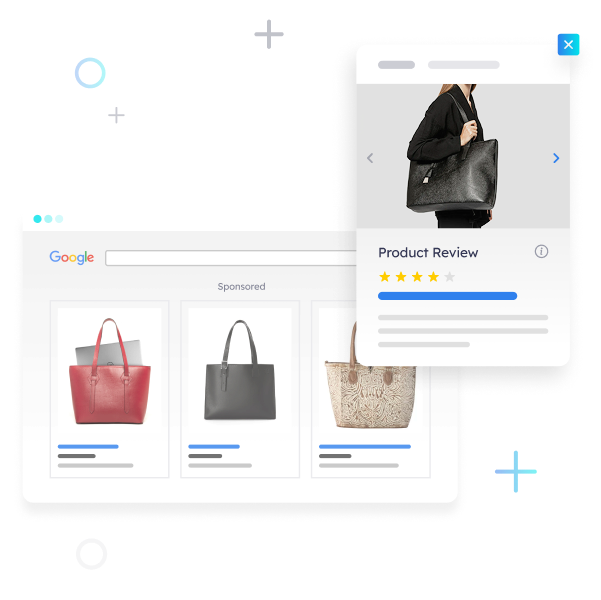
How to improve lead quality from paid channels without killing volume
If paid lead generation fails when it is optimized only for volume, the solution is not to reduce spend or add more filters at the ad level. The real leverage sits after the click, on the website.
Paid channels bring people in at very different stages of readiness. Some visitors are still trying to understand their problem. Others are actively evaluating solutions. Treating all of them the same forces teams to choose between lead volume and lead quality.
The alternative is to qualify intent onsite, based on real behavior, instead of trying to guess it upfront.
This is where tools like Pathmonk change how paid lead generation works. Instead of showing the same experience to every paid visitor, Pathmonk analyzes real-time intent signals, such as:
- Pages visited and content depth
- Navigation patterns and interaction behavior
- Return visits and comparison activity
Based on these signals, the website adapts the microexperience shown to each visitor.
- Lower-intent visitors are guided through awareness-stage experiences
- Educational content
- Low-pressure lead generation
- Value framing without sales push
- Higher-intent visitors see decision-oriented experiences
- Proof and validation
- Differentiation and positioning
- Clear next steps aligned with sales
This approach removes the pressure to over-optimize for CPL. Paid campaigns can focus on relevance and reach, while qualification happens dynamically onsite.
Paid lead generation becomes more effective not because fewer people convert, but because the right people move down the funnel.
How sales teams benefit when paid lead generation is intent-driven
Improving lead quality from paid channels is not just a marketing concern. It has a direct and measurable impact on sales efficiency, deal velocity, and win rates.
When buyer intent is surfaced before the lead reaches sales, conversations start from a very different place.
With an intent-driven approach, sales teams receive:
- Leads with context, not just contact details
- Visibility into what the buyer engaged with, not just where they converted
- Signals that indicate readiness to buy, not just interest
This reduces the time spent qualifying from scratch. Conversations begin closer to real buyer needs, making discovery more relevant and shortening sales cycles.
This is where Pathmonk plays a key role. By analyzing onsite behavior in real time, Pathmonk surfaces intent signals before a lead is handed off. Sales teams gain visibility into how a prospect navigated the site, what content influenced the conversion, and how strong the buying signal was at the moment of engagement.
As a result:
- Fewer cycles are wasted on low-intent follow-ups
- Sales prioritizes leads based on readiness, not arrival time
- Marketing and sales align around the same intent signals
This alignment reduces friction between teams. Marketing no longer has to defend lead volume, and sales no longer dismisses paid leads as low quality. Both teams evaluate success using shared indicators tied to pipeline and revenue.
How Avrek Law Firm increased qualified leads by 175% from paid traffic
Avrek Law Firm, a US-based personal injury law firm, was already investing heavily in paid acquisition. PPC campaigns were driving consistent traffic to the website, but conversions were underperforming. Visitors arrived, browsed, and left without submitting their cases.
The challenge was not traffic volume, but trust and intent. Legal services require a high level of confidence, and paid visitors arrive at different stages of readiness. Showing the same experience to everyone made it difficult to qualify serious prospects.
To solve this, Avrek Law Firm implemented Pathmonk to adapt the website experience based on real-time visitor behavior.
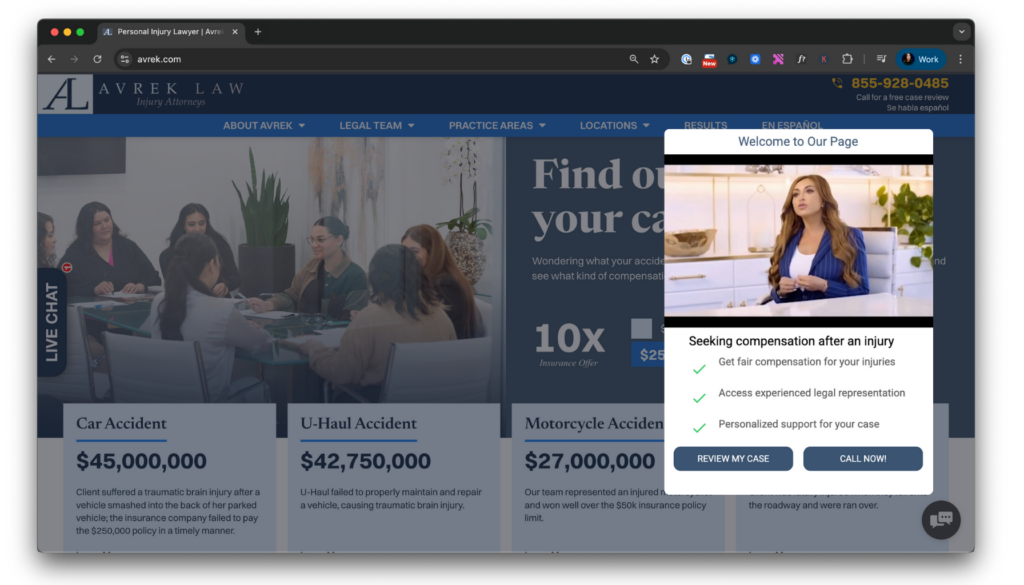
Lower-intent visitors were guided through awareness-stage content designed to build credibility, such as an introductory video from the firm’s founder. Visitors showing stronger intent were presented with trust signals like verified reviews and clear options to submit their case or get in touch.
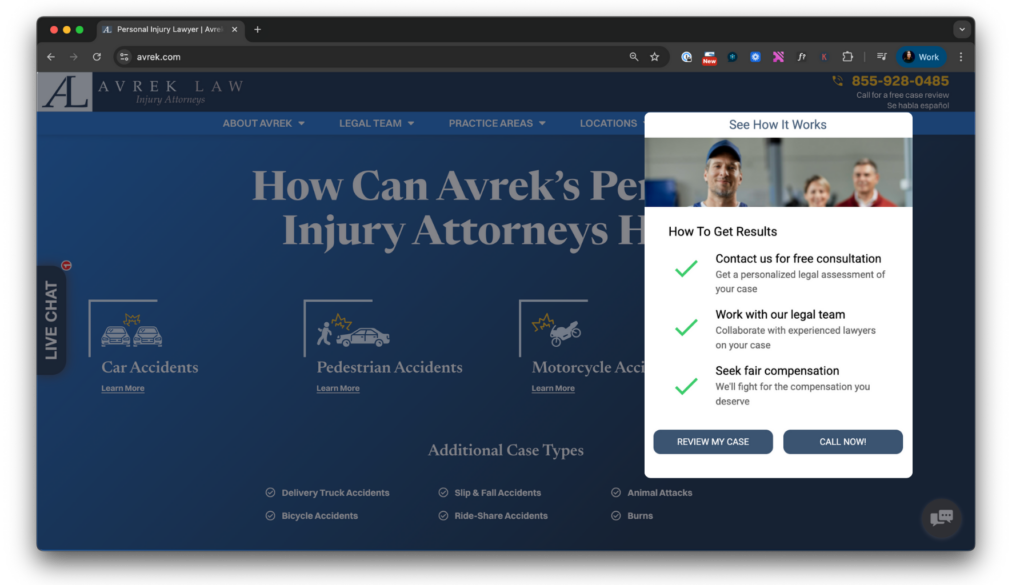
Instead of filtering traffic at the ad level, qualification happened onsite, as visitors moved through the journey.
The result was a 175% increase in qualified leads, with paid traffic converting into real case reviews, not just form submissions. By aligning paid acquisition with intent-based onsite experiences, Avrek Law Firm turned paid volume into measurable business outcomes.
Calculate your increased profit in just a few clicks
Easily find out how many conversions and revenue you can expect once Pathmonk is installed on your website.
Calculate your gains
FAQs on paid lead generation
How do paid platforms decide which users see your lead ads?
Paid platforms prioritize users most likely to complete the desired action based on historical conversion data. This means ads are often shown to people who convert easily, not necessarily those who are evaluating a purchase. Over time, this optimization can skew traffic toward lower-intent users if intent is not validated after the click.
Can paid lead generation work for complex or high-ticket offerings?
Yes, but it requires a different setup. High-ticket or complex purchases need education, proof, and progressive qualification. Paid traffic can initiate demand, but onsite experiences must adapt to guide buyers through evaluation rather than pushing immediate conversion.
Should paid lead generation be optimized differently for B2B and B2C?
Yes. B2B buying journeys are longer, involve multiple stakeholders, and rely more on validation signals. B2C decisions may be faster but still require trust. In both cases, intent-based onsite qualification improves results, but the signals and experiences differ by context.
How can websites help qualify paid traffic without adding friction?
Websites can qualify intent by observing behavior instead of forcing users to declare intent upfront. Page depth, content sequencing, interaction patterns, and return visits provide strong indicators of readiness. These signals allow experiences to adapt without increasing form complexity.
How does Pathmonk fit into a paid lead generation strategy?
Pathmonk acts as the qualification layer after the click. It analyzes visitor behavior in real time and adapts micro-experiences based on intent, helping teams turn paid traffic into qualified opportunities rather than raw leads.
Is paid lead generation still worth investing in?
Paid lead generation remains valuable when it is integrated into a broader demand and qualification system. When intent signals, onsite progression, and sales alignment are in place, paid channels can reliably contribute to pipeline and revenue.
Increase +180% conversions from your website with AI
Get more conversions from your existing traffic by delivering personalized experiences in real time.
- Adapt your website to each visitor’s intent automatically
- Increase conversions without redesigns or dev work
- Turn anonymous traffic into revenue at scale

Key takeaways
- Paid lead generation isn’t broken. It just delivers what you ask it to deliver. If you optimize for volume, you’ll get volume.
- High lead volume and low buyer quality usually come from how campaigns are measured, not from the channel itself.
- Paid traffic can include serious buyers, especially in search or well-targeted campaigns. The problem is treating every visitor the same once they land.
- Lead quality is mostly decided after the click, not in the ad. What happens on the website matters more than most teams think.
Paid lead generation only works long term when it’s connected to the buying journey, sales context, and revenue, not just form fills.