Introduction
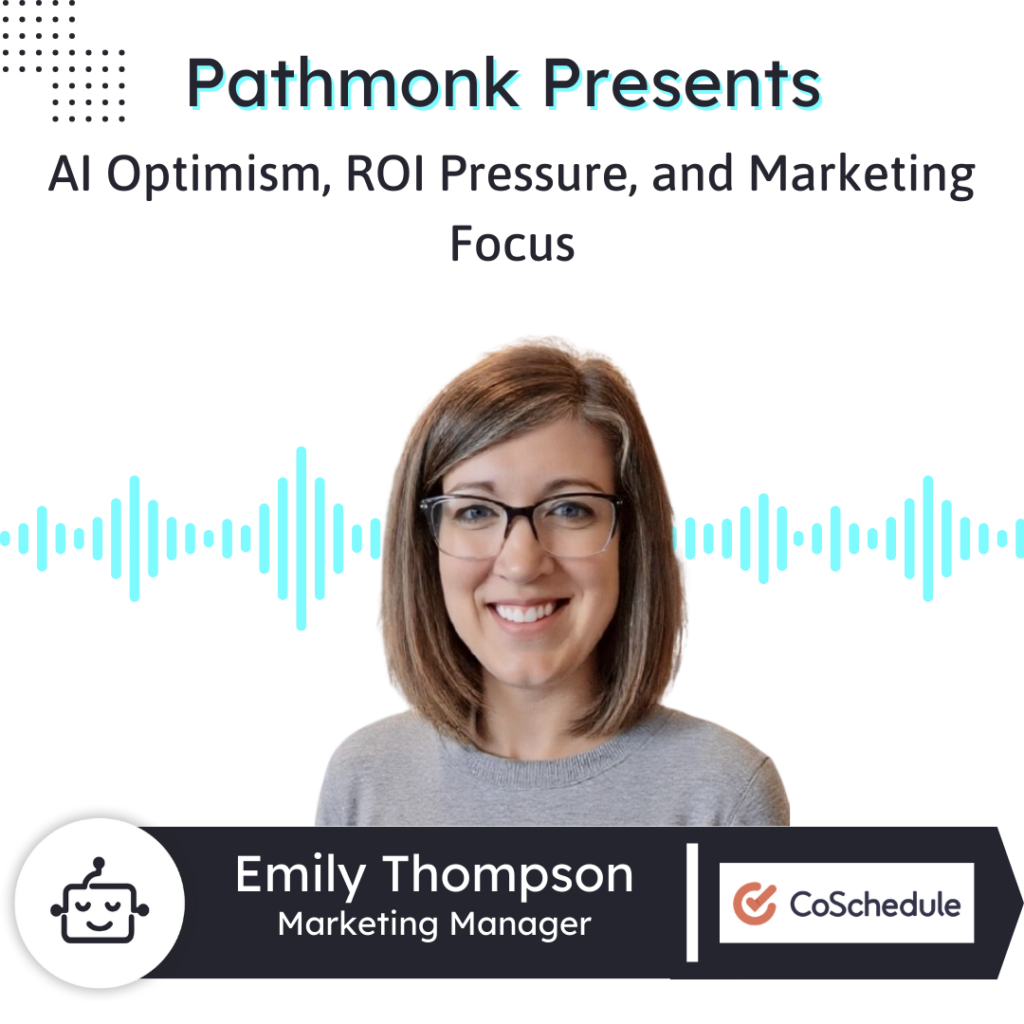
In this episode of Pathmonk Presents, Emily Thompson, Marketing Manager at CoSchedule, breaks down the findings from CoSchedule’s latest marketing research report and what they reveal about AI adoption and performance pressure. While 79% of marketers say AI improved their results, ROI is declining across channels and lead generation remains the top priority.
Emily shares why marketing project management is the overlooked lever for growth, how content saturation is raising the stakes, and why staying human is more critical than ever. If you’re navigating AI-driven change, tightening KPIs, and rethinking your productivity systems, this conversation delivers clarity and direction.


Increase +180% conversions from your website with AI
Get more conversions from your existing traffic by delivering personalized experiences in real time.
- Adapt your website to each visitor’s intent automatically
- Increase conversions without redesigns or dev work
- Turn anonymous traffic into revenue at scale
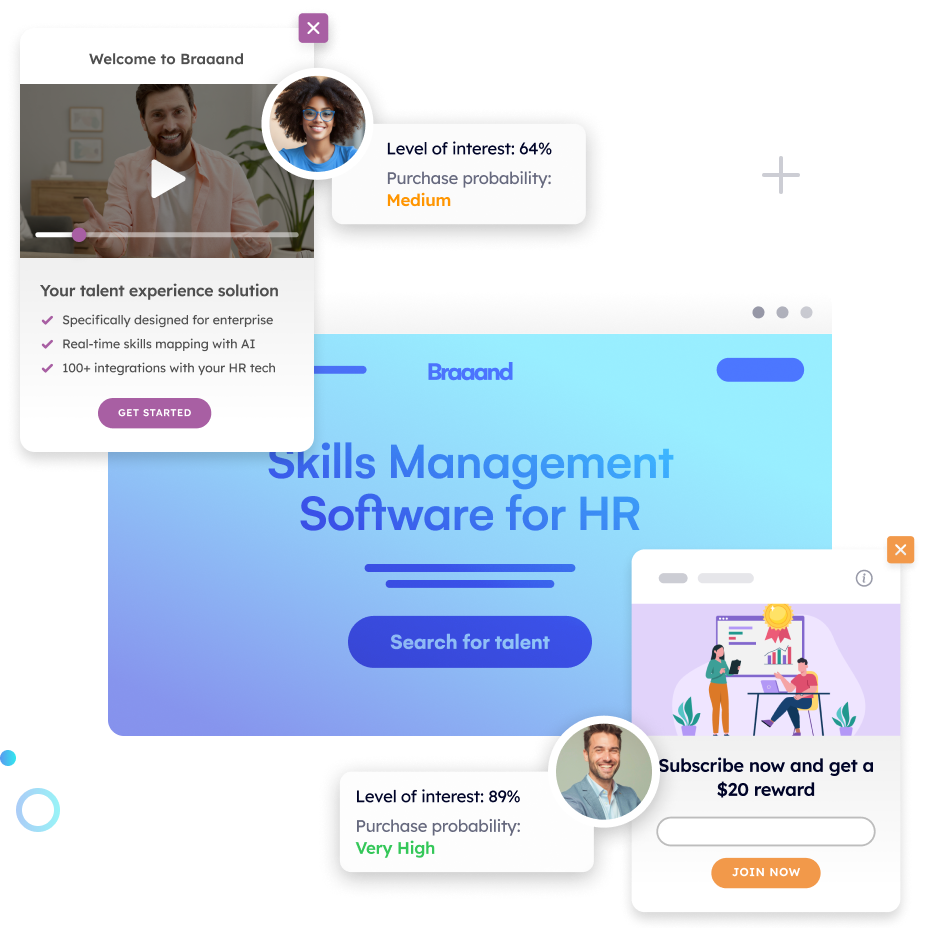
Rick: Pathmonk is the AI for website conversions. With increasing online competition, over 98% of website visitors don’t convert. The ability to successfully show your value proposition and support visitors in their buying journey separates you from the competition online. Pathmonk qualifies, converts leads on your website by figuring out where they are on the buying journey and influencing them in key decision moments.
Relevant micro experiences like case studies, intro videos are much more. Stay relevant to your visitors and increase conversions by 50% by adding Pathmonk to your website in seconds. By letting the AI do all the work and increase conversions while you keep doing marketing as usual, check us out on Pathmonk.com.
Hey everybody. Welcome back to today’s episode of Pathmonk Presents. Today we’re joined by Emily Thompson. She’s the marketing manager at CoSchedule. Emily, welcome to the show.
Emily Thompson: Hey, thanks so much for having me, Rick. It’s great to be here.
Rick: It’s great to have you, Emily. And I’m excited about this one, especially because of the way that’s manifested in a way where we’ve been trying to get this scheduled and finally we are here.
We talked about the report. Now I’m just hinting at it, but we talk about the report that you guys did at CoSchedule. But before we get into all of that, let’s start with the basics for a second. Emily. What’s the big idea behind CoSchedule and how would you describe it to someone new?
Emily Thompson: Yeah, so we are a marketing project management software and I know that some of those terms can be gobbledygook. So really we are designed to help marketers manage campaigns, clients content, social media, all from one place. I like to describe it to my friends as imagine your project management software merged with your social media scheduling tool.
That’s CoSchedule. We are predominantly a social media scheduling software, but we also different from a lot of the schedulers. We also have a huge calendar arm of our software for project management. So a lot of people love it because it’s a one stop shop for all of the project management details that come with content, which every marketer knows is just a behemoth to manage. The project management element of content is so time consuming and so difficult when it’s not done well. So we really care about helping marketers speed up that process and eliminate the headaches of project management.
Rick: Yeah, that’s a way to help marketers stay sane, right? In many different ways.
Are there specific subsets, if you will, specific type of marketers that you feel could really get help from using CoSchedule? Is there a main problem that you help them solve at the moment, or maybe different problems? All in all, trying to understand really: who’s your ICP? Who’s the person that actually could benefit from using your product?
Emily Thompson: You know what’s so fun in my role is we really span the full spectrum of marketers because we have different levels of our product. So we have everything from a really lower level of responsibility of our product all the way up to a higher grade for enterprise organizations.
So I have a friend who works very part-time, not even a marketer, has been assigned to take over social media for her nonprofit who uses CoSchedule, all the way up to organizations with 50,000 employees using CoSchedule to manage all of their marketing and their multiple marketing departments. So all across the board, which is a really fun ICP.
Rick: No, I’ll bet. It’s got to be hard to target all of those different—it’s such a broad spectrum.
But at the same time, I’m sure there are problems these people share, right? The scheduling part, the project management. So it might be hard to specify, but also easier to find messaging that resonates, because you find clusters of problems and say, okay, this is what we help you solve. Does that make sense?
Emily Thompson: Yeah, I know at Pathmonk you specialize in helping people understand the different behavior of different audiences on your website, and we definitely care a lot about that too. We understand that you talk differently to a solo social media strategist than you do to a major organization.
But at the end of the day, I think the thing we all have in common is we all have major management elements of our job that need to be refined. We are all drowning in too much work and need a system that helps us be productive.
Whether it’s a social media strategist that’s just flying by the seat of her pants because she doesn’t really have a system, all the way up to: we have so many people to manage and so many projects.
I think we’re all figuring out how to do project management well, and it’s interesting—that’s not a topic I see marketers talking about very often.
But I think project management is one of those things that when it’s done well, you don’t see it and you take it for granted. But when it’s not in place, the whole organization suffers.
So it’s fun to be a part of a tool that helps keep marketers sane no matter what size their organization is in, no matter what task they have on their plates.
Rick: Yeah. You make a good point about project management not being talked about as much, because it’s just a priority. And going back to how CoSchedule works, you’re helping with prioritizing—project management is a lot about that.
Speaking of prioritizing: I had the pleasure to go through the report that you guys did, what marketers are prioritizing in 2026. There was an interesting stat in there: 79% of marketers prioritize AI-driven goals right now.
Do you think we are accidentally contributing to that noise? Or maybe there’s a way out—what’s your opinion?
Emily Thompson: Yeah, I’ll just give a little background on the survey so people know what we’re talking about. Every year CoSchedule does a major marketing industry research project. We have, just having been in business for 12 years, a huge database of marketers and we love to engage them with a survey to ask something relevant in their world.
So a year ago we asked: are you using AI? Where are you at with AI? Do you find it helpful? Do you not find it helpful? And found that marketers were overwhelmingly positive about AI and had fully integrated it into their work life.
A year later we wanted to turn around and go: okay, now a year into fully integrating AI into your life, how are you doing? What’s working in your marketing? What’s not working? Where are you seeing ROI decline and where is it increasing?
We wanted to look at: how is the marketing industry doing? We know a lot of things changed rapidly in 2025 with AI and search.
And this is what the results showed: marketers were overwhelmingly positive about AI. 79% indicated they believe their performance increased in 2025 because of using AI. 73% said AI will significantly reshape my work this year.
We asked a question about sentiment towards AI and only 3% believed that it had fundamentally hurt the industry. Only 1% believed it had reached its creative peak and would start declining in 2026.
So there’s this sense that the debates I see frequently on LinkedIn about whether or not AI is valuable—our research showed that conversation is over. The sentiment is incredibly optimistic.
Which you can miss if you only read the loud voices.
But things are not all rosy at the same time: marketers indicated that ROI has declined across every channel. When asked which channels are delivering the best results, there was no clear winner. Email, maybe by a tiny margin, but not much.
And they indicated their biggest challenge and top priority this year will be lead generation. And they’re deeply concerned about AI content saturation.
So you have this sense of: things are tight. Marketers are under higher pressure, higher stakes. They maybe have less of an idea of what moves the needle than they did a year ago.
But they aren’t blaming AI for those challenges.
Surely we’re entering this year with higher stakes and more challenges in marketing than before.
And so I really think 2026 is the year we have to get laser sharp about metrics and looking at what’s actually working, what’s leading to growth. And it might be incremental more than landslides in this new environment.
Rick: That’s a good point, and thanks for adding the context. I came out guns blazing with the stat, and now you’re giving everyone what it means.
I like the optimistic take. I don’t love the gloom and doom. Of course we have guardrails, we need to use it safely. But AI is here to stay and we need to find ways to use it to our advantage.
You mentioned channels—lead gen being one. We’re big on websites. I know your background is content and social.
How much of a role does your website play in all of this? Do you use AI to help with the content you put out? And is there anything you think really works at the moment as far as AI and conversions?
Emily Thompson: The fascinating thing about doing research is you have to be ready to learn the industry says something different from what you believe.
One interesting thing that came out of the survey is: marketers indicated that social media—at the same time as saying lead generation is their top priority—said social media is the area we’re most leaning into.
You would expect they would say their website. So that was surprising and it makes you wish you could go back and ask more questions.
But I do still believe the website is crucial for driving conversions. And we share a love for understanding how different targets behave differently on your website—looking at it granularly, then zooming out and drawing inferences, and customizing their journey according to their needs.
Marketing has changed drastically, very quickly. But since I started my career, I still think there are drumbeat fundamentals that are as important as before and as hard to get right as they were decades ago.
We have to be laser focused on the problems or goals our visitors have and crystal clear about how we solve that. It’s not about us, it’s about them.
The more human we do that, the more we build immediate trust and give them a reason to enter into a relationship with us.
We have to understand their problems, not our flashy selling points. And we need to understand how they use us, not how we wish they used us.
In the past, we could maybe get away with doing that generically. AI has taken that away because it raised the stakes. Now anyone can do it generically.
So we have to be as human as we possibly can because the bar has been raised—even if that sounds like an oxymoron to say AI and human in the same paragraph.
One of my favorite use cases for lead generation on a website is solid use of video that, in the intro, speaks directly to the visitor: “I see this pain point you’re dealing with, here’s how I can resolve that.”
And it’s interesting because when I say that, it sounds basic. Marketing 101. And yet I so rarely see it done well, that I think AI reminds us we have to get back to the basics—and do it better than we ever have before.
Rick: Great point. I love the emphasis on being human and connecting to the pain point.
Someone I spoke to recently said they’re shifting from “how to” to “how I,” and people resonate with that more—you’re a person, you struggled with something, and you’re explaining how you dealt with it.
Now, I want to switch gears. Emily, you’re a marketing manager—what’s a day in the life for you? What are the main things you focus on? Give us a glimpse.
Emily Thompson: Speaking of project management, a lot of my day is spent making sure that my team has what they need and are empowered to execute their roles on their specific channels.
So a day in the life for me is looking at our KPIs and how things are performing, looking ahead to what we need to be prioritizing, meeting with our different teams across product, engineering and customer support and sales.
But then also just making sure that my team of marketers who work with me have everything they need to thrive.
Rick: Awesome.
Now personally, there’s a flood of content out there. It’s hard to stay focused and discern good content from bad content. How do you stay focused and keep learning with this ocean of slop out there?
Emily Thompson: I’m so glad you asked that because it’s very difficult right now to know where to land when voices and trends swing the gamut.
I joke that I could start my morning reading bleeding edge AI content and think, “Oh man, we’re behind, we gotta be doing that.” And then sign into LinkedIn and see someone still going off about em dashes. We have got to stop talking about em dashes.
I asked a question on my LinkedIn at the end of the year—the anti year in review: what was the least helpful thing you did for your career this year?
Mine was: I read way too many bleeding edge AI marketing newsletters in 2025. It took me a minute to realize they were talking about the flashiest, shiniest objects that weren’t going to move the needle in my workplace. And I needed to stop trying to stay on the leading edge when there were fundamentals that needed more of my priority.
One thing that grounded me is this research that CoSchedule does every year because it grounds me in marketer reality versus headlines.
Headlines always go to the most sensational, newest, trending. But it’s exhausting to follow it all and panic that you’re behind.
So it’s a balancing act of adoption versus being confident in what you know and your experience. We’re reinventing a new normal here, and I think the survey stats can help us know where to land versus the voices vying for attention that maybe aren’t worth listening to—always.
Rick: I love that point about em dashes. It’s a small thing, but funny—and the focus on minutia rather than bigger picture.
I was using em dashes before AI was mainstream. Now I stopped using them because I don’t want people to think I’m using AI.
Before we wrap: rapid fire segment? Few quick questions. Ready?
Emily Thompson: Yeah, sure.
Rick: When it comes to content, do you prefer watching, listening, or reading?
Emily Thompson: Reading. I’m an old soul. I read the classics. I started a book club to read the greatest novels of all time. I’m old school.
Rick: Love it. What’s the latest book or written content you picked up? Any gems?
Emily Thompson: I just reread Jane Eyre by Charlotte Bronte and A Christmas Carol by Charles Dickens. Not brand new reads, but I’m reading them for my book club.
One thing we always discuss is: why did this book endure? Why has it stood the test of time? And I think that parallels to marketing—we’re trying to create a story that endures and is memorable.
So I would argue every marketer should read. I could argue at great length why reading makes you a better marketer.
Rick: I’d agree with that.
If you had a magic wand and could fix one frustrating thing in your marketing life with tech, what would it be?
Emily Thompson: I’m an editor at heart, and every editor has one thing they correct over and over.
I had a job where 20 times a day I said, “Make sure the capitalization is consistent.” So I would love a tool—hey, in the day of AI, that tool is here—that eliminates repetitive tasks that happen over and over.
Rick: Makes sense. And what’s one repetitive task you’d love to put on autopilot forever?
Emily Thompson: I guess I said that in my previous answer—editing and capitalization.
Let me give you a bigger picture answer: I wish I could at all times have a “phone a friend” lifeline—someone all knowing in marketing—so I could bounce ideas off of.
I want someone I can call and say, “What do you think of this? Debate me. Tell me why this is a terrible idea,” because we’re stepping into a new normal.
The ability to turn to tried and true realities isn’t there anymore. Marketing teams have shrunk, so we don’t have the same number of people to collaborate with.
And marketing is so different business to business that even my marketing friends can’t always be good sounding boards because they don’t have time to go into all the nuances.
So I’d like a magical phone-a-friend lifeline in marketing.
Rick: That would be good.
Emily, thank you for being on the show. Last word: if someone forgets everything, what should they remember about the work you guys are doing at CoSchedule?
Emily Thompson: If you are suffering and drowning in tasks—because I genuinely believe most marketers have more on their plate than they can get done in a day—reach for help. Reach out to tools that can get you off the crazy train.
We have to get sharper. AI has taken away general marketing as we know it. I think the area we should start getting sharpest is project management. It’s hard to hire, it’s hard to master. We will live and die by it as organizations.
If you find yourself drowning in day-to-day management, take a minute to breathe and look for tools that can help.
Rick: Great message. And if people want to do that—where can they find you guys?
Emily Thompson: Sure. Find us at coschedule.com.
Rick: Too easy.
Emily, thanks again for being with us today. Hopefully we do this again soon—maybe before the year ends, or for the next report. But it was really insightful. Wish you a wonderful day. Thank you so much.
Emily Thompson: Thanks. I’d love to come back. Thanks for the opportunity.
Rick: All right. Thank you. Bye everyone.