Introduction
Tom Lillywhite, SVP of Sales at Naveo Commerce, outlines how the company delivers fast, flexible, and human-centered tech solutions for grocery retailers. Naveo Commerce positions itself as a lightweight, highly agile middleware layer that connects complex systems without the heavy lift of full-stack platforms.
Tom explains how they help both large chains and independent retailers simplify e-commerce operations, streamline data workflows, and accelerate time to market. He dives into the value of clarity, human-focused design, and long-term partnerships in a market crowded with fragmented tools. The episode offers sharp insights into avoiding complexity traps, improving customer experience, and building tech that actually reflects real-world retail needs.


Increase +180% conversions from your website with AI
Get more conversions from your existing traffic by delivering personalized experiences in real time.
- Adapt your website to each visitor’s intent automatically
- Increase conversions without redesigns or dev work
- Turn anonymous traffic into revenue at scale
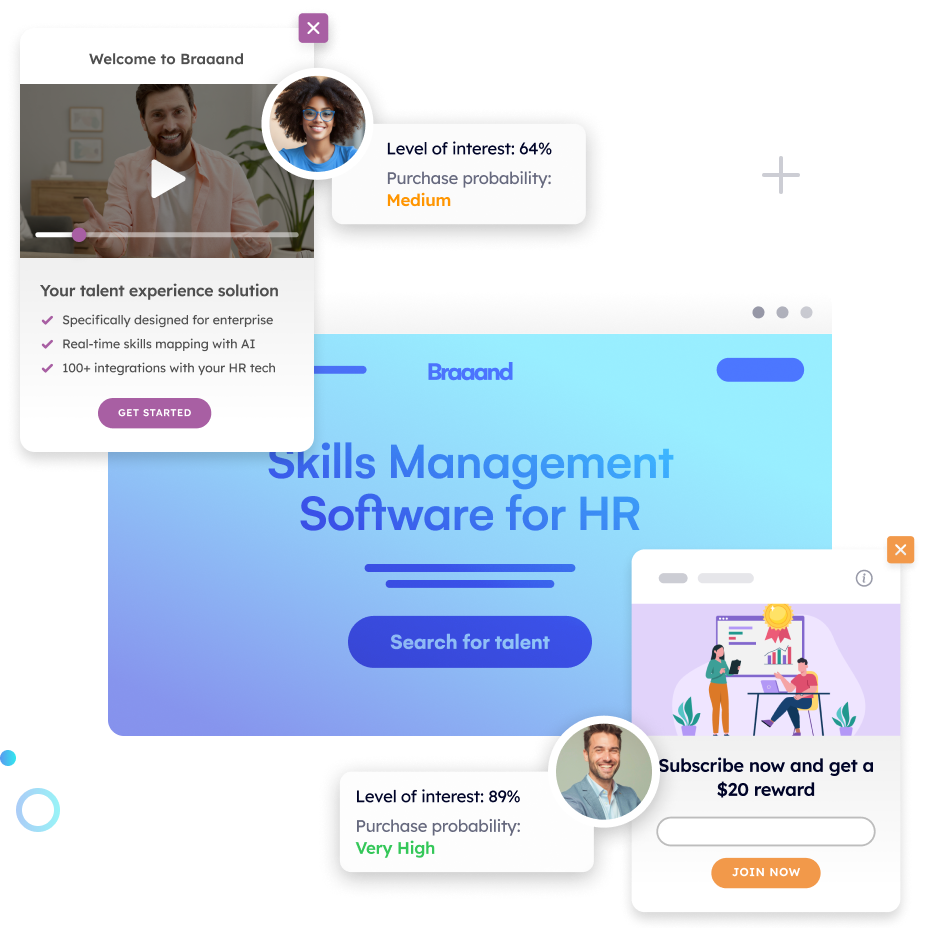
Rick: Pathmonk is the AI for website conversions. With increasing online competition, over 98% of website visitors don’t convert. The ability to successfully show your value proposition and support visitors in the buying journey separates you from the competition online. Pathmonk qualifies and converts leads on your website by figuring out where they are in the buying journey and influencing them in key decision moments with relevant micro experiences like case studies in videos, and much more.
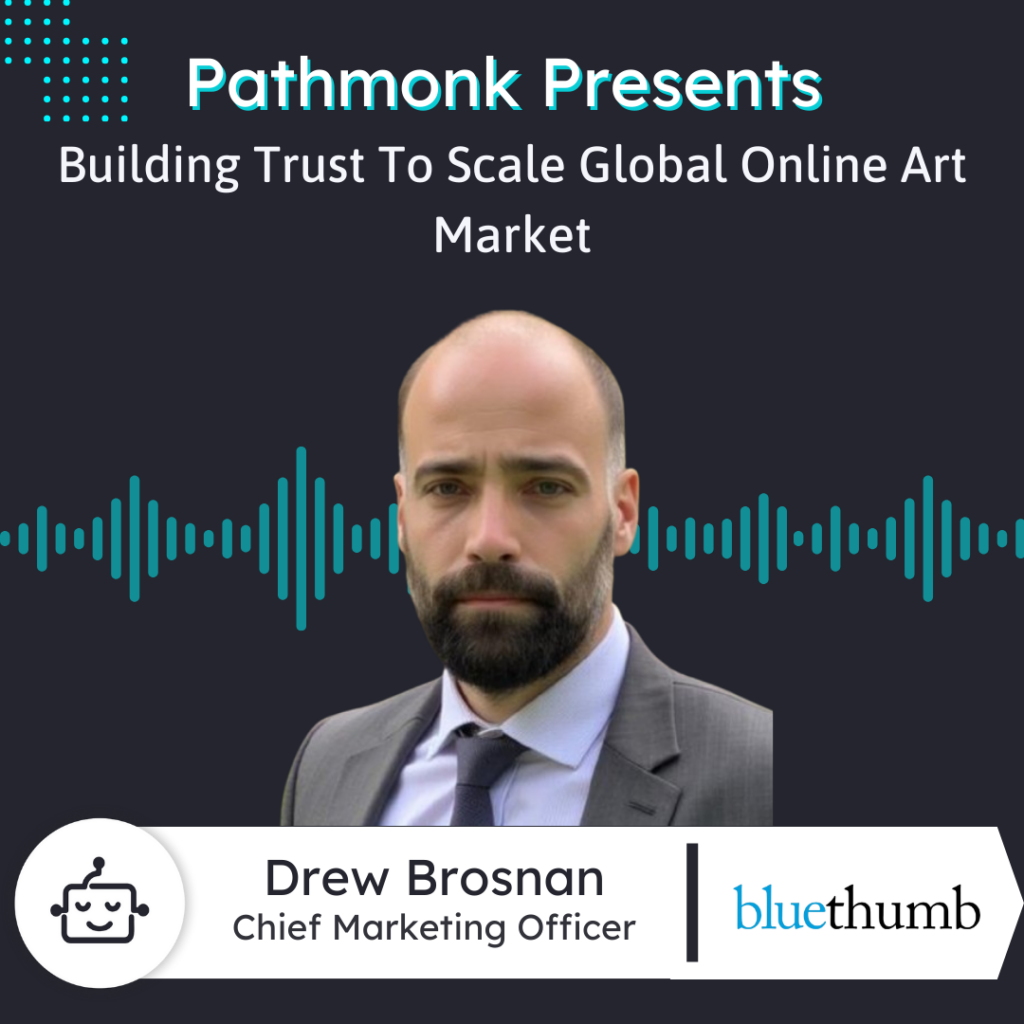
Stay relevant to your visitors and increase convergence by 50% by adding Pathmonk to your website in seconds. Letting the AI do all the work and increase convergence by 50% while you keep doing marketing as usual. Check us out on Pathmonk.com. Hey everybody. Welcome back to today’s episode of Pathmonk Presents. Today we are joined by Drew is the CMO of Bluethumb. Drew, welcome to the show. Hey, thanks for having me, Rick. Thanks for being here, drew. we’re just talking about Bluethumb and what you guys are working on shortly before hitting record, but, maybe we go back to the basics for a second, drew.
And we talk about what’s the big idea behind, Bluethumb, and if you were explaining it to a friend over coffee, how would you describe what you do?
Drew Brosnan: So we are a digital replacement for a gallery. Traditionally galleries are where you buy art that’s over a certain price point. for us it’s around a thousand dollars.
And so if you’re looking for a piece of art at that price, generally you go to the gallery, you learn stories about the artist, you learn stories and information about the context behind each piece of art and the why and the what that’s going on as far as mediums and, process. we’re the digital replacement for that.
We’re essentially an eBay. It allows physical mediums of art to be sold online. our secret is that we build up trust just like in the galleries. And so if you’re in a physical gallery, the gallery manager will come up. They’ll, teach you about, the value behind the artwork. They’ll teach you about the artist.
We’re the, digital replacement for all of that, online.
Rick: Okay. Are there any types of customers that are the best fit for your product at the moment? As you’re saying that you are like the eBay for digital art, for art, what kind of goals and needs, if you will. And we’re getting into the ICP territory here a little bit, right?
Like who buys from you and what they’re looking for really. But yeah, just curious to know who’s the best fit for your product.
Drew Brosnan: Yeah, so it’s mostly, homemakers and so women that are in their sort of, thirties to fifties are major cohorts for us. but really anybody that’s looking to do interior design.
So we do have some interior design that’s, based on, commercial and then also some trade where, folks will be, interior designing for other people.
Rick: Okay. makes a lot of sense. now again, staying on, on the more technical side of things about, your marketing strategy.
What are the most effective, customer acquisition channels that you’ve seen at the moment, and how have you optimized them to drive consistent sales?
Drew Brosnan: So that’s been evolving over the last couple years, and A few years ago, our strongest channels were based in. Product listing ads. We have over a quarter million artworks live and so it’s easy for folks to be able to search through our stuff and purchase. but more recently, we’ve had a lot more success with dynamic social, product ads, and so we.
Comping, different types of ad mediums based on our, metadata that we have about our artists, metadata we have about our products. And, we’re building composites that sort of personalize and speak directly. To those artists and those artworks, rather than spitting a large swath of just product ads that, have the default user generated content.
We’re building these personalized little ad units to try and get the grand grain of granularity down to something that’s really interesting, for the potential customer and, hopefully enlightening, right? We’re introducing them to how the company works and then getting to this granular level of, oh, you’re interested in this type of art.
Here’s some suggestions or. Oh, we see now that you’re browsing these types of artists, here’s some other artists in the same vein, and here’s some more sort of educational content about the artists that you’re interested in.
Rick: Okay. So I’m curious, how much of a role does that strategy, like for your website, let’s say, comes They come from an ad.
Right now they land on your website. How much of a role does your website play in, in real time, if you will, in pulling in new clients and Personalizing the experience, if you will, just showing them different kinds of artists that might be interested in different types of art, right? All those kind of things.
How does that work for you guys?
Drew Brosnan: Yeah, so we’re in the discovery phase of personalizing the website. We have, a personalized search result in a sense, but we don’t take a lot of the data that we have in our customer data platform and apply that on site in a way that. Exciting. And so we’ve tested a couple sort of ideas of, surfacing, content on site when certain CDP elements fire.
but we have a lot more information that’s coming out of our marketing end. Coming outta the sort of personalization on site end of our, output. And so we’re, making strides to get those ad units and stuff moved into a very personalized space. And I think we’ll have to figure out a way to, to trigger those same sort of experiments on site.
Rick: Okay. Yeah. that makes sense. and maybe, if we touch a little bit on. From your experience, what you’re seeing with, Bluethumb, but also, from, you can draw from any experience. Sure. What do you think makes a website actually convert and, drive more sales? and, on that end, maybe if there are any, tools that you can share.
people do love a, tech stack. if you have a mention or two, that’s great. If not, then we can talk about frameworks or any ways that you’ve seen. That, the website converts. It could be messaging, it could be a bunch of things, of course. But, from your experience, what actually works.
Drew Brosnan: Yeah. So from my experience, and this is coming from a, a marketing perspective, really the big deal is having your product team work well with the marketing team. And you can have, a tool that’s doing the conversion rate optimization on site Optimizely or Path Month or whatever.
And, unless you’re working tightly with. Teams in this case, product team, working tightly with the marketing team is the context I have the most experience with. those experiments don’t get placed and Obvious experiments to get the site working are pretty, easy to, to source.
but once you get through those, the rest of the experimentation is business model specific. And so to surface that sort of good discovery about what about the business model is worth experimenting with our limited bandwidth, for experimentation and, what should we do with those tests?
it’s critical that you get rituals in place so that on a quarterly basis you’re discovering with the team, where those pain points are, where they think the opportunities are. That would take just a little bit more engineering experimentation to, to really unlock scaling within these different categories.
And within marketing, almost all of the growth that is attributed to marketing is really a product marketing. Improvement like 80% of the time in my experience. And working with the product team to, feed them the pain points of the business model, not just oh, we wish we could convert more, but hey, we do things a certain way.
We aren’t able to, for example, we build a lot of dynamic, on demand content. And if the metadata that the users have provided isn’t clean, it’s really hard for us to build good ads at scale. and so we’ll build, let’s say we’re building a mood board. right now that basically builds each of our artworks into a mood board that has different dynamics based on the style of art, the color, and the side of the art and that sort of stuff.
And so the composition of the mood board will change based on the dynamic of the art. And so that’ll be sent out to Pinterest. It’ll send folks back on the landing pages on site. And so it’ll be like a, soft lead magnet for folks that are doing interior designing. For us to put the image, on the, on the ad unit, we need to know if the image is in situ, which meaning if the art is placed in a room or if it’s a, if it’s a closeup, we need to know the size of the, image since artists are allowed to upload different types of images to their UGC.
And so when we don’t have that sort of, good metadata coming in from the engineers. in this case, we can’t execute on these experiments that then move the product marketing and the whole organization forward. And so it’s really getting into that nitty gritty ugly space where.
You’re in the messy middle of, I can’t do this in my team. In this case marketing, you need to place the experiments with product. They’re already super busy. and then, on top of that, you need to evaluate the sort of effort, impact mix to even get it prioritized from the marketing team.
And so I think it’s really important to get the rituals in place with product and each team that you know, is a customer of the product, where, they could, Claim that they have pain points without having to back them up with revenue, estimates of how much it’ll make when they’re fixed every single time.
A certain amount of, product stuff just needs to be fixed for each team based on the fact that, they’re, like, okay, like my operations are hurting based on this. And so even if that’s some small chunk of the product’s overall output, say five or 10%, that’s the sort of thing that really I think starts making the whole machine run a lot faster.
So you can get, I guess just to sum all this ramble up, you can get, you can get lost in making effort impact decision prioritizations within your product marketing team, really within any team. But there should be space, let’s say 10% in your workload for just clearing out problems that seem to be just hurting operations, pain points where it’s just a little bit frustrating to do something that’s not automated.
It’s a little bit frustrating to not have a certain piece of information in the CDP about a customer, so it’s easy to activate audiences, ads, changes on website, that sort of stuff. And so a lot of times that tech debt piles up and only the really big important stuff gets moved. And so it’s important to take those little piecemeal pieces, especially the ones that hurt your team the most, and make sure they get, a little bit of the prioritization.
Rick: Yeah, that, I love that, you gave us a glimpse into, that decision metrics, that prioritization and for this specific exam example. And that’s a perfect segue actually, for, we wanna, what we want to hear about next, which is a little bit more about you Drew as a leader, right?
So you talked about your team and the product team. Can you give us an idea of, what you focus on a, day-to-day? What are the most important things? If you wanna break it down, the three most important things that you focus on. I’m sure there’s more than that, but, just to get an idea of what do you focus on and what’s your workday look like?
Drew Brosnan: Sure. Yeah. I guess the three big focuses for me, leading the marketing group are. the first is strategic clarity. I think about strategy as a tree, and so on top we have an OKR system, supported by KPIs. And so keeping that aligned with leadership really important to me.
but then to the extent that it’s a tree, that kind of leads into the second most important bit, which is agile Kanban operations. The OKRs all link in to our epic stories. OKRs generally run for us at a quarterly basis. They’re big strategic movers. these stories, they operate on more of a monthly basis, and so the tree starts to break out like normal.
calendar. aggregations and monthly we’ve got stories. And then on the weekly, daily basis we’ve got, cards that we play that connect to those stories that link up into our OKRs. And so for me, making sure that process is matured and the rituals are. Our, are continuing to hit the, sustainable work pace that we think is healthy, is really important, I think, to making the team healthy and happy and making sure that the growth is headed in the direction that leadership is, aiming for.
and then the third bit, is really structural integrity of the marketing tech stack. a lot of times, especially with product integrations, we get MVP, levels of, integration and so we’ll ask for new tool. It will get an MVP type integration, meaning that, it gets the minimum viable product fit.
and then, the hope is that later down the road it’ll get more engineering love, but a lot of times it gets dropped off in this MVP state. And Staying on top of the marketing tech stack and having clear ideas of where you’d like to be as an end state. and making sure that you have milestones to that end, helps keep everyone’s butts to the fire.
everyone’s nose stays more to the grindstone, if you will. And, and then that allows really that whole sort of three part machine to, to get off the ground.
Rick: Okay. No, thanks for sharing that. I think it’s pretty interesting, especially the last part about. adding that urgency, if you will, but also clarity on where you’re going, essentially how to do it.
if that’s not so clear, then you have to think about it. But yeah, there’s a, few moving parts in it that definitely someone has to have an idea of, how to structure that. To, stay on the topic of structure. Now, we’re going into, the back half of the podcast here, and, before we wrap things up, I would love us to jump into our, rapid fire segment.
And so we, we try to keep, things light and engaging here, drew. really there’s a few questions. nothing crazy really, but the only unspoken rule is for a concise question. we, we want a concise answer. Does that make sense? All right. So maybe let’s, let’s get started with this one. I know there’s a flaw of content out there, right?
How do you stay ahead, of things, and the, question really is do you prefer watching, reading or listening to content?
Drew Brosnan: I’m a visual learner, so I prefer watching, but I don’t think it’s the most. Efficient way of learning. Probably most of the time. I’ll run my videos at whatever the maximum speed is, like two x, 2.5 x and then put on captions because the words start to sound kind of crazy.
yeah. And yeah, I’ll try and consume videos as fast as I can, but I still don’t think that allows me to learn as quickly as reading. and to that end, for a long time I’ve used a feed aggregator. To take all of the blogs in the marketing world and, and put those into one spot where I can just keep track of them.
More recently, I now do an AI feed aggregate, and basically I take my list of feeds, the AI reads, whatever’s new for the week, and then, just summarizes a, an email of, all that. And so then I just catch up over that, email summary. and I don’t have to then spend time doing the whole, scrolling through the feed thing, unless I, wanna in some spare time.
because it’s a dirty, habit. pleasure I guess you could call it. because it’s nice to scroll through stuff, ambiently. And enjoy that. But again, not very efficient. And so getting that weekly sort of summary of all of your blogs that you’re using on AI in the email allows me quickly make sure that I’ve got those talking points ready.
Rick: All right, drew, I also have a, particular question for you about, your marketing life with tech. So if you had a magic wand and you could fix one frustrating thing in your marketing life with tech, what
Drew Brosnan: would it be?
I think I would fix my inability to perfectly personalize our offering to the customer. it’s always struggling when you can visualize how it would be best to, gain more of a customer’s trust, improve more of a customer’s ability to buy easily, frictionlessly, all that stuff. Removing all of that takes a lot of different, team partnerships, tech stack partnerships, experiential knowhow, all that stuff. And I would definitely take the magic wand and create this sort of perfect, customer market product fit. And so build this, perfect magical triangle where the product perfectly fits the customer and that perfectly fits the marketing positioning.
Wouldn’t that be sweet? Yep. I’d be out of a job.
Rick: So maybe let’s not use that magic wand for a little while and then when it comes time to retire, then you can pull it out. okay. Lastly, drew, if you could go back and give your past self a quick pep talk at the start of your, journey in this field, what advice would you drop?
Drew Brosnan: I would say. To be more aggressive about learning, but be more selective about learning well-known methodologies and be selective about learning stuff that’s gonna be safe and future facing. So I think if you learn, a couple languages that are very function specific, built into tools that you know that you’re using at a certain job.
That learning sometimes can just go right out the window when, you switch tool stacks, when you switch jobs, when you switch functions. but if you learn the prevailing, top five languages, let’s say Python in this case, you know that’s gonna serve you for a long time. It’s future facing.
Future languages will be derivative of that. and so I think it’s important to, both be really aggressive about continued learning and then be really selective about learning only the stuff that’s gonna work in the future.
Rick: Okay. That’s that’s really good one. drew, I, I wanna thank you for this last few gems that you share with us and also wanna thank you a lot for being on the show with us today.
As we wrap things up, I wanna give you the last word. If someone forgets everything about the interview today, drew, what is the one thing that it should remember about the work you guys are doing at Blue Thump?
Drew Brosnan: we’re really working to be the most trusted name in art, and so we’ll be not the biggest art marketplace as much as we’ll be the most trusted art marketplace in the world.
right now we’re the biggest, art marketplace in Australia. But that’s not really important to us. we’re working through our, product fit through our marketing, through all of our, all of our team’s efforts to build trust. And being the most trusted name and art in the world is, where we’re headed.
and it’s a really exciting path.
Rick: It sounds like it, for sure. So how can we help, where can people go to check you guys out and, see if there’s anything, maybe the interior designer, maybe for the, the art, person just like passionate about art. Where could they go to, to check out,
Drew Brosnan: what you sell?
Yeah, absolutely. you can just, search for us online@bluethumb.com au.
Rick: All right, drew, again, thank you for, being on the show with us today and, wish you a wonderful day. Awesome. Thanks so much for the time, Rick. Of course. All right. Bye everyone.