
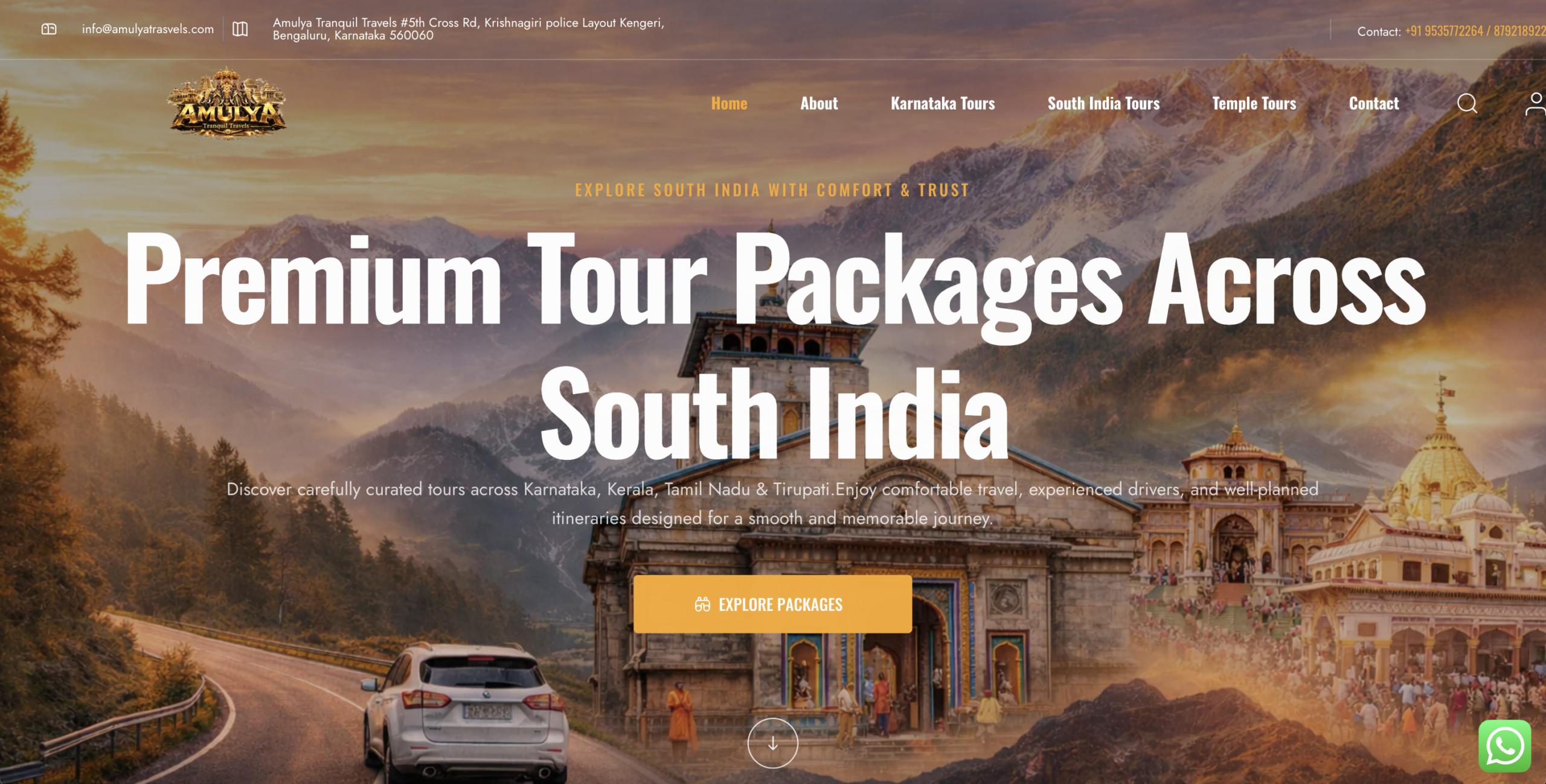
"Premium Tour Packages Across South India" communicates category membership, not competitive advantage. The subheadline anchors on operational features — comfortable travel, experienced drivers, well-planned itineraries — which every regional competitor claims identically. Travel buyers in India's crowded mid-market are choosing between dozens of operators with interchangeable promises. Without a unique mechanism — a particular expertise, an exclusive route, a differentiating service model — the hero section gives zero reason for a cold visitor to prefer this brand. The five-second test fails completely: visitors leave with no memorable differentiation anchor.
"Explore Packages" is an orientation prompt, not a conversion accelerant. For a visitor arriving with specific intent — a temple circuit, a family trip to Kerala, a corporate outing — this CTA delays the outcome they want and resets them into a discovery mode they did not need. Travel lead generation converts best when intent is captured at its hottest point: immediately in the hero, through destination-specific or intent-specific entry paths. The absence of a secondary CTA offering immediate contact or a callback request means that visitors who are ready to book now have no fast path available to them.
The contact form collects name, email, phone number, and an open message field against a minimal headline — "You're in the right place to connect with us" — with no stated response time, no commitment to what happens after submission, and no contextual reassurance about data use or follow-up quality. In travel, the emotional contract of a booking inquiry requires the prospect to share personal contact information with a brand they may not yet trust. That risk is not being offset by any value framing. The form reads as a generic WordPress contact widget dropped in without conversion intent, because structurally that is precisely what it is.
The tour page presents a vehicle and pricing table with per-seat rates by car type, but the booking form positioned alongside it collects name, email, phone, number of passengers, vehicle type, and a freeform travel plan note — without confirming the price the visitor just read applies to their selection. Travel buyers making a financial commitment require price confirmation at the point of form submission. The absence of a live price summary or a clear statement that the quoted rate applies creates cognitive uncertainty that pauses commitment. Visitors who are nearly decided abandon rather than submit into an ambiguous outcome.
The homepage presents a large grid of destination thumbnails — Mysore, Bangalore, Madikeri, Ooty, Coorg, Udupi, Uttara Karnataka, Hill Forts, Hampi, Chikmagalur — each linking through to tour pages. This architecture distributes attention across twelve simultaneous choices without priority or intent hierarchy, creating option overload for visitors who arrived with a specific need. Travel buyers at the decision stage do not need to browse; they need to find their specific journey and commit. A catalogue presentation serves discovery-stage visitors, but the homepage receives mixed-intent traffic, including paid visitors who have already qualified themselves through their search query.
The homepage features multiple traveller testimonials in a carousel format, and the statistics section cites 2K+ happy travellers, 100+ destinations, and 120+ five-star reviews. However, the visible testimonials are brief sentiment confirmations — general positive statements about comfort and service — without specificity about destinations traveled, trip types, or measurable experiences. In travel, the most persuasive social proof is outcome-specific: where the traveller went, what they experienced, and why this operator made the difference. Vague positive statements are psychologically equivalent to five-star averages: visible but not actionable for a visitor weighing a real booking decision.
The header uses "Amulya Tranquil Travels," the footer references "Amulya TravelTour & Travels," the contact page map widget displays a different third-party operator name, and the domain is "amulyatrasvels.com" with a misspelling. For first-time visitors conducting trust validation — a standard behaviour before committing contact details to a travel operator — these inconsistencies introduce doubt about the organisation's legitimacy. Professional buyers and cautious leisure travellers will notice the typographic and naming discrepancies and interpret them as signals of low operational maturity. In an industry where trust is the primary conversion barrier, brand inconsistency is a direct lead suppressor.
The product-level tour pages present a timeline-style itinerary, a vehicle pricing table, an inclusions and exclusions checklist, and a booking form — all structurally appropriate, but the descriptive text is brief and formulaic. There is minimal long-form content addressing the questions that search-intent visitors arrive with: what makes this route worth the price, what similar travellers experienced, how this differs from independent travel, what is included in driver arrangements. Tour-category pages rank best when they contain substantive destination authority content — location context, traveller considerations, seasonal guidance — layered beneath the transactional booking architecture. Current pages cannot compete for tail-end queries that represent the majority of travel search volume.
- All 21 prioritised CRO suggestions with experiment ideas
- Industry benchmarks for your category & traffic level
- Discoverability (SEO + GEO) full audit results
- A/B test hypotheses ready to implement
- Personalised session with a CRO specialist
The findings presented here are directional and indicative in nature. They do not take into account internal data such as revenue performance, customer lifetime value, traffic quality, seasonality, or proprietary testing.
Recommendations should be interpreted as optimization opportunities rather than absolute assessments. Actual impact may vary depending on audience composition, acquisition channels, and business context. This report is not exhaustive and should be used as a starting point for further analysis and experimentation.