
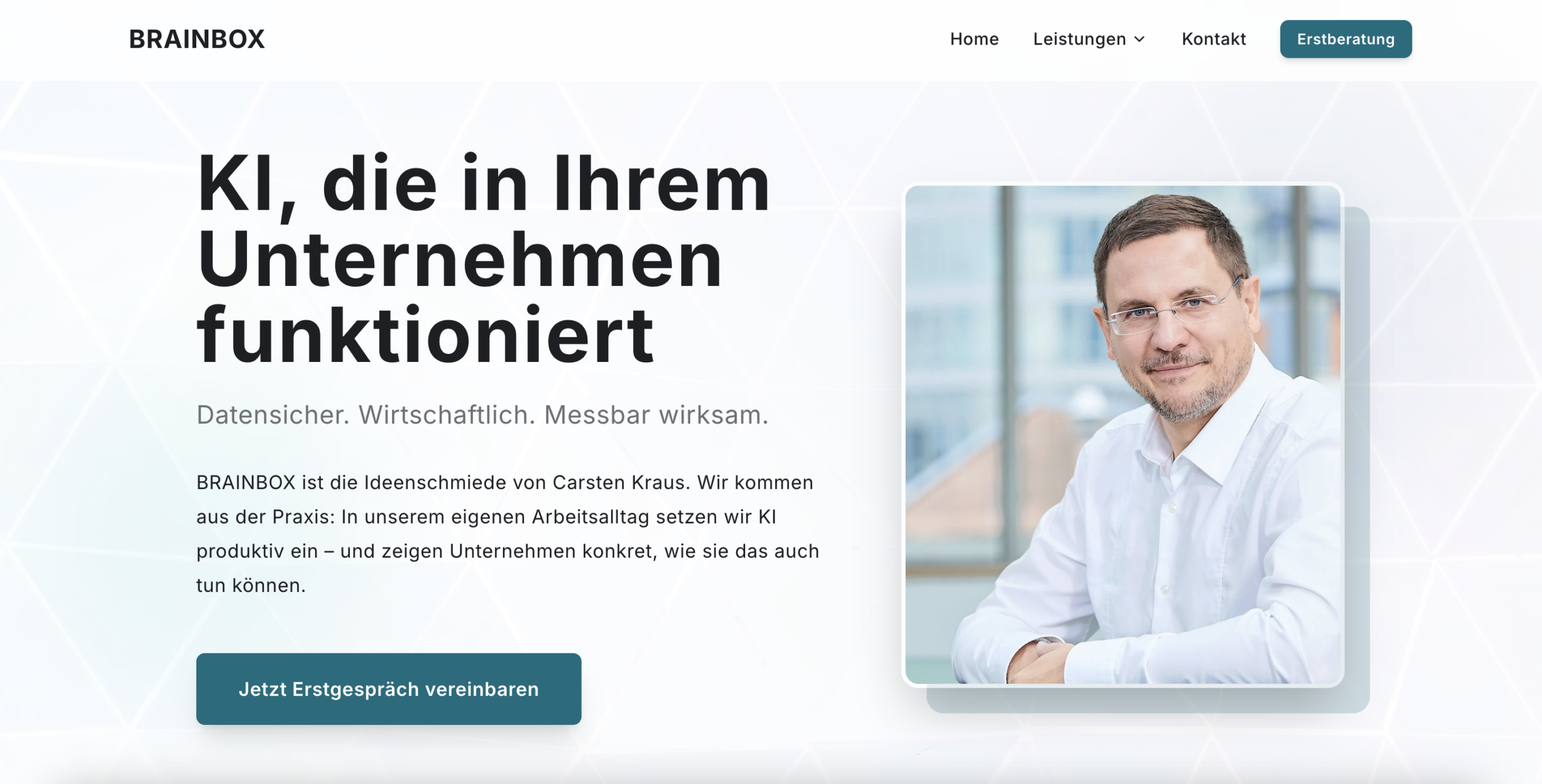
The primary navigation is clean but generic, offering no segmentation by industry, company size, or use case. In high-consideration B2B services, buyers scan for immediate confirmation that the solution is built for companies like theirs. Without that signal, relevance feels assumed rather than proven. This forces visitors to self-qualify mentally, increasing cognitive friction at the exact moment clarity should be strongest.
The site hierarchy emphasizes capabilities and technical services instead of business outcomes. Buyers evaluating AI initiatives think in terms of operational impact, efficiency gains, cost reduction, and competitive advantage. When the structure leads with what you build rather than what it achieves, visitors must translate features into value on their own. That additional cognitive step reduces clarity and slows commercial momentum during the critical persuasion window.
The site references past clients but does not prominently showcase quantified outcomes, implementation metrics, or measurable business impact. In AI consulting, credibility is established through transformation evidence such as cost reduction, efficiency gains, deployment timelines, or performance improvements. Without visible economic validation, risk perception remains elevated — especially for enterprise buyers accountable for budget allocation.
The messaging strongly emphasizes data security, compliance, infrastructure control, and reliability. While these are essential in regulated environments, they position the company as safe rather than strategically transformative. For decision-makers driving AI adoption, the primary question is not just “Is it secure?” but “Will this create measurable competitive advantage?”
The dominant call to action across the site is a direct consultation request, with no visible intermediate engagement layer such as a diagnostic, readiness assessment, or ROI preview. For complex AI initiatives, many buyers require progressive validation before committing time to a meeting. Without a lower-friction entry point, interest does not naturally convert into action.
The solution content is concise and largely feature-driven, with limited expansion into industry scenarios, operational use cases, or detailed implementation context. For high-consideration AI services, buyers often arrive through specific problem-based queries rather than brand searches. Without deeper, keyword-aligned content that addresses real-world applications and decision criteria, the site underperforms in capturing high-intent organic traffic.
There are no visible industry-specific, use-case-specific, or role-specific landing pages. In B2B AI consulting, buyers often search with modifiers such as “AI for manufacturing,” “AI for SMEs,” or “DSGVO-compliant AI system.” Without segmented entry points aligned to these intent variations, the site forces all traffic into a generalized message.
The primary conversion action across the site is a direct consultation request supported by a minimal contact form. While friction is low, there are no visible signals around who the engagement is for, what budget range is typical, what project scope is expected, or what happens after submission. For high-ticket AI consulting, clarity around qualification increases confidence and attracts more serious buyers.
- All 21 prioritised CRO suggestions with experiment ideas
- Industry benchmarks for your category & traffic level
- Discoverability (SEO + GEO) full audit results
- A/B test hypotheses ready to implement
- Personalised session with a CRO specialist
The findings presented here are directional and indicative in nature. They do not take into account internal data such as revenue performance, customer lifetime value, traffic quality, seasonality, or proprietary testing.
Recommendations should be interpreted as optimization opportunities rather than absolute assessments. Actual impact may vary depending on audience composition, acquisition channels, and business context. This report is not exhaustive and should be used as a starting point for further analysis and experimentation.