Bulkdoor
https://www.bulkdoor.in/
Conversion Rate Optimization audit summary
Last audit performed on Feb 03, 2026
Analyzed version 1.0
CRO index
Conversion & growth
20%
based on 67 total criteria
Analytics & tracking
52%
based on 43 total criteria
UX & engagement
8%
based on 34 total criteria
Discoverability (SEO + GEO)
Unavailable for non customers
We have 21 CRO suggestions for you
Unlock all with a personalized session with our team
Improvement suggestions
1. Low-quality hero banners undermine credibility
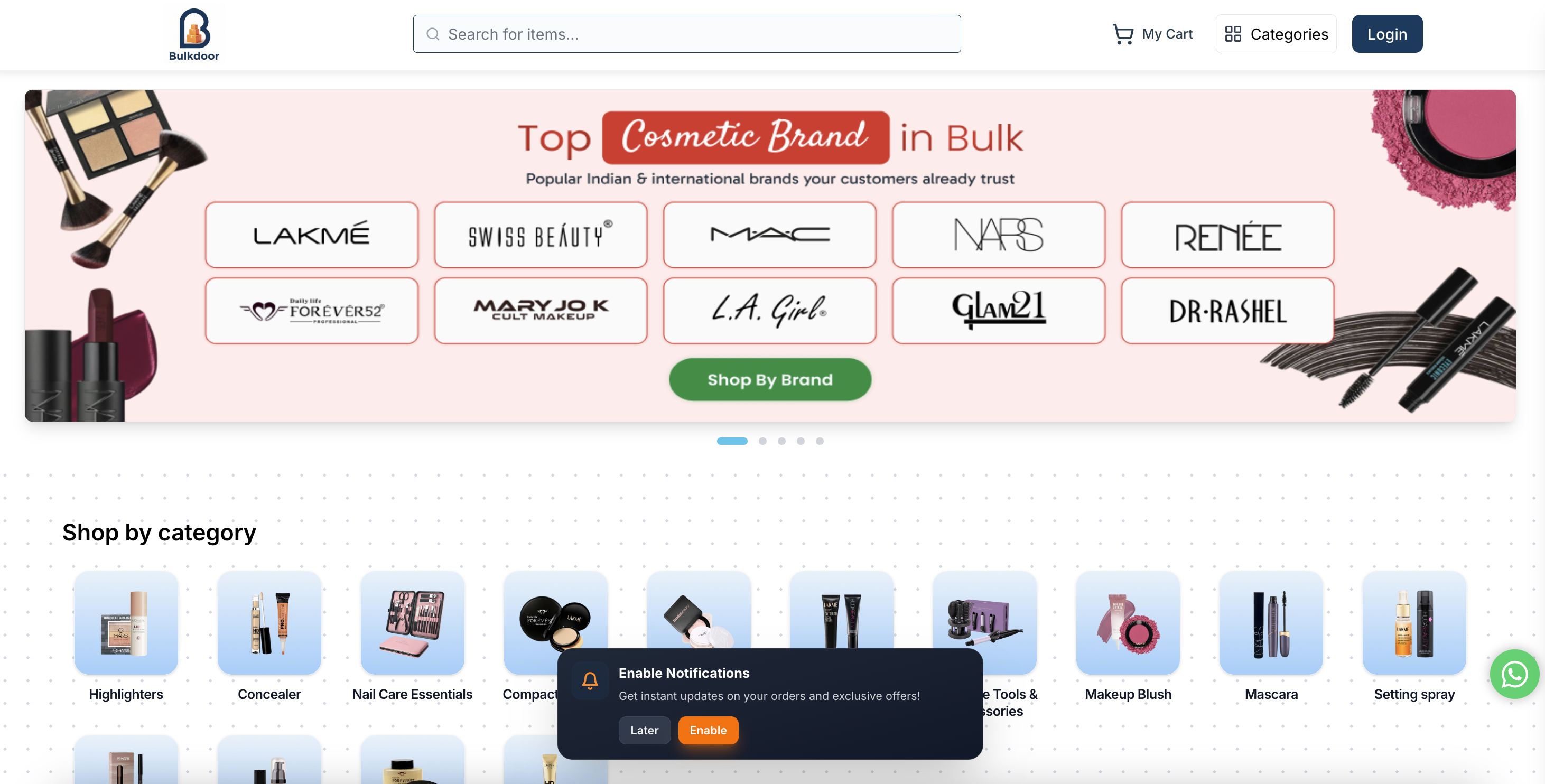
CriticalThe hero banners are visually low quality and feel stretched, cluttered, and inconsistent with a professional B2B platform. Text overlays compete with background images, reducing legibility and making the message hard to absorb at a glance.
For a B2B marketplace, the hero should establish trust and clarity immediately. Improving image quality, simplifying visuals, and prioritizing clear messaging would significantly improve perceived professionalism and credibility.
2. Notification permission overlay disrupts core browsing
CriticalThe “Enable notifications” overlay appears during product exploration and interrupts the primary task: evaluating products. This is especially disruptive on a B2B site, where users are often comparing items carefully.
Permission requests should be delayed until clear engagement signals are present, or removed entirely from early browsing to avoid unnecessary friction.
3. Product cards missing images
CriticalSome product cards appear without images, creating an incomplete and unprofessional experience. In a marketplace context, missing images immediately raise concerns about product quality and reliability.
Ensuring that all products have consistent, high-quality imagery is essential to maintain trust and reduce hesitation.
4. Infinite scrolling prevents access to critical information
CriticalThe product listing relies on infinite scrolling, continuously loading new products without a natural stopping point. As a result, users are unable to reach the footer, where essential information such as contact details, policies, company background, and trust signals are located. This effectively hides critical links for B2B visitors like the contact form.
Buyers often scroll specifically to the footer to validate legitimacy, understand terms, or find contact options before initiating a conversation. Introducing pagination, a clear “load more” interaction, or a defined break in the product feed would restore access to these elements and remove a major conversion blocker.
5. B2B enquiry paths are hidden and hard to access
HighIn line with the above, despite positioning as a wholesale marketplace, the site provides no clear or prominent path for enquiries. The only available option is a generic “Contact Us” link located in the footer, which is already difficult to reach due to infinite scrolling behavior. This forces high-intent buyers to actively hunt for a way to get in touch.
Buyers expect clear CTAs such as “Request bulk pricing,” “Talk to sales,” or “Get a wholesale quote,” ideally visible in the header or hero section. Making the enquiry flow easy to find would significantly reduce friction and align the experience with B2B buying behavior.
6. Homepage overwhelms users with volume instead of guidance
HighThe homepage immediately floods users with products, offers, brands, and categories without explaining where to start or what matters most.
Clear entry points such as “Top bulk sellers,” “Most ordered by retailers,” or “Start your bulk order here” would dramatically improve clarity.
7. No visible customer testimonials or business proof
HighThe site does not surface any customer testimonials, case examples, or proof from existing buyers. For a wholesale marketplace, this is a major trust gap. Buyers are being asked to place bulk orders without seeing evidence that other retailers, salons, or resellers have successfully done the same.
Displaying testimonials, logos of existing customers, short quotes from buyers, or simple metrics (e.g. number of businesses served, repeat buyers, order volume) would significantly increase trust and reduce perceived risk before initiating contact or placing large orders.
8. No intent-based guidance throughout the experience
HighThe site does not adapt or guide users based on their intent. All visitors are presented with the same experience, whether they are casually browsing, comparing suppliers, or actively looking to place a bulk order. This forces users to self-navigate a large and complex catalog without support.
Introducing intent-based guidance, preferably automated, would reduce friction, shorten decision time, and help serious buyers reach the right next step faster instead of getting lost in product overload.
Want to unlock the full CRO report?
Get access to all recommendations, benchmarks, and experiment ideas.
Unlock full accessAdapt calls-to-action based on user readiness
CriticalAll visitors are presented with the same primary CTA regardless of engagement level.
Guide undecided users with progressive interactions
HighUsers showing exploration behavior are not guided toward soft commitment actions.
Reduce friction at high-intent conversion points
CriticalHigh-intent visitors face the same experience as early-stage users.
Important note
This audit is based on an automated and heuristic-based analysis of publicly accessible pages. The evaluation follows industry best practices across conversion rate optimization (CRO), usability, analytics, and discoverability.
The findings presented here are directional and indicative in nature. They do not take into account internal data such as revenue performance, customer lifetime value, traffic quality, seasonality, or proprietary tooling.
Recommendations should be interpreted as optimization opportunities rather than absolute assessments. Actual impact may vary depending on audience composition, acquisition channels, and business context.
This report is not exhaustive and should be used as a starting point for further analysis and experimentation.