
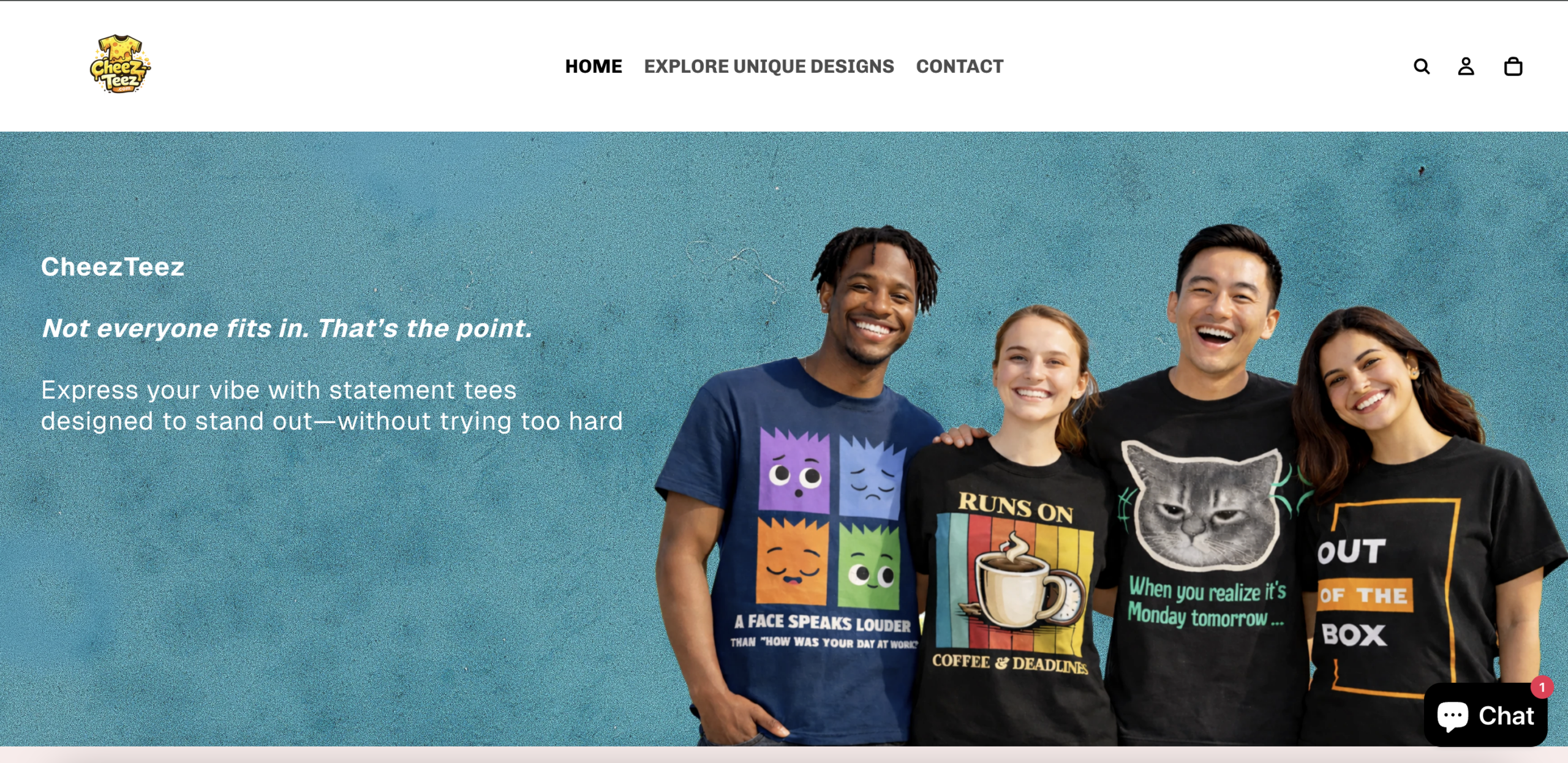
The hero presents the brand tagline and lifestyle photography but contains no clickable call-to-action button. Visitors arriving with purchase intent, particularly from paid social, are given no immediate directive to progress toward product discovery. In graphic apparel, where purchase decisions are made on impulse and emotional resonance, the 5-second window demands a clear action. A hero without a CTA forces every visitor to self-navigate, dramatically increasing bounce among low-patience paid traffic and wasting the attention that ad spend purchased.
The FAQ prominently includes "Are any purchases final sale?", strongly signaling that returns are not universally available. For an unrecognized apparel brand with no customer reviews and no visible size guide, a final-sale condition is one of the most severe purchase blockers a storefront can impose. Behavioral research on apparel e-commerce consistently shows that return flexibility can lift first-time buyer conversion by 20 to 30 percent. Without risk reversal, the brand demands full commitment from visitors who have zero prior experience with the product, the fit, or the fabric.
The site applies a single, identical experience to every visitor regardless of traffic source, browsing behavior, or purchase stage. A shopper arriving from a paid social ad who has viewed three products and hesitated receives the exact same storefront as someone landing cold on the homepage for the first time. There is no mechanism to surface recently viewed items, guide undecided browsers toward a quiz or curated collection, or adapt messaging based on session depth. In a catalog driven by impulse and identity resonance, the gap between a visitor who has found their design and one who is still browsing is enormous, and the site makes no attempt to close it.
The product page explicitly states "Be the first to write a review," confirming that no reviews exist anywhere on the site. In graphic apparel, reviews serve two functions beyond generic trust: they validate fit accuracy, including sizing, shrinkage, and fabric weight, and they affirm the humor or cultural resonance of each design. Without this layer, buyers are asked to trust an unknown brand on both product quality and design relevance simultaneously, which is a compounded risk that systematically suppresses first-purchase rates on cold traffic.
The homepage features a marquee reading "LIMITED DROPS • EXTRA SAVINGS AT CHECKOUT," which serves as the site's sole urgency mechanism. Neither element is product-specific: a "limited drops" claim without a drop date, quantity indicator, or countdown timer reads as boilerplate rather than genuine scarcity. Similarly, "extra savings at checkout" creates curiosity while generating uncertainty about the actual discount, which can paradoxically delay the add-to-cart action as visitors wait to discover the offer rather than acting on the current price. Specificity is the conversion multiplier in scarcity-based mechanics.
Product pages display color and size selectors but include no size guide link, no fit description, and no model measurement reference. For graphic apparel, size selection friction is among the highest abandonment causes because buyers cannot physically inspect the product before committing. The absence of guidance forces a guess, particularly among international visitors unfamiliar with the brand's sizing conventions. Shoppers uncertain of their size either abandon outright, select conservatively and receive a dissatisfying fit, or add to cart intending to return — which is not a viable option under a restrictive return policy.
The primary navigation offers only three items: Home, Explore Unique Designs, and Contact. There are no category pathways for humor style, occasion, audience segment, or design theme. For a graphic apparel brand selling across multiple design concepts, the inability to filter or browse by theme forces every visitor into a single undifferentiated product grid. Impulse purchases in this category are driven by immediate design resonance; when discovery requires manual browsing through an unsegmented grid, match probability per session drops and average pages-per-session decline alongside it.
Product pages contain minimal text beyond the title and a variant selector. There are no product descriptions, no design concept explanation, no fabric or care information, and no keyword-relevant copy of any kind. For graphic apparel, long-tail organic search represents a significant low-cost acquisition channel, covering queries based on design theme, humor style, occasion, and recipient. Without relevant copy on each product page, the site is structurally invisible to transactional search queries and is entirely dependent on paid channels for cold audience acquisition, which structurally inflates customer acquisition cost with no organic offset.
- All 21 prioritised CRO suggestions with experiment ideas
- Industry benchmarks for your category & traffic level
- Discoverability (SEO + GEO) full audit results
- A/B test hypotheses ready to implement
- Personalised session with a CRO specialist
The findings presented here are directional and indicative in nature. They do not take into account internal data such as revenue performance, customer lifetime value, traffic quality, seasonality, or proprietary testing.
Recommendations should be interpreted as optimization opportunities rather than absolute assessments. Actual impact may vary depending on audience composition, acquisition channels, and business context. This report is not exhaustive and should be used as a starting point for further analysis and experimentation.