
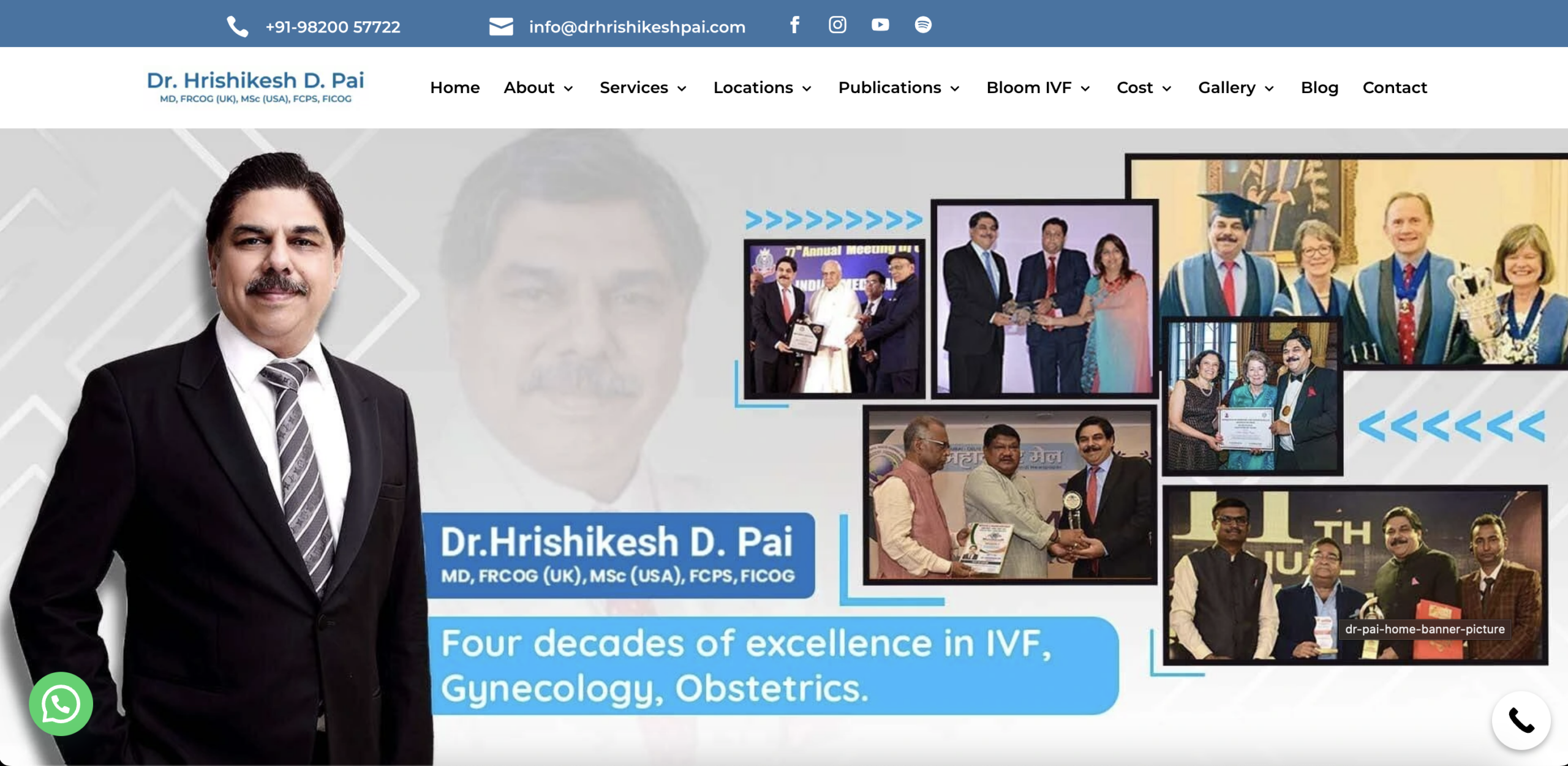
The hero headline — "Four decades of excellence in IVF, Gynecology, Obstetrics" — is a practitioner's professional statement, not a patient promise. Visitors arriving at this site are predominantly couples in emotional distress navigating a high-stakes, high-cost, and high-uncertainty decision. Within five seconds they are not asking "is this doctor credentialed?" They are asking "can this doctor help me have a child?" The primary visual real estate is filled with award ceremony photography alongside the physician: peer recognition imagery that validates professional standing among colleagues but provides no emotional resolution for anxious prospective patients. This creates an immediate identity disconnect: the site speaks to the practitioner's world, not the visitor's.
Clinical pregnancy rate per cycle and live birth rate are the single most influential purchase decision factors in the IVF category. Prospective patients research these metrics obsessively and compare providers on this basis before making contact. The hero section, homepage, and primary solutions page contain no visible success rate figure. What appears instead are credential lists, media appearances, academic publications, and procedure explanations. A practitioner with four decades of clinical experience almost certainly has a compelling success rate story to tell. Its complete absence from conversion surfaces creates a gap that competitors who publish their data will exploit directly: visitors who need this number will find it elsewhere.
The booking form appears as a modal overlay triggered at multiple scroll depths, requiring full name, email, phone, treatment selection, location selection, and a free-text message, before any value exchange or assurance has occurred. There is no stated response time, no description of what happens after submission, no commitment promise regarding how the enquiry will be handled, and no medical privacy reassurance — a factor that carries disproportionate weight in healthcare contexts. Patients disclosing a fertility struggle are emotionally exposed. Any friction that suggests their information will be mishandled or the experience will be impersonal increases abandonment significantly. The form is demanding vulnerability before offering safety.
Scrolling past the hero, the homepage sequentially surfaces: a BBC World Service interview reference, a FIGO World Congress lecture mention, an AI product announcement, event listings, a media coverage section, and publication links — all before the visitor has encountered a complete picture of what a consultation involves, what treatments are available for their specific situation, or what outcomes patients can expect. This is the content architecture of an academic press room, not a patient acquisition funnel. High-intent visitors in the consideration phase — often comparing providers and seeking a reason to choose — need treatment clarity, outcome proof, and a clear path to contact. They are not visiting to review a professional timeline.
The site presents at least six concurrent contact mechanisms in active viewport: a phone number in the top bar, an email address in the top bar, a floating WhatsApp button, a vertical "Book An Appointment" sidebar tab, a dedicated contact page form, and a modal form triggered repeatedly at scroll depth. There is no visual or strategic hierarchy establishing which channel is primary or preferred. In conversion psychology, parallel equal-weight options reduce total contact attempts by inducing channel selection anxiety: the visitor is now deciding how to contact rather than whether to contact. Each channel was added with good intent, and each one collectively reduces the conversion efficiency of all others.
The primary navigation contains ten top-level items — Home, About, Services, Locations, Publications, Bloom IVF, Cost, Gallery, Blog, Contact — several with multi-level dropdowns. For a patient arriving with a specific intent, whether to explore IVF options, understand costs, or contact the clinic, this structure forces a scanning and categorisation decision before any forward movement is possible. Publications, Gallery, and the sub-brand section in particular serve an audience that is not the primary converting segment. Every navigation item that does not lead toward a conversion path is cognitive overhead imposed on visitors at the precise moment they most need the site to feel simple and trustworthy rather than encyclopaedic.
The homepage and solutions pages feature Google Reviews, awards, media coverage, and an extensive credential list. The visible testimonials are brief and confirm satisfaction but provide no measurable outcome data. There are no case narratives structured around patient profile (diagnosis, prior failed cycles, specific challenge), treatment approach, and result (live birth, pregnancy after prolonged difficulty). In the IVF category, this outcome-narrative format is the most effective conversion accelerant because it allows prospective patients to pattern-match their own situation to a validated result: "someone with my diagnosis, at my age, after my number of failed attempts, succeeded here." The current proof architecture validates the doctor; it does not validate the patient's chances.
The Mumbai-focused service page targets commercial queries centred on expertise and local authority, supported by a long-form structure listing procedures, credentials, and clinic locations. However, the page buries clinical differentiators behind credential enumerations and does not appear to target the long-tail patient queries that drive high-intent organic traffic in this category: cost comparisons, age-specific success probability, comparative outcomes for repeated treatment failure, or protocol explanations at the level of detail patients research during consideration. High-value local medical queries are intensely competitive, and ranking for them requires not just keyword presence but topical depth, review schema integration, and FAQ content that maps directly to the queries patients type at 11pm on their third research session.
- All 21 prioritised CRO suggestions with experiment ideas
- Industry benchmarks for your category & traffic level
- Discoverability (SEO + GEO) full audit results
- A/B test hypotheses ready to implement
- Personalised session with a CRO specialist
The findings presented here are directional and indicative in nature. They do not take into account internal data such as revenue performance, patient lifetime value, traffic quality, seasonality, or proprietary testing.
Recommendations should be interpreted as optimization opportunities rather than absolute assessments. Actual impact may vary depending on audience composition, acquisition channels, and business context. This report is not exhaustive and should be used as a starting point for further analysis and experimentation.