Ecom North | Singapore Summit 2026
https://ecomnorth.com/pages/singapore-summit-2026
Conversion Rate Optimization audit summary
Last audit performed on Feb 25, 2026
Analyzed version 1.0
CRO index
Conversion & growth
56%
based on 67 total criteria
Analytics & tracking
70%
based on 43 total criteria
UX & engagement
48%
based on 34 total criteria
Discoverability (SEO + GEO)
Unavailable for non customers
We have 21 CRO suggestions for you
Unlock all with a personalized session with our team
Improvement suggestions
1. No explicit ICP definition or problem alignment in the hero
CriticalThe hero communicates scale and status (“APAC’s #1 ecommerce conference”, “Singapore Summit: Uncharted, Unstoppable”) but does not define who this is specifically for or what strategic problem it solves. There is no clear role targeting (founders, CMOs, DTC operators, marketplace sellers, enterprise ecommerce leaders). In B2B event marketing, clarity of audience fit within 5 seconds is the single biggest predictor of conversion. When the visitor cannot self-identify immediately, cognitive friction increases and intent weakens.
This creates pipeline leakage by attracting broad, curiosity-driven traffic while failing to trigger urgency in high-value segments. Senior decision-makers do not see explicit relevance to their current business challenges, which reduces pass purchases from premium segments and increases lower-quality attendee mix. That impacts sponsor value, long-term brand equity, and future ticket price elasticity.
2. Outcome ambiguity: No concrete transformation promise e
CriticalThe messaging emphasizes scale (“#1”, “1000+”, “200+”, “6”, “1000+”) and energy but does not articulate a tangible transformation. What does attending change? Revenue growth? Customer acquisition efficiency? Cross-border expansion? AI adoption? Operational scaling? Without a clear before-and-after state, the buyer must infer value. In high-consideration purchases like conferences, especially for senior operators, outcome clarity drives decision velocity.
This weakens conversion because budget holders need ROI narratives. If the page does not equip them with one, they either delay the decision or deprioritize the event. That slows ticket sales, increases reliance on early-bird discounting, and reduces the likelihood of enterprise group purchases.
3. Discount-led urgency instead of value-led urgency
Critical“Buy early, save more” and the countdown timer anchor urgency around price, not strategic opportunity. Price-based urgency is effective for consumer impulse purchases but less effective for B2B decision-makers evaluating allocation of time and budget. When urgency is framed around discount expiration rather than access to rare insight, exclusive networking, or competitive advantage, perceived value positioning erodes.
This can compress perceived brand positioning and attract more price-sensitive attendees rather than high-value operators. Over time, that affects attendee quality, sponsor ROI, and the event’s ability to increase ticket pricing without resistance.
4. Multiple competing CTAs without funnel clarity
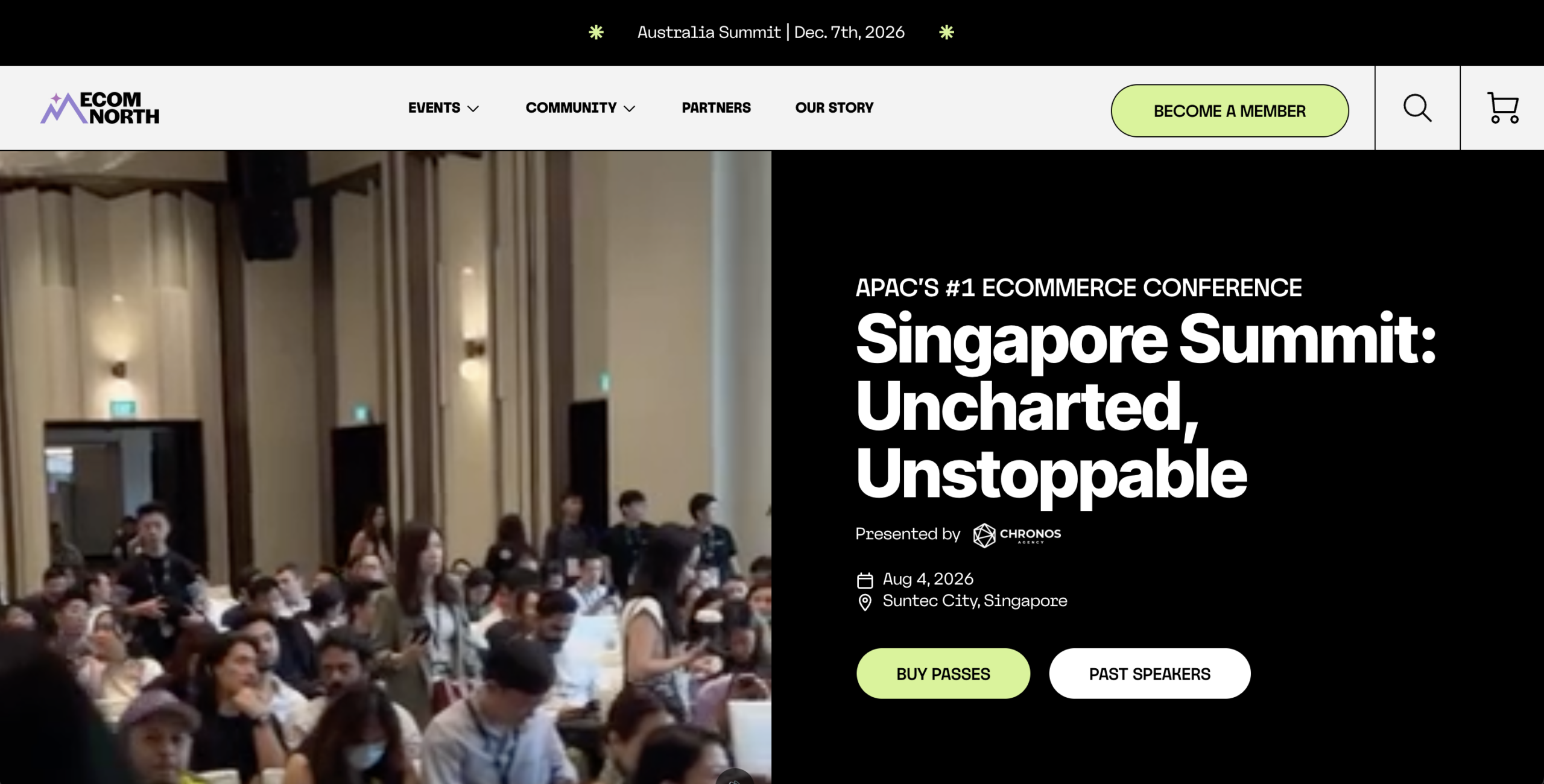
CriticalIn the hero alone, there are “Buy Passes,” “Past Speakers,” and “Become a Member.” On the homepage, there are also summit navigation options and global expansion links. For cold traffic, especially from paid acquisition, the primary conversion path must be singular and obvious. Competing CTAs diffuse intent and increase cognitive branching.
This creates measurable drop-off as visitors explore instead of committing. “Past Speakers” in particular diverts users away from the transaction moment into informational browsing. That increases session depth but reduces immediate purchase velocity, increasing cost per acquisition and delaying revenue recognition.
5. Narrative sequencing prioritizes scale before strategic relevance
HighThe persuasion order moves from hero → discount → merch → why attend → numbers → experiences → speakers → sponsors → global expansion. The structure emphasizes brand footprint and momentum before clearly articulating strategic content themes or tactical value. For cold traffic, persuasion should move from relevance → problem → solution → proof → scale.
By front-loading scale and merchandising elements (“Get pumped” visuals, merch), the page risks signaling lifestyle over substance. That can reduce conversion among operators seeking high-density insight rather than event culture. It slows down buyer progression from curiosity to commitment.
6. Primary revenue CTA (“Buy Passes”) is non-functional in the hero
HighThe hero section contains the primary monetization trigger: “Buy Passes.” If this button does not work, the most commercially important interaction on the page is broken at the exact moment of peak intent. In funnel psychology, the hero CTA captures impulse commitment before doubt, comparison, or distraction sets in. Any friction or failure at this point destroys momentum and shifts the visitor from decisive mode to skeptical mode. Even a single failed click introduces uncertainty about operational reliability and trustworthiness.
This creates direct revenue leakage. High-intent visitors arriving from paid search, retargeting, or direct traffic will attempt to convert immediately. If the action fails, a large percentage will not retry or navigate manually. Instead, they exit. This increases paid acquisition waste, inflates cost per acquisition, reduces ticket velocity, and damages perceived credibility.
7. Authority signaling without semantic depth for high-consideration queries
HighThe homepage emphasizes scale (numbers, sponsors, speakers) but does not visibly demonstrate topical depth around ecommerce themes (AI in ecommerce, cross-border scaling, retention strategies, marketplace growth, etc.). Search engines reward semantic authority and content depth for high-intent event queries. Without agenda previews, content themes, or structured topic clusters on the homepage, the page signals brand energy rather than subject-matter authority.
This reduces the site’s ability to rank for long-tail commercial queries like “AI ecommerce conference Asia,” “ecommerce growth summit Singapore,” or “retention marketing conference APAC.” Over time, this constrains organic pipeline growth and weakens the event’s ability to attract qualified, strategy-driven operators through search rather than paid promotion.
8. Above-the-fold information density competes with itself
HighThe hero area combines a large moving event image, a bold multi-line headline, presenter logo, date/location details, two CTAs, top navigation, a promotional announcement bar (“Australia Summit | Dec. 7th, 2026”), and utility icons (search/cart). This creates multiple visual anchors fighting for attention within the first 5–8 seconds. From a UX cognition standpoint, when too many elements demand scanning at once, users default to skimming rather than processing. That weakens message absorption and slows comprehension of what action to take.
The business consequence is reduced decisiveness. Instead of quickly understanding the value and committing, visitors spend their early seconds orienting themselves. That increases bounce probability for cold paid traffic and reduces immediate ticket purchases from high-intent users. In conversion environments, clarity speed directly correlates with revenue velocity. Here, cognitive noise slows it down.
Want to unlock the full CRO report?
Get access to all recommendations, benchmarks, and experiment ideas.
Unlock full accessAdapt calls-to-action based on user readiness
CriticalAll visitors are presented with the same primary CTA regardless of engagement level.
Guide undecided users with progressive interactions
HighUsers showing exploration behavior are not guided toward soft commitment actions.
Reduce friction at high-intent conversion points
CriticalHigh-intent visitors face the same experience as early-stage users.
Important note
This audit is based on an automated and heuristic-based analysis of publicly accessible pages. The evaluation follows industry best practices across conversion rate optimization (CRO), usability, analytics, and discoverability.
The findings presented here are directional and indicative in nature. They do not take into account internal data such as revenue performance, customer lifetime value, traffic quality, seasonality, or proprietary tooling.
Recommendations should be interpreted as optimization opportunities rather than absolute assessments. Actual impact may vary depending on audience composition, acquisition channels, and business context.
This report is not exhaustive and should be used as a starting point for further analysis and experimentation.