Fluorescent Gallery
https://www.fluorescentgallery.com/
Conversion Rate Optimization audit summary
Last audit performed on Feb 18, 2026
Analyzed version 1.0
CRO index
Conversion & growth
34%
based on 67 total criteria
Analytics & tracking
58%
based on 43 total criteria
UX & engagement
15%
based on 34 total criteria
Discoverability (SEO + GEO)
Unavailable for non customers
We have 21 CRO suggestions for you
Unlock all with a personalized session with our team
Improvement suggestions
1. High-consideration product sold with low-consideration architecture
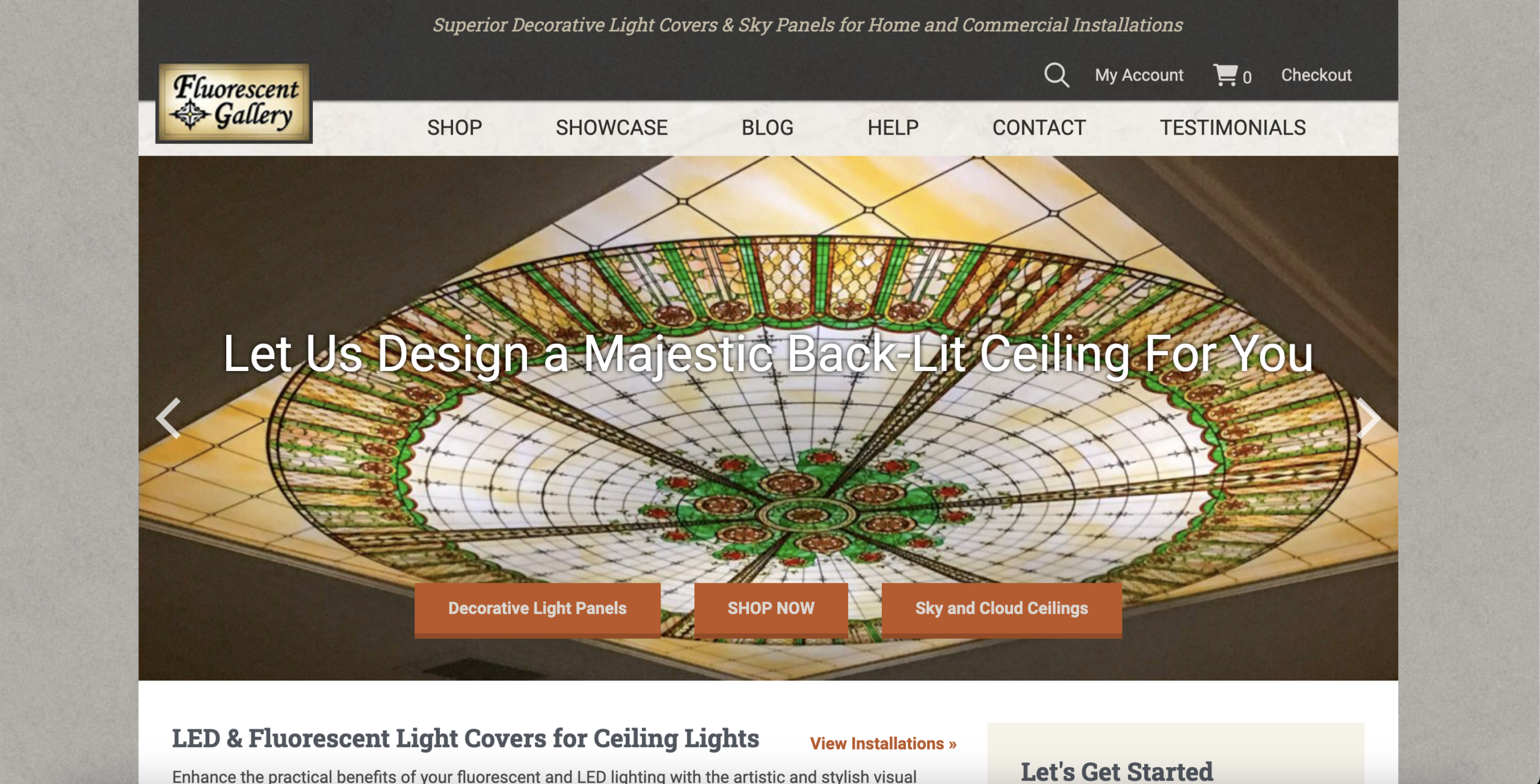
CriticalThe hero message “Let Us Design a Majestic Back-Lit Ceiling For You” positions the brand as design-led and potentially custom. However, the product page presents a relatively simple “Add to Cart” structure with dropdowns and pricing ranges ($63–$84). There is a mismatch between perceived installation complexity and transactional simplicity.
For commercial lighting and architectural ceiling installations, buyers expect specification depth, technical validation, and project-level reassurance. When the purchase architecture resembles a commodity SKU checkout rather than a guided specification experience, it creates subconscious doubt about expertise and reliability. That misalignment suppresses trust formation and may limit larger commercial orders.
2. Weak 5-second clarity for mixed B2B and B2C audience
CriticalThe homepage headline emphasizes design aesthetics, but it is not immediately clear whether the primary buyer is a homeowner, contractor, architect, or facility manager. Navigation includes “Shop,” “Showcase,” “Blog,” and “Testimonials,” but does not clearly segment use cases (Residential vs Commercial vs Hospitality).
Mixed-intent traffic requires rapid self-identification. Without explicit audience segmentation, visitors must mentally filter whether the offering applies to them. That cognitive effort reduces engagement probability. For commercial buyers especially, lack of role-specific clarity can reduce perceived relevance and increase bounce risk.
3. Trust architecture is thin for installation-dependent products
CriticalThis category involves structural ceiling modifications, lighting integration, and potentially commercial compliance. However, the homepage and product page show limited visible trust density: no visible certifications, no warranty framing, no installation guarantees, no safety compliance badges.
In installation-driven categories, buyers evaluate risk heavily. If structural compatibility, durability, fire rating, or material quality are not clearly reinforced, hesitation increases. This particularly affects commercial decision-makers who are risk-sensitive and may require documentation before committing.
4. Layout prioritizes category browsing over decision making
CriticalThe homepage transitions quickly into multiple large category tiles such as “Commercial Lighting,” “Sky Ceiling Murals,” and “High Resolution Wall Murals”. While this supports exploration, it does not clearly escalate toward a primary revenue objective.
When a layout distributes equal visual weight across many categories without reinforcing a dominant offer or high-margin pathway, momentum flattens. Visitors browse rather than commit. The absence of progressive persuasion toward a single high-value action weakens conversion acceleration.
5. Product page lacks technical depth relative to purchase complexity
HighOn the product page, visible content includes a brief description, panel brightness indicator, size options, and material dropdown. However, there is limited visible technical specification density (e.g., material thickness, durability rating, installation compatibility, lighting type compatibility).
For ceiling and lighting installations, buyers require specification clarity. Insufficient technical reinforcement increases perceived risk and encourages off-site research. That increases drop-off probability and reduces checkout completion rates.
6. Visual hierarchy does not emphasize commercial credibility
HighThe hero image showcases a decorative ceiling installation, but the surrounding layout includes standard ecommerce navigation and general-purpose buttons. There is limited visible emphasis on large-scale installations, enterprise projects, or institutional case studies in the primary fold.
For a category serving commercial installations, credibility signaling must be dominant. Without visual prioritization of large projects or proof-of-scale installations, enterprise buyers may perceive the brand as residential-first or small-scale, limiting high-ticket opportunity capture.
7. AOV expansion opportunities are underutilized
HighThe product page focuses on single-item selection with optional size and material adjustments. There is no visible structured bundling, installation kits, accessory recommendations, or project-based grouping in the screenshot. The buying experience is SKU-centric rather than project-centric, despite this being a category that often involves multi-panel ceiling coverage or coordinated installation components.
Installation-driven purchases frequently require multiple panels, lighting compatibility components, mounting considerations, or aesthetic matching across a space. When the interface does not visually or structurally encourage project-level thinking, buyers default to single-unit evaluation. This suppresses average order value and limits the capture of larger commercial or multi-room residential opportunities. The experience supports transaction execution but does not actively elevate basket size or frame purchases as scalable design projects.
8. SEO content depth appears thin for a technical category
HighVisible homepage content includes general descriptions of LED and fluorescent covers, but there is limited evidence of deep, keyword-optimized, intent-driven technical content. The product page copy is concise and visually light, with minimal specification expansion, use-case explanation, or search-aligned descriptive language.
For installation-driven and commercial lighting categories, long-tail SEO queries such as “custom fluorescent light diffuser panels,” “LED ceiling replacement covers,” and “commercial backlit ceiling panels” represent high-intent traffic. Thin content reduces semantic authority and weakens the site’s ability to rank for specification-heavy or solution-driven searches. Beyond traffic acquisition, shallow technical content also limits buyer confidence at the consideration stage, particularly for commercial decision-makers who require detailed information before committing to structural modifications.
Want to unlock the full CRO report?
Get access to all recommendations, benchmarks, and experiment ideas.
Unlock full accessAdapt calls-to-action based on user readiness
CriticalAll visitors are presented with the same primary CTA regardless of engagement level.
Guide undecided users with progressive interactions
HighUsers showing exploration behavior are not guided toward soft commitment actions.
Reduce friction at high-intent conversion points
CriticalHigh-intent visitors face the same experience as early-stage users.
Important note
This audit is based on an automated and heuristic-based analysis of publicly accessible pages. The evaluation follows industry best practices across conversion rate optimization (CRO), usability, analytics, and discoverability.
The findings presented here are directional and indicative in nature. They do not take into account internal data such as revenue performance, customer lifetime value, traffic quality, seasonality, or proprietary tooling.
Recommendations should be interpreted as optimization opportunities rather than absolute assessments. Actual impact may vary depending on audience composition, acquisition channels, and business context.
This report is not exhaustive and should be used as a starting point for further analysis and experimentation.