
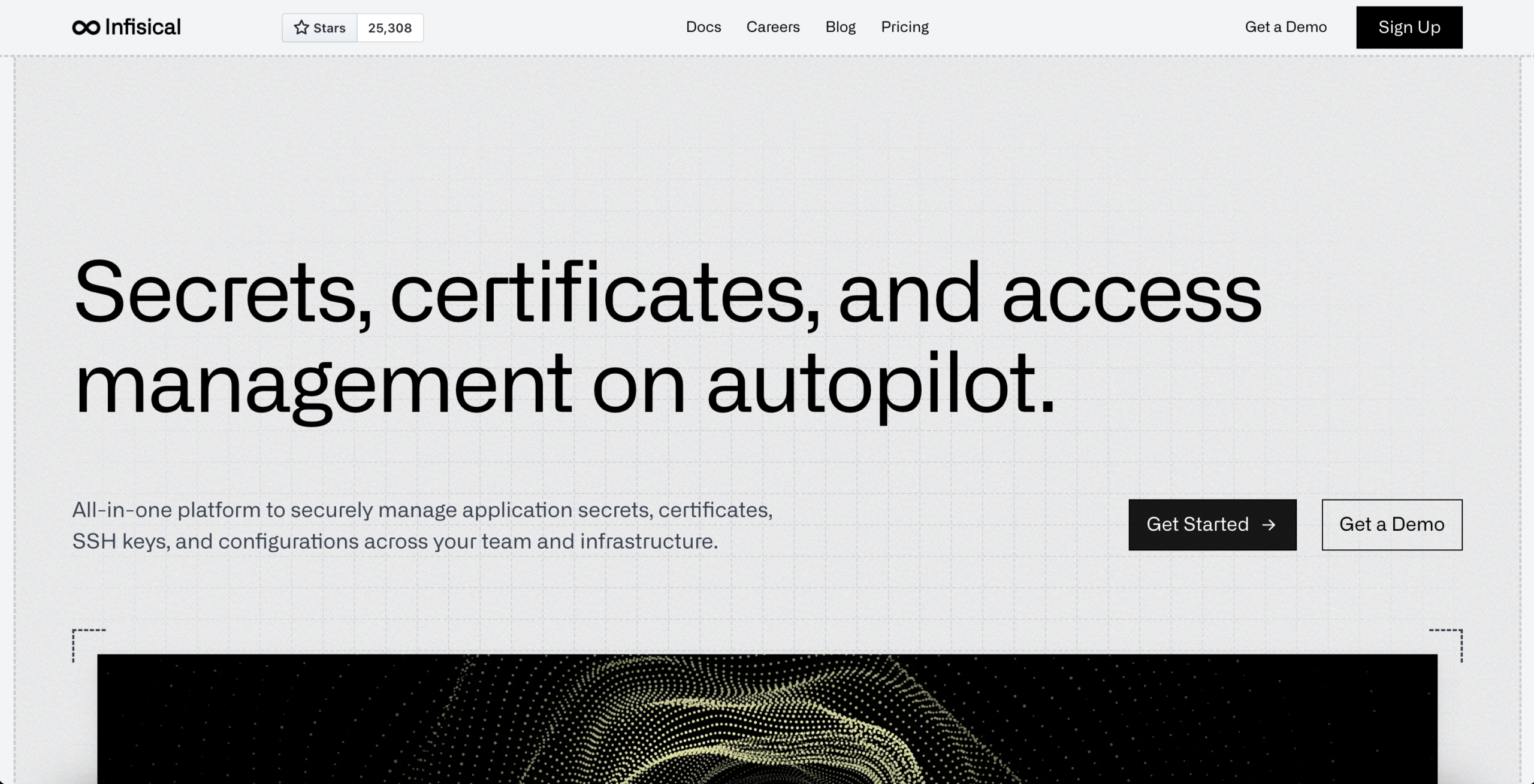
"Secrets, certificates, and access management on autopilot" enumerates three distinct product categories in one headline without resolving buyer identity. A developer landing from a paid search ad for secrets management reads this and must mentally confirm that the product is relevant to them — the comma-separated list creates a classification task, not an instant orientation signal. "On autopilot" adds a process benefit but does not address the primary buyer anxiety in this space, which is security posture risk and credential sprawl exposure. In high-consideration security SaaS, the hero must collapse the evaluation distance — not expand it by surfacing adjacent products before the core use case is established.
"Get Started" and "Get a Demo" are presented as visually near-equal options in the hero section, with the same button height and comparable visual weight. For a visitor who has not yet resolved whether they are a self-serve developer or a buying-committee enterprise evaluator, this creates a meta-decision that precedes the actual conversion action. Research on dual-CTA hero structures consistently shows suppressed aggregate click-through to either option when both are given equivalent prominence. The problem is compounded by the fact that the navigation also carries both options simultaneously, meaning the decision is presented at least twice before any content has been consumed.
The demo request form requires six fields — first name, last name, business email, job title, a free-text description of needs, and an attribution question — before any commitment is confirmed. The conversion page headline "Contact our team" is generic and neutral, offering no specificity about what the demo entails, how long it runs, what the visitor will learn, or what happens after submission. There is a single testimonial placed to the left, but it addresses product capability rather than the demo experience or onboarding confidence. In B2B conversion psychology, high-field forms are only defensible when preceded by outcome-specific value framing that makes the effort feel proportionate to what is being received.
The navigation prominently features a GitHub star counter displaying 25,308 stars. For a developer evaluating open-source tooling, this is a meaningful adoption signal. However, for an enterprise security buyer or IT decision-maker arriving from a paid campaign, GitHub stars carry no commercial weight and may actively introduce ambiguity — specifically the concern that this is a community project rather than an enterprise-grade, vendor-backed product. The homepage attempts to serve both audiences but has no mechanism to segment or adapt to them, meaning enterprise trust signals are diluted by developer community framing throughout the above-the-fold experience.
The homepage displays a logo strip featuring recognized companies including LG, Lucid, Pay-per-Connect, Nvidia, Pay-Cor, and others. While brand-name social proof establishes legitimacy, it does not resolve the specific purchase anxiety that drives security platform evaluation: "Will this work in my infrastructure, at my scale, without breaking my deployment pipeline?" The single visible testimonial from the conversion page references Kubernetes, CI/CD, and secrets workflow — genuine technical specificity — but it is isolated on the demo page rather than placed in the evaluation flow on the homepage where decisions begin. Quantity of logos without outcome-specific case content converts at a lower rate than a single well-evidenced proof story.
After the hero, the homepage moves immediately into three feature sections (Secrets Management, Certificate Management, Privileged Access Management), each with a brief headline and two text links. This structure replicates a documentation index rather than building purchase momentum. A cold visitor who has not yet committed to evaluation is presented with breadth before depth, and feature-category navigation before problem-solution alignment. Effective lead generation homepages follow a problem-consequence-solution-proof-CTA arc; the current structure skips the problem and consequence phases entirely and leads with product taxonomy, which mirrors the organization's internal mental model rather than the buyer's evaluation journey.
The demo request page places a physical address block and a support redirect alongside the form as the primary content flanking the conversion action. This arrangement answers a question most motivated visitors are not asking at this stage — "Where are you located?" — rather than the questions they are actively holding: "What will I get from this demo?", "How long will this take?", "Who will I be speaking with?", and "What happens to my data?" The layout invests page real estate in company legitimacy signals that belong earlier in the funnel and neglects the objection-handling content that directly determines whether a motivated visitor submits or abandons.
The product documentation is hosted on the same root domain as the marketing site, with the docs section presenting a full navigation environment, independent CTAs ("Start for Free"), and deeply interlinked technical reference content. While this creates a unified developer experience, it also means the domain's crawl budget and topical authority are distributed across commercial intent pages and technical reference content simultaneously. Search engines evaluate domain-level topical coherence when assigning category authority; a domain that returns both "Request a Demo" landing pages and low-level API reference documentation sends mixed intent signals that dilute ranking potential for high-value commercial queries in the secrets management and PKI categories.
- All 21 prioritised CRO suggestions with experiment ideas
- Industry benchmarks for your category & traffic level
- Discoverability (SEO + GEO) full audit results
- A/B test hypotheses ready to implement
- Personalised session with a CRO specialist
The findings presented here are directional and indicative in nature. They do not take into account internal data such as revenue performance, customer lifetime value, traffic quality, seasonality, or proprietary testing.
Recommendations should be interpreted as optimization opportunities rather than absolute assessments. Actual impact may vary depending on audience composition, acquisition channels, and business context. This report is not exhaustive and should be used as a starting point for further analysis and experimentation.