Junaid Jamshed
https://j-pakistan-mean3.myshopify.com/
Conversion Rate Optimization audit summary
Last audit performed on Feb 16, 2026
Analyzed version 1.0
CRO index
Conversion & growth
34%
based on 67 total criteria
Analytics & tracking
58%
based on 43 total criteria
UX & engagement
44%
based on 34 total criteria
Discoverability (SEO + GEO)
Unavailable for non customers
We have 21 CRO suggestions for you
Unlock all with a personalized session with our team
Improvement suggestions
1. The homepage lacks a strong value proposition
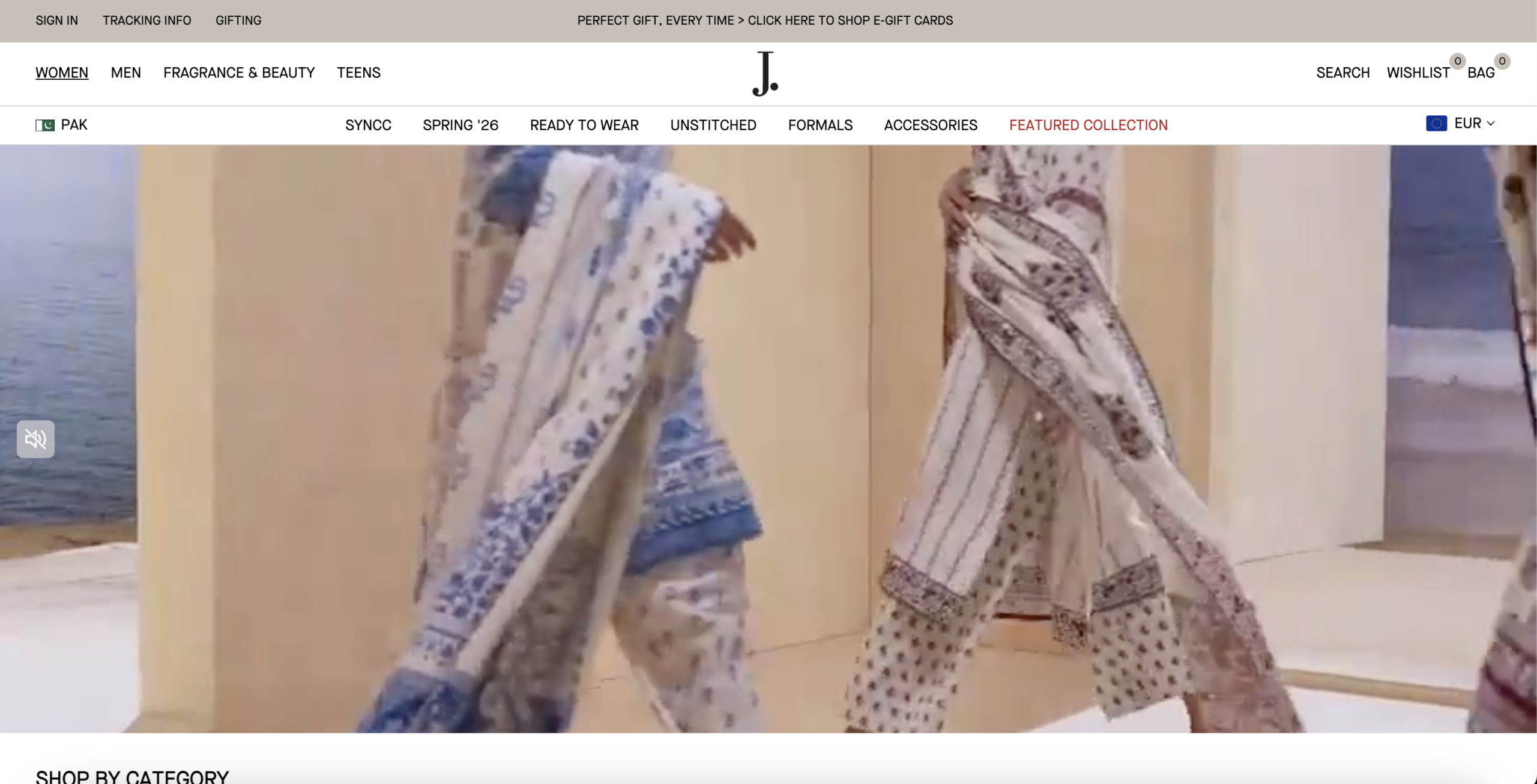
CriticalThe hero section shows lifestyle imagery and collections, but there is no clear, bold value proposition explaining why this brand should be chosen. There is no visible statement around craftsmanship, price positioning, delivery speed, fabric quality, or brand heritage. For a fashion ecommerce brand, especially in a competitive market, clarity of positioning is essential.
Without a strong opening statement or commercial hook, the site relies heavily on visuals alone. This makes the experience feel premium but not persuasive. Users must infer the brand’s value instead of being clearly told what differentiates it.
2. Weak call-to-action hierarchy
CriticalAcross the homepage, there are many banners (“Shop by Category,” “Trending,” “In the Spotlight,” “Co-ord Sets,” etc.), but there are no strong, consistent CTAs driving action. Most sections function visually, but they don’t clearly instruct users to “Shop Now,” “Explore Collection,” or “View All.”
This creates passive browsing rather than guided shopping. High-performing fashion ecommerce sites use consistent CTA language to reduce friction and push users toward category pages quickly. Here, the layout feels more editorial than transactional.
3. Product visibility is compromised by missing imagery
CriticalIn the “Trending” section, multiple product tiles display only a “J.” logo placeholder instead of actual product images. For a fashion ecommerce brand, this is not a minor cosmetic flaw — it is a fundamental breakdown in visual merchandising. Apparel purchasing is highly visual and emotional. When products are not clearly displayed, the core driver of engagement is removed. Users cannot evaluate design, fabric flow, fit, or detailing, which makes clicking through significantly less likely.
Whether this is caused by slow loading, technical errors, or a design oversight, the impact is severe. Empty or placeholder tiles signal poor quality control and reduce perceived professionalism. In a competitive clothing market, even small visual inconsistencies erode trust and credibility. This directly affects click-through rates, browsing depth, and ultimately revenue performance.
4. Absence of urgency and conversion incentives
CriticalThe homepage lacks visible urgency or incentive mechanisms commonly used in apparel ecommerce. There are no sale banners, limited-time offers, stock scarcity cues, free shipping thresholds, or delivery cut-off messaging. While the brand aesthetic feels calm and curated, it also removes psychological triggers that typically encourage faster decision-making. Without signals that products may sell out, prices may change, or shipping windows may close, users have little motivation to act immediately.
In fashion ecommerce, urgency is not just a promotional tactic — it is a conversion accelerator. Seasonal drops, limited collections, and high-demand items benefit significantly from scarcity framing and time-based prompts. The absence of these elements may contribute to delayed purchases and higher abandonment rates. A more intentional use of urgency, without compromising brand positioning, could meaningfully improve conversion performance.
5. Absence of a best-sellers strategy in a large catalog
HighDespite offering hundreds of products, there is no visible “Best Sellers” or “Most Popular” section guiding users toward proven high-performing items. In large fashion catalogs, this is a critical UX and revenue optimization mechanism. Most ecommerce stores naturally have a subset of SKUs that drive the majority of revenue. Highlighting these products reduces decision fatigue and accelerates purchase confidence.
Without a clearly featured best-sellers section, users are left to browse a vast inventory without guidance. This increases choice paralysis and weakens conversion efficiency. From a business perspective, if certain items convert better or carry higher margins, prioritizing them strategically can significantly increase overall profitability. The absence of a structured best-sellers strategy suggests missed opportunities in both UX optimization and revenue maximization.
6. Thin SEO content across category and product pages
HighWith a large catalog, organic visibility should be a major acquisition channel. However, there appears to be minimal SEO-supporting content on key pages. Category sections function primarily as product grids without meaningful descriptive copy, and there is little evidence of structured keyword-rich content explaining fabrics, styles, occasions, or seasonal collections.
Thin content limits the site’s ability to rank for high-intent search queries such as “women lawn suits in Pakistan,” “festive unstitched collection,” or “men formal kurta designs.” Search engines require semantic depth, contextual relevance, and internal linking to establish topical authority. Without this, the brand is likely underperforming in organic discovery relative to its catalog size.
7. Absence of product reviews weakens trust and conversion
HighThere are no visible customer reviews or ratings on product listings or homepage sections. In apparel ecommerce, reviews are a primary trust mechanism. They provide social proof, reduce uncertainty about sizing, fabric quality, and fit, and help users feel confident before purchasing. Without reviews, every product appears unvalidated, especially to first-time buyers.
Fashion purchases carry inherent risk: Will it fit? Does the fabric look the same in real life? Is the quality worth the price? Reviews directly address these anxieties. Their absence increases hesitation and likely impacts conversion rates, particularly for higher-priced items.
8. Missed opportunity to guide high-intent users
HighWith hundreds of products available, behavioral signals are extremely valuable. Visitors browsing festive collections could be shown matching accessories. Returning users could see “Recently viewed” or “Recommended for you.” High-engagement users could be directed toward best sellers or premium lines.
By not adapting the experience based on user signals, the site treats traffic as homogeneous rather than strategic. Personalization and intelligent merchandising could meaningfully improve product discovery, average order value, and overall conversion performance.
Want to unlock the full CRO report?
Get access to all recommendations, benchmarks, and experiment ideas.
Unlock full accessAdapt calls-to-action based on user readiness
CriticalAll visitors are presented with the same primary CTA regardless of engagement level.
Guide undecided users with progressive interactions
HighUsers showing exploration behavior are not guided toward soft commitment actions.
Reduce friction at high-intent conversion points
CriticalHigh-intent visitors face the same experience as early-stage users.
Important note
This audit is based on an automated and heuristic-based analysis of publicly accessible pages. The evaluation follows industry best practices across conversion rate optimization (CRO), usability, analytics, and discoverability.
The findings presented here are directional and indicative in nature. They do not take into account internal data such as revenue performance, customer lifetime value, traffic quality, seasonality, or proprietary tooling.
Recommendations should be interpreted as optimization opportunities rather than absolute assessments. Actual impact may vary depending on audience composition, acquisition channels, and business context.
This report is not exhaustive and should be used as a starting point for further analysis and experimentation.