Lush Hair
https://nigeria.lushhairafrica.com/
Conversion Rate Optimization audit summary
Last audit performed on Feb 20, 2026
Analyzed version 1.0
CRO index
Conversion & growth
41%
based on 67 total criteria
Analytics & tracking
45%
based on 43 total criteria
UX & engagement
32%
based on 34 total criteria
Discoverability (SEO + GEO)
Unavailable for non customers
We have 21 CRO suggestions for you
Unlock all with a personalized session with our team
Improvement suggestions
1. The hero section lacks a concrete, differentiating value proposition
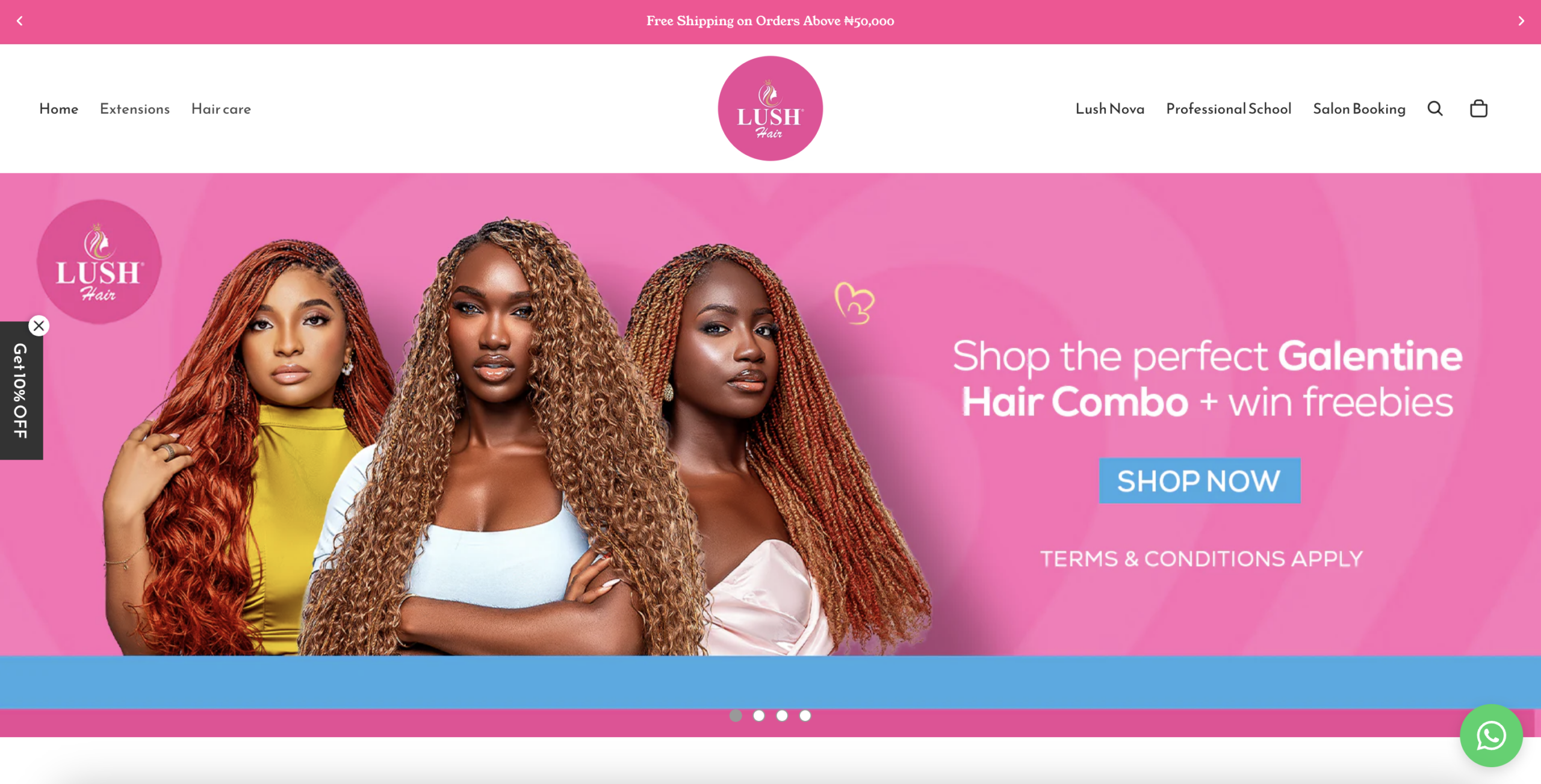
CriticalThe hero banners display campaign messaging (like Valentine's), not positioning. In the first 5–8 seconds, a new visitor does not learn what the brand actually does, why it’s different, or why it’s better for this type of hair specifically. The models are strong visually, but the message is promotional rather than problem-led. There is no mechanism articulation (e.g., scalp treatment system, braid longevity technology, moisture retention formula). Without a problem-solution framing, the brand is cognitively grouped with generic hair sellers.
At scale, paid traffic will convert below potential because cold visitors are not anchored in a clear reason to believe. You are forcing traffic to self-educate through scrolling instead of immediately answering “Why this brand?” This weakens ROAS efficiency, reduces new visitor conversion rate, and increases bounce from paid social where intent is low to moderate.
2. Same generic experience for all visitors
CriticalThe website delivers the same experience, messaging hierarchy, and product exposure regardless of traffic source, intent stage, or audience type. There is no segmentation by concern, funnel stage, location, or behavior. This forces every visitor to self-navigate and self-qualify, increasing cognitive load and reducing purchase velocity. In mixed-intent ecommerce, generic experiences systematically underperform because they ignore context and intent signals.
At scale, this reduces both conversion rate and revenue efficiency. Paid traffic becomes more expensive because cold visitors are not guided toward relevant entry points. High-intent search users are not fast-tracked to solution-specific pages. Returning users are not recognized or upsold into routines or bundles. Without personalization or intent-based routing, the site converts at its average instead of its potential. This is not a UX issue; it is a monetization ceiling.
3. Weak trust stacking in high-friction category
CriticalThe product page shows product name, price, bullet points, and variant toggle. There is no visible strong review count, no trust badges, no guarantee, no visible return policy, no clinical claims, no ingredient credibility, and no transformation proof above the fold. Hair/scalp products are high-risk purchases. Dandruff treatments especially require trust reinforcement.
This creates friction at the most expensive stage of the funnel: bottom intent. Without aggressive objection handling, first-time buyers hesitate. That hesitation reduces add-to-cart rate and dramatically lowers new customer conversion. Trust density directly correlates with revenue scalability in beauty ecommerce.
4. Minimal AOV expansion logic
CriticalOn the product page, “You May Also Like” appears below content, but there is no visible bundling logic, no “complete the routine,” no treatment system framing, no quantity incentives, and no visible threshold-based upsell beyond free shipping at ₦50,000 in the top bar. There is no structured cart-building psychology.
Haircare thrives on regimen selling. Without system-based upsells (e.g., cleanse → treat → moisturize → seal), you are forcing single-product purchases. That caps AOV and weakens LTV expansion. Over time, this limits revenue scalability and increases reliance on traffic growth rather than monetization efficiency.
5. FAQs buried in the footer = lost bottom-funnel revenue
HighHair care is a high-friction purchase category. Buyers have predictable concerns: “Will this work for braids?”, “Is it sulfate-free?”, “Will it irritate my scalp?”, “How long does one bottle last?”, “Is it safe for kids?”, “What if it doesn’t work?” When FAQs are buried in the footer, you force users to leave the buying moment to search for reassurance. That breaks psychological momentum. The highest intent users are the most likely to seek reassurance. If the reassurance is not immediately visible near the CTA, hesitation increases.
At scale, this suppresses conversion rate from search and comparison traffic. Bottom-funnel buyers convert based on friction removal, not inspiration. If you are paying for Google traffic around “anti dandruff for braids,” every unanswered question reduces paid efficiency. Hidden FAQs = higher cart abandonment, lower paid ROAS, and increased reliance on discounts to close the gap.
6. No clear best-sellers or high-margin items
HighWhen visitors land on a non-household brand, they look for social proof signals disguised as merchandising. “Best seller” is one of the strongest psychological shortcuts in ecommerce. It reduces cognitive load and communicates: “Start here. Others already validated this.” Your homepage and product grids show items, but there is no visible hierarchy highlighting what drives the majority of revenue or margin.
Without demand anchoring, you force equal consideration across products. That dilutes conversion and slows decisions. High-margin SKUs should be visually prioritized and strategically elevated. If this is not done, traffic distributes randomly instead of being steered toward the products that maximize profitability. Over time, this caps contribution margin and weakens revenue efficiency.
7. No guided entry point, high decision paralysis
HighRight now, the homepage presents: campaigns, products, transformations, categories, stories, etc. But there is no guided “start here” pathway. Visitors are not told how to shop. There is no segmentation by hair concern (itching scalp, braid care, moisture retention, hair growth), no “build your routine,” no quiz, no diagnostic, no clear entry funnel.
Mixed-intent traffic needs direction. Paid social traffic especially arrives with low clarity. If they don’t immediately see a pathway relevant to their problem, they scroll, get overwhelmed, and exit. This increases bounce rate and reduces conversion velocity. Without guided selling, you are relying on self-navigation, which kills performance at scale.
8. High-ticket verticals undervalued by homepage hierarchyy
HighThe current homepage architecture prioritizes low-AOV ecommerce products while visually and structurally deprioritizing at least two other higher-margin verticals: Professional School and Salon. This creates a misalignment between business model and conversion architecture. Education should be leveraged as an authority amplifier to increase perceived product efficacy and pricing tolerance. Salon should operate as real-world proof of performance, reinforcing trust for first-time buyers.
When these pillars are integrated into a single growth system, they create a compounding revenue flywheel. Retail drives brand discovery and introduces customers to the ecosystem. Salon converts local traffic and increases product attachment through professional usage validation. Professional School produces trained stylists who both validate and distribute the brand, increasing LTV and reducing customer acquisition dependency.
Want to unlock the full CRO report?
Get access to all recommendations, benchmarks, and experiment ideas.
Unlock full accessAdapt calls-to-action based on user readiness
CriticalAll visitors are presented with the same primary CTA regardless of engagement level.
Guide undecided users with progressive interactions
HighUsers showing exploration behavior are not guided toward soft commitment actions.
Reduce friction at high-intent conversion points
CriticalHigh-intent visitors face the same experience as early-stage users.
Important note
This audit is based on an automated and heuristic-based analysis of publicly accessible pages. The evaluation follows industry best practices across conversion rate optimization (CRO), usability, analytics, and discoverability.
The findings presented here are directional and indicative in nature. They do not take into account internal data such as revenue performance, customer lifetime value, traffic quality, seasonality, or proprietary tooling.
Recommendations should be interpreted as optimization opportunities rather than absolute assessments. Actual impact may vary depending on audience composition, acquisition channels, and business context.
This report is not exhaustive and should be used as a starting point for further analysis and experimentation.