
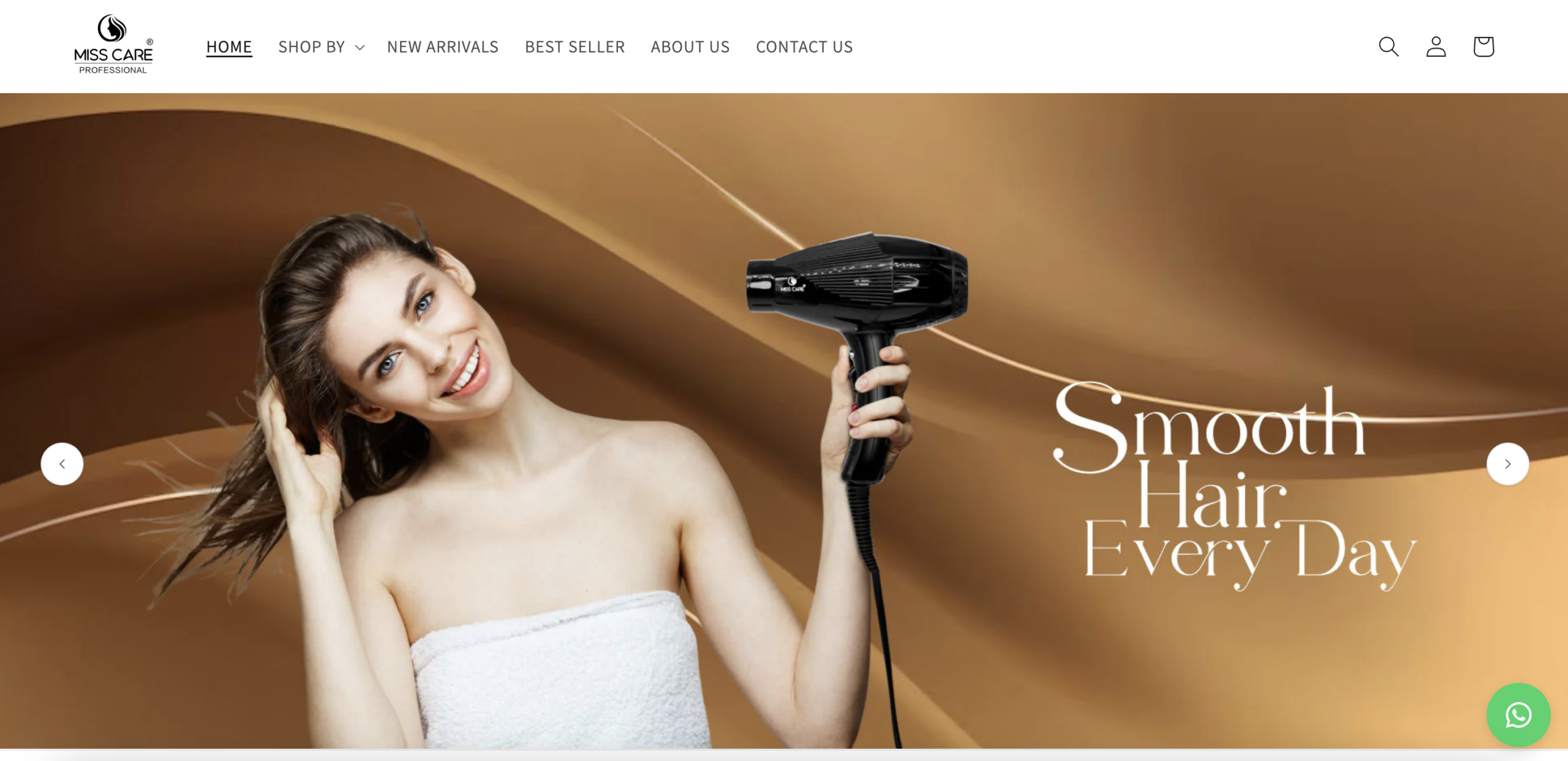
The above-the-fold experience presents a full-bleed aspirational image and a three-word mood-statement headline with no visible call-to-action button, no price anchor, no urgency signal, and no direct path to purchase. In ecommerce conversion psychology, the hero section is the site's highest-leverage real estate: it captures intent at peak attention, and the primary job is to direct that intent toward a commercial action. A carousel of atmospheric visuals does the opposite — it substitutes aesthetic engagement for purchase momentum. Visitors arriving from paid social or search with specific hair care intent are offered no cue to act, which forces them to self-navigate a discovery structure designed for browsing rather than buying.
The homepage hero is implemented as an auto-advancing image slider with navigation arrows. Rotating carousels are among the most consistently conversion-negative design patterns in ecommerce: they dilute the impact of any single message, they train visitor attention away from static content, and they virtually guarantee that most visitors never see any slide beyond the first. In a category where product specificity drives intent — a visitor looking for a keratin treatment behaves differently than one looking for a hair dryer — a carousel that cycles through both sends an ambiguous category signal. The brand cannot win attention for a specific offer when the interface itself is cycling away from it.
A featured product page displays a prominent sold-out badge alongside a price and review count, but offers no alternative path: no "notify me" restock email capture, no redirect to a comparable in-stock product, and no contextual messaging to retain visitor intent. When a buyer reaches a product page in a purchase-ready state and encounters an out-of-stock signal with no recovery mechanism, the session ends. This represents a complete revenue leak: the acquisition cost was paid, the visitor arrived with intent, and the site returned no value. In a brand with multiple product categories and likely partial inventory fluctuation, this pattern is structural rather than isolated.
The brand name and navigation hierarchy both signal professional-grade positioning, and the homepage includes a "trusted by experts" credibility section. However, on the product page — the actual site of the purchase decision — the professional claim is not operationalised. There is no explanation of what separates this formulation from a consumer-grade alternative: no salon partnership data, no licensed professional endorsement with credentials, no formulation origin story, and no comparison framing that makes the price point feel earned. Buyers considering a Rs. 525 hair treatment versus a Rs. 200 drugstore alternative need a reason to pay the premium; that reason is absent at the moment it matters most.
Neither the product page nor the homepage hero area contains any visible reference to shipping cost, estimated delivery timeframe, or returns policy. In ecommerce conversion research, unexpected shipping cost at checkout is the single most cited reason for cart abandonment, and the anticipation of that unknown creates pre-checkout hesitation during the evaluation phase. Indian ecommerce buyers are particularly sensitive to total landed cost, given the prevalence of COD options and the expectation of shipping cost transparency from marketplace competitors. The absence of this information at the point of purchase evaluation means buyers carry unresolved cost uncertainty all the way to checkout — with high abandonment as the outcome.
The product page review section displays 27 ratings at 4.41 stars, but the visible review text is brief, generic, and structurally repetitive — multiple reviews share nearly identical phrasing and describe identical outcomes. Shoppers encountering social proof that reads as templated or algorithmically generated apply a significant credibility discount to the entire review set, regardless of the rating average. In the beauty and personal care category, purchase decisions are heavily mediated by peer experience: buyers want to know if the product worked for hair texture similar to theirs, at what frequency, and what the first-use experience was like. Homogenous review copy provides none of this specificity and therefore fails as a decision-stage trust accelerant.
The product page description is structured as a sequence of bullet-point lists: key benefits, ideal-for segments, and a brief brand rationale. While this format is legible and SEO-serviceable, it operates entirely in the rational feature layer and fails to address the emotional and risk-based objections that govern beauty purchases: "Will this damage my hair further?", "How long until I see results?", "Does this work on chemically treated hair?", "Is this safe to use without a professional?". In a category where buyers carry significant product anxiety — and where the cost of a wrong choice is visible on their head — description copy that lists ingredients and use cases without resolving fear does not close the sale. It merely informs consideration.
The site spans at least four distinct product verticals — hair treatments, hair colour, grooming appliances, and skin care — each with meaningfully different search intent profiles, competitor landscapes, and buyer journeys. For a brand without a category-dominant domain authority, pursuing organic ranking across all four simultaneously typically results in thin performance in each, rather than strong performance in any. Search engines reward topical depth and internal link coherence; a homepage that presents appliances and keratin masks as coordinate categories sends dilute topical signals that work against ranking for either. The organic funnel consequently relies on branded and navigational queries rather than high-volume transactional terms, which limits acquisition scalability at zero marginal cost.
- All 19 prioritised CRO suggestions with experiment ideas
- Industry benchmarks for your category & traffic level
- Discoverability (SEO + GEO) full audit results
- A/B test hypotheses ready to implement
- Personalised session with a CRO specialist
The findings presented here are directional and indicative in nature. They do not take into account internal data such as revenue performance, customer lifetime value, traffic quality, seasonality, or proprietary testing.
Recommendations should be interpreted as optimization opportunities rather than absolute assessments. Actual impact may vary depending on audience composition, acquisition channels, and business context. This report is not exhaustive and should be used as a starting point for further analysis and experimentation.