No Return Apparel
https://noreturnapparel.com/
Conversion Rate Optimization audit summary
Last audit performed on Feb 23, 2026
Analyzed version 1.0
CRO index
Conversion & growth
41%
based on 67 total criteria
Analytics & tracking
45%
based on 43 total criteria
UX & engagement
32%
based on 34 total criteria
Discoverability (SEO + GEO)
Unavailable for non customers
We have 21 CRO suggestions for you
Unlock all with a personalized session with our team
Improvement suggestions
1. Abstract Emotional Messaging Replaces Commercial Clarity
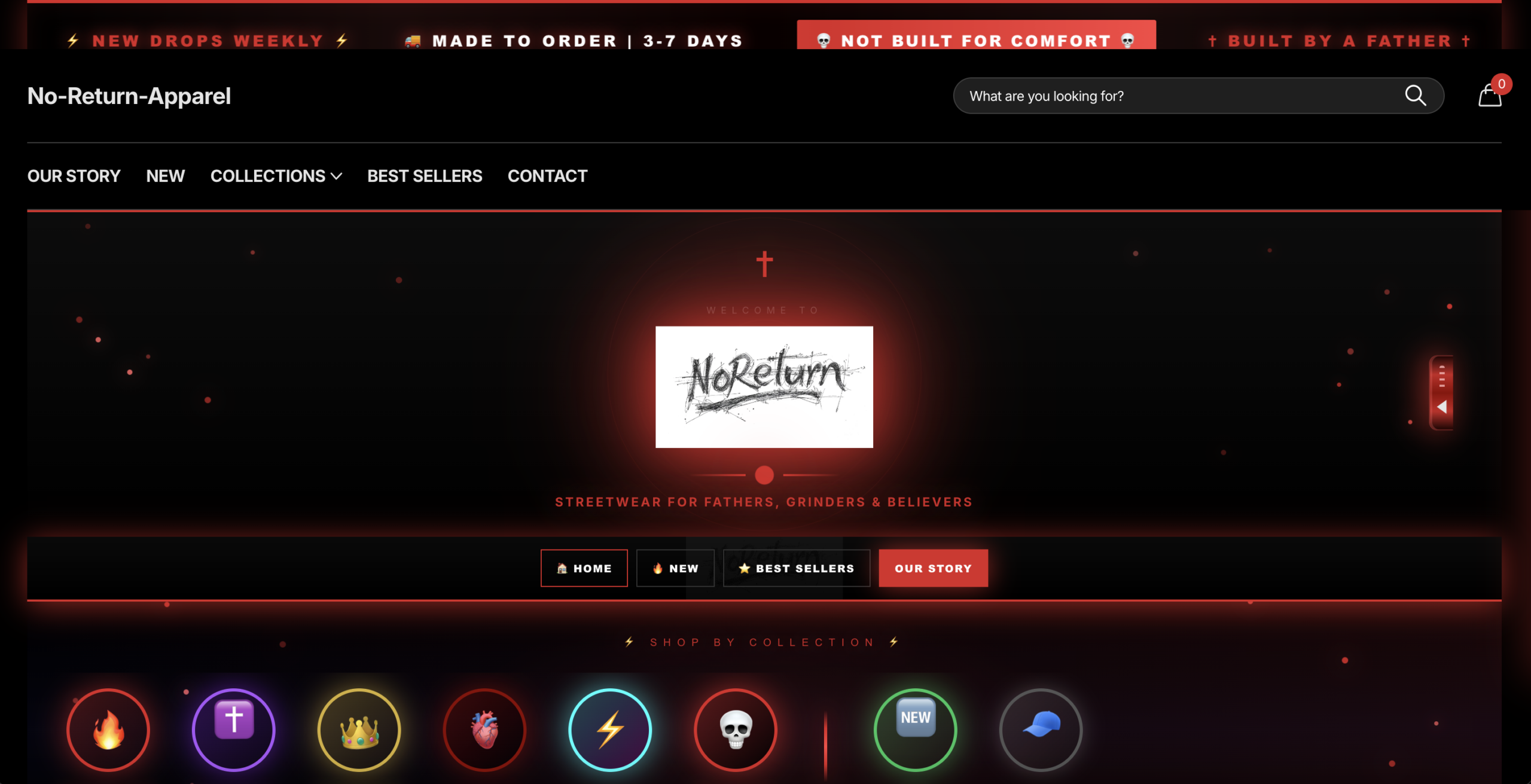
CriticalThe homepage hero (“Through the darkness you find the light”) and brand positioning (“Streetwear for fathers, grinders & believers”) communicates emotion but not product value. Within 5 seconds, a first-time paid traffic visitor cannot clearly answer: What exactly do they sell? Why is it different? Why should I buy here instead of another Christian apparel brand? The messaging leans symbolic rather than transactional. There is no immediate articulation of quality, fit, material, craftsmanship, production method, or brand mechanism. The emotional narrative dominates the commercial hierarchy.
This creates measurable revenue leakage because paid social and cold traffic require clarity before inspiration. Emotional resonance amplifies conversion only after basic commercial understanding is established. Without tangible differentiation, visitors categorize the brand as “another graphic Christian shirt store.” That triggers price comparison behavior and reduces both conversion rate and AOV. Abstract positioning also weakens SEO intent capture and makes scaling beyond warm audiences significantly harder.
2. Design-First Bias Over Conversion-First Architecture
CriticalThe homepage is visually heavy: glowing effects, red accents, particle backgrounds, stylized icons, dramatic banners. However, commercial hierarchy is diluted. Decorative weight competes with product visibility. The page scroll progression reads like a brand manifesto rather than a structured buying journey. Best sellers and new arrivals are present, but they are embedded within strong visual theming rather than clearly optimized conversion modules.
This introduces cognitive fatigue early in the session. Every additional visual element consumes attention bandwidth that could be reinforcing product desirability. High visual noise suppresses scanning efficiency, especially for paid traffic on mobile. Over time, this lowers conversion rate at scale because users must work harder to extract shopping-relevant information. Design energy is high, but commercial momentum is weak.
3. Weak Differentiation in a High-Commodity Category
CriticalChristian streetwear is a crowded niche. The product page (e.g., “Forged by God | Christian Warrior Streetwear”) shows a graphic tee with a strong religious message. However, there is no visible articulation of fabric quality, print durability, fit type, sourcing method, craftsmanship, or unique production mechanism. The differentiation appears aesthetic only. When differentiation is visual rather than structural, competitors can replicate it easily.
This drives price sensitivity and erodes brand defensibility. Without mechanism-based differentiation, the brand competes on vibe rather than value. That reduces pricing power and caps margin expansion. Over time, customer acquisition costs rise while lifetime value stagnates because nothing structurally anchors loyalty beyond emotional alignment.
4. Trust Signals Exist but Lack Depth and Proof Density
CriticalThe product page displays “Secure Checkout,” “Quality Guaranteed,” “Free Shipping $75+,” and “Easy Returns”. These are standard Shopify reassurance icons. There is a star rating visible, but review density and credibility reinforcement are unclear. There is no visible user-generated content, no fit feedback summaries, no detailed testimonial blocks, no craftsmanship proof.
Trust is not built through icons alone. First-time buyers, especially in apparel, fear poor fit, low fabric quality, fading prints, or long shipping times. When trust reinforcement is shallow, visitors hesitate. This increases bounce rate and cart abandonment. At scale, weak trust density lowers conversion rate from paid traffic and suppresses first-time buyer confidence.
5. Product Pages Under-Leverage Revenue Psychology
HighThe product presentation appears image-dominant but copy-light. There is no visible deep product description, no storytelling around material weight, stitching, comfort, durability, wash resilience, or lifestyle application. Apparel requires sensory substitution online. Without rich detail, visitors cannot mentally simulate ownership.
This suppresses both CR and AOV. Lack of depth reduces justification for premium pricing. It also weakens perceived quality anchoring, which makes cross-sells less effective. When the product page fails to emotionally and rationally validate the purchase, visitors delay decision-making or exit to comparison-shop.
6. Limited AOV Expansion Architecture
HighThere is a “Complete the look” section, which is positive. However, it appears passive and visually similar to standard product grids. There is no bundling logic, no multi-item discount framing, no outfit-based pricing incentive, no visible buy-more-save-more structure.
Without explicit AOV engineering, apparel brands leave 20–40% potential revenue untapped. Passive cross-sells rely on user initiative rather than behavioral nudging. This results in single-item checkouts dominating revenue mix, which reduces total order value and makes paid traffic less profitable.
7. SEO & Long-Tail Capture Underdeveloped
HighFrom visible structure, category pages appear visually styled but not content-dense. There is no visible educational or keyword-depth section. Messaging is emotional rather than search-aligned. Titles such as “Christian Warrior Streetwear” may rank narrowly, but broader search intent like “Christian father t-shirt,” “faith-based dad clothing,” or “Christian men’s graphic tees” are not visibly leveraged.
This limits organic scalability and increases reliance on paid acquisition. When SEO content depth is thin, the brand misses transactional long-tail capture, which is the highest converting traffic segment in ecommerce. Over time, this increases acquisition dependency risk.
8. Generic Experience for All Visitors (No Intent Segmentation)
HighEvery visitor sees the same homepage hierarchy, same hero message, same product ordering, same navigation emphasis. There is no visible segmentation by intent type (gift buyer vs self-buyer), traffic source (paid social vs organic), lifecycle stage (new vs returning), or belief intensity (casual faith wearer vs identity-driven buyer). The messaging assumes a homogeneous audience of “fathers, grinders & believers,” but in reality this traffic will be highly fragmented.
When everyone sees the same experience, high-intent buyers must dig, gift buyers lack reassurance, and skeptical cold traffic lacks proof. Behavioral psychology shows that relevance increases perceived value instantly. Without dynamic or even basic structural segmentation, the brand forces all visitors through the same narrative funnel, which reduces resonance and suppresses conversion velocity.
Want to unlock the full CRO report?
Get access to all recommendations, benchmarks, and experiment ideas.
Unlock full accessAdapt calls-to-action based on user readiness
CriticalAll visitors are presented with the same primary CTA regardless of engagement level.
Guide undecided users with progressive interactions
HighUsers showing exploration behavior are not guided toward soft commitment actions.
Reduce friction at high-intent conversion points
CriticalHigh-intent visitors face the same experience as early-stage users.
Important note
This audit is based on an automated and heuristic-based analysis of publicly accessible pages. The evaluation follows industry best practices across conversion rate optimization (CRO), usability, analytics, and discoverability.
The findings presented here are directional and indicative in nature. They do not take into account internal data such as revenue performance, customer lifetime value, traffic quality, seasonality, or proprietary tooling.
Recommendations should be interpreted as optimization opportunities rather than absolute assessments. Actual impact may vary depending on audience composition, acquisition channels, and business context.
This report is not exhaustive and should be used as a starting point for further analysis and experimentation.