
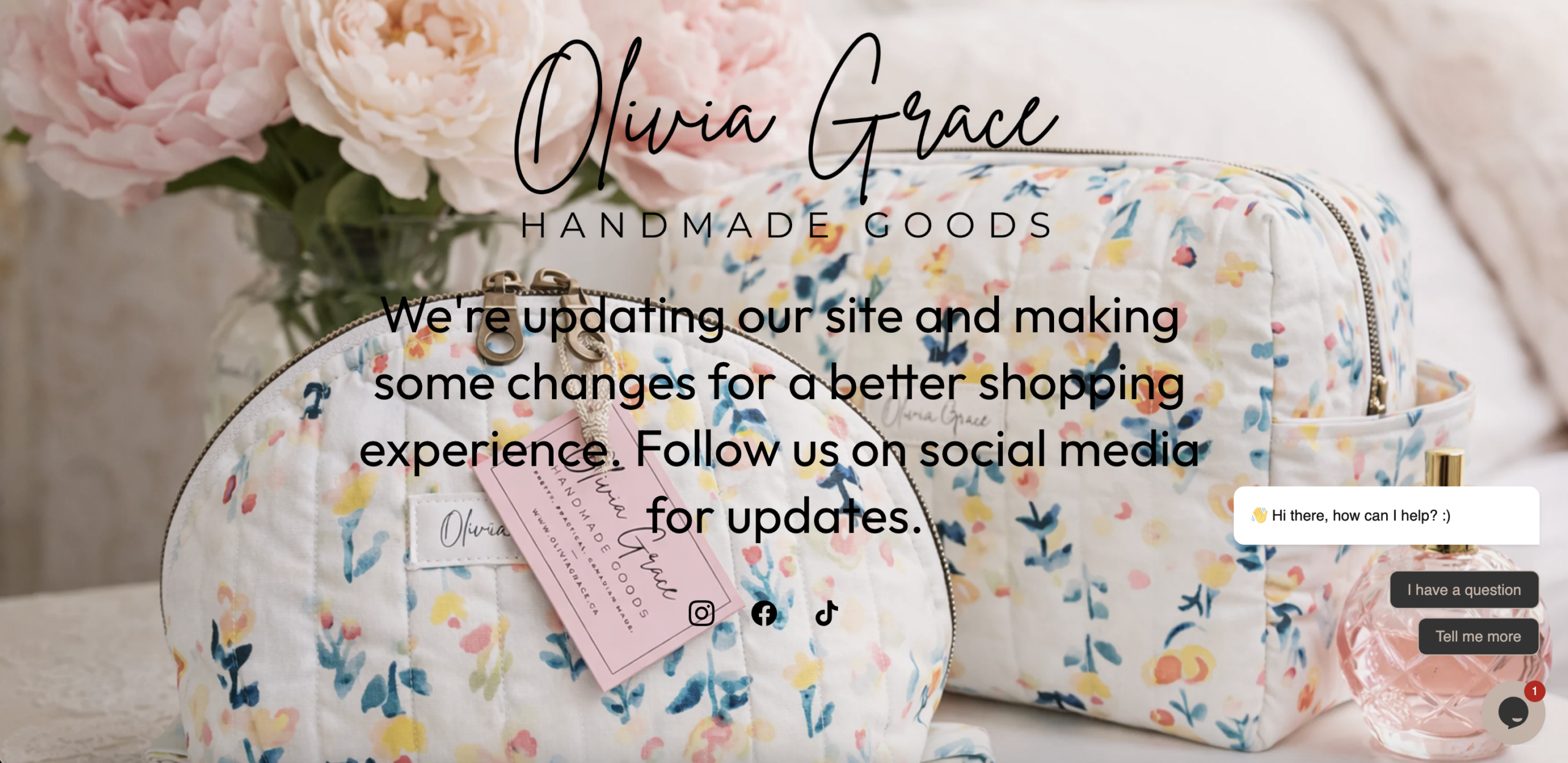
The site currently presents a maintenance message in place of any shoppable content, products, or purchase path. Every visitor who arrives, regardless of channel or intent level, encounters a dead end. There is no product discovery, no catalog, no cart, and no checkout. In e-commerce conversion architecture, this is not a suboptimal funnel, it is the complete absence of one. Every paid click, organic visit, and social referral driven to the domain during this period yields zero revenue return, compounding acquisition spend with zero conversion ceiling.
The only call to action on the site instructs visitors to follow social media channels for updates. In behavioral terms, this converts high-intent buyers who arrived ready to purchase into passive social followers, a fundamentally weaker relationship than an owned marketing asset. Social algorithms control reach, organic follow-through rates are low, and there is no mechanism to re-engage visitors who follow and disengage before relaunch. The traffic arriving now, which may include the brand's highest-intent audience driven by paid or word-of-mouth referrals, is being surrendered rather than preserved.
The maintenance page contains no email sign-up, no waitlist form, and no mechanism to collect contact information from visitors who arrive and find the store unavailable. Email remains the highest-ROI owned channel in e-commerce, typically generating 30–40% of revenue for healthy DTC brands. A pre-launch list built during the downtime period, even at low traffic volumes, would represent a warm, high-intent audience primed for a launch email sequence. Sending a relaunch announcement to zero subscribers means the launch day has no owned activation layer.
The maintenance copy communicates operational status ("we're updating") rather than commercial anticipation. There is no countdown, no relaunch date, no "first to know" promise, and no description of what is coming. For a handmade goods brand where product scarcity and limited-run nature are natural value signals, the downtime period is an underused opportunity to build anticipation and urgency before the first product becomes purchasable. Visitors who arrive now have no incentive to return, no emotional hook, and no reason to engage beyond this single low-context visit.
The hero communicates the brand name and "handmade goods" as a category descriptor, but conveys nothing about what specifically is sold, who it is for, or what makes the products worth waiting for. The product imagery visible in the background shows quilted pouches and bags, but this context exists only visually and is not reinforced by any copy. A visitor arriving from a paid social ad targeting craft or gift buyers has no clear confirmation that this brand matches their intent. Without explicit product-type, audience, and differentiation signals in the text layer, the site cannot do the foundational positioning work that supports both direct conversion and paid channel efficiency.
A live chat widget is visible and actively prompting visitors with a greeting, suggesting immediate support is available. However, with no products, no shopping features, and no purchase path available on the site, any visitor who engages with the chat is entering a support channel with no transactional outcome. The presence of an active chat widget signals operational readiness that the rest of the page contradicts. For visitors who perceive a gap between the interactive support layer and the non-functional storefront, this inconsistency can reduce brand credibility rather than building it.
The hero background features high-quality lifestyle photography of the brand's quilted products, which credibly communicates craftsmanship and aesthetic. However, this imagery is used as a full-bleed background behind the maintenance message, making it compositionally decorative rather than commercially intentional. There is no product naming, no price anchoring, no "coming soon" product preview, and no visual hierarchy that guides the eye toward a desired action. In conversion-first e-commerce design, product photography is a trust signal and desire driver; here, its impact is diluted by being used purely as a wallpaper treatment.
The maintenance page contains minimal indexable text, no product keywords, no category signals, and no semantic content that search engines can use to attribute relevance. Every day the site remains in this state, crawlers revisit and find no substantive content to index, progressively reducing the topical authority and keyword associations the domain may have previously built. For a handmade goods brand competing in organic search against established craft and gifting marketplaces, domain authority is a slow-accumulating asset, and a content-empty maintenance page is not neutral for SEO — it is actively regressive.
- All 21 prioritised CRO suggestions with experiment ideas
- Industry benchmarks for your category & traffic level
- Discoverability (SEO + GEO) full audit results
- A/B test hypotheses ready to implement
- Personalised session with a CRO specialist
The findings presented here are directional and indicative in nature. They do not take into account internal data such as revenue performance, customer lifetime value, traffic quality, seasonality, or proprietary testing.
Recommendations should be interpreted as optimization opportunities rather than absolute assessments. Actual impact may vary depending on audience composition, acquisition channels, and business context. This report is not exhaustive and should be used as a starting point for further analysis and experimentation.