
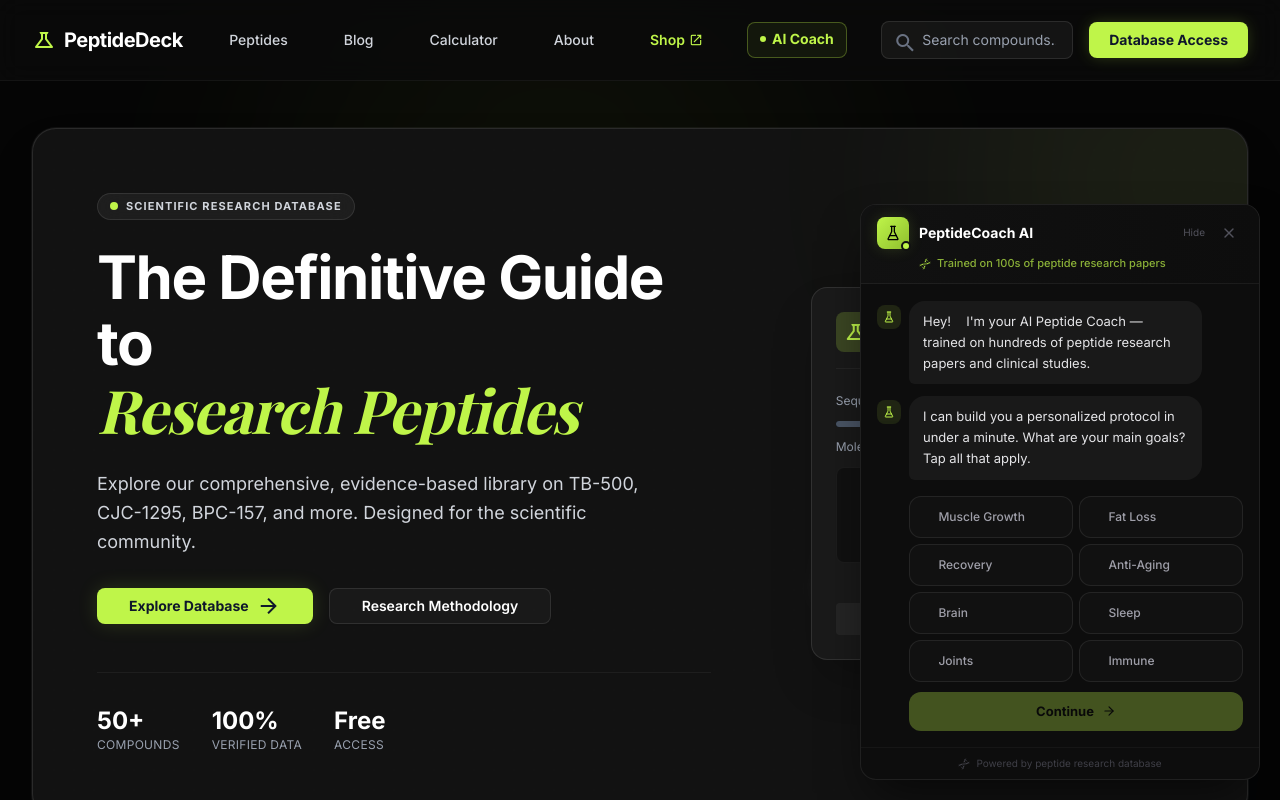
The "Shop" navigation item carries an external link indicator, meaning the entire transactional experience takes place on a separate domain. From the moment a visitor clicks "Shop" or any "Buy Now" CTA, the purchase happens off-site: retargeting pixels do not fire on the transaction event, attribution is broken at the most commercially valuable step, and any trust equity built on the research content side transfers to an external vendor without benefit to the site. In a category where buyer hesitation is already elevated by regulatory complexity, completing the transaction on a second, unfamiliar domain is the highest-friction purchase architecture possible. Trust must be rebuilt from zero at the exact moment commitment is required.
The hero headline frames the site as "the definitive guide to research peptides," a positioning that signals reference library rather than supplier or retailer. The primary CTA reinforces this: "Explore Database" is a browsing action, not a buying action. Visitors arriving from commercial-intent queries — searches for specific compounds with purchase intent — are immediately re-routed into an educational context. This framing extends time-on-site while suppressing conversion rate, because it repositions the visitor as a learner rather than a buyer at the exact moment the first impression is formed. The secondary proof points (50+ Compounds, 100% Verified Data, Free Access) continue the research-resource framing without a single signal oriented toward the purchase.
The primary navigation CTA reads "Database Access," a phrasing that implies a gated or paid subscription tier. Simultaneously, the hero features "Free Access" as a prominent proof point alongside "50+ Compounds" and "100% Verified Data." This contradiction means visitors cannot determine, before clicking, whether they are being invited to pay, register for free, or simply browse. Ambiguous CTAs are among the most reliable conversion suppressors in behavioral economics: when an action's outcome is unclear, the default response is to delay the action entirely. The contradiction also undermines perceived value: if access is genuinely free, the "Database Access" CTA framing sets a false expectation that cheapens the offer once resolved.
The "Research Purposes Only. Not for human consumption" disclaimer appears in the site footer and across product and compound pages. The functional buyer of research peptides — biohackers, longevity practitioners, performance-focused individuals — is making a personal use decision. The disclaimer forces every such buyer to maintain a cognitive fiction throughout the entire research and purchase process, suppressing confidence and increasing hesitation at each stage of evaluation. This is not theoretical friction: the legal framing creates a direct conflict between the buyer's actual intent and the brand's stated positioning, and that conflict is resolved by a meaningful portion of visitors through abandonment rather than purchase. The disclaimer, as deployed, does the maximum permissible legal work while performing minimum conversion management.
The compound detail pages are research-excellent: they contain chemical structure data, half-life information, mechanism-of-action explanations, dosage protocols, research findings, and scientific references. However, they contain no mechanisms that accelerate a purchase decision. There is no urgency framing, no stock or availability signal, no customer reviews or outcome-specific social proof tied to the vendor, no guarantee or trust badge adjacent to the buy action, and no cross-sell or AOV-expansion logic. The "Buy Now" button appears as an isolated element without any surrounding purchase confidence architecture. In ecommerce psychology, the product page is the highest-stakes conversion surface, the point where rational and emotional motivations must both be satisfied simultaneously. This page satisfies the rational layer comprehensively while leaving the emotional and risk-reduction layers entirely unaddressed.
The blog index page displays multiple articles using visually identical or near-identical product images from what appears to be a single vendor's product line, with the same packaging appearing across many consecutive posts. In a content category where perceived scientific authority is the primary trust driver — and where the target audience includes researchers and practitioners who evaluate sources critically — repetitive, undifferentiated product photography signals low-effort content production at the visual layer. Trust in the written research content is directly correlated with production standards: when the visual presentation feels generic or formulaic, a meaningful share of attentive visitors discounts the accuracy of the written claims regardless of their actual quality. At the scale of 200+ articles, this effect compounds across first impressions.
The "AI Coach" navigation element, described as an AI trained on hundreds of studies, is the most differentiating visible product feature on the site: no comparable feature appears across standard research peptide database or vendor sites. An AI trained on peptide research literature has immediate and obvious perceived value for the target audience — it is the kind of tool that can convert a browse session into a registered user or subscriber. However, it appears as a navigation item with no hero-level prominence, no dedicated feature page, no pricing or registration context, and no lead capture mechanism visible. If this feature is free and ungated, it is a missed identity-building and email capture opportunity of considerable scale. If it is a paid or premium feature, it is dramatically underpromoted relative to its differentiation potential.
The blog contains a large volume of articles targeting queries that carry latent purchase intent: "does Sermorelin work," "Sermorelin cost, prescription and insurance coverage," "Sermorelin before and after: real results," and "Retatrutide cost and price." These are not informational queries — they are buyer decision-stage queries from users who are actively evaluating whether to purchase a compound. The blog answers them with editorial research content rather than routing the reader toward a product page, vendor comparison, or purchase CTA. This architecture is SEO-excellent: it captures high-intent organic traffic. However, it converts that traffic into article readers rather than buyers, generating organic sessions without downstream revenue attribution. The gap between traffic quality and conversion rate is a systematic revenue leak at scale.
- All 21 prioritised CRO suggestions with experiment ideas
- Industry benchmarks for your category & traffic level
- Discoverability (SEO + GEO) full audit results
- A/B test hypotheses ready to implement
- Personalised session with a CRO specialist
The findings presented here are directional and indicative in nature. They do not take into account internal data such as revenue performance, customer lifetime value, traffic quality, seasonality, or proprietary testing.
Recommendations should be interpreted as optimization opportunities rather than absolute assessments. Actual impact may vary depending on audience composition, acquisition channels, and business context. This report is not exhaustive and should be used as a starting point for further analysis and experimentation.