River Street Sweets
https://www.riverstreetsweets.com/
Conversion Rate Optimization audit summary
Last audit performed on Feb 16, 2026
Analyzed version 1.0
CRO index
Conversion & growth
45%
based on 67 total criteria
Analytics & tracking
58%
based on 43 total criteria
UX & engagement
44%
based on 34 total criteria
Discoverability (SEO + GEO)
Unavailable for non customers
We have 21 CRO suggestions for you
Unlock all with a personalized session with our team
Improvement suggestions
1. Geographic access restrictions are blocking potential revenue
CriticalThe website appears to deny access to users from certain countries, preventing them from viewing the homepage or browsing products. Whether intentional or caused by security configuration, this creates a hard barrier at the very top of the funnel. Unlike checkout friction, this issue prevents any engagement from happening at all. Users who encounter an access denial are unlikely to retry or troubleshoot; they will simply move to a competitor.
Even if the brand does not currently ship internationally, fully blocking access is a high-risk approach. A better strategy would allow browsing while clearly communicating shipping limitations at checkout. Geographic denial not only eliminates potential international revenue but may also affect SEO visibility, brand discovery, and legitimate users who are misclassified by security tools. From a conversion perspective, this is a structural revenue constraint that should be carefully reviewed.
2. The brand relies on discounts instead of differentiation
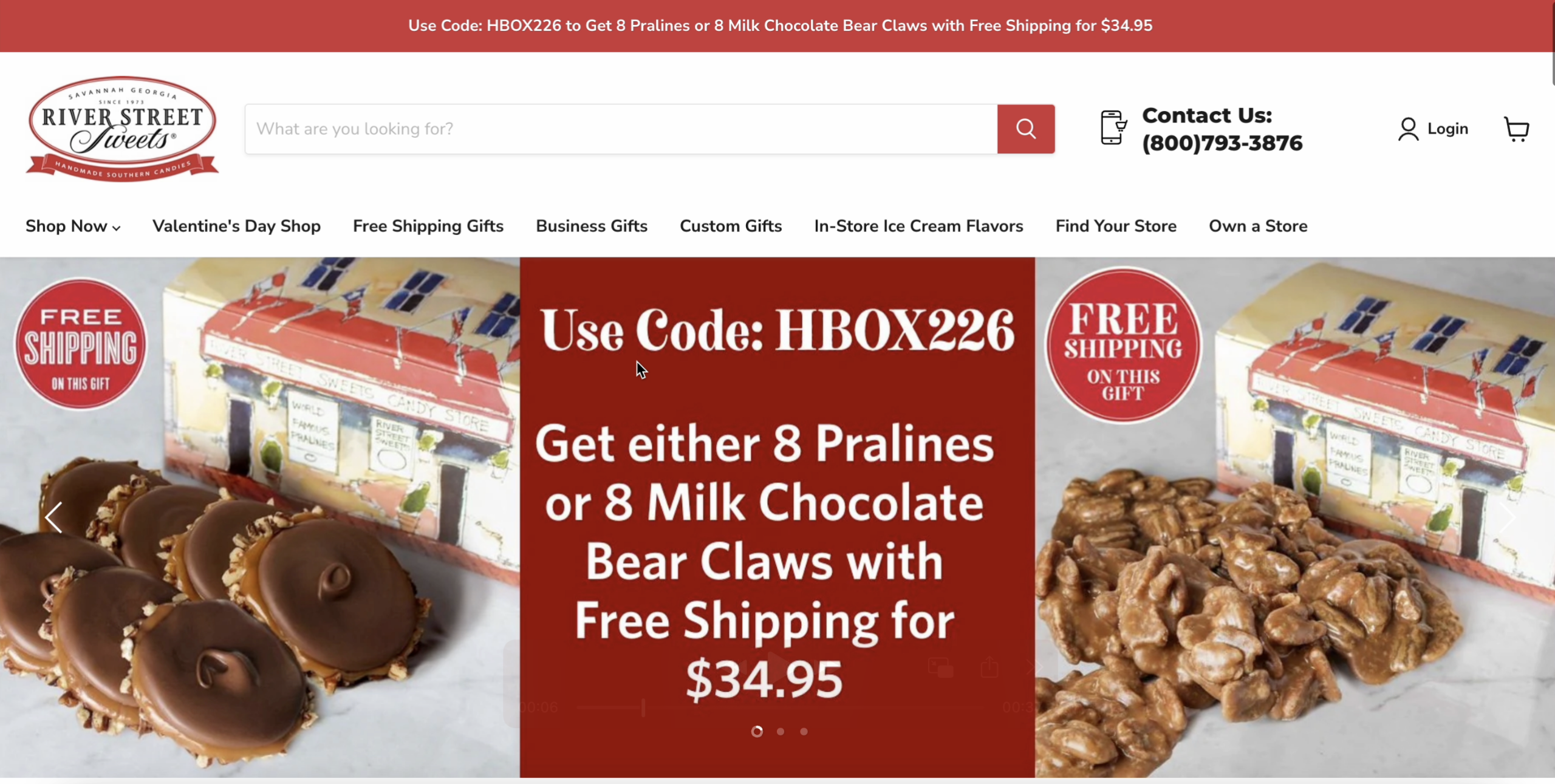
CriticalThe homepage is heavily promotion-driven, with prominent discount codes, repeated “FREE SHIPPING” badges, and price-focused messaging dominating the hero and category sections. The first impression users receive is an offer, not a reason to choose this brand. There is little emphasis above the fold on heritage, craftsmanship, quality, or emotional positioning — despite the brand having strong differentiators such as being handmade and established since 1973.
Over-reliance on promotions conditions customers to buy based on discounts rather than brand value. This can erode perceived premium positioning and compress margins over time. For a heritage confectionery brand, emotional storytelling and craftsmanship should lead the narrative, with offers acting as secondary conversion accelerators. Currently, the balance is reversed, which risks commoditizing the product and reducing long-term brand equity.
3. Funnel segmentation is unclear and diluted
CriticalThe navigation and homepage mix multiple audience intents within the same primary structure: retail shoppers, corporate gift buyers, franchise prospects (“Own a Store”), and in-store visitors. These are fundamentally different user journeys with different motivations, budgets, and decision cycles. Yet they are presented at equal weight within the same navigation hierarchy.
This lack of segmentation creates friction because the site does not clearly prioritize or guide high-intent buyers. Retail customers looking for chocolates are exposed to franchise links. Corporate buyers are not given a clearly defined, elevated pathway. When audiences are not segmented intentionally, the experience feels generic rather than tailored, which weakens conversion efficiency across all segments.
4. The homepage lacks strategic hierarchy
CriticalThe homepage feels modular rather than strategically structured. It moves from promotional hero to category tiles, to best sellers, to more categories, to brand storytelling, without a clear conversion narrative. High-impact elements like best sellers and social proof are placed mid-page instead of being used to immediately reinforce trust and drive action.
Effective ecommerce homepages guide users through a logical progression: value proposition → proof → products → segmentation → reinforcement. Here, the order feels assembled rather than optimized. The result is a visually strong page that lacks directional clarity, potentially slowing down purchase decisions and increasing cognitive load.
5. Corporate gifting is significantly under-optimized
HighCorporate gifting appears as just another category tile alongside retail-focused sections. However, business gifting is typically a higher-margin, higher-AOV segment with longer customer lifetime value. It requires a different sales approach, often including bulk pricing, customization, consultation, and recurring relationships.
By not elevating corporate gifting into a clearly segmented funnel with dedicated messaging, landing pages, and lead capture options, the site likely underperforms in this segment. A more intentional B2B pathway could increase average order value and unlock repeat revenue opportunities. Currently, this high-potential segment is treated like a standard retail category.
6. Lack of urgency and scarcity mechanisms
HighDespite operating in a category that is highly seasonal and gift-driven, the site does not visibly leverage structured urgency or scarcity cues. While promotional codes and free shipping are present, there are no indicators such as “Limited batch,” “Selling fast,” “Order by [date] for guaranteed Valentine’s delivery,” or stock-based scarcity messaging. This is a missed opportunity, particularly in a product category where timing is often critical.
Urgency mechanisms reduce hesitation and accelerate purchase decisions. For gifting and seasonal products, they are especially powerful conversion levers. Without them, users are given no reason to act now rather than later. This likely increases cart abandonment risk and delays purchase decisions, especially during high-demand periods such as holidays or special occasions.
7. The search bar is prominent but may not be conversion-optimized
HighThe search bar occupies significant visual space in the header, signaling that it is a primary navigation tool. However, there is no visible evidence of predictive search suggestions, trending queries, autocomplete previews, or dynamic product recommendations. When search is made visually dominant, users expect it to be fast, intelligent, and assistive.
If the search functionality is basic or static, this prominence becomes a liability rather than an asset. A large search bar should function as a conversion accelerator, helping users quickly find flavors, gift boxes, dietary preferences, or price ranges. Without optimization features, it risks becoming visual clutter while underperforming as a navigation tool.
8. The experience is generic and identical for all users
HighThe website presents the same homepage, offers, product hierarchy, and messaging to every visitor regardless of intent, behavior, or context. A first-time visitor looking for a Valentine’s gift, a returning customer reordering favorites, and a corporate buyer exploring bulk gifting all receive the same experience. There is no visible segmentation, personalization, or dynamic prioritization based on user behavior.
This one-size-fits-all approach limits conversion potential. Different users arrive with different motivations: gifting urgency, personal indulgence, bulk procurement, seasonal browsing, or repeat purchase intent. Without adapting messaging, product recommendations, or CTAs to these contexts, the site underutilizes opportunities to increase relevance, reduce friction, and accelerate decision-making.
Want to unlock the full CRO report?
Get access to all recommendations, benchmarks, and experiment ideas.
Unlock full accessAdapt calls-to-action based on user readiness
CriticalAll visitors are presented with the same primary CTA regardless of engagement level.
Guide undecided users with progressive interactions
HighUsers showing exploration behavior are not guided toward soft commitment actions.
Reduce friction at high-intent conversion points
CriticalHigh-intent visitors face the same experience as early-stage users.
Important note
This audit is based on an automated and heuristic-based analysis of publicly accessible pages. The evaluation follows industry best practices across conversion rate optimization (CRO), usability, analytics, and discoverability.
The findings presented here are directional and indicative in nature. They do not take into account internal data such as revenue performance, customer lifetime value, traffic quality, seasonality, or proprietary tooling.
Recommendations should be interpreted as optimization opportunities rather than absolute assessments. Actual impact may vary depending on audience composition, acquisition channels, and business context.
This report is not exhaustive and should be used as a starting point for further analysis and experimentation.