Saveri
https://saveri.in/
Conversion Rate Optimization audit summary
Last audit performed on Feb 18, 2026
Analyzed version 1.0
CRO index
Conversion & growth
34%
based on 67 total criteria
Analytics & tracking
58%
based on 43 total criteria
UX & engagement
44%
based on 34 total criteria
Discoverability (SEO + GEO)
Unavailable for non customers
We have 21 CRO suggestions for you
Unlock all with a personalized session with our team
Improvement suggestions
1. Static and generic experience for all traffic types
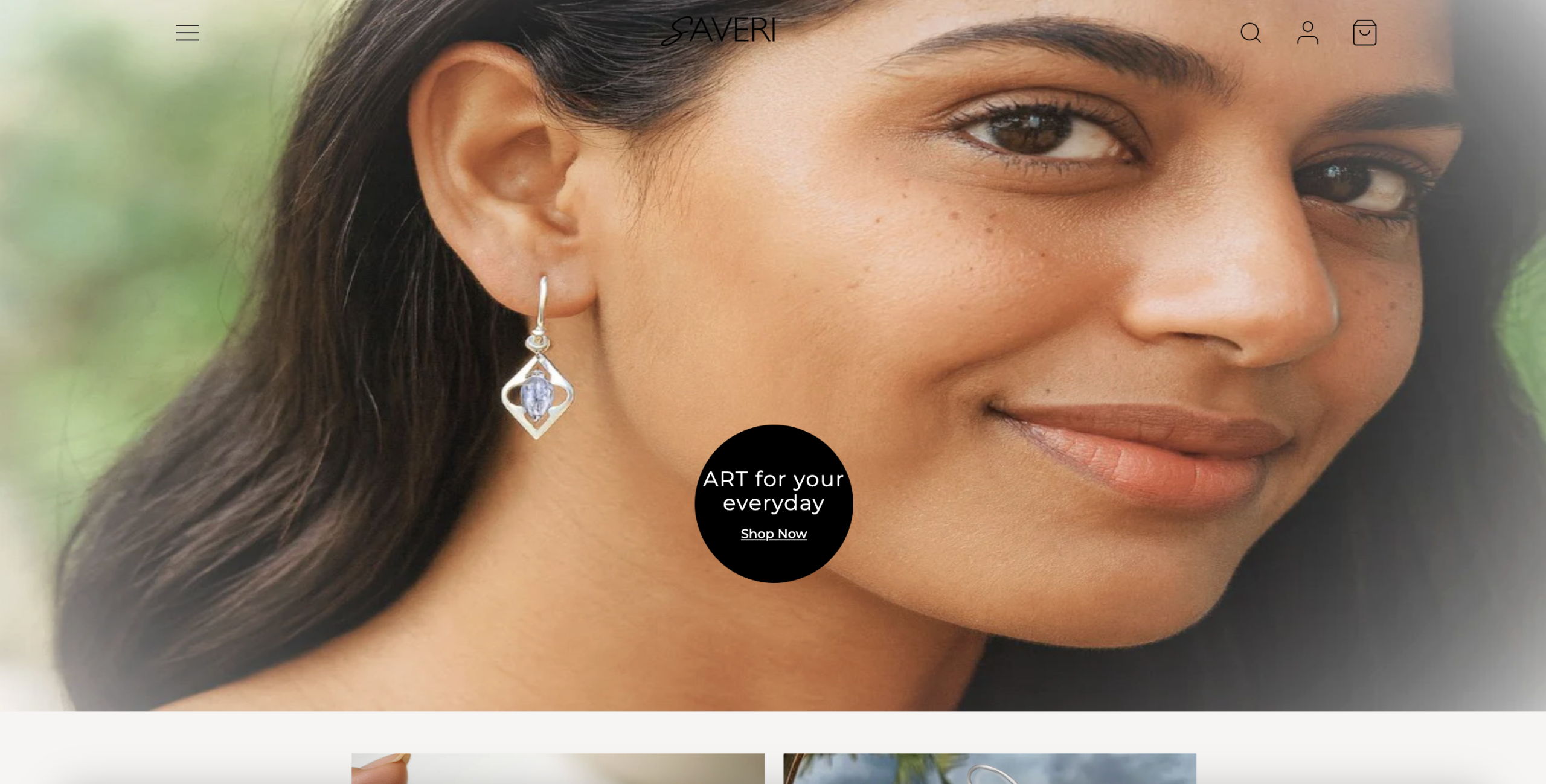
CriticalThe homepage hero “ART for your everyday” delivers the same abstract message to every visitor regardless of acquisition channel or behavioral signals. Paid social traffic, organic product-intent visitors, and direct returning users all encounter identical positioning. This ignores behavioral context.
High-intent visitors need acceleration. Low-intent visitors need persuasion. Gift buyers need reassurance. Comparison shoppers need differentiation. By presenting a single static narrative, the site fails to adapt messaging to visitor intent. This suppresses engagement depth and increases bounce for transactional visitors who expected product clarity immediately.
2. Absence of immediate trust signals
CriticalAbove the fold and in early homepage sections there are no visible trust accelerators: no review count, no rating stars, no shipping reassurance, no warranty claims. For non-household brands, lack of reassurance increases perceived risk, especially in jewelry where material authenticity and return friction matter. Trust hesitation directly suppresses add-to-cart rates.
Introduce a persistent trust strip under the hero and near product CTAs. Display review averages with volume, material certifications (e.g., 92.5 silver), shipping timelines, and return clarity. On product pages, place shipping and returns reassurance directly beneath “Add to Bag” to reduce last-second hesitation.
3. Weak differentiation in a commoditized category
CriticalNothing on the homepage or product page clearly explains why Saveri is uniquely defensible versus Etsy sellers, Amazon brands, or local jewelers. Without strong differentiation, users default to price comparison behavior. In commoditized markets, lack of defensibility compresses margins and weakens brand memory.
Add a dedicated differentiation block high on the homepage outlining craftsmanship, sourcing, design philosophy, or cultural heritage. If applicable, emphasize in-house design, limited production runs, natural gemstones, or artisanal processes. This section must clearly answer: “Why buy from Saveri instead of somewhere else?”
4. Product pages lack persuasive depth
CriticalThe “Infatuation Studs” page is visually clean but conversion-light. Description content is minimal and collapsible, reviews are not prominently visible, and emotional reinforcement is limited. Jewelry purchases require both rational justification (quality, durability) and emotional reinforcement (identity, symbolism). Current structure leaves too much unspoken.
Expand product pages with structured persuasion: 3–5 benefit bullets (“Lightweight for all-day wear,” “Hypoallergenic 92.5 silver”), a short emotional narrative, visible reviews near the CTA, and a “Why you’ll love it” section. Include occasion guidance (“Perfect for daily office wear or gifting”) to reduce buyer uncertainty.
5. Absence of a best-sellers / high ROI strategy
HighDespite offering multiple products, there is no visible “Best Sellers” or “Most Popular” section guiding users toward proven high-performing items. This is a critical UX and revenue optimization mechanism. Most ecommerce stores naturally have a subset of SKUs that drive the majority of revenue. Highlighting these products reduces decision fatigue and accelerates purchase confidence.
Without a clearly featured best-sellers section, users are left to browse a vast inventory without guidance. This increases choice paralysis and weakens conversion efficiency. From a business perspective, if certain items convert better or carry higher margins, prioritizing them strategically can significantly increase overall profitability. The absence of a structured best-sellers strategy suggests missed opportunities in both UX optimization and revenue maximization.
6. Over-indexing on aesthetic storytelling over selling
HighThe homepage features multiple decorative and editorial sections that prioritize brand mood over purchase progression. While visually refined, the structure behaves more like a lookbook than a revenue engine. Excess aesthetic layering increases cognitive load and delays exposure to high-conversion elements.
Bestsellers and high-intent collections should appear soon for first-time visitors. Reduce decorative transitional sections and increase product education early. Every lifestyle block should include a clear purchase pathway and product grid to maintain commercial momentum.
7. No dynamic differentiation between gift buyers and self-purchasers
HighJewelry ecommerce typically has at least two major behavioral segments: self-expression buyers and gift buyers. The homepage and product pages do not appear to differentiate messaging, reassurance, or sequencing based on inferred purchase context.
Gift buyers have higher anxiety around returns, delivery timing, and packaging. Self-purchasers focus more on identity, styling, and repeat usage. When both segments receive the same persuasion architecture, relevance decreases. Lower relevance reduces emotional resonance and purchase confidence, directly impacting conversion rate.
8. Thin SEO content limits qualified traffic
HighThe homepage and product page rely heavily on visual storytelling and minimal text. Headings like “ART for your everyday” and short product descriptions provide very little semantic depth. There is limited keyword-rich, intent-aligned content explaining materials, use cases, categories, craftsmanship, or buyer scenarios.
From an SEO perspective, this creates a discoverability ceiling. Search engines need structured, descriptive language to understand what the site sells and for which queries it should rank. Thin content weakens the ability to capture long-tail commercial intent searches such as “sterling silver topaz studs,” “everyday minimalist silver earrings,” or “gift earrings under 2000 INR.”
Want to unlock the full CRO report?
Get access to all recommendations, benchmarks, and experiment ideas.
Unlock full accessAdapt calls-to-action based on user readiness
CriticalAll visitors are presented with the same primary CTA regardless of engagement level.
Guide undecided users with progressive interactions
HighUsers showing exploration behavior are not guided toward soft commitment actions.
Reduce friction at high-intent conversion points
CriticalHigh-intent visitors face the same experience as early-stage users.
Important note
This audit is based on an automated and heuristic-based analysis of publicly accessible pages. The evaluation follows industry best practices across conversion rate optimization (CRO), usability, analytics, and discoverability.
The findings presented here are directional and indicative in nature. They do not take into account internal data such as revenue performance, customer lifetime value, traffic quality, seasonality, or proprietary tooling.
Recommendations should be interpreted as optimization opportunities rather than absolute assessments. Actual impact may vary depending on audience composition, acquisition channels, and business context.
This report is not exhaustive and should be used as a starting point for further analysis and experimentation.