
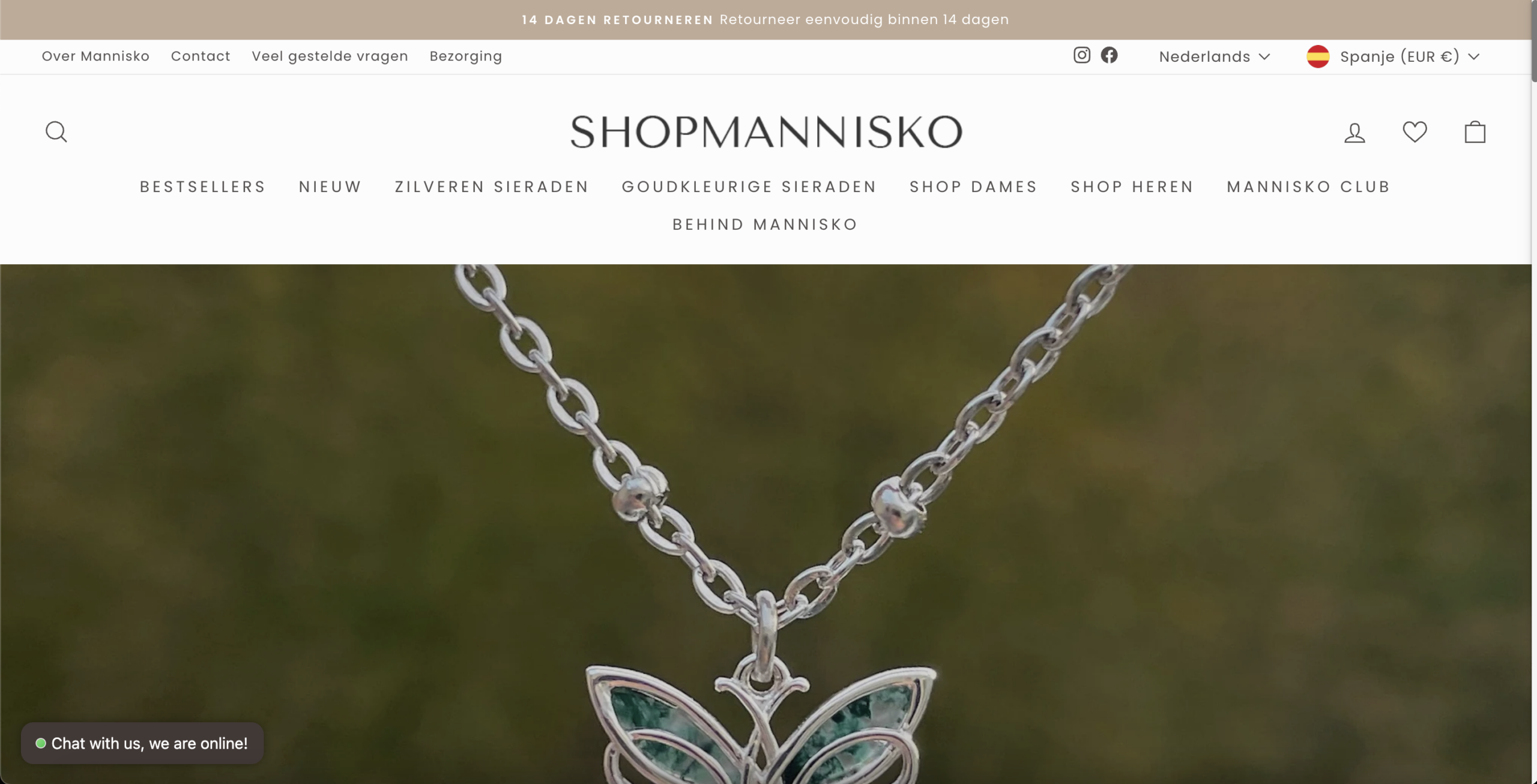
The entire above-the-fold experience on ShopMannisko consists of a full-bleed product photograph with no headline, no value proposition copy, no primary CTA button, and no brand differentiation statement. Visitors arriving from paid social or cold organic traffic have no informational anchor to determine what brand they have landed on, who it is for, or why they should stay. In ecommerce conversion psychology, the hero must perform three jobs in under 5 seconds: establish categorical identity, communicate a reason to engage, and provide a clear directional action. ShopMannisko's hero performs none of them. Even luxury brands that rely on pure visual storytelling, like Cartier or Tiffany, have strong brand recognition that allows imagery to substitute for copy. An unrecognized brand cannot make that trade.
Product pages across the catalog display empty review sections inviting visitors to be the first reviewer, while the site header simultaneously claims 4.9/5 from 900+ reviews. This contradiction is one of the most damaging trust signals in ecommerce: the buyer is told the brand is trusted at scale, then arrives at the specific product they intend to purchase and finds no corroborating proof. Review specificity at the product level is categorically more persuasive than aggregate brand ratings because it answers the precise question the buyer is asking: does this specific item deliver as expected? The absence of product-level reviews forces buyers to extrapolate trust from a brand they do not yet know, an inference most will decline to make.
Product pages show a single image: a wrist-on lifestyle photograph at medium resolution with no close-up of chain construction, clasp mechanism, stone detail, scale reference, or flat-lay against a neutral surface. For a jewelry brand operating in the €15–€35 price range, a tier where perceived quality must be visually justified rather than assumed, this is a catastrophic content gap. Buyers cannot assess material finish, chain thickness, stone quality, or how the piece interacts with light. Visual detail density is the primary proxy for quality perception in fashion and jewelry ecommerce when tactile evaluation is impossible. The current imagery communicates ambiguity, not confidence.
Across the hero, homepage, and product page, there is no articulation of what makes ShopMannisko a distinct choice. The navigation organizes products by material type (silver, gold-colored) and gender (Dames, Heren), the same taxonomy as every generic jewelry store. There is no stated design philosophy, no origin story connected to craft, no material provenance claim, no aesthetic identity anchored in copy. "Gemstone Gallery: the art of nature in jewelry" appears mid-page but is immediately undercut by the generic staging of the rest of the site. In a category with near-zero switching costs and hundreds of direct Shopify competitors, price parity without differentiation means buyers default to whoever ranks first on Google or has the lowest CPA on Meta, a race the brand cannot sustain on unit economics alone.
Product descriptions and FAQs are collapsed behind accordion toggles, invisible to visitors on page load. In conversion psychology terms, copy that requires a deliberate interaction to access has an effective read rate close to zero for cold traffic. Buyers who have not yet decided to purchase will not seek out persuasion; it must be served proactively. Hidden descriptions also strip product pages of crawlable keyword content, preventing them from ranking for long-tail transactional queries that would capture high-purchase-intent organic traffic.
The site defaults to Dutch-language content ("Zilveren Sieraden", "Goudkleurige Sieraden", "Veel gestelde vragen") while simultaneously displaying a mismatched country/currency selection in the header. A visitor whose locale doesn't align with the site language encounters an immediate mismatch signal: either the localization is broken, or the brand has not invested in serving their market. Either interpretation erodes the trust foundation before the visitor has evaluated a single product. In conversion psychology, even minor friction signals in the navigation and header, the first UI elements processed, trigger skepticism that depresses engagement through the entire session. Hreflang configuration issues or an absent geo-IP redirect are the likely technical root.
The "Gratis Cadeautje" (free gift) offer appears approximately 400px below the fold, presented as a soft banner with no urgency framing, no minimum order threshold visible above the fold, and no connection to the buying decision moment. Free gift with purchase mechanics are among the highest-performing AOV levers in jewelry and fashion ecommerce because they shift the mental calculation from "do I want this item?" to "what am I getting for my money?", reframing a purchase decision as a value-extraction opportunity. Positioned where it currently sits, below a large hero image and the site's star rating bar, the majority of high-bounce-rate cold traffic never encounters it.
The primary navigation presents eight items: Bestsellers, Nieuw, Zilveren Sieraden, Goudkleurige Sieraden, Shop Dames, Shop Heren, Mannisko Club, Behind Mannisko. This structure forces every visitor to perform a mental mapping exercise, matching their intent ("I want a gift for someone" / "I want something for a night out" / "I want a statement piece under €30") to an arbitrary material-color taxonomy. Simultaneously, the navigation competes with its own SEO potential: "Zilveren Sieraden" and "Goudkleurige Sieraden" are material descriptors, not search-intent terms. Shoppers searching for "dames armband zilver" or "cadeau voor haar sieraden" will not find category pages optimized to capture that intent in a navigation built around material type.
- All 21 prioritised CRO suggestions with experiment ideas
- Industry benchmarks for your category & traffic level
- Discoverability (SEO + GEO) full audit results
- A/B test hypotheses ready to implement
- Personalised session with a CRO specialist
The findings presented here are directional and indicative in nature. They do not take into account internal data such as revenue performance, customer lifetime value, traffic quality, seasonality, or proprietary testing.
Recommendations should be interpreted as optimization opportunities rather than absolute assessments. Actual impact may vary depending on audience composition, acquisition channels, and business context. This report is not exhaustive and should be used as a starting point for further analysis and experimentation.