
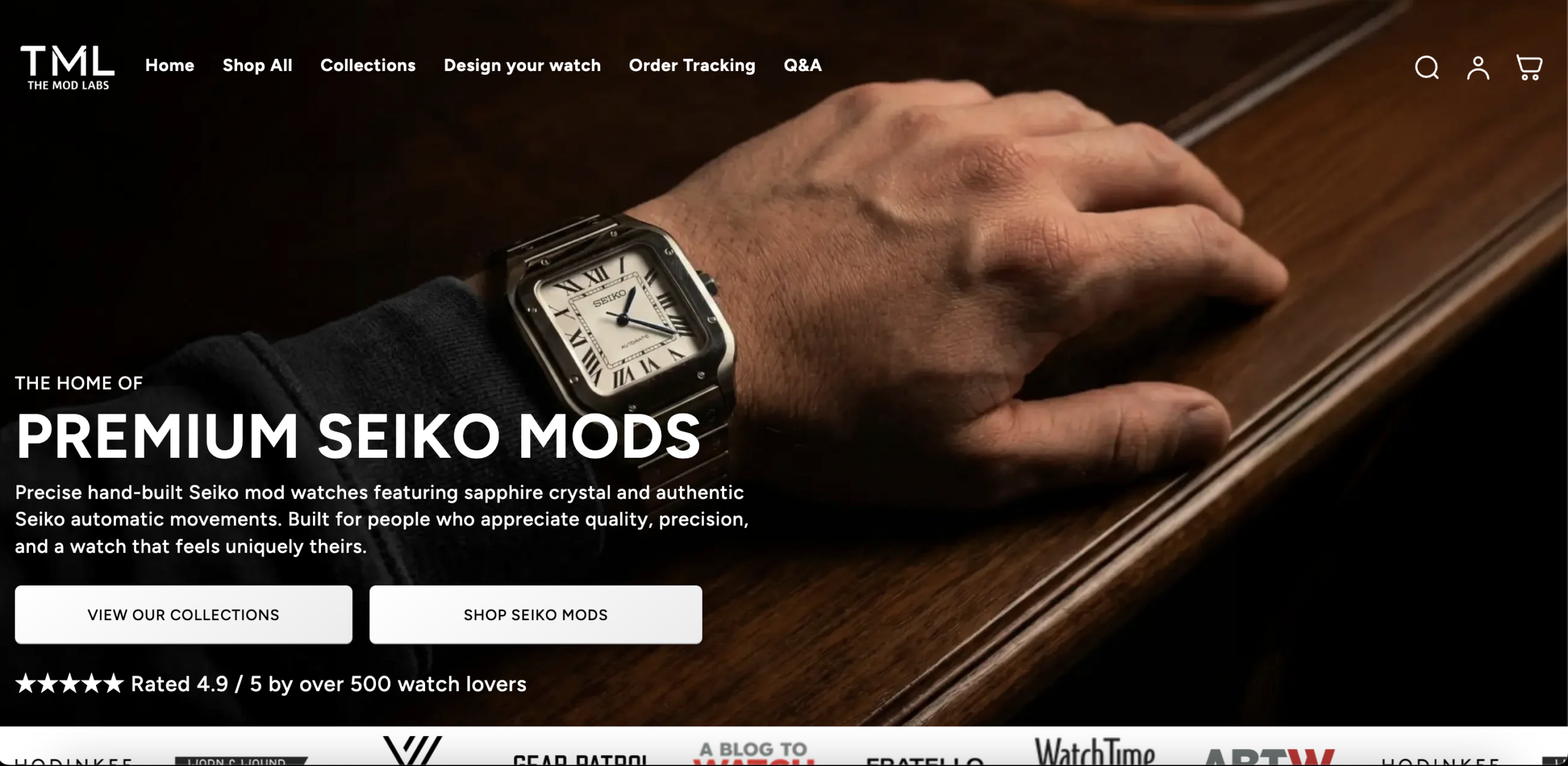
The hero section presents two full-width, visually identical buttons — "View our collections" and "Shop Seiko mods" — with no visual dominance signal separating them. For a visitor arriving with purchase intent, this immediate fork forces a meta-decision before any engagement has occurred. Behavioral economics identifies this as the paradox of choice operating at its smallest and most costly scale: when two options of equal apparent weight are presented simultaneously, a measurable proportion of users select neither, particularly within the 5–8 second evaluation window that governs most first visits. Compounding the problem, the copy distinction between the two CTAs is functionally invisible to a new visitor — browsing collections and shopping mods describe overlapping, near-identical actions with no meaningful difference in promised outcome.
No product page, collection page, or homepage section contains any inventory signal, restock indicator, production-run limit, or time-sensitive availability marker. For a handcrafted watch product where each unit involves individual assembly and custom parts sourcing, the natural scarcity of limited production runs is a commercially legitimate urgency lever that is being entirely suppressed. In the €150–300 premium impulse-adjacent segment, the absence of any purchase velocity trigger means the site depends entirely on buyer-initiated motivation — a passive conversion model that systematically underperforms against the same audience exposed to demand signals. Even factually accurate indicators — production batch size, weeks-to-ship, or current stock levels — would materially reduce browse-without-buy behavior.
The navigation prominently features "Design your watch" — which should represent the highest-ticket, highest-lifetime-value entry point on the site. A visitor arriving from a Seiko mod community looking for a bespoke build is the most commercially valuable prospect the brand can attract. Yet this CTA leads to a destination without the trust infrastructure that a custom order purchase requires: no examples of previous custom builds with outcome imagery, no lead time expectations, no price range indicator, no testimonials from custom order buyers, and no clear articulation of the process from consultation to delivery. A custom watch purchase carries substantially higher perceived risk than an off-the-shelf product and requires more persuasion architecture, not less.
The homepage and collections page present twelve distinct watch families in a uniform grid with short lifestyle taglines, but no price range indicators, no "best seller" markers, no editorial positioning distinguishing entry-level from premium tiers, and no indication of which collection represents the brand's signature offering. A visitor with €200–350 to spend on a custom mod watch has no guidance on where in the catalog their budget aligns or which collection would best match their intent. Flat catalog presentation treats all twelve options as equally relevant — a structure that increases decision paralysis risk and reduces click-through to any individual product page. Revenue-optimized catalog architecture uses social proof signals, editorial hierarchy, and selective price anchoring to route the majority of visitors toward the two or three collections with the highest conversion rate and AOV.
The above-the-fold section carries a scrolling marquee of notable watch media logos — including Hodinkee, Gear Patrol, Watch Time, ABTW, and others — which represent substantial credibility signals within the watch enthusiast community. A mention in any of these publications carries meaningful third-party authority. However, no pull quote, article excerpt, publication date, or link to source material is attached to any logo. The media strip functions purely as logo-display rather than substantiated editorial proof. A skeptical first-time buyer from a paid channel has no way to verify what was said, in what context the brand was featured, or when the coverage occurred — which significantly reduces the trust transfer these logos are capable of generating.
Product pages feature brand narrative copy and quality callout icons — sapphire crystal, genuine Seiko movements, stainless steel — but the written description text is brief and emotionally generic. Absent from the visible product page content are: the specific movement reference, water resistance depth in ATM, crystal type, case and lug dimensions, lug width for aftermarket strap compatibility, bracelet clasp mechanism, and any comparison to what an equivalent Swiss aesthetic costs from a recognized manufacturer. For a €150–300+ purchase from a brand the buyer has not transacted with before, the description must resolve the questions that justify the price to the buyer, and — in gifting scenarios — to a partner or recipient. Buyers who cannot answer these questions from the product page do not convert; they research elsewhere and often do not return.
The product page displays a horizontal icon strip — warranty, inclusive shipping, premium quality, genuine Seiko — positioned below the product images, but no returns policy detail, no exchange window, no satisfaction guarantee language, and no "what if the sizing is wrong?" reassurance appears in proximity to the add-to-cart button. For a watch purchase, fit is a specific and legitimate purchase concern: bracelet length, lug width, and case profile all affect wearability, and a buyer unfamiliar with Seiko mod sizing will carry unresolved anxiety into the checkout decision. The trust icon strip signals the intent of risk reduction without delivering the actual content — a distinction that motivated buyers notice and that suppresses conversion particularly among first-time buyers from paid traffic.
The twelve product collections are named with invented brand-specific terms — Gmteiko, Nautiko, Santeiko, Seikjust, Seitona, Royal Seioak, Seikjust Daydate, Seikmaster, Skyjust, Seikmarinar, Paneiko, Seiknaut. While these naming conventions are internally memorable and carry coherent brand logic, they carry no search equity because no buyer is searching for them. The watch-buying audience searches by reference style ("Seiko diver mod", "Panerai-style Seiko mod", "Seiko Datejust inspired"), by use case ("everyday Seiko mod", "dress watch Seiko mod"), and by component specification ("sapphire crystal Seiko mod under €200"). The absence of this search-aligned language in collection names, H1 headings, and page copy means the site cannot capture the informational and transactional queries that drive discovery by buyers who do not already know the brand.
- All 20 prioritised CRO suggestions with experiment ideas
- Industry benchmarks for your category & traffic level
- Discoverability (SEO + GEO) full audit results
- A/B test hypotheses ready to implement
- Personalised session with a CRO specialist
The findings presented here are directional and indicative in nature. They do not take into account internal data such as revenue performance, customer lifetime value, traffic quality, seasonality, or proprietary testing.
Recommendations should be interpreted as optimization opportunities rather than absolute assessments. Actual impact may vary depending on audience composition, acquisition channels, and business context. This report is not exhaustive and should be used as a starting point for further analysis and experimentation.