

B2B E-commerce
Revenue & sales
Fabric House is an international textile company specializing in premium Italian fabrics and designer deadstock materials. Through its e-commerce platform and physical showrooms across Europe, the company serves fashion brands, designers, and creative professionals looking for high-quality and sustainable textiles. By giving surplus fabrics from established manufacturers a second life, Fabric House combines traditional textile expertise with a modern, digital-first distribution model.
The challenge: hard to guide buyers through a high-complexity catalog
Fabric House offers an impressive range of premium fabrics. But that strength was also creating friction.
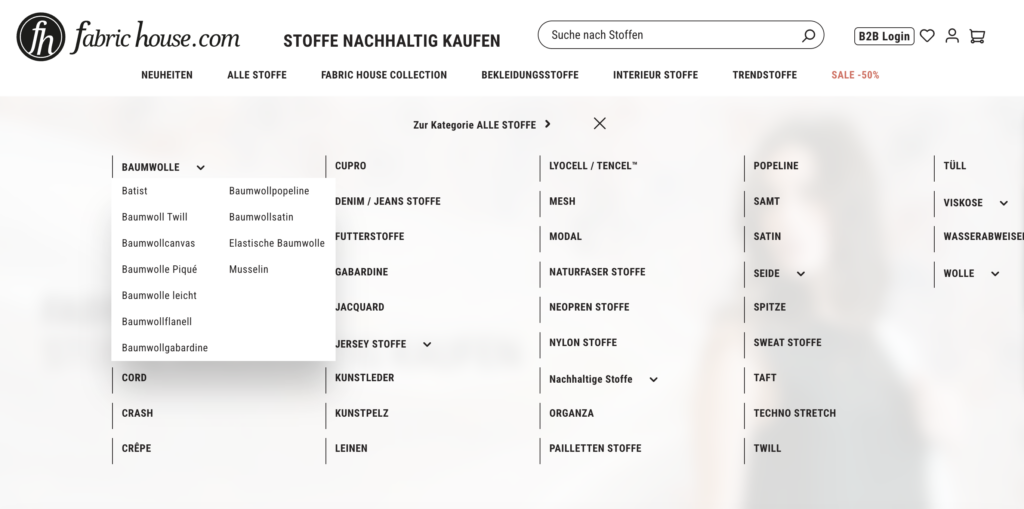
The navigation is structurally complex: Dozens of fabric categories, technical textile names, multiple sub-groups. For someone who already knows exactly what they’re looking for, the experience might work, but for a first-time visitor, it’s overwhelming.
When users land on the website, they are immediately faced with a wide matrix of options: cotton, cupro, jacquard, gabardine, lyocell, neoprene, twill, satin, organza, and many more. Without deep textile knowledge, it’s difficult to know where to begin.
This created three core issues:
- Choice overload, increasing bounce risk
- Decision fatigue before even reaching product pages
- High-value wholesale buyers navigating the same exploratory flow as small retail shoppers
The problem wasn’t traffic, but rather the lack of guidance.
Fabric House needed a way to help visitors quickly orient themselves, reduce friction, and guide them toward the right products, without simplifying the catalog or restructuring the website.
The solution: AI-powered, automated personalized guidance
Instead of redesigning the website or reducing the number of categories, Fabric House introduced Pathmonk as an intelligent guidance layer on top of the existing structure to simplify decision making.
As a pilot, Fabric House started with their German subdomain to validate impact in a controlled environment before scaling across other markets. By isolating one language and audience, the team could measure performance cleanly, optimize the setup, and build a proven framework for rollout.
Pathmonk analyzed visitor behavior in real time and deployed microexperiences designed to:
- Help first-time visitors orient themselves faster
- Reduce choice overload
- Identify high-intent and bulk buyers early in the journey
- Guide users toward the most relevant fabric categories
At the center of the strategy was a Product Selector: a guided experience that asked simple, structured questions to understand what the visitor was actually looking for.
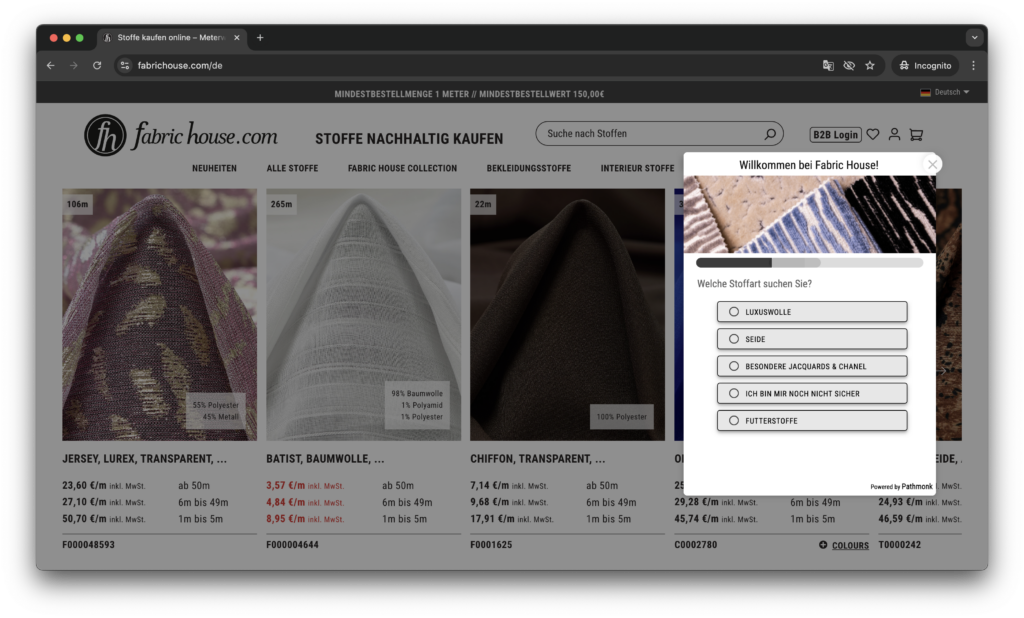
Instead of forcing users to navigate dozens of technical categories on their own, the selector helped them navigate through the catalogue. For example, rather than choosing between “cupro,” or “jacquard,” visitors could answer intent-based questions about fabric characteristics or what they wanted to create.
Based on those signals, Pathmonk dynamically guided them toward the most relevant products.
To drive traffic into the Product Selector, Pathmonk deployed different microexperiences dynamically based on real-time intent signals and funnel stage.
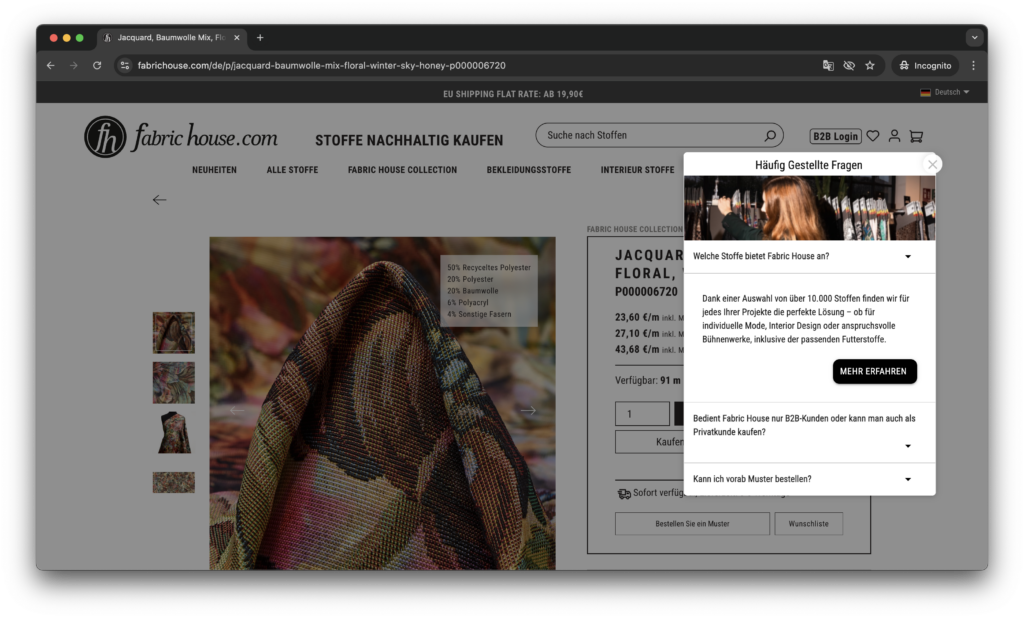
Depending on user behavior, visitors were shown tailored entry points such as an introductory video, customer testimonials, FAQs, or brand trust content.Each microexperience was personalized to the visitor’s decision stage, but all shared a single objective: directing users to open the Product Selector.
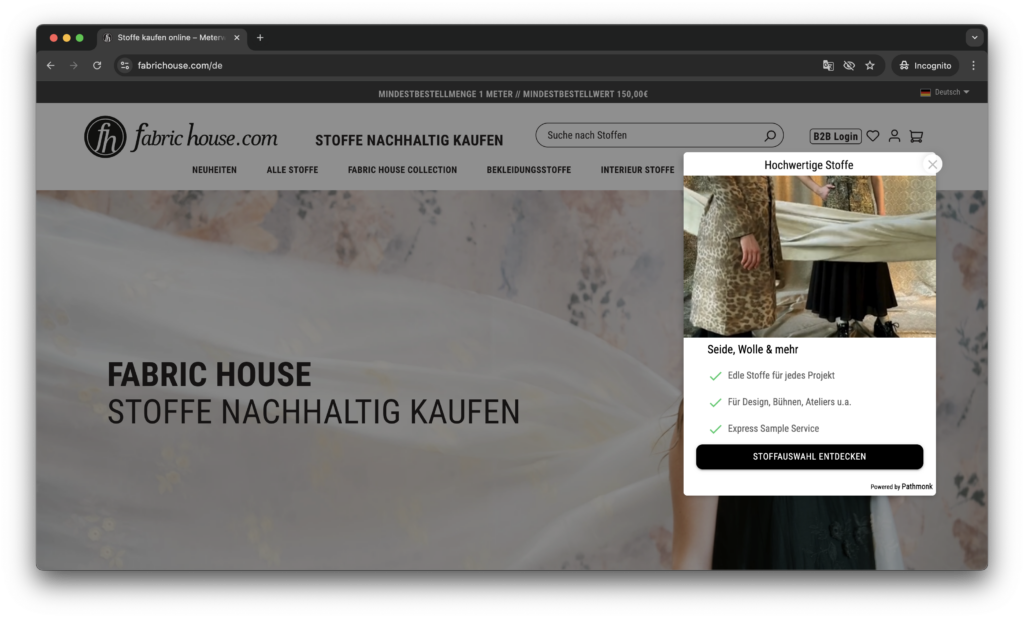
This ensured consistent progression toward guided product discovery while adapting messaging to individual intent.
Why did Fabric House choose Pathmonk instead of more traditional CRO tools such as Dynamic Yield, ContentSquare, Mutiny, Drift, Gong, or ClickFunnels?
- Money-back guarantee: To make the decision risk-free, Pathmonk offered them a money-back guarantee: if the traffic exposed to Pathmonk did not deliver at least a 20% uplift, the investment would be fully refunded. This allowed the team to test Pathmonk with confidence and focus purely on measurable impact.
- Speed to value with no dev dependency: Unlike traditional CRO platforms that require coding, design work, or heavy onboarding, Pathmonk could be installed via GTM in minutes and immediately began learning from visitor behavior. This meant no delays, no dev tickets, and no friction, just fast results.
- Fast setup: Pathmonk offers flawless integration with various CRM systems, enabling easy synchronization and streamlined data management.
- Cookieless technology: Pathmonk operates without the use of tracking cookies, adhering to privacy regulations and catering to user preferences for enhanced data security.
The results: +78% revenue uplift in just one week
Within the first week of running Pathmonk on the German subdomain, Fabric House recorded a clear and measurable performance increase.
✅ +36% conversion uplift
✅ +78% revenue uplift
What makes this especially significant is that revenue grew significantly compared to conversions.
While conversions increased by 36%, revenue increased by 78%. This indicates that Pathmonk didn’t just generate more purchases, it successfully guided higher-value buying behavior, increasing average order value.
The funnel comparison further confirms this impact across the journey:
- +21.4% uplift at awareness stage
- +25% uplift at consideration
- +28.5% uplift at decision
Rather than improving only bottom-of-funnel performance, Pathmonk strengthened progression at every stage, from discovery to purchase.
How can we measure the exact impact of Pathmonk?
To ensure reliable attribution, Fabric House followed Pathmonk’s recommended A/B testing setup by activating personalization on 50% of total traffic:
- Control group (disabled): standard website experience
- Pathmonk group (enabled): visitors exposed to Pathmonk’s AI-driven micro-experiences
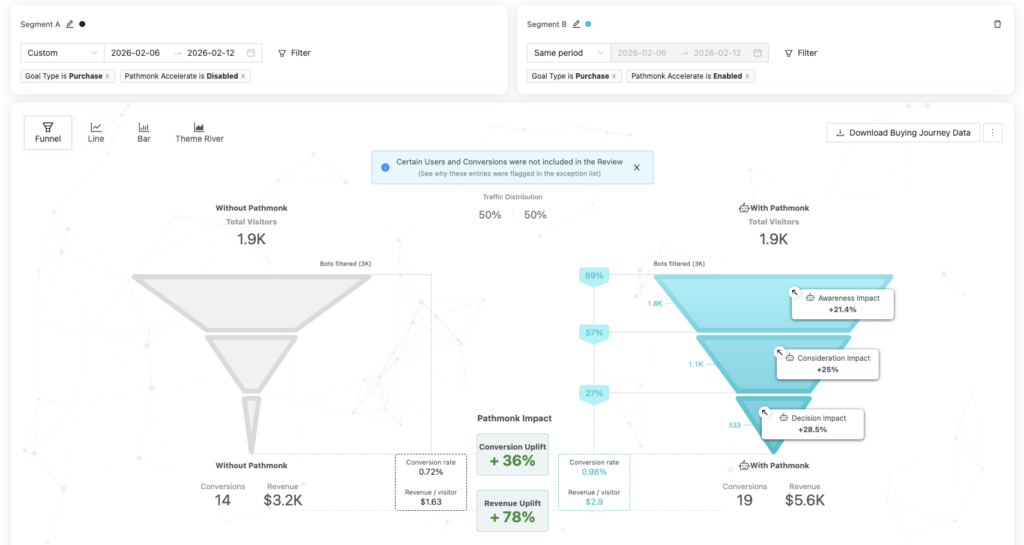
Both groups received traffic of equal quality during the same time period. This clean split allowed Fabric House to isolate the true incremental impact of Pathmonk, ruling out seasonality, external campaigns, or traffic fluctuations.
The uplift measured in the German market serves as a replicable model. Since the setup is language-based and modular, the same strategy can be rolled out country by country through additional Pathmonk accounts, each optimized for a specific language and market.
Next steps: scaling personalization across markets
Because each market operates in a different language and attracts slightly different customer profiles, Fabric House’s next step is to scale Pathmonk by creating additional accounts per language/country, allowing each market to be optimized independently with its own goal, messaging, and behavioral data.
The initial setup will remain dedicated to optimizing the German e-commerce experience and identifying high-value wholesale intent through intent-based microexperiences and the Product Selector.
By separating accounts by market, Fabric House can:
- Maintain precise targeting and personalization in each language
- Avoid mixing behavioral signals across countries
- Keep attribution clear and performance measurable per region
- Scale conversion and revenue uplift market by market using the same proven framework
Get your website’s conversion score in minutes
- Instant CRO performance score
- Friction and intent issues detected automatically
- Free report with clear next steps