
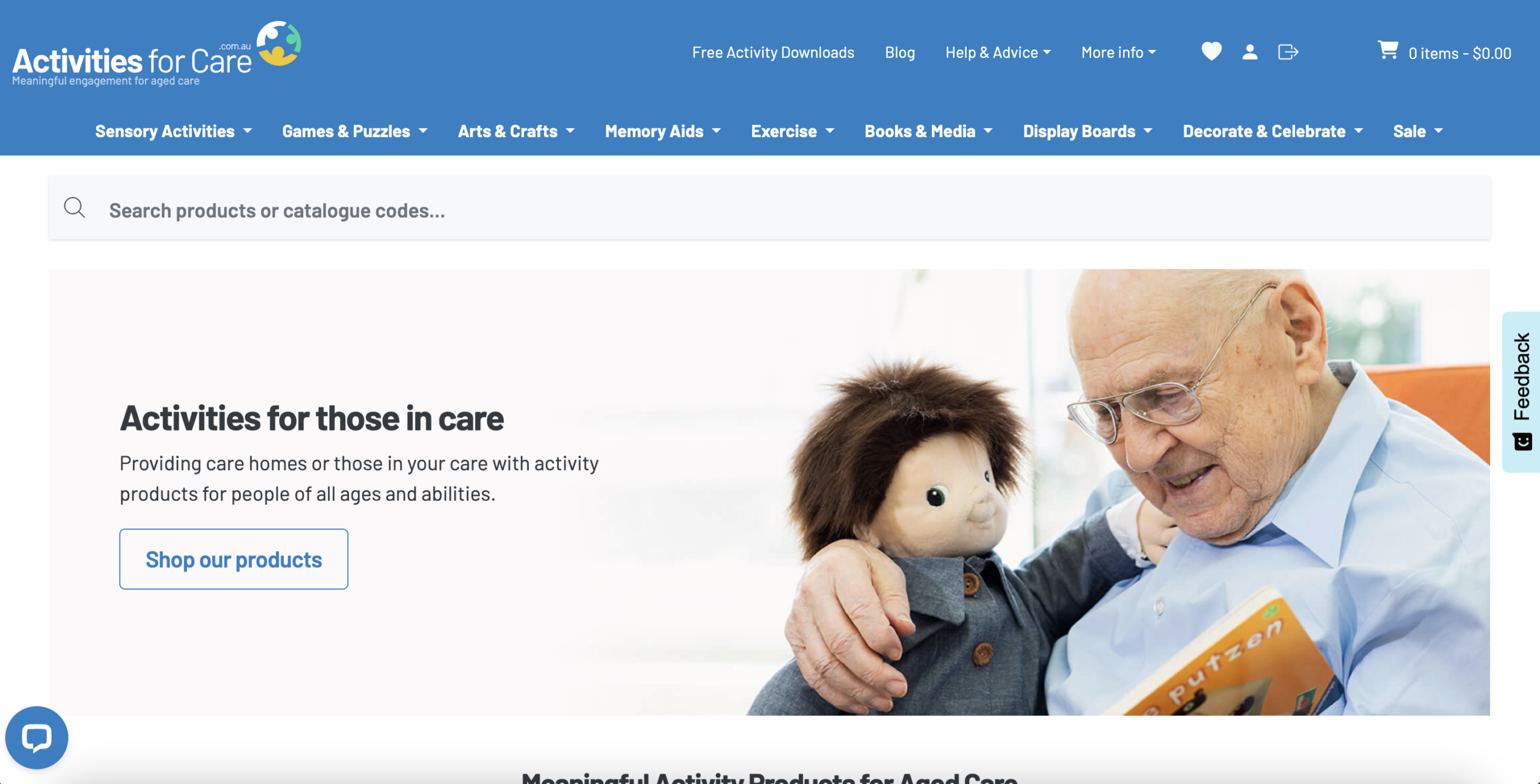
Full report | New design

Pathmonk
CRO Audit
Activities for Care
activitiesforcare.com.au
Health & Care Australia WooCommerce
Audit performed Feb 16, 2026  ·  Report version 1.0  ·  21 CRO suggestions identified
Activities for Care
Overall Score
42
Based on 67 criteria
Conversion & Growth
i
Conversion & Growth
This site
38%
Category avg
61%
Top failures
No trust signals above the fold
No B2B or bulk purchase pathway
No cart abandonment recovery
38%
Analytics & Tracking
i
Analytics & Tracking
This site
55%
Category avg
68%
Top failures
No session recording tool (Hotjar / Clarity)
No email marketing platform connected
Mobile PageSpeed score of 29/100
55%
UX & Engagement
i
UX & Engagement
This site
33%
Category avg
58%
Top failures
No clear visual hierarchy above the fold
Mobile menu not thumb-friendly (71% of traffic)
Product pages broken on mobile
33%
Discoverability (SEO + GEO)
i
Discoverability
This site
43%
Category avg
55%
Top failures
Not mentioned in any AI search response
Domain Rating 18 vs category avg of 34
No product schema or structured data
43%
Executive Summary
Activitiesforcare.com.au is leaving an estimated $180,000–$240,000 in annual revenue on the table.
A CRO score of 42/100 places this site in the bottom quartile for health & care e-commerce. The findings below identify where visitors are dropping off — and what fixing it is worth.
Top 5 Critical Findings
Priority Action Plan
Top 5 Critical Findings
These are the highest-impact issues identified across the audit. Fixing these five alone would meaningfully move conversion rate, average order value, and organic visibility.
01 Critical UX & Engagement
Navigation overload is killing first impressions
9+ top-level navigation categories greet first-time visitors with no intent-based entry points. In a category where buyers have a specific need — dementia activities, sensory tools, care home kits — forcing them to browse an undifferentiated menu creates immediate cognitive overload. The navigation was built for the site owner's mental model, not the buyer's journey.
Fix with Pathmonk Automatically done for you

Pathmonk overlays intent-based navigation prompts onto the existing site without any structural redesign.

  • Detects visitor intent from referral source, search query, and behavioural signals
  • Surfaces contextual entry points matching the visitor's likely need (e.g. dementia, sensory, care home)
  • Dynamically reorders navigation prominence based on session intent tier
  • No dev work or site restructure required
Operational Impact: Zero navigation redesign needed. Intent-matched entry points activate automatically from day one.
Fix on your own

Restructuring navigation manually requires audience research, IA work, and dev implementation.

  1. Audit top landing pages and map the 3–4 primary buyer intents
  2. Redesign top nav around audience or condition (e.g. "For Dementia", "For Care Homes")
  3. Add intent-based hero CTAs aligned to top buyer segments
  4. A/B test new navigation structure vs current
  5. Monitor bounce rate and pages-per-session to validate
Operational Cost: Requires UX design, developer time, and ongoing A/B testing governance.
View in UX & Engagement deep dive →
02 Critical Conversion & Growth
No trust signals above the fold
Zero testimonials, review counts, trust badges, or care home logos are visible without scrolling. In aged care, purchasing decisions carry significant emotional weight — buyers need immediate reassurance that they are sourcing from a credible, specialist provider. The current homepage forces trust to be built through browsing rather than communicated upfront.
Fix with Pathmonk Automatically done for you

Pathmonk injects contextually timed trust signals based on visitor behaviour — surfacing the right proof at the right moment.

  • Automatically surfaces testimonials matched to visitor intent stage
  • Triggers trust overlays when exit intent or hesitation signals are detected
  • Reorders social proof based on what's converting for similar visitor profiles
  • No homepage redesign required
Operational Impact: Trust signals activate in real time without any manual page editing or developer involvement.
Fix on your own

Adding trust signals manually requires design, copy, and dev work to update the homepage.

  1. Collect and curate 3–5 strong care home or buyer testimonials
  2. Add a star rating + review count strip below the hero headline
  3. Add a logo bar featuring recognisable care organisations
  4. Include trust badges adjacent to the primary CTA
  5. A/B test placement and format against current homepage
Operational Cost: Requires homepage redesign, copywriting, and dev implementation. Ongoing review collection needed.
View in Conversion & Growth deep dive →
03 Critical Conversion & Growth
B2B buyers have no conversion path
There is no "For Organisations" page, no bulk pricing pathway, no enquiry form, and no indication that care home procurement teams are catered for. Institutional buyers likely represent a disproportionate share of revenue potential — purchasing in volume for multiple residents — yet the site provides no conversion path for them whatsoever.
Fix with Pathmonk Automatically done for you

Pathmonk identifies B2B visitor signals and automatically routes them toward the highest-value conversion action.

  • Detects organisational intent from domain type, UTM source, and session behaviour
  • Surfaces a dedicated B2B enquiry prompt for visitors showing procurement-level intent
  • Captures lead data without requiring a separate B2B landing page
  • Routes high-value leads directly into CRM or email follow-up sequences
Operational Impact: B2B leads captured immediately — no new page build or dev resource required.
Fix on your own

Building a manual B2B pathway requires dedicated pages and lead capture infrastructure.

  1. Create a dedicated "For Care Homes & Organisations" landing page
  2. Add bulk pricing tiers or a quote request form
  3. Link from homepage navigation and product pages
  4. Set up a CRM or email follow-up sequence for enquiries
  5. Add a persistent "Organisation enquiries" CTA in the site header
Operational Cost: Requires page design, copywriting, form integration, and CRM setup.
View in Conversion & Growth deep dive →
04 Critical Conversion & Growth
Cart abandonment has no recovery mechanism
No abandoned cart email sequence, exit-intent offer, or retargeting pixel is in place. Industry benchmarks put cart abandonment rates for care/health e-commerce at 72–78%. Without any recovery mechanism, every abandoned session is permanently lost revenue. Recovery sequences typically recapture 5–15% of abandoned carts with minimal ongoing effort.
Fix with Pathmonk Automatically done for you

Pathmonk intercepts abandonment intent in real time — before the visitor leaves — using behavioural signals to trigger the right recovery prompt.

  • Detects exit intent, scroll reversal, and session hesitation at cart stage
  • Triggers personalised retention messages before abandonment occurs
  • Surfaces time-limited offers or reassurance prompts based on cart value
  • Captures email for follow-up if the visitor still exits
Operational Impact: Abandonment recovery activates automatically. No email platform setup or sequence management required.
Fix on your own

Manual abandonment recovery requires an email platform, sequence setup, and ongoing optimisation.

  1. Install Klaviyo or equivalent email marketing platform
  2. Set up WooCommerce abandoned cart tracking integration
  3. Build a 3-email recovery sequence (1hr, 24hr, 72hr)
  4. Add an exit-intent popup with a discount or free shipping offer
  5. Install a retargeting pixel for Meta or Google re-engagement
  6. Monitor recovery rate and optimise sequence copy monthly
Operational Cost: Requires email platform subscription, dev integration, copywriting, and ongoing optimisation.
View in Conversion & Growth deep dive →
05 High UX & Engagement
Product pages don't support the buying decision
Product pages contain minimal descriptions with no use cases, care setting context, suitability guidance, or social proof. For a category where buyers need to match items to specific resident needs — cognitive ability, physical limitation, care setting — thin product content creates uncertainty that kills purchase intent. Buyers who are unsure simply leave.
Fix with Pathmonk Automatically done for you

Pathmonk dynamically surfaces the most relevant product information based on the visitor's intent profile.

  • Identifies whether the visitor is a care professional, family member, or institutional buyer
  • Surfaces the most decision-relevant content for that intent type
  • Injects contextual social proof — reviews from buyers with similar profiles
  • Triggers guided product selector prompts for undecided visitors
Operational Impact: Product page relevance improves for every visitor type — no content rewrite or redesign required.
Fix on your own

Improving product pages manually requires a content audit and systematic rewrite across the catalogue.

  1. Audit top 20 product pages for description depth and suitability guidance
  2. Add "Suitable for" tags (condition, mobility level, care setting)
  3. Rewrite descriptions: who is it for, what does it do, what outcome does it deliver
  4. Add lifestyle imagery showing the product in a real care setting
  5. Integrate a review request sequence post-purchase to build social proof
Operational Cost: Significant copywriting time across full product catalogue. Photography investment for lifestyle imagery.
View in UX & Engagement deep dive →
Category Deep Dive
Conversion & Growth
This category evaluates how effectively the site transforms traffic into measurable business outcomes — covering positioning clarity, persuasion depth, pricing psychology, purchase acceleration, and commercial intent signalling.
38%
Conversion Readiness Score
Category avg: 61%
Strategic Implication
Revenue potential is structurally constrained by positioning ambiguity, insufficient trust signal density, and limited decision-stage reinforcement. Scaling traffic under current site architecture risks higher bounce rates rather than compounded revenue efficiency. Fixing conversion fundamentals before investing in acquisition is the highest-ROI path forward.
Value proposition clarity above the fold
Visitor immediately understands what the site sells, for whom, and why it's the right choice — without scrolling.
Target audience clearly identified on homepage
The homepage explicitly addresses its buyer — care staff, families, or care home organisations — rather than a generic visitor.
Primary CTA above the fold
A single dominant call-to-action is visible without scrolling, directing visitors toward a clear next step.
CTA copy is specific and outcome-driven
Button copy communicates a specific action or benefit (e.g. "Find Activities for Dementia") rather than generic labels like "Click Here" or "Learn More".
Hero image relevant to the audience
Homepage hero imagery reflects the actual use context — care settings, elderly users, or activity scenarios — building immediate relevance.
Trust badges visible
SSL certificate, money-back guarantee, secure payment logos, or return policy icons are visible on the homepage or product pages.
Testimonials or reviews on homepage
Customer or care home testimonials are featured on the homepage to establish credibility before the visitor navigates deeper.
Social proof on product pages
Star ratings and review counts are visible on product pages, providing peer validation at the point of purchase decision.
Pricing visible on product listings
Prices are displayed on category/listing pages without requiring the visitor to click into each product to see the cost.
Shipping cost visible before checkout
Delivery costs or a free shipping threshold are communicated on product pages or the cart — before the visitor reaches checkout.
Guest checkout available
Visitors can complete a purchase without being required to create an account or log in first.
Checkout completed in 3 steps or fewer
The full purchase journey from cart to order confirmation requires no more than 3 distinct steps or page loads.
Payment method breadth
At least 3 payment options are available — e.g. credit/debit card, PayPal, and a Buy Now Pay Later option such as Afterpay or Zip.
Sticky Add-to-Cart on product pages
The purchase CTA remains accessible during product page scroll — via a sticky bar or fixed button — on both desktop and mobile.
Cart upsell or cross-sell present
The cart or checkout page suggests complementary products, bundles, or frequently bought together items to increase order value.
Urgency or scarcity signals
Stock level warnings ("Only 3 left"), limited-time offers, or demand indicators are used to motivate purchase decisions.
Return and refund policy visible
A clear return/refund policy is accessible from product pages or the footer, reducing purchase anxiety for first-time buyers.
Contact information visible
A phone number, email address, or live chat option is clearly accessible — increasing trust and reducing pre-purchase hesitation.
B2B or bulk purchase pathway exists
Care homes and organisations can find a dedicated pathway for bulk orders, wholesale pricing, or account enquiries.
Exit-intent or on-site lead capture
An exit-intent popup, discount offer, or email capture mechanism is present to recover visitors before they leave the site.
Product photography quality
Products are shown from multiple angles with at least one lifestyle or in-context image showing the product in a care setting.
Product descriptions address buyer questions
Descriptions go beyond specifications to answer key questions: who is it for, what condition does it suit, and what outcome does it deliver.
Variant selector clarity
Size, type, colour, or other product variants are presented clearly with visual selectors — not just dropdown text menus.
Related or recommended products on product pages
Each product page surfaces relevant alternatives or complementary items to keep the visitor engaged and increase basket size.
Recently viewed products feature
A "recently viewed" section helps returning or browsing visitors quickly return to products they've already shown interest in.
Breadcrumb navigation present
Breadcrumbs on category and product pages allow visitors to orient themselves and navigate back without using the browser back button.
Promotional banners or offers visible
Active promotions, seasonal offers, or discount codes are communicated prominently — ideally in a header bar or hero section.
Free shipping threshold communicated
If free shipping is available above a spend threshold, this is clearly communicated in the cart or site header to incentivise higher order values.
Newsletter or loyalty programme signup visible
An email signup or loyalty programme is surfaced to capture visitors not yet ready to purchase, enabling future re-engagement.
Mobile checkout experience
The checkout flow is fully usable on mobile — thumb-friendly buttons, no pinch-zoom required, and form fields are appropriately sized.
Category Deep Dive
Analytics & Tracking
This category evaluates whether the site has the instrumentation needed to measure its own performance — covering tag installation, traffic analysis, and technical page speed.
55%
Analytics Readiness
Category avg: 68%
Strategic Implication
The site has basic analytics instrumentation but is missing critical behavioural tracking tools and advertising pixels. Without session recording, heatmaps, or A/B testing infrastructure, optimisation decisions are being made blind. Traffic quality signals suggest room for significant engagement improvement before investing further in acquisition.
Google Analytics 4 installed
GA4 tag detected — core analytics instrumentation is in place.
Google Tag Manager present
GTM container detected — tag management infrastructure exists for deploying additional tracking without code changes.
Meta / Facebook Pixel installed
Meta Pixel detected — retargeting and conversion tracking for Facebook/Instagram campaigns is enabled.
Google Ads conversion tag present
No Google Ads conversion tracking detected — paid search campaigns cannot be optimised for purchase conversions.
Session recording tool installed
No Hotjar, Microsoft Clarity, or equivalent detected — there is no visibility into how visitors actually interact with pages.
A/B testing tool detected
No A/B testing platform detected — conversion experiments cannot be run without additional infrastructure.
Cookie consent / CMP platform present
A cookie consent banner is present — basic compliance with privacy regulations is in place.
Remarketing pixel present
At least one remarketing pixel detected — retargeting audiences can be built from site visitors.
Email marketing platform connected
No Klaviyo, Mailchimp, or equivalent detected — email capture and automation infrastructure is absent.
Live chat tool installed
No live chat or support widget detected — real-time visitor assistance and lead capture is unavailable.
Monthly Visits
24.3K
↓ 8% vs prev. 3 months
Bounce Rate
68%
Category avg: 48%
Avg. Visit Duration
2m 14s
Category avg: 3m 42s
Pages per Visit
3.2
Category avg: 4.8
Mobile vs Desktop
71%
Mobile share of visits
Mobile 71%Desktop 29%
Traffic Source Breakdown
Organic Search
52%
Direct
28%
Referral
10%
Social
7%
Paid
3%
📱 Mobile
29
Performance Score
🖥 Desktop
60
Performance Score
LCP Largest Contentful Paint
6.2s
Poor — target <2.5s
CLS Cumulative Layout Shift
0.18
Needs improvement — target <0.1
INP Interaction to Next Paint
180ms
Good — target <200ms
TTFB Time to First Byte
1.4s
Needs improvement — target <0.8s
Category Deep Dive
UX & Engagement
This category evaluates the quality of the user experience across the three audited pages — above the fold, homepage, and product page — assessing visual clarity, readability, mobile usability, and layout quality.
33%
UX Readiness
Category avg: 58%
Strategic Implication
The site suffers from layout inconsistency, low visual hierarchy, and significant mobile usability gaps. Visitors on mobile — which accounts for 71% of traffic — encounter a degraded experience that directly suppresses conversion. Addressing UX fundamentals across the three core pages would have an outsized impact on engagement and time on site before any additional traffic investment.
Visual hierarchy is clear
The eye is guided naturally to the most important element — headline, then CTA — without competing for attention.
Hero section is uncluttered and focused
The hero communicates a single clear message without being crowded by navigation, banners, or competing elements.
No intrusive popups blocking content on arrival
Visitors are not immediately interrupted by a modal, cookie wall, or overlay before seeing the page content.
Page load feels fast subjectively
The page renders content quickly enough that a visitor does not perceive a loading delay — consistent with the PageSpeed score of 29/100 on mobile.
Consistent visual design language throughout
Fonts, colours, spacing, and component styles are consistent across all homepage sections.
Whitespace and layout density feels balanced
Content sections are appropriately spaced — not too crowded or too sparse — creating a comfortable reading experience.
Typography is readable and well-sized
Body text is legible at default zoom on desktop — adequate font size, line height, and contrast.
Colour contrast meets basic accessibility standards
Text and interactive elements have sufficient contrast ratio against their backgrounds (WCAG AA minimum).
Search bar visible and accessible
A search input is prominently accessible from the homepage without requiring navigation.
Navigation labels are intuitive and descriptive
Menu items use plain language that matches what visitors expect — not internal jargon or overly creative labels.
Footer is organised and comprehensive
The footer provides quick access to key pages — policies, contact, categories — in a structured layout.
Mobile menu is usable
The hamburger or mobile menu opens correctly, is navigable by thumb, and does not obscure key content.
No horizontal scroll on mobile
The homepage fits within the mobile viewport width without triggering unintended horizontal scrolling.
Text readable without zooming on mobile
Font sizes are large enough to read comfortably on a mobile device without requiring pinch-to-zoom.
Images load correctly on mobile
Homepage images render without distortion, cropping issues, or layout-breaking overflow on mobile screens.
Buttons are thumb-friendly on mobile
Tap targets on the homepage meet the minimum 44×44px recommended size for comfortable mobile interaction.
Product title is descriptive and specific
Product names communicate what the item is, who it's for, and any key differentiating attribute — not just a generic label.
Multiple product images present (3+)
Each product page shows at least 3 images covering different angles or views of the product.
Lifestyle or in-context imagery present
At least one image shows the product being used in a real care setting, helping buyers visualise practical use.
Image zoom or enlarge functionality available
Visitors can zoom into product images to inspect detail — important for tactile or sensory products.
Information hierarchy is logical
Content follows a natural scan order: product name → price → CTA → description → supporting detail.
Consistent layout across product pages
All product pages follow the same structural template — no jarring layout shifts between different product types.
Long content organised with tabs or accordions
Lengthy product descriptions, specs, or FAQs are grouped into collapsible sections to avoid overwhelming the page.
Out of stock products clearly labelled
Unavailable products are visually distinct — labelled, greyed out, or offering a back-in-stock notification option.
Product page fully usable on mobile
All product page elements — images, selectors, CTA, description — render and function correctly on a mobile device.
Font sizes readable on product page mobile
Product descriptions and key information are readable at default zoom on a standard mobile screen.
No layout breaks on product page mobile
The product page layout holds correctly on mobile — no overlapping elements, cut-off text, or broken image grids.
Category Deep Dive
Discoverability — SEO + GEO
This category evaluates how easily the site can be found through traditional search engines and emerging AI-powered search surfaces — covering technical SEO, on-page signals, off-page authority, local presence, and generative engine visibility.
43%
Discoverability Score
Category avg: 55%
Strategic Implication
The site has foundational SEO in place but is missing critical on-page optimisation across product and category pages. More significantly, the brand has zero presence in AI-generated search responses — a rapidly growing traffic source that will become increasingly important as buyers shift toward conversational search. Establishing structured, AI-readable content is now a competitive necessity, not a future consideration.
HTTPS / SSL active
The site serves all pages over HTTPS — a baseline ranking signal and trust indicator.
XML sitemap present
A sitemap.xml file is accessible, helping search engines discover and index all key pages.
Robots.txt properly configured
Robots.txt is present and does not block critical pages from being crawled.
Canonical tags present
Canonical tags are missing or inconsistently applied, creating duplicate content risk across product variants and paginated pages.
No redirect chains detected
Multiple redirect chains detected — these dilute link equity and slow page load times for both users and crawlers.
Mobile-friendly
The site passes Google's mobile usability check at a basic level.
Structured data / schema markup present
No product schema, breadcrumb schema, or organisation schema detected — missing rich result eligibility in search.
Open Graph tags present
OG tags are absent or incomplete — shared links on social media will not display correctly with image and title previews.
Homepage title tag present, unique, and under 60 characters
Homepage title tag is present, unique, and within the recommended length for full display in search results.
Homepage meta description present and compelling
The homepage meta description does not communicate a clear value proposition to drive click-through from search results.
H1 present and keyword-relevant
A single H1 tag is present on the homepage and contains the primary target keyword.
H2/H3 structure logical and keyword-rich
Subheadings are not aligned with secondary target keywords — a missed opportunity for topical relevance signals.
Image alt text present on key images
Hero and product images are missing descriptive alt text — losing image search visibility and accessibility compliance.
Internal links to key category pages
The homepage links to main product categories, distributing crawl budget and link equity to key commercial pages.
Product pages have unique title tags
Multiple product pages share identical or templated title tags — creating duplicate title issues across the catalogue.
Product pages have unique meta descriptions
Meta descriptions are auto-generated from product description snippets rather than crafted for search click-through.
Product H1s match search intent
Product page H1 tags use internal naming conventions rather than the terms buyers actually search for.
Product descriptions contain relevant keywords
Descriptions are minimal and do not incorporate keyword variations that match how buyers search.
Product schema markup present
No product schema detected — pages are ineligible for rich results showing price, availability, and ratings in search.
URL structure is clean and descriptive
Product and category URLs use readable, keyword-relevant slugs — no ID-only or parameterised URLs.
Category pages have unique title tags and meta descriptions
Category title tags and meta descriptions are auto-generated and not optimised for search intent or click-through.
Category pages have introductory text
Category pages consist solely of product grids with no introductory copy — missing topical relevance signals for ranking.
FAQ or structured content present
No FAQ pages or structured Q&A content detected — missing a key format for featured snippet and AI answer eligibility.
Blog or educational content present
No blog or resource content detected — the site is missing a key driver of long-tail organic traffic and topical authority.
Brand entity clearly defined on site
No About page, founder story, or structured brand entity signals — making it harder for search engines and AI models to establish brand identity.
Domain authority is competitive
Domain Rating of 18/100 — significantly below the category average of 34. Limited authority constrains ranking potential for competitive keywords.
Referring domain count is healthy
Only 47 referring domains detected — a thin backlink profile for a catalogue-based e-commerce site targeting competitive care terms.
Backlink profile is clean
No significant toxic or spammy backlink signals detected — the existing link profile is low volume but clean.
Brand mentions across the web
Brand mentions are minimal outside of direct backlinks — limited PR, editorial, or community presence detected.
Google Business Profile present and complete
No verified Google Business Profile detected — missing local search visibility for care-related queries with geographic intent.
NAP consistency across directories
Name, address, and phone number are inconsistently listed across Australian business directories.
Australian directory listings present
The business is not listed in key Australian directories (True Local, Yellow Pages AU) — missing local citation signals.
Location signals in content
Australian location references appear in site content — establishing geographic relevance for AU-specific queries.
Pathmonk queries Bing AI with the most relevant search terms for this business category. The responses below reflect what a potential customer would see if they asked an AI assistant about this topic — and whether Activities for Care is mentioned.
"best activity products for aged care Australia"
✗ Not mentioned
When looking for activity products for aged care in Australia, several specialist suppliers stand out. Alzheimer's Australia and Hammond Care provide resources and recommended product lists for dementia-friendly activities. For purchasing, Sensory Direct and LifeTec Queensland offer curated ranges of sensory and cognitive engagement products suited to residential care settings. General retailers such as Big W and Spotlight carry some relevant items at lower price points, though their aged care–specific ranges are limited.
"sensory activities for elderly care homes"
✗ Not mentioned
Sensory activities are widely recommended for elderly residents in care homes, particularly those living with dementia or cognitive decline. Effective options include sensory bins, tactile fidget blankets, aromatherapy sessions, and reminiscence kits. Suppliers commonly referenced by occupational therapists in Australian care settings include Rompa, Sensory Direct, and TFH Special Needs Toys.
"where to buy dementia activities Australia"
✗ Not mentioned
In Australia, dementia activity products can be sourced from several channels. Dementia Australia maintains a resource library and occasionally recommends suppliers. Specialist online retailers such as Sensory Direct and Assistive Technology Australia carry targeted dementia activity ranges. Occupational therapy equipment suppliers including Patterson Medical also stock relevant products.
"activities for care home residents Australia"
✗ Not mentioned
Care homes in Australia are increasingly investing in structured activity programmes to support resident wellbeing. Recommended activity categories include physical (seated exercise), cognitive (puzzles, memory games), creative (art therapy, music), and social (group games). Products are available through aged care–focused suppliers, though many activities coordinators report difficulty finding a single supplier covering the full range needed.
Activities for Care is not mentioned in any AI-generated response
Across all 4 tested queries, the brand does not appear in Bing AI responses. Competitors and tangentially related brands are being cited instead. As AI search adoption grows, invisible brands lose discovery opportunities that do not show up in traditional SEO rankings.
ER
Elena Rossi
Senior CRO Analyst · Pathmonk
✓ Personally reviewed
“I reviewed this audit personally. Happy to walk you through the findings.”
📅  Book a walkthrough
Audit at a Glance
Overall Score
42/100
Criteria audited
67
Critical issues
5
Monthly visits
24.3K
Revenue at risk
$180–240K