
How do you generate leads when you don’t even fully know your ICP yet? Short answer: You don’t wait until your ICP is clear. You generate leads to figure it out. Start with a working hypothesis based on the problem you solve, a broad industry, and one likely buyer role. Treat this as temporary. Your goal at this stage isn’t volume, it’s learning which people show urgency, understand the value quickly, and are willing to pay.
Run low-scale, high-signal lead gen: targeted outbound, founder-led conversations, or a narrow offer like an audit or teardown that filters people out. Track who converts, what problem they describe in their own words, and where they hesitate. After every small batch of conversations, narrow aggressively. Once patterns repeat, your ICP becomes obvious and only then does it make sense to scale.
Table of Contents
Most advice on lead generation assumes you already know exactly who you’re targeting. Your ICP is clear, your positioning is locked, and your messaging just needs distribution. That’s not how it works in real life.
In early-stage teams, new products, or evolving markets, the problem is the opposite. You need leads to understand who actually converts, but you’re told to wait until your ICP is fully defined before doing anything. That creates a deadlock: no leads without an ICP, no ICP without leads.
The reality is simpler. You don’t define your ICP first and then generate leads. You generate leads in a controlled way to discover your ICP. The goal at this stage isn’t scale or efficiency. It’s learning who shows intent, who engages, and who is willing to move forward. This article breaks down how to generate leads when your ICP is still fuzzy, without burning budget or attracting the wrong audience.
Why waiting for a perfect ICP is a mistake
ICPs are discovered, not defined in isolation. You can’t reliably predict who will buy, why, and how fast without real market interaction. Any ICP built purely from assumptions, desk research, or internal debate will be fragile and often wrong.
It also creates false safety. Teams delay outreach, campaigns, and conversations in the name of “strategy,” while losing the fastest feedback loop they have: real prospects reacting to real offers. The only way to validate an ICP is through selling, listening, and iterating. Action sharpens focus, waiting blurs it.
So, these are the steps you need to take to start generating prospects:
Generate better leads to grow your sales
Discover new strategies to unlocking a flood of high-quality leads from your website.
1. Start with a working ICP, not a perfect one
You don’t need to magically figure everything out before you start. Even when your ICP feels blurry, you already have some signal. The problem is pretending that signal needs to be perfect before you act.
What you need is a working ICP, a strong hypothesis. Something good enough to move, not something polished enough to present in a deck.
- Keep it intentionally rough.
- Pick a broad industry, not a hyper-specific niche.
- Define a realistic company size range, not your dream customer.
- Anchor everything around one problem you know you can solve right now.
- Then choose the role that feels closest to that pain, even if you’re not sure they’re the final decision-maker.
No personas yet, no positioning exercise, and definitely no overthinking. This is about having something concrete to put in front of real people. Once you do that, behavior does the work for you. Who engages, who asks questions, who follows up, who disappears. That’s the data that sharpens your ICP.
2. Run “learning-focused” lead gen, not growth campaigns
When your ICP isn’t clear, the goal of lead generation changes. You’re not trying to scale yet, you’re trying to learn. That means you optimize for conversations and patterns, not MQL volume or cost per lead.
At this stage, good channels are the ones that give you fast, qualitative feedback. You want to see who replies, what they push back on, and where interest drops.
For B2B, good channels at this stage are the ones that give you direct, qualitative feedback:
- LinkedIn outbound with one or two tightly framed messages tied to a specific problem
- Founder-led or expert-led cold email, where the message reflects real experience instead of generic copy
- High-intent content with a narrow CTA, like an audit, teardown, diagnosis, or focused consult
- Warm intros and partnerships that shortcut trust and surface real objections quickly
For B2C, good channels look different. You’re still optimizing for learning, but learning comes from behavior more than conversation:
- Small-budget paid social tests with tightly scoped audiences and one clear message
- High-friction offers that require intent, like short assessments, waitlists, or paid trials
- Direct response landing pages with one action and clear problem framing
- Email capture tied to a specific outcome, not generic discounts or newsletters
In both cases, the common thread is fast feedback and clear signals.
Bad channels also differ, but the pattern is the same: anything that prioritizes volume before understanding.
For B2B, bad channels at this stage include:
- Broad paid ads that force you to spend before you know what actually converts
- SEO at scale, where feedback cycles are too slow to help shape an early ICP
- Generic lead magnets designed to capture as many emails as possible
For B2C, bad channels include:
- Wide-reach paid campaigns optimized for clicks instead of post-conversion behavior
- Influencer campaigns before you know which message or audience resonates
- Discount-led offers that attract price-sensitive users without teaching you anything
If a channel makes it harder to understand why someone converted or didn’t, it’s the wrong channel right now. You can scale later. First, you need signal.
3. Offer something that filters people
At this stage, what you offer is doing most of the work. And it shouldn’t be designed to appeal to everyone. Your offer should filter people out as much as it pulls the right ones in.
If your lead magnet sounds useful to anyone with a website or a business, it’s too generic. You’re not learning anything from that. You want an offer that makes some people think, “this is exactly for me,” and others immediately bounce. That’s a good sign.
Be very clear about the context and the limits. Say who it’s for and who it’s not. For example:
- “Free 15-minute teardown for B2B SaaS websites with more than 10k monthly traffic.”
- “We only work with X. If that’s not you, this won’t be useful.”
That kind of framing feels uncomfortable at first, but it does something important. It raises intent for the right people and cuts noise fast. You’re not trying to maximize sign-ups. You’re trying to see patterns.
If everyone converts, your ICP is too broad and your offer isn’t filtering enough. If no one converts, your problem framing is probably off, or you’re aiming at the wrong pain.
Both outcomes give you signal. And at this stage, signal is more valuable than volume.
4. Track who converts and why, not just that they convert
At this stage, it’s not enough to know that someone converted. You need to understand who converted and why they bothered.
A booked call or a form fill is just a signal that something clicked. On its own, it’s pretty useless. What matters is what pushed that person to act in that moment, what problem they had in their head, and what nearly stopped them.
Early on, your CRM shouldn’t feel like a reporting tool. It should feel like a notebook. You want to capture who booked the call, what role they have, what triggered them to reach out, how they described the problem in their own words, and where they hesitated or pushed back.
After a handful of real conversations, patterns start showing up. The same roles. The same frustrations. The same questions before pricing comes up. You’ll learn more from ten honest calls than from a thousand impressions ever could. That’s the kind of data that actually shapes your ICP.
5. Narrow aggressively after each batch
This is usually the moment where teams get uncomfortable, because it forces you to let go of ideas you were attached to.
After every small batch of conversations, roughly ten to fifteen, you should go back and reassess what you’ve just learned. Not in a formal way, and not with a complex framework. Just by looking at the conversations and being honest about what actually happened.
Some people show urgency immediately. Others are interested but clearly not in a position to act. Some grasp the value within a few minutes, while others need long explanations and still don’t quite get there. Some ask about pricing early because they’re already evaluating options. Others stay in education mode and never really move forward.
When you look at those patterns together, your ICP starts narrowing on its own. Certain roles stop appearing. Certain use cases drag every conversation out. One or two types of companies consistently move faster and feel easier to sell to.
6. Only then do you scale lead generation
Scaling lead generation only makes sense once learning has done its job. Before that point, scaling doesn’t create more opportunities, but more noise, more spend, and more confusion.
You know you’re ready to scale when lead generation stops feeling random. When conversations start sounding familiar and objections repeat. When certain types of prospects move faster, ask better questions, and need less convincing. That’s when lead gen shifts from exploration to execution.
At that point, it’s about amplifying what you already know works.
Paid channels start working because you’re no longer guessing what to lead with. You know which problem triggers action, which role reacts to it, and what language resonates. Instead of testing five vague messages, you can put budget behind one or two proven angles and measure performance with confidence. Paid spend stops being an experiment and starts behaving like a lever.
SEO also changes role. Earlier on, content is useful for learning and credibility, but slow for feedback. Once your ICP is clear, SEO becomes a compounding engine. You’re no longer writing broadly about a topic. You’re creating pages around specific pains, comparisons, and use cases you already know convert. That’s when organic traffic becomes qualified, not just abundant.
Messaging improves across the board. Your homepage becomes clearer because it’s written for a specific buyer. Lead magnets convert better because they speak to a real situation, not a generic need. Outbound becomes more efficient because you’re repeating language that already worked in conversations, not inventing new copy every week.
Scaling also means tightening the funnel, not just widening the top. You start filtering harder. You raise friction intentionally. You say no to segments that slow deals down, even if they technically could buy. This is where lead generation becomes selective instead of inclusive.
Scaling before clarity doesn’t accelerate growth. It delays it by making learning more expensive and harder to interpret.
Calculate your increased profit in just a few clicks
Easily find out how many conversions and revenue you can expect once Pathmonk is installed on your website.
Calculate your gains
How to generate leads with Pathmonk when your ICP is not fully defined yet
When your ICP isn’t fully defined, many traditional lead generation strategies become hard to execute.
You’re usually forced to:
- Guess which message should resonate
- Prioritize one audience before you have enough evidence
- Commit to static pages, forms, or funnels that assume a single type of visitor
This is where a behavior-led approach, like the one Pathmonk enables, becomes useful.
Instead of requiring a clearly defined ICP upfront, Pathmonk adapts the website experience in real time based on how visitors behave, rather than who you assume they are. Engagement patterns, interaction depth, and on-site actions drive how the experience evolves.
Practically, this means:
- You don’t need to decide in advance which value proposition is “the right one”
- Different visitor intents can be addressed on the same page
- Lead generation can start while you’re still learning who converts and why
For early-stage or evolving companies, this approach allows you to:
- Adjust CTAs, messaging, or micro-interactions based on engagement signals
- Capture leads from multiple potential ICPs without splitting traffic or building parallel funnels
- Use behavioral data to identify conversion patterns instead of relying on assumptions
Rather than treating an unclear ICP as a blocker, this setup turns the website into a feedback loop. It keeps lead generation active while simultaneously helping you understand which audiences, behaviors, and journeys are actually worth doubling down on.
In this phase, that combination of lead capture and learning is often more valuable than perfect targeting.
How Pathmonk increased +54% qualified leads for wellness clinic Allure Medical with diverse audiences
Allure Medical is a fast-growing wellness and aesthetics clinic group with multiple locations and a wide range of treatments. Traffic wasn’t the problem. Understanding who was ready to book, who was still researching, and why most visitors hesitated was.
At the time, Allure didn’t have one clear “ideal patient.” Different visitors landed with different needs, levels of urgency, and decision readiness, but the website treated them all the same.
The main challenges:
- Visitors arrived with mixed intent (research, comparison, ready to book)
- One-size-fits-all messaging created friction instead of clarity
- No reliable way to tell who was close to booking without guessing upfront
Instead of trying to define the perfect ICP first, Allure focused on learning from behavior.
What they did:
- Introduced a lightweight qualification flow that adapted based on visitor behavior
- Let visitors self-select interests through a short survey
- Adjusted messaging, social proof, and CTAs in real time based on engagement signals
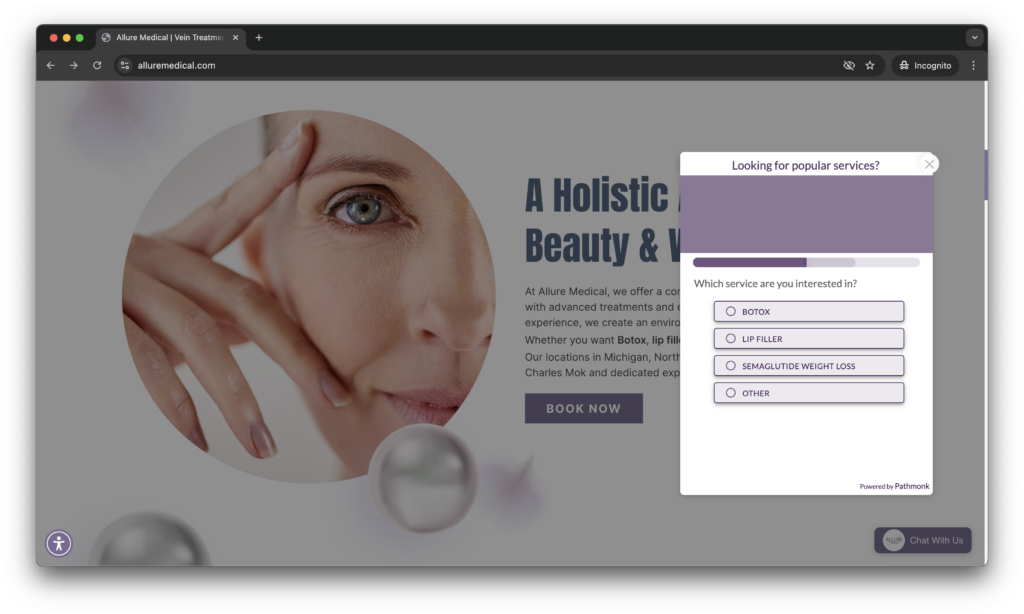
This meant lead generation could continue while the team learned which behaviors and journeys actually led to booked appointments.
The outcome:
- +54% increase in booked appointments in 30 days
- No increase in traffic or ad spend
- Clearer insight into which patient intents converted fastest and where hesitation occurred
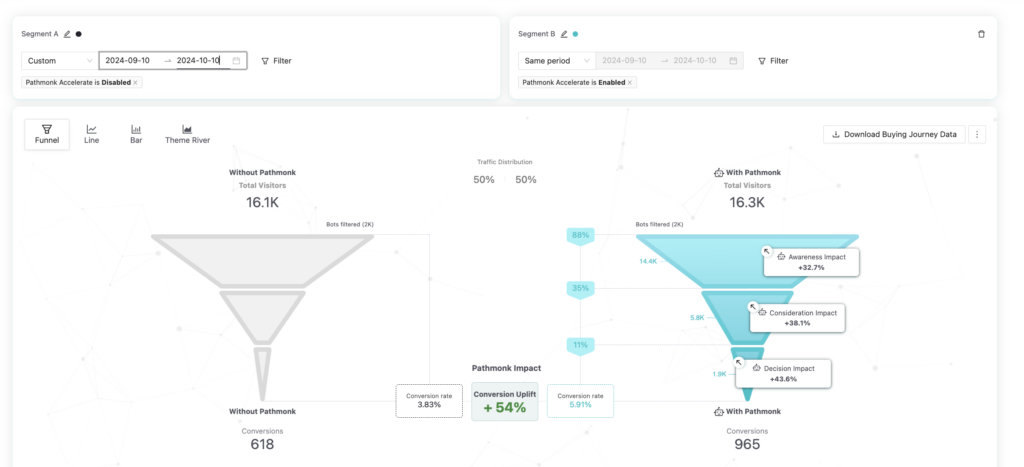
In this case, not knowing the ICP upfront wasn’t a blocker. The website itself became the feedback loop that made lead generation and learning happen at the same time.
FAQs about lead generation without clear ICP
Can you generate leads without a defined ICP?
Yes. In fact, that’s how most ICPs are discovered in practice. Early lead generation gives you real conversations, real objections, and real buying signals. Waiting to define an ICP first usually means delaying the very feedback you need to define it properly.
What’s the best channel before you know your ICP?
Channels that give you fast feedback. In B2B, that’s usually outbound, founder-led email, partnerships, or high-intent inbound with a narrow CTA. In B2C, it’s small paid tests and behavior-driven website flows. The common factor is speed and clarity, not reach.
Should you run paid ads without an ICP?
Only in small, tightly controlled tests. Paid ads can be useful for learning, but dangerous for scaling when your assumptions aren’t validated yet. If you can’t clearly explain why someone converted, you’re spending too early.
How long does it take to clarify an ICP through lead generation?
Usually between 30 and 90 days, assuming you’re actively reviewing conversations and behavior. The timeline has less to do with traffic volume and more to do with how seriously you analyze what happens after people convert.
Key takeaways
- You don’t need a perfectly defined ICP to generate leads. You generate leads to figure out your ICP.
- Early lead generation is about learning, not scale. Optimize for conversations and patterns, not volume.
- Start with a working ICP based on a real problem, a broad industry, and one likely buyer role.
- Use channels that give fast feedback. If you can’t tell why someone converted, the channel is wrong at this stage.
- Your offer should filter people out. If everyone converts, it’s too broad. If no one converts, the framing is off.
- Track who converts and why. Ten real conversations are more valuable than a thousand impressions.
- Narrow aggressively after each batch of leads. Let patterns collapse your ICP inward.
- Only scale once the buying pattern is obvious. Until then, lead generation is research.
Increase +180% conversions from your website with AI
Get more conversions from your existing traffic by delivering personalized experiences in real time.
- Adapt your website to each visitor’s intent automatically
- Increase conversions without redesigns or dev work
- Turn anonymous traffic into revenue at scale