

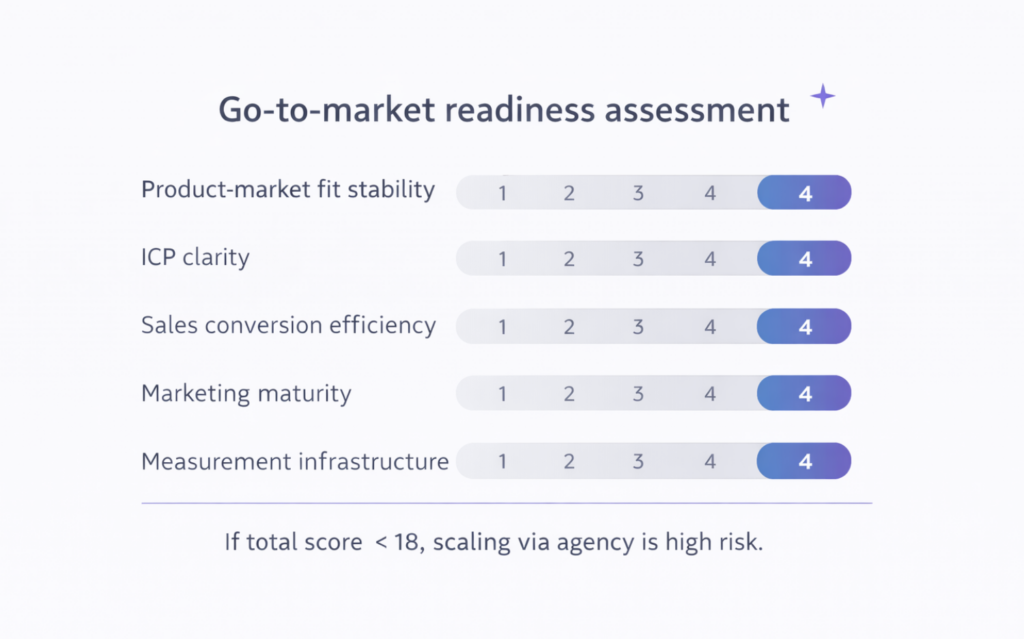
Hiring a lead generation agency makes sense when you have validated product market fit, a clearly defined ideal customer profile, internal sales capacity to convert pipeline, and insufficient in-house bandwidth or specialized expertise to scale acquisition efficiently. It is most effective when used to accelerate an already working acquisition model, not to fix positioning, messaging, or product issues.
It does not make sense when core go-to-market fundamentals are unresolved, attribution is unclear, sales conversion is weak, or internal alignment is missing. In those cases, adding external lead volume increases cost and complexity without improving revenue outcomes.
Table of Contents
The question of when to hire a lead gen agency has become more complex because the underlying mechanics of B2B acquisition have changed.
Customer journeys are now multi touch, multi channel, and increasingly influenced by AI search interfaces, peer communities, and self directed research. At the same time, paid acquisition costs have increased, outbound response rates have declined, and attribution has become probabilistic rather than deterministic. Scaling pipeline is no longer a matter of increasing spend in one channel. It requires tight coordination between traffic acquisition, conversion architecture, sales qualification, and measurement infrastructure.
What many marketers misunderstand is this: a lead generation agency is an execution multiplier, not a strategic correction mechanism. Agencies can scale channels that already work. They cannot compensate for weak ICP definition, unclear positioning, inefficient sales processes, or broken attribution models. When these fundamentals are unstable, additional lead volume increases cost without improving revenue efficiency.
In this article, we will examine the decision structurally. You will learn how to evaluate go-to-market readiness, model CAC impact before committing budget, identify where agencies create leverage versus drag, and understand how conversion architecture and behavioral personalization influence the ROI of external acquisition. The goal is not to advocate for or against agencies, but to define the conditions under which the decision is economically rational.
Increase conversions from your PPC campaigns
Get more value from your paid traffic by personalizing the website experience based on visitor intent, not just the ad they clicked.
Book a demo
Defining what a lead gen agency actually does (and doesn’t)
Before deciding whether to hire one, you need a precise definition of scope. “Lead generation” is often used loosely, but agencies operate within specific functional boundaries.
At a structural level, a lead gen agency manages acquisition mechanics, not go-to-market strategy. Understanding that distinction prevents misplaced expectations.
Most agencies operate in one or more of the following domains:
1. Paid acquisition management
This includes:
- Paid search account management
- Paid social campaign setup and optimization
- Display and sometimes programmatic media buying
- Budget allocation and bid strategy tuning
Their leverage comes from managing auction mechanics, audience targeting, creative testing, and bid optimization. They do not define positioning, pricing, or product packaging.
2. Outbound prospecting
This includes:
- Cold email sequencing
- LinkedIn outreach automation
- List building and enrichment
- Sometimes SDR augmentation
Outbound agencies optimize for meeting volume and reply rates, not necessarily revenue efficiency. Target quality is heavily dependent on ICP precision provided internally.
3. Appointment setting
Some agencies focus exclusively on booking meetings. They may qualify leads against predefined criteria and pass them directly to sales.
Here the primary metric becomes:
- Cost per meeting
- Meeting show rate
- Pipeline generated per booked meeting
Without downstream visibility into opportunity and close rates, this model can distort CAC.
4. Demand capture optimization
Some agencies go beyond traffic acquisition and support:
- Landing page testing
- Conversion rate optimization
- Funnel diagnostics
However, this is typically limited to static experimentation frameworks such as A/B testing. Dynamic behavioral adaptation is rarely included unless specialized tools are used.
5. Campaign execution
This includes:
- Creative asset production
- Ad copy writing
- Campaign structuring
- Basic analytics reporting
Execution depth varies significantly by agency maturity.
What agencies typically do not own
It is equally important to define exclusions. Most lead gen agencies do not own:
- Product marketing strategy
- Core positioning
- Pricing architecture
- Sales enablement
- Lifecycle marketing
- Retention and expansion strategy
- Attribution modeling design
They depend on internal clarity in these areas. If these inputs are weak or inconsistent, performance degrades quickly.
If we represent the revenue system as: Traffic → Leads → SQL → Opportunity → Closed won → Retained revenue
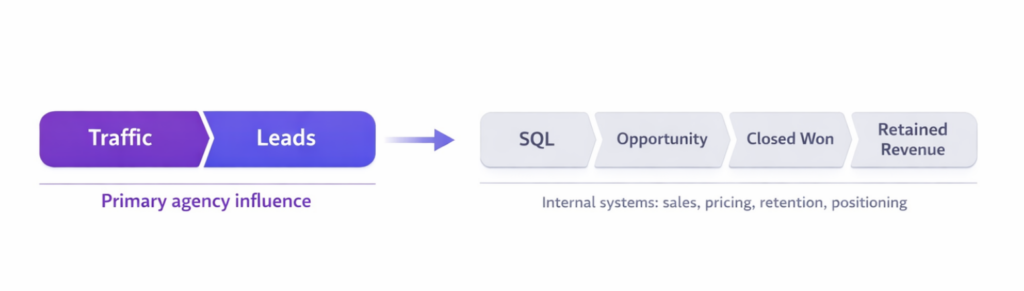
An agency primarily influences the first two transitions. If later stage conversion rates are unstable, increasing early volume may increase total cost without improving total revenue.
Boost your clients’ performance and keep them longer
Help your clients get more value from their traffic with AI-personalized customer journeys that improve conversions across SEO, PPC, and campaigns.
Book a demo
When hiring a lead gen agency makes sense
Hiring a lead gen agency is rational when it increases leverage inside a stable revenue system. The common pattern across successful engagements is this: the fundamentals are working, but capacity, specialization, or speed are constrained.
What follows are the situations where agencies typically create economic value rather than operational noise.
Scenario 1: You have validated one scalable channel but lack bandwidth
This is the cleanest case.
You already have a channel producing predictable pipeline at acceptable CAC. Conversion rates are stable across cohorts. Increasing spend has historically produced proportional increases in qualified pipeline. The bottleneck is internal bandwidth.
For example, paid search may already be contributing 40 percent of pipeline with consistent cost efficiency, but keyword expansion, creative testing, and landing page iteration are happening slowly because the internal team is stretched across multiple priorities.
In this situation, an agency does not redefine strategy. It increases execution velocity. That can mean deeper keyword coverage, more granular bid strategy tuning, structured experimentation cadence, or systematic landing page optimization. The objective is not to “fix” the channel but to compound it.
The economic logic is straightforward. If current spend is 50,000 per month at a CAC of 20,000 and sales has capacity to absorb 30 percent more volume, then scaling spend while maintaining conversion rates increases revenue without increasing structural complexity. The agency functions as an execution multiplier.
If CAC rises sharply as spend scales, that signals saturation or targeting inefficiency. That is a channel constraint, not a bandwidth problem.
Scenario 2: You need speed more than capability building
There are situations where time is the primary constraint. Hiring a senior demand gen leader can take several months from sourcing to full ramp. An agency can deploy in weeks.
This is rational when pipeline gaps are immediate, funding milestones depend on short term growth, or competitive pressure requires rapid acquisition expansion. In these cases, the opportunity cost of waiting is higher than the margin premium paid to an agency.
However, this should be treated as a bridge, not a structural substitute for internal ownership. Agencies can accelerate early execution, but they do not accumulate institutional knowledge in the same way internal teams do. Over time, reliance without parallel capability building increases dependency risk and reduces strategic control.
A common pattern is temporary acceleration through an agency while simultaneously hiring internal talent and gradually transferring ownership.
Scenario 3: You are entering a new market with a proven ICP
Market expansion works when the ICP is already validated elsewhere. If you have repeatable win patterns, stable pricing, and clear buyer roles in one region, an agency can help operationalize expansion in another.
For example, expanding from North America into DACH requires localization, compliance awareness, and channel nuance. An agency with regional experience can shorten the learning curve on targeting, messaging adaptation, and platform dynamics.
The condition here is evidence. The ICP must be defined by historical revenue performance, not assumption. If the target segment in the new market is hypothetical or loosely defined, outsourcing acquisition amplifies uncertainty.
Agencies are effective at operationalizing proven models. They are not designed to discover product market fit in new geographies.
Scenario 4: You lack specialized channel expertise
Certain acquisition channels require deep technical specialization that is inefficient to build internally for short term needs.
Examples include programmatic buying with complex bidding logic, advanced LinkedIn segmentation for enterprise ABM, high volume outbound infrastructure with deliverability management, or complex paid search account restructuring across multiple product lines.
If you plan to test a channel aggressively for six to nine months, building a full internal team for that experiment may not make economic sense. An agency can provide concentrated expertise without long term hiring commitments.
The key is clarity of scope. Agencies perform best when tasked with well defined channel ownership rather than vague mandates to “generate more leads.”
Scenario 5: You need structured experimentation at scale
Experienced marketing teams often reach a point where they have exhausted obvious optimizations. Growth now depends on systematic experimentation across audiences, messaging angles, and conversion flows.
Agencies can support this by running parallel tests across creative variants, audience clusters, and landing page structures. When structured properly, this produces more than incremental performance lift. It generates structured learning about which segments respond to which value propositions.
The value here is not just short term lead volume. It is data density. If experiments are documented rigorously and connected to downstream revenue metrics, the output becomes strategic input for product marketing and sales enablement.
Without disciplined measurement, experimentation devolves into surface level creative rotation.
When hiring a lead gen agency does not make sense
Just as important as the positive cases are the conditions where hiring an agency increases cost without solving the core constraint.
1. Early stage product validation
If you are still testing pricing, refining core use cases, or redefining your buyer persona, externalizing acquisition multiplies ambiguity. Campaign performance will fluctuate not because the agency is underperforming, but because the underlying offer is unstable.
At this stage, learning quality matters more than volume. Internal iteration loops are usually faster and cheaper.
2. Broken sales process
If sales consistently rejects marketing leads, conversion from SQL to opportunity is weak, or close rates are highly volatile, the bottleneck is downstream.
Increasing top of funnel volume in this scenario inflates pipeline metrics while depressing overall win rates. Reps become overloaded, qualification quality drops, and CAC increases.
Before scaling acquisition, fix qualification criteria, objection handling, and sales process consistency.
3. Undefined ICP
Broad targeting often produces attractive cost per lead metrics but poor revenue per lead outcomes. Agencies optimize toward the metrics defined in the contract. If ICP is vague, they will optimize toward cheaper audiences.
Without a tightly defined ideal customer profile grounded in revenue data, scaling acquisition introduces structural inefficiency.
4. Expectation mismatch
If leadership expects guaranteed revenue outcomes rather than probabilistic improvement in acquisition efficiency, the relationship will deteriorate.
Lead generation is a statistical system. Agencies improve inputs. They cannot control sales execution, macroeconomic shifts, or buying committee dynamics.
Clear definition of success metrics at the outset prevents misalignment.
5. Budget constraints that force short testing windows
Optimization requires time. Paid channels need multiple learning cycles. Outbound campaigns need deliverability stabilization and response calibration. Conversion experiments require statistically meaningful sample sizes.
If budget constraints force cancellation after 30 days, results will likely be inconclusive. Two to three optimization cycles are typically required before directional performance becomes visible.
If you cannot commit to that time horizon, it is better to delay external engagement than to generate misleading early data.
Why you should model ROI before hiring an agency
A structured ROI model reduces emotional decision making.
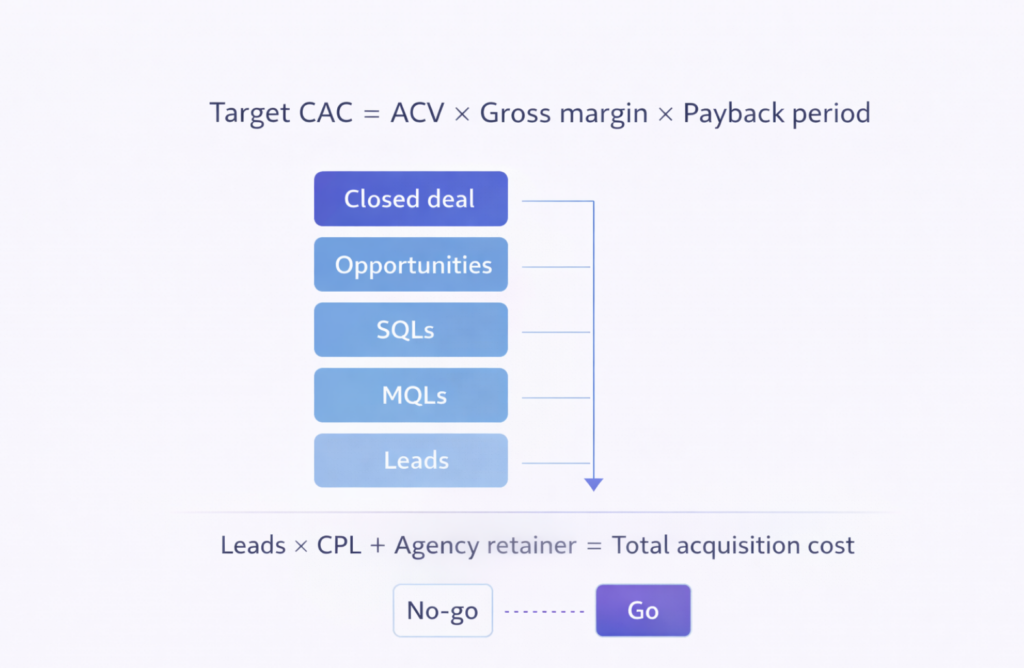
Step 1: Define target CAC
Target CAC = acceptable payback period × monthly gross margin × ACV structure.
For example:
- ACV: 30,000
- Gross margin: 80 percent
- Payback target: 12 months
Maximum CAC = 30,000 × 0.8 × (12 / 12) = 24,000
Step 2: Back calculate required conversion rates
If average deal size is 30,000 and close rate from opportunity to deal is 20 percent: You need 5 opportunities to close 1 deal.
If opportunity rate from SQL is 50 percent: You need 10 SQLs. If MQL to SQL is 40 percent: You need 25 MQLs.
Now compare this against projected CPL from agency.
If projected CPL is 400: 25 leads × 400 = 10,000 marketing spend. Add agency retainer, for example 8,000 monthly.vTotal = 18,000 to produce one closed deal under ideal conversion.
If CAC target is 24,000, this works. If conversion rates are lower, it fails quickly.
This exercise forces clarity on internal efficiency before outsourcing.
Channel trade-offs: agency vs in house
Dimension | Agency | In house |
Speed to launch | High | Moderate |
Channel specialization | High | Variable |
Institutional knowledge | Low initially | High |
Long term cost efficiency | Moderate | High after ramp |
Strategic control | Shared | Full |
Cross functional alignment | Requires coordination | Direct |
For early scale phases, agency can accelerate. For long term compounding, in house capability usually wins.
What are the operational implications of hiring an agency for lead generation?
Hiring a lead gen agency is not just a budget decision. It changes internal workflows, reporting structures, and cross functional coordination. If those operational adjustments are not made explicitly, performance degrades quickly.
1. Sales alignment
The first operational shift occurs between marketing and sales. When an agency drives acquisition, targeting and messaging decisions are often made weekly based on campaign data. Without structured feedback from sales, optimization becomes blind. Sales needs to provide recurring qualitative input, not just close rate statistics.
That includes patterns from discovery calls, recurring objections, deal velocity differences by segment, and indicators of poor fit. If certain industries consistently stall at the proposal stage or if specific job titles lack authority, that information must flow back into targeting logic immediately.
Without this loop, agencies will continue optimizing toward surface level metrics such as cost per lead or booked meetings. Campaign performance may look stable while revenue quality declines. The agency cannot detect misalignment unless sales feedback is structured and consistent.
A practical approach is a weekly or biweekly performance review that combines campaign metrics with pipeline stage movement and qualitative notes from sales conversations.
2. Data integration
The second operational implication is technical. Agencies operate in ad platforms and sometimes in outbound tools. Your internal systems operate in CRM and marketing automation. If lead source mapping, campaign naming conventions, and opportunity attribution are inconsistent, you lose the ability to evaluate performance accurately.
Marketing operations must ensure that:
- Lead data flows cleanly from ad platform to marketing automation to CRM.
- Campaign and source fields remain consistent across systems.
- Opportunities retain original source visibility even when influenced by multiple touchpoints.
If this infrastructure is weak, performance evaluation defaults to superficial metrics. The agency may appear successful based on lead volume while downstream revenue metrics tell a different story.
In addition, duplication across channels must be controlled. If outbound and paid campaigns target overlapping segments without coordination, attribution becomes distorted and sales outreach conflicts can emerge.
3. Creative and messaging ownership
The third operational shift concerns messaging control. Agencies can produce ad copy and creative variants, but they should not be responsible for defining core positioning. That responsibility remains internal, typically within product marketing or strategic marketing leadership.
Internal teams must provide clear messaging frameworks, differentiated value propositions per persona, and objection handling language grounded in real sales data. Without this, agencies default to generic performance copy optimized for clicks rather than qualification.
Consistency across assets also becomes more complex once external teams are involved. Paid ads, landing pages, outbound scripts, and website messaging must align. If each layer evolves independently, prospects experience narrative fragmentation, which reduces trust and conversion efficiency.
The most effective structure treats agencies as execution engines operating within well defined strategic guardrails. They test and optimize within those boundaries, but they do not originate the company’s narrative.
How Pathmonk works alongside a lead gen agency
When you hire a lead gen agency, the focus is typically on traffic acquisition and meeting volume. Campaigns are optimized around CPL, cost per meeting, and pipeline generated. What usually remains static is the website experience.
If all paid and outbound traffic lands on the same pages with the same messaging and the same calls to action, conversion efficiency becomes the limiting factor. Agencies can improve targeting and creative, but they cannot dynamically adapt the on site experience for different visitor intents without building and managing multiple segmented funnels manually.
Pathmonk operates at that constraint layer by adding a real time behavioral personalization layer on top of your existing website.
It analyzes live session data such as navigation patterns, scroll depth, interaction behavior, referral context, and engagement signals to model visitor intent dynamically. Instead of assuming intent based purely on campaign source or form fields, it evaluates how the user actually behaves on the site.
Based on that predicted intent, Pathmonk adapts micro elements of the experience in real time. This can include adjusting CTA hierarchy, surfacing relevant use cases, changing proof elements, or introducing qualification flows when high purchase intent is detected.
The underlying website infrastructure remains the same. No need to duplicate dozens of landing pages per persona. The adaptation happens at the experience layer, per session.
In practice, this means the same traffic driven by your agency produces higher conversion rates and better qualified leads because the website responds to intent instead of treating all visitors equally.
How Avrek Law Firm increased +175% qualified leads from PPC with Pathmonk
Avrek Law Firm was already investing in paid search campaigns to drive traffic from high intent queries related to accident claims. Traffic volume was not the issue. The firm had brand credibility and consistent visibility in search results. The constraint was conversion efficiency.
The PPC campaigns were optimized correctly at the acquisition layer. The bottleneck was the website experience.
- First time exploratory visitors were pushed toward immediate case submission.
- High intent visitors were not given reinforced proof at the right moment.
- Trust building elements were present but not prioritized dynamically.
As a result, increasing PPC budget would likely have increased traffic without proportionally increasing qualified case reviews. CAC would rise.
Instead of scaling traffic further, Avrek implemented Pathmonk to optimize the conversion layer on top of existing PPC efforts.
Pathmonk analyzed real time visitor behavior and adapted the website experience accordingly:
- Early stage visitors were shown an introduction video from the founder to establish credibility quickly.

- Visitors demonstrating deeper engagement were presented with client testimonials and external reviews.
- High intent users were surfaced streamlined case review forms and direct call options at the appropriate moment.
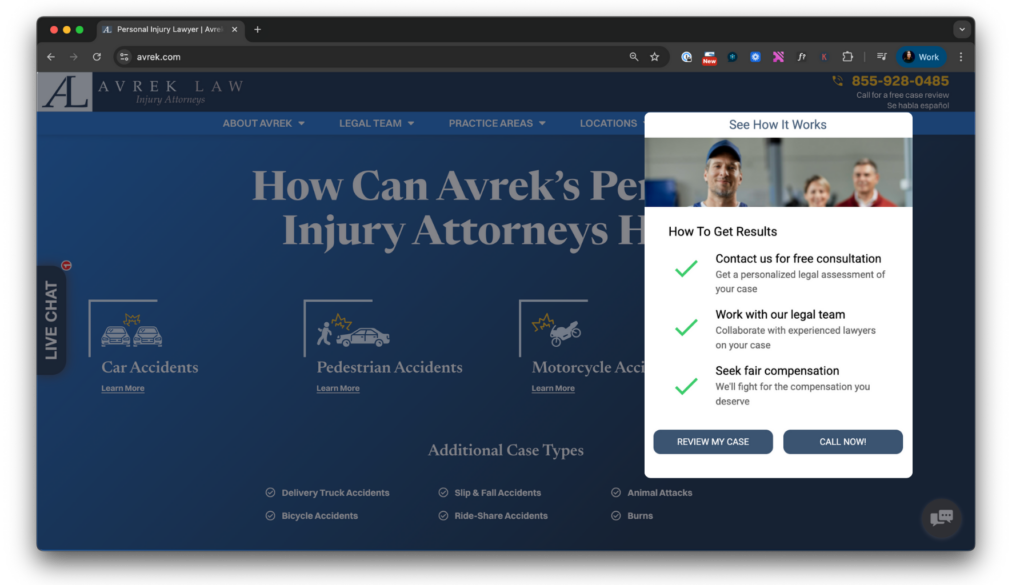
The acquisition strategy remained unchanged. The conversion architecture became adaptive.
Without increasing PPC spend, Avrek achieved:
- 175% increase in qualified case submissions
- Higher engagement depth per session
- More efficient conversion of paid traffic
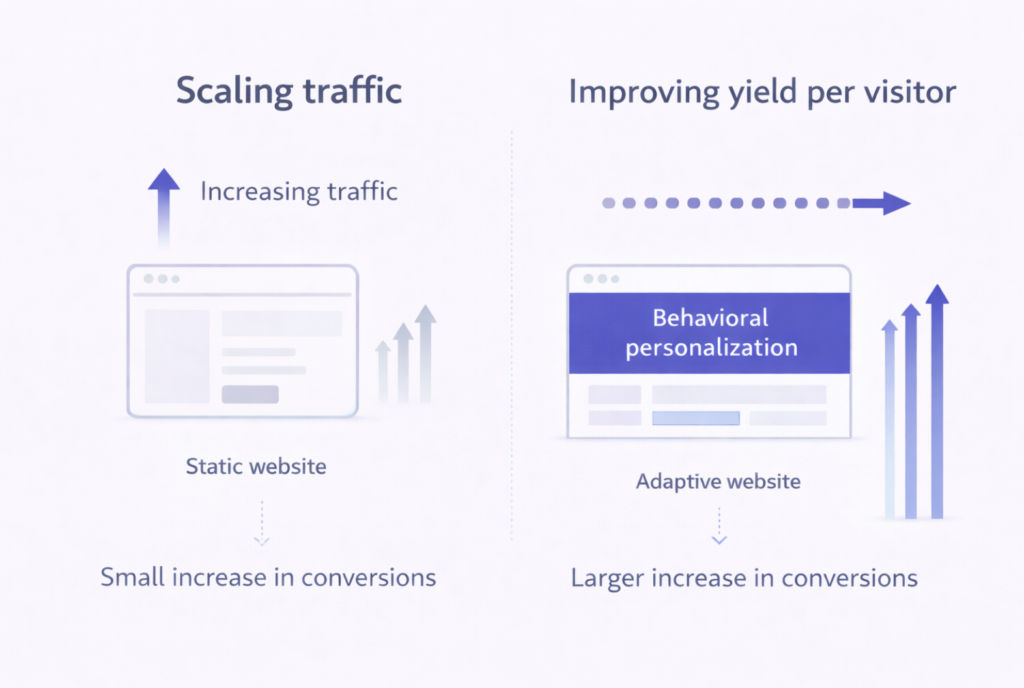
This case illustrates a common pattern in agency-driven PPC strategies. Traffic optimization alone reaches diminishing returns when the website experience is static.
By improving conversion yield per visitor, Avrek increased the return on their existing acquisition investment. Instead of relying solely on traffic scaling to grow pipeline, they increased the revenue output of the same traffic base.
Get your website’s conversion score in minutes
- Instant CRO performance score
- Friction and intent issues detected automatically
- Free report with clear next steps
FAQ on hiring a lead gen agency
Is hiring a lead gen agency better than building an internal SDR team?
It depends on cost structure and speed requirements. Agencies provide immediate execution but limited institutional knowledge accumulation. Internal SDR teams build long term capability but require ramp time and management overhead.
How long should you test an agency before evaluating performance?
At least two full sales cycles for B2B SaaS. Early CPL data is insufficient. Revenue attribution requires opportunity level tracking over time.
Should agencies be paid on performance only?
Pure performance models often incentivize volume over quality. Hybrid retainers with pipeline quality metrics tend to align incentives better.
Can an agency fix poor positioning?
No. Agencies can test messaging variations, but if core value proposition lacks differentiation, acquisition efficiency will remain low.
How do you prevent channel conflict between agency and in-house teams?
Define channel ownership clearly. Avoid overlapping experimentation on identical audiences without coordination. Share performance dashboards transparently.
Does higher lead volume always improve pipeline?
Not necessarily. If sales capacity is constrained or qualification criteria are weak, higher volume can reduce overall close rates and increase CAC.
How should attribution be handled when using agencies?
Track primary source and influenced source at opportunity level. Avoid relying solely on last click metrics. Evaluate revenue contribution over time, not just CPL.
When does outbound agency support outperform paid acquisition?
Outbound can outperform when targeting narrow enterprise accounts with clear trigger events and high ACV. Paid acquisition often performs better for broader mid market segments.
Key takeaways
- Hire a lead gen agency to scale validated acquisition, not to fix strategic gaps.
- Ensure product market fit, ICP clarity, and sales efficiency before outsourcing.
- Model CAC mathematically before committing budget.
- Agencies amplify execution; they do not replace go-to-market strategy.
- Conversion efficiency often matters more than traffic volume.
- Behavioral website adaptation can improve ROI without increasing spend.
- Measure revenue impact, not just cost per lead.
- Use agencies as accelerators, not substitutes for internal marketing leadership.